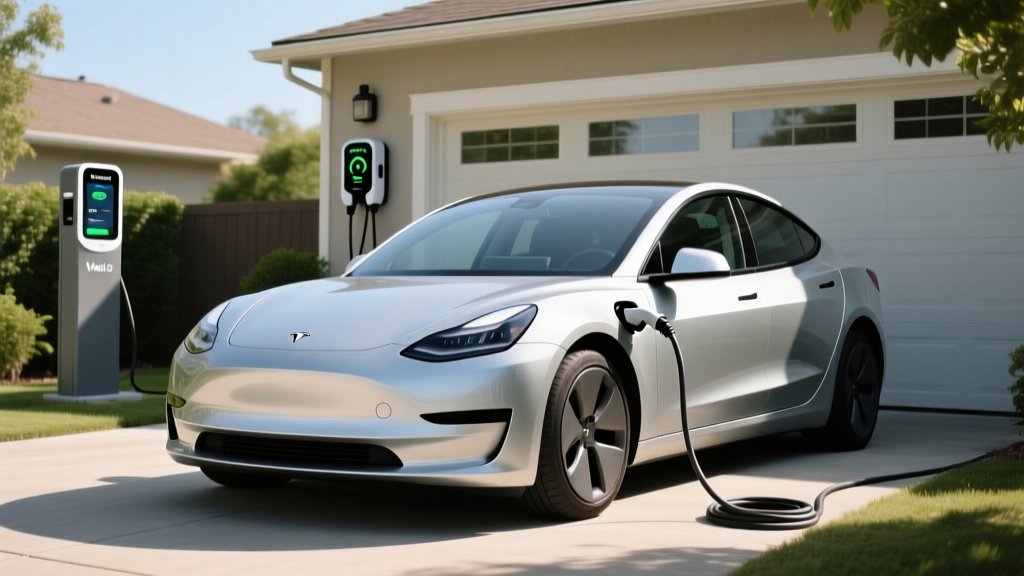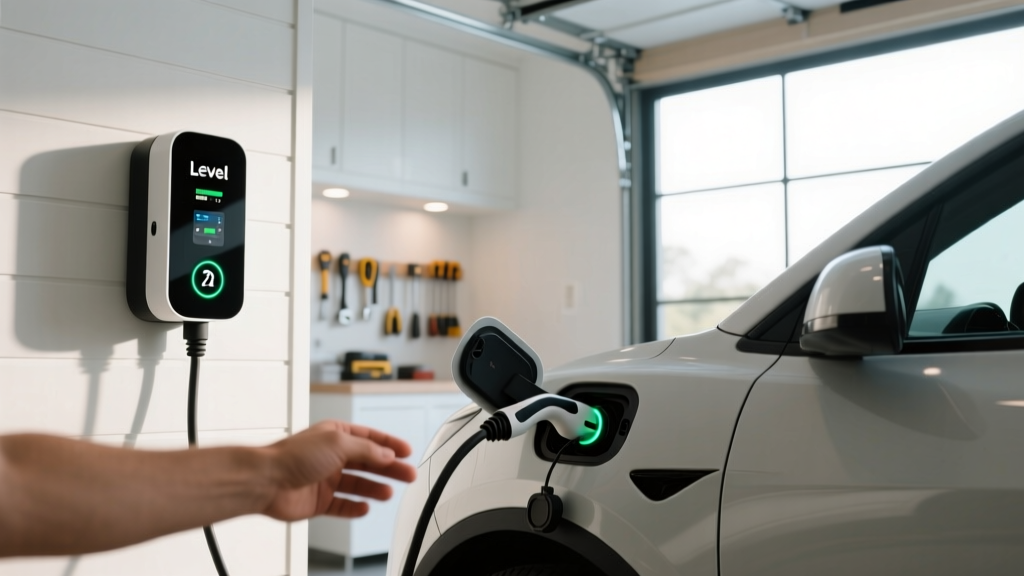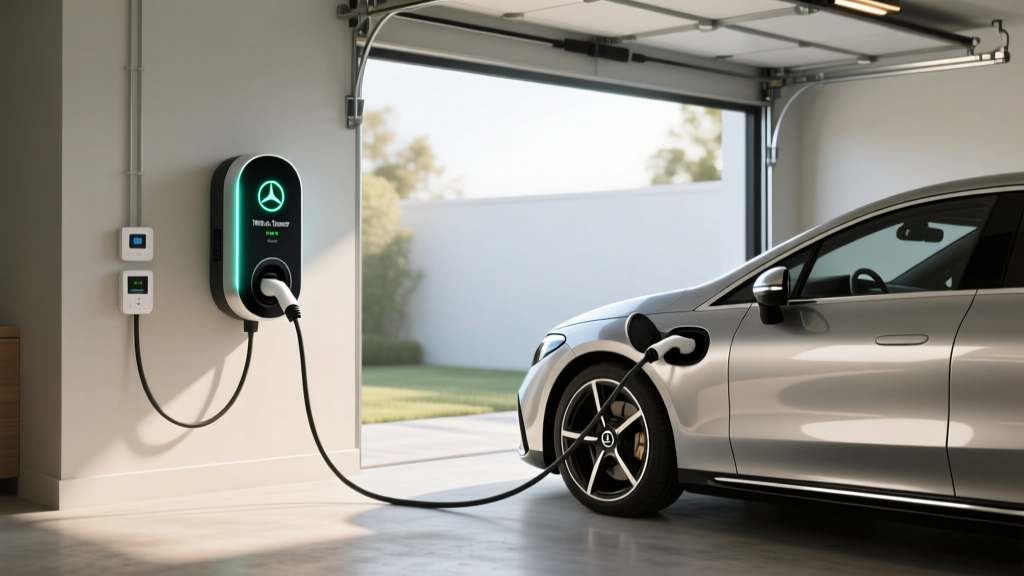
If you own or are considering a Mercedes-Benz EQ vehicle — from the EQB compact SUV to the flagship EQS sedan — home charging is where the vast majority of your charging will happen. A proper Mercedes home charger setup means waking up to a full battery every morning, avoiding public charging markups, and adding convenience that gas stations can't match. But navigating the Mercedes-Benz Wallbox, third-party alternatives, electrical requirements, and installation costs requires precision. This guide breaks down every number you need.
Understanding Charging Levels: What Speed Do You Actually Need?
Before choosing a Mercedes home charger, you need to understand the three charging levels and what they deliver in real-world terms. The critical distinction: kW (kilowatts) measures power — the rate of energy flow, like water pressure from a hose. kWh (kilowatt-hours) measures energy — the total amount stored in your battery, like gallons in a tank. Never confuse the two.
| Level | Voltage | Power (kW) | Miles Added/Hour | Best For |
|---|---|---|---|---|
| Level 1 | 120V (standard outlet) | 1.2–1.9 kW | 3–5 miles | PHEVs, emergency top-ups, overnight trickle |
| Level 2 | 240V (dryer-style outlet) | 3.3–19.2 kW | 12–70 miles | Daily home charging for all BEVs and PHEVs |
| DC Fast Charge | 400–800V DC | 50–350 kW | 150–300+ miles (in 20 min) | Road trips, rapid top-ups on public networks |
For a Mercedes-Benz EQS 450+ with its 108.4 kWh usable battery, Level 1 charging would take roughly 72 hours from empty to full — completely impractical. A Level 2 Mercedes home charger at 11.5 kW (48 amps) replenishes that same battery in about 10 hours, which aligns perfectly with an overnight charge. DC fast charging is reserved for road trips: the EQS can peak at 200 kW on a compatible CCS1 station, adding 185 miles in roughly 15 minutes under ideal conditions, though the charge curve tapers significantly above 80% state of charge (SoC).
The Mercedes-Benz Wallbox: Official Equipment Explained
Mercedes-Benz offers its own branded home charging hardware, the Mercedes-Benz Wallbox Home, designed to integrate with the Mercedes me connect app ecosystem. Here are the specifications for the current-generation unit:
- Power output: Up to 11.5 kW (48 amps on a 60-amp dedicated circuit)
- Connector: CCS1 (J1772 + DC combo), compatible with all current US-market EQ models natively
- Cable length: 24 feet (7.3 meters), attached tethered cable
- Smart features: Wi-Fi connectivity, Mercedes me app integration, scheduled charging, energy usage tracking, remote start/stop
- Enclosure rating: NEMA 4 (suitable for indoor or outdoor installation)
- Price: Approximately $700–$800 (equipment only, before installation)
The Wallbox Home is a solid unit, but it's not the only option. Many Mercedes EQ owners opt for third-party Level 2 chargers that offer comparable or superior performance, sometimes at lower cost. The key requirement is CCS1 compatibility — which is standard across virtually all Level 2 chargers sold in the US market.
Top Charger Alternatives for Mercedes EQ Vehicles
If you're not committed to the OEM Mercedes-Benz Wallbox, several third-party chargers pair excellently with EQ models. Here's how the top contenders compare:
| Charger | Max Power | Amperage | Cable Length | Smart Features | Price (2026) |
|---|---|---|---|---|---|
| Mercedes-Benz Wallbox Home | 11.5 kW | 48A | 24 ft | Mercedes me app, scheduling | ~$750 |
| ChargePoint Home Flex | 12 kW (50A) | Up to 50A (adjustable) | 23 ft | App, Alexa, load sharing | ~$699 |
| Emporia Level 2 EV Charger | 11.5 kW (48A) | Up to 48A | 24 ft | App, energy monitoring, solar integration | ~$399 |
| Grizzl-E Smart | 10 kW (40A) | 40A | 24 ft | App, OCPP, extreme cold rated | ~$449 |
| Wallbox Pulsar Plus | 11.5 kW (48A) | 48A | 25 ft | App, Power Sharing, compact | ~$599 |
For Mercedes EQ owners who want the tightest app integration, the OEM Wallbox Home is the clear pick. For those prioritizing value, the Emporia offers energy monitoring and solar integration at nearly half the price. The ChargePoint Home Flex is the most versatile, with adjustable amperage that lets you dial the circuit requirement from 16A up to 50A — useful if your electrical panel has limited headroom.
Installation Costs: What You'll Actually Pay
The single most common question from Mercedes EQ buyers: How much does it cost to install a home EV charger? The honest answer depends heavily on your home's existing electrical infrastructure. Here's a realistic breakdown based on 2026 electrician labor rates and equipment pricing:
| Component | Simple Install (panel adjacent) | Complex Install (panel upgrade needed) |
|---|---|---|
| Charger equipment (Level 2, 48A) | $400–$800 | $400–$800 |
| 240V dedicated circuit (60A breaker) | $300–$800 | $800–$1,500 |
| Electrical permit | $50–$200 | $50–$200 |
| Panel upgrade (100A → 200A service) | N/A (not needed) | $1,500–$4,000 |
| Conduit/wiring (long runs over 50 ft) | $0–$200 | $400–$1,500 |
| Total estimated range | $750–$2,000 | $3,150–$8,000 |
Homes built after 2000 typically have 200-amp electrical service with available breaker slots, making a simple install straightforward. Homes built before 1980 often have 100-amp service that's already near capacity — adding a 60-amp dedicated circuit for a 48-amp charger may require a panel upgrade. Always get a load calculation from a licensed electrician before assuming you have capacity. The National Electrical Contractors Association maintains a directory of qualified professionals.
Electrical Requirements and Safety Considerations
A Level 2 Mercedes home charger running at 48 amps requires a 60-amp dedicated circuit on your electrical panel. This follows the National Electrical Code (NEC) 80% rule: continuous loads (defined as running 3+ hours, which EV charging always qualifies as) must not exceed 80% of the circuit breaker rating. So 48A continuous draw × 125% = 60A breaker minimum.
Critical safety and code requirements for your installation:
- Dedicated circuit: The charger must have its own breaker — not shared with other appliances or outlets
- GFCI protection: Required for outdoor installations and in many jurisdictions for indoor garage installations as well (NEC 2023 and later)
- NEMA 4 rating: Mandatory for outdoor-mounted chargers to withstand rain, dust, and temperature extremes
- Hardwired vs. plug: Chargers above 40A (like a 48A unit) should be hardwired directly to the circuit rather than using a NEMA 14-50 plug, which can overheat under sustained high-current loads
- Permit and inspection: Virtually all jurisdictions require an electrical permit and post-installation inspection — skipping this can void homeowner's insurance coverage for electrical fires
Connector Compatibility: NACS, CCS1, and the Mercedes Transition
Which connector does your Mercedes EQ vehicle use? As of the 2026 model year, the situation requires careful attention because Mercedes-Benz is in the middle of a connector transition:
| Connector | Status | Mercedes Models (US Market) | Home Charging Impact |
|---|---|---|---|
| CCS1 (J1772 + DC pins) | Current standard through 2024 models | EQS (2022–2024), EQE (2023–2024), EQB (2022–2024) | Native compatibility with virtually all Level 2 home chargers |
| NACS (Tesla-style) | Adopted starting 2025 model year | 2025+ EQS, EQE, CLA EV (upcoming) | Requires NACS-equipped charger or CCS1-to-NACS adapter for older chargers |
| CHAdeMO | Legacy, phasing out | None (Mercedes never used CHAdeMO in US) | Not relevant for Mercedes owners |
If you own a 2022–2024 Mercedes EQ model with CCS1, any standard Level 2 charger with a J1772 connector will work natively for AC home charging. If you have a 2025+ model with the NACS port, you'll want either a NACS-equipped charger (several manufacturers now offer these) or a CCS1-to-NACS adapter — which Mercedes provides or can be purchased aftermarket. For home Level 2 AC charging, the physical difference is manageable with adapters. For DC fast charging on road trips, the NACS port gives access to Tesla Supercharger stations via the Mercedes me Charge network integration.
Charging Costs: Home vs. Public vs. Gasoline
How much does charging a Mercedes EQ vehicle actually cost per mile, and how does it compare to gasoline? The numbers depend on your electricity rate and whether you charge at home or in public:
| Scenario | Rate ($/kWh) | Vehicle (Efficiency) | Cost per Mile |
|---|---|---|---|
| Home off-peak (utility time-of-use) | $0.08–$0.12 | EQS 450+ (3.0 mi/kWh) | $0.027–$0.040 |
| Home standard rate (national avg) | $0.16 | EQS 450+ (3.0 mi/kWh) | $0.053 |
| Public Level 2 (ChargePoint, EVgo) | $0.25–$0.40 | EQS 450+ (3.0 mi/kWh) | $0.083–$0.133 |
| DC fast charging (Electrify America, EA Pass) | $0.35–$0.55 | EQS 450+ (3.0 mi/kWh) | $0.117–$0.183 |
| Gasoline equivalent (Mercedes S-Class 3.0T, 24 MPG combined) | $3.40/gallon | S-Class (24 MPG) | $0.142 |
Home charging at off-peak rates delivers per-mile fuel costs roughly 70–80% lower than an equivalent gasoline Mercedes S-Class. Even at the national average residential rate of $0.16/kWh (per EIA data), the EQS costs about $0.053 per mile — roughly one-third the cost of gasoline. However, frequent DC fast charging at public rates can erode much of that savings, approaching or even exceeding gasoline cost per mile. This is why a Mercedes home charger isn't just a convenience — it's the economic foundation of EV ownership.
Charging Time Examples for Mercedes EQ Models
Real-world charging times depend on battery size, charger power, and the charge curve (charging slows above 80% SoC to protect battery health). Here are 10–80% estimates for current Mercedes EQ vehicles on a Level 2 home charger at 11.5 kW:
- EQB 300 4MATIC (66.5 kWh usable): Approximately 4 hours, 10–80%
- EQE 350+ (90.6 kWh usable): Approximately 5 hours 40 minutes, 10–80%
- EQS 450+ (108.4 kWh usable): Approximately 6 hours 45 minutes, 10–80%
- EQE SUV 350 4MATIC (90.6 kWh usable): Approximately 5 hours 40 minutes, 10–80%
On DC fast charging, the EQS 450+ peaks at 200 kW and can achieve 10–80% in roughly 31 minutes under ideal thermal conditions. However, real-world DC charging is rarely ideal: cold batteries (below 50°F/10°C) without preconditioning can see peak rates cut in half, and sustained rates average well below the peak figure. Always precondition your battery via the Mercedes me app before arriving at a DC fast charger to maximize charge speed.
Federal Incentives for Home Charger Installation
Under the current IRS §30C Alternative Fuel Vehicle Refueling Property Credit, homeowners may claim a tax credit of up to 30% of the cost of home EV charger equipment and installation, capped at $1,000. However, eligibility is subject to specific requirements:
- The property must be located in an eligible census tract (generally low-income or non-urban areas — check the IRS eligibility tool)
- The credit applies to both equipment and installation labor costs
- It is a non-refundable credit — you must have sufficient tax liability to benefit
- Point-of-sale transfer is not available for this credit (unlike the §30D vehicle credit); you claim it on your federal tax return
Consult a tax professional to confirm eligibility for your specific situation, as census tract rules and IRS guidance may update annually.
Frequently Asked Questions
How much does it cost to install a Mercedes home charger?
A straightforward installation (panel has capacity, short wire run) typically costs $750–$2,000 total, including equipment ($400–$800), electrician labor ($300–$800), and permits ($50–$200). If your home needs an electrical panel upgrade from 100A to 200A service, total costs can reach $3,150–$8,000. Always get a professional load calculation first.
Can I use a non-Mercedes charger with my EQ vehicle?
Yes. Any Level 2 charger with a J1772 connector (which is virtually all of them) will charge a CCS1-equipped Mercedes EQ vehicle. For 2025+ models with NACS ports, you'll need a NACS-equipped charger or a CCS1-to-NACS adapter. The car doesn't require Mercedes-branded hardware to charge safely.
Do I need to upgrade my electrical panel?
It depends on your home's existing service amperage and available breaker slots. Homes with 200A service and open slots usually don't need an upgrade. Homes with 100A service or panels already near capacity will likely need a panel upgrade ($1,500–$4,000) to safely add a 60A dedicated circuit. A licensed electrician must perform a load calculation to determine this.
How fast will a Level 2 home charger add range to my EQS?
At 11.5 kW (48 amps), a Level 2 charger adds approximately 30–34 miles of range per hour to an EQS 450+. A full overnight charge (8–10 hours) easily replenishes the entire 305-mile EPA-estimated range. Real-world highway range in cold weather may be closer to 240–260 miles, which still fully replenishes overnight.
Is the Mercedes-Benz Wallbox worth the premium over third-party chargers?
If you value seamless Mercedes me app integration and OEM-matched aesthetics in your garage, the Wallbox Home ($750) is worth considering. However, chargers like the ChargePoint Home Flex ($699) or Emporia ($399) deliver equal or greater power output with robust third-party apps. The charging speed and safety are identical — the difference is software ecosystem and brand preference.
Should I get a hardwired charger or one with a NEMA 14-50 plug?
For chargers drawing 40A or more (which includes most 48A units), hardwired installation is recommended and often required by code. NEMA 14-50 receptacles under sustained 40A+ loads have been associated with overheating in some installations. Hardwiring eliminates the plug as a failure point. If you want portability, limit yourself to a 32A (7.7 kW) charger on a 40A circuit with a 14-50 plug.