EQS Range Reality: What the EPA Sticker Doesn't Tell You
The 2026 Mercedes-Benz EQS 580 Sedan carries a 118 kWh usable battery pack and an EPA-estimated range of up to 390 miles on the rear-wheel-drive EQS 450+ trim, while the dual-motor EQS 580 4MATIC is rated at approximately 371 miles. Those numbers look exceptional on paper — and they are, relative to the broader EV market — but real-world EQS range depends heavily on how and where you charge, how you drive, and what the weather is doing.
- EPA sticker (EQS 450+): 390 miles
- Highway driving (75 mph, moderate climate): ~310–335 miles
- Cold weather (below 32°F, highway): ~250–285 miles
- Mixed city/highway (55–65 mph, 60°F): ~350–375 miles
Source: fueleconomy.gov
The EQS achieves its efficiency through a slippery 0.20 drag coefficient, standard heat pump, and sophisticated thermal management. But a 118 kWh pack is heavy, and at sustained highway speeds the energy consumption rises noticeably. Understanding your charging infrastructure — at home and on the road — is how you keep that range usable day to day.
Charging Levels Explained: kW, Miles Per Hour, and the EQS
Before we get to specific equipment, let's nail down the distinction that trips up more new EV owners than any other: kW (kilowatts) measures power — the rate at which energy flows into your battery. kWh (kilowatt-hours) measures energy — the total capacity of the battery itself. Think of kW as the width of the hose and kWh as the size of the bucket.
The EQS's 118 kWh battery is a very large bucket. How quickly you fill it depends entirely on the charging level you're using.
| Level | Voltage | Max Power (kW) | Miles of Range Added Per Hour | Typical Use Case |
|---|---|---|---|---|
| Level 1 | 120V AC | 1.4–1.9 kW | ~3–5 mi/hr | Emergency / overnight trickle |
| Level 2 | 240V AC | 7.2–19.2 kW | ~20–55 mi/hr | Home daily charging, workplace |
| DC Fast Charging | 400V+ DC | 50–200 kW (EQS peak) | ~150–480 mi/hr (peak) | Road trips, rapid top-ups |
The EQS accepts up to 11 kW on Level 2 AC (its onboard charger limit) and up to 200 kW on DC fast charging. That onboard charger ceiling is critical: even if you install a 19.2 kW home charger, the EQS will only draw 11 kW from it. You won't damage anything — the car regulates its own draw — but you won't charge any faster than an 11 kW unit provides.
Charging Times: 10–80% for the EQS 118 kWh Pack
Here's what charging actually looks like in minutes and hours, not just kW ratings. These times assume you're starting at 10% state of charge (SoC) and charging to 80%, which is the practical fast-charging window most EV owners use to preserve battery health.
| Charging Method | Power Delivered | 10–80% Time (EQS 118 kWh) | Notes |
|---|---|---|---|
| Standard 120V outlet (Level 1) | ~1.4 kW | ~70+ hours | Not practical for daily use |
| 240V / 32A (Level 2, 7.7 kW) | 7.7 kW | ~10.5 hours | Common NEMA 14-50 circuit |
| 240V / 48A (Level 2, 11.5 kW) | 11 kW (EQS max) | ~7.5 hours | Optimal home setup for EQS |
| DC Fast Charger (150 kW station) | ~130 kW avg | ~35 minutes | Real-world sustained average |
| DC Fast Charger (200 kW peak) | ~155 kW avg | ~31 minutes | Peak 200 kW tapers above 50% SoC |
Charging curve reality check: The EQS peaks near 200 kW only at low state of charge (roughly 10–30% SoC) and with proper battery preconditioning. As the pack fills, the charge rate tapers significantly. By 60% SoC you might see 120–140 kW; above 80%, it drops below 50 kW. This is normal lithium-ion behavior — the battery management system protects the cells from heat and stress. If you're planning road-trip stops, plan to charge from 10–80% and then move on rather than waiting for a full 100%.
Home Charger Installation: Electrical Requirements, Costs, and Panel Upgrades
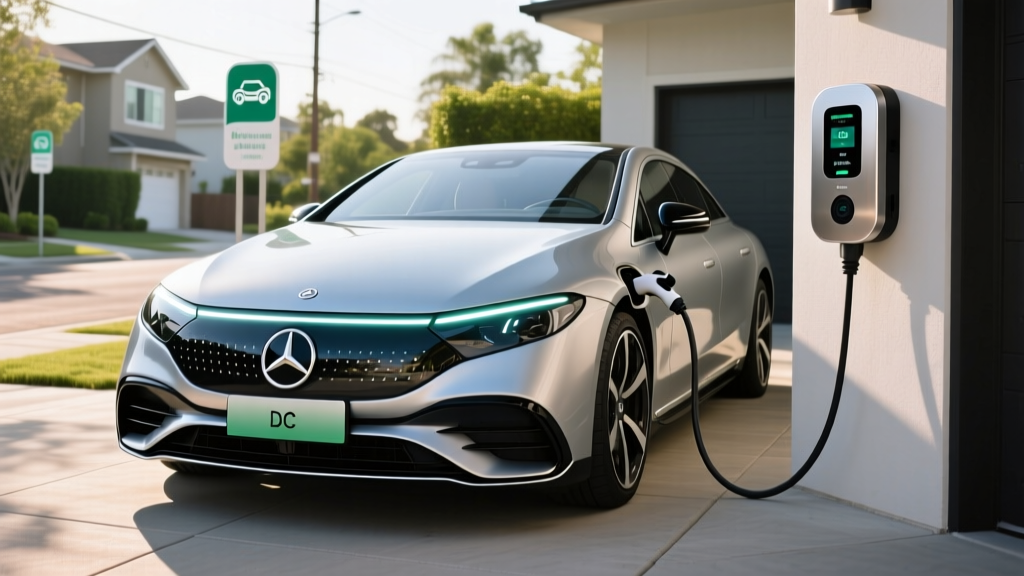
For the EQS, the sweet spot is a hardwired Level 2 charger on a 60-amp dedicated circuit, delivering up to 48 amps continuous (11.5 kW). This matches the car's 11 kW onboard charger almost perfectly. Here's what that installation actually involves and what it costs.
Electrical Requirements
- Voltage: 240V (standard for Level 2 — same as a dryer or oven circuit)
- Amperage: 60A breaker for a 48A continuous-load charger (NEC requires 125% overhead)
- Wiring: 6 AWG copper (or 4 AWG aluminum) THHN in conduit, or 6/2 NM-B for short indoor runs
- Dedicated circuit: The charger must have its own breaker — no sharing with other appliances
- GFCI protection: Required for outdoor installations per NEC 2020 and later; most hardwired EVSEs have built-in ground-fault protection
Do You Need a Panel Upgrade?
This is the single biggest cost variable. The average US home has a 100A or 200A main electrical panel. A 60A EV circuit draws a significant chunk of that capacity. If your panel is already near its limit — running electric heat, a dryer, an oven, and an AC unit — you may need a service upgrade to 200A or even 400A, or you may need to install a smaller charger (e.g., 32A/7.7 kW) on a 40A breaker.
A licensed electrician will perform a load calculation per NEC Article 220 to determine whether your existing panel can handle the additional draw. Don't skip this step.
| Item | Low Estimate | High Estimate | Notes |
|---|---|---|---|
| Level 2 Charger (Equipment) | $400 | $750 | 48A smart charger, 25-ft cable |
| Electrician Labor | $500 | $1,500 | Varies by run length, wall type, conduit |
| Permit & Inspection | $50 | $300 | Required in most jurisdictions |
| Panel Upgrade (if needed) | $1,500 | $4,500 | 200A service upgrade; not always required |
| Total (no panel upgrade) | $950 | $2,550 | Most homes with 200A panels |
| Total (with panel upgrade) | $2,450 | $7,050 | Older homes with 100A service |
Federal incentive note: The §30D tax credit applies to the vehicle, not the charger. However, the Residential Clean Energy Credit (25C) may cover 30% of home charger equipment and installation costs up to $1,000, subject to income and eligibility requirements. Consult a tax professional for your specific situation.
Connector Compatibility: NACS, CCS, and What the EQS Uses
As of the 2025 model year, Mercedes-Benz transitioned the EQS lineup in North America to the NACS (North American Charging Standard) connector — the same plug used by Tesla. If you're buying a new 2026 EQS, it will come with a NACS charge port natively. This is a significant advantage for access to Tesla Supercharger stations.
| Connector | Used By | EQS Compatibility | Adapter Needed? |
|---|---|---|---|
| NACS (Tesla) | Tesla, Ford, GM, Rivian, Mercedes (2025+), Volvo, others | Native on 2025+ EQS | No |
| CCS1 | Most non-Tesla EVs (2024 and earlier), Electrify America stations | 2022–2024 EQS models; adapter for 2025+ models at CCS stations | NACS-to-CCS adapter for 2025+ models |
| CHAdeMO | Nissan Leaf, older Japanese EVs | Not compatible | No adapter available |
Practical advice: If you own a 2022–2024 EQS with a CCS1 port, you can purchase a CCS-to-NACS adapter (roughly $200–$250) to access Tesla Superchargers. If you have a 2025+ NACS-equipped EQS, you may want a NACS-to-CCS adapter for Electrify America and other CCS-only public stations. Keep the relevant adapter in your frunk.
Cost to Charge the EQS: Home vs. Public vs. Gas Comparison
The EQS's 118 kWh battery means a full charge holds a lot of energy — and the cost of that energy varies dramatically depending on where you plug in.
| Scenario | Rate ($/kWh) | Full Charge Cost (118 kWh) | Cost Per Mile (390 mi range) |
|---|---|---|---|
| Home, off-peak utility rate | $0.08–$0.12 | $9.44–$14.16 | $0.024–$0.036 |
| Home, standard residential rate | $0.14–$0.18 | $16.52–$21.24 | $0.042–$0.054 |
| Public Level 2 (ChargePoint, etc.) | $0.25–$0.49 | $29.50–$57.82 | $0.076–$0.148 |
| DC Fast (Electrify America, EVgo) | $0.35–$0.55 | $41.30–$64.90 | $0.106–$0.166 |
| Tesla Supercharger (NACS) | $0.25–$0.40 | $29.50–$47.20 | $0.076–$0.121 |
| Gas equivalent (25 MPG, $3.40/gal) | — | $53.04 (for 390 mi) | $0.136 |
At home on off-peak rates, the EQS costs roughly 2.5 to 3.5 cents per mile to "fuel" — about one-quarter the cost of a comparable gasoline luxury sedan getting 25 MPG combined. Even at public DC fast chargers, you're generally paying less per mile than gas, though the gap narrows at the most expensive networks.
The EQS 450+ achieves an EPA-rated 97 MPGe combined (fueleconomy.gov), which translates to roughly 34 kWh per 100 miles. Use that figure to calculate costs on your specific utility rate.
Recommended Home Chargers for the Mercedes-Benz EQS
Since the EQS caps its AC charging at 11 kW, there's no benefit to buying a charger rated above 48 amps. Here are three proven options that match the car's capabilities, with the details that matter.
ChargePoint Home Flex
- Power output: Up to 12 kW (50A), configurable down to 16A
- Connector: NACS or J1772 (select at purchase)
- Cable length: 23 feet
- Smart features: Wi-Fi, app scheduling, utility integration, Alexa
- Price: ~$550–$650
- Best for: Flexibility — adjustable amperage lets you match your circuit
Wallbox Pulsar Plus
- Power output: Up to 11.5 kW (48A)
- Connector: NACS or J1772
- Cable length: 25 feet
- Smart features: Wi-Fi + Bluetooth, app control, Power Sharing (two chargers on one circuit)
- Price: ~$450–$550
- Best for: Compact size, clean design, good app
Tesla Wall Connector
- Power output: Up to 11.5 kW (48A)
- Connector: NACS native
- Cable length: 24 feet
- Smart features: Wi-Fi, OTA updates, power sharing, access control
- Price: ~$425–$475
- Best for: NACS-equipped EQS owners who want a premium, reliable unit
All three are UL-listed, rated for indoor and outdoor use (NEMA 4 or equivalent), and hardwired for best performance. NEMA 14-50 plug-in versions are available for ChargePoint and Wallbox if you prefer portability over max amperage (14-50 outlets are limited to 40A continuous / 9.6 kW).
Safety, Code, and Installation Best Practices
A Level 2 charger draws sustained high current for hours — this is not a phone charger. Proper installation protects your home and your investment.
- Dedicated circuit: Never share the EV circuit with other loads. NEC 625.40 requires a dedicated branch circuit for EVSE.
- GFCI protection: Outdoor installations require ground-fault protection. Hardwired units with integrated GFCI are preferred over plug-in units on GFCI breakers, which can nuisance-trip.
- Outdoor rating: If mounting outside, the charger must be rated NEMA 4 (weather-resistant). All three recommendations above qualify.
- Permit and inspection: Most municipalities require an electrical permit for EVSE installation. The inspection verifies wire gauge, breaker sizing, grounding, and proper mounting. Don't skip this — unpermitted work can void home insurance claims.
- Cable management: A 25-foot cable is heavy. Use a wall-mounted cable organizer or retractable reel to prevent tripping hazards and connector damage.
Frequently Asked Questions
How much does it cost to install a home EV charger for the EQS?
Expect $950–$2,550 for a typical installation with an adequate electrical panel (equipment, electrician labor, and permit combined). If your home needs a panel upgrade from 100A to 200A service, add $1,500–$4,500. The total for a full panel-upgrade scenario lands between $2,450 and $7,050. Get at least two quotes from licensed electricians and confirm they perform an NEC Article 220 load calculation.
How fast will each charging level add range to the EQS?
Level 1 (120V) adds roughly 3–5 miles of range per hour — essentially unusable for a 118 kWh pack. Level 2 at 11 kW (the EQS's AC maximum) adds about 30–35 miles per hour, meaning an overnight session from 10% to 80% takes about 7.5 hours. DC fast charging at peak rates can add up to 180+ miles in 15 minutes, though sustained averages are lower due to charge-curve taper.
Which connector and charger is compatible with my EQS?
The 2025 and newer EQS uses the NACS connector natively, giving direct access to Tesla Superchargers and a growing number of NACS-equipped public stations. The 2022–2024 EQS uses CCS1 and requires a CCS-to-NACS adapter for Tesla Supercharger access. For home charging, any Level 2 charger with the matching connector plug will work — just ensure the charger's amperage matches your circuit capacity.
How much does charging the EQS cost per mile compared to gas?
At home on off-peak electricity ($0.10/kWh), the EQS costs about $0.03 per mile — roughly 75% less than a gasoline luxury sedan getting 25 MPG at $3.40/gallon ($0.14/mile). Even on expensive DC fast chargers ($0.45/kWh), the cost is approximately $0.15/mile, still competitive with gas. The savings are most significant when you charge at home, which is where 80%+ of EV charging happens for most owners.
What electrical upgrades might I need for a home charger?
The most common upgrade is a panel capacity increase. Homes with 100A service almost always need an upgrade to 200A to safely add a 60A EV circuit. Homes with 200A service usually have sufficient capacity, but a load calculation is required to confirm. Other potential upgrades include adding a sub-panel (if the main panel is full), upgrading the meter base, or running new conduit for long wire runs from the panel to the garage or driveway. Your electrician will identify these during the initial assessment.
Does the EQS support vehicle-to-home (V2H) or bidirectional charging?
As of the 2026 model year, the Mercedes-Benz EQS does not support V2H or V2G (vehicle-to-grid) bidirectional charging in the US market. Mercedes has demonstrated bidirectional capability in select international markets, but North American hardware and utility interoperability are not yet available. If home backup power is a priority, consider a dedicated home battery system instead.