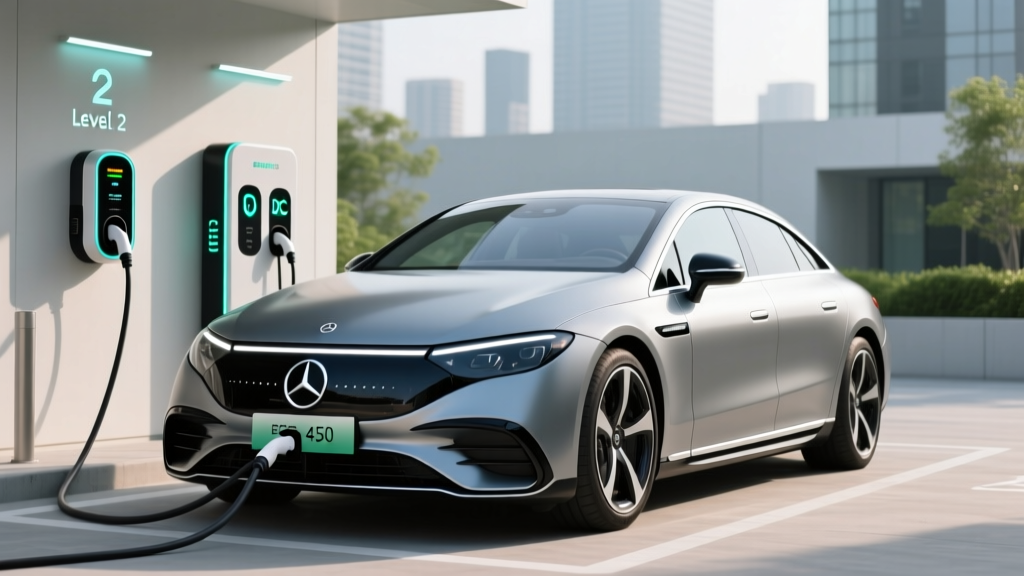
The 2023 Mercedes-Benz EQS 450+ pairs a 108 kWh usable battery with a sleek 0.20 drag coefficient to deliver one of the longest EPA range estimates in the luxury EV sedan segment. But sticker range is only half the story — how you charge this 5,200-pound flagship at home, and what happens on public DC fast chargers, determines whether ownership is effortless or frustrating.
This guide breaks down the EQS 450+'s real-world range, its charging architecture, and exactly what you need to wire up a home Level 2 station — including panel upgrades, cost breakdowns, and equipment picks that match the EQS's 10.9 kW onboard charger.
2023 Mercedes-Benz EQS 450+ Range: EPA vs. Reality
The rear-wheel-drive EQS 450+ carries an EPA-estimated 350 miles of range on its 108 kWh (usable) lithium-ion NMC battery pack. The all-wheel-drive EQS 450 4MATIC, which adds a front motor for 355 hp total, drops to an EPA 340 miles. The performance-oriented EQS 580 4MATIC (536 hp) checks in at 345 miles.
EPA sticker: 350 miles
Highway cruising (70–80 mph): ~290–310 miles
Cold weather (below 32°F): ~260–290 miles
Combined mixed driving: ~310–330 miles
Mercedes' efficiency advantage comes partly from that slippery aero and partly from a standard heat pump, which reduces cabin-heating energy draw in winter. Still, expect a 10–20% range reduction in freezing temperatures and sustained highway speeds above 75 mph. According to fueleconomy.gov, the EQS 450+ achieves 97 MPGe combined (34 kWh/100mi).
| Spec | EQS 450+ | EQS 450 4MATIC | EQS 580 4MATIC |
|---|---|---|---|
| EPA Range | 350 mi | 340 mi | 345 mi |
| Battery (usable) | 108 kWh NMC | 108 kWh NMC | 108 kWh NMC |
| Horsepower | 335 hp | 355 hp | 536 hp |
| 0–60 mph | 5.9 sec | 5.3 sec | 4.1 sec |
| Max DC Charge Rate | 200 kW | 200 kW | 200 kW |
| 10–80% DCFC Time | ~31 min | ~31 min | ~31 min |
| Onboard Charger (L2) | 10.9 kW | 10.9 kW | 10.9 kW |
| Base MSRP (2023) | $104,400 | $107,400 | $125,900 |
Charging Levels Explained: How Fast Will Each Add Range?
EV charging operates at three tiers. The critical distinction: kW (kilowatts) measures power — the rate of energy delivery — while kWh (kilowatt-hours) measures energy capacity, the size of your battery. Think of kW as the flow rate of a hose and kWh as the size of the bucket.
| Level | Voltage | Power (kW) | Miles Added/Hour | Use Case |
|---|---|---|---|---|
| Level 1 | 120V | 1.4 kW | ~4 mi/hr | Overnight trickle; emergency |
| Level 2 | 240V | 7.7–11.5 kW | 25–38 mi/hr | Daily home charging |
| DC Fast | 400–800V DC | 50–350 kW | 150–600+ mi/hr* | Road trips; quick top-ups |
*Miles-per-hour at DCFC varies by state of charge; peak rates only apply at low SoC and taper above 80%.
For the EQS 450+ with its 108 kWh pack, Level 1 is impractical as a primary strategy — a full charge would take roughly 77 hours. Level 2 at the car's maximum 10.9 kW acceptance rate replenishes the pack from 10–100% in approximately 10 hours. DC fast charging at a 200 kW station takes the battery from 10–80% in about 31 minutes, though the charge curve tapers sharply above 80% SoC to protect the NMC cells.
Home Level 2 Installation: Electrical Requirements & Costs
The EQS 450+'s 10.9 kW onboard charger means you'll want a 48-amp Level 2 station (which delivers up to 11.5 kW on a 60-amp circuit) to maximize charging speed. A 40-amp station (9.6 kW output on a 50-amp circuit) is the practical minimum that still provides a full overnight charge.
Electrical Requirements
- Circuit: Dedicated 60-amp breaker for a 48A charger, or 50-amp breaker for a 40A charger
- Voltage: 240V split-phase (standard US residential)
- Wire gauge: 6 AWG copper (60A) or 8 AWG copper (50A)
- Panel capacity: Minimum 100-amp service; 200-amp preferred for homes with other electric appliances
- Outlet vs. hardwired: NEMA 14-50 outlet (50A max) or hardwired connection (required for 60A+ circuits per NEC code)
Do You Need a Panel Upgrade?
Older homes with 100-amp service or limited breaker slots may require a panel upgrade before adding a 60-amp EV circuit. A licensed electrician will perform a load calculation (NEC Article 220) to determine if your existing panel can handle the additional draw alongside HVAC, electric range, dryer, and water heater. If you need a service upgrade to 200 amps, add $1,500–$3,500 to your project total.
| Component | Low End | High End | Notes |
|---|---|---|---|
| Level 2 Charger (hardware) | $350 | $750 | 40A–48A smart chargers |
| Electrician labor | $400 | $1,500 | Varies by run length & complexity |
| Permit & inspection | $50 | $250 | Required in most jurisdictions |
| Electrical materials (wire, conduit) | $100 | $400 | Longer runs = higher cost |
| Panel upgrade (if needed) | $1,500 | $3,500 | 100A → 200A service upgrade |
| Total (no panel upgrade) | $900 | $2,900 | Most typical installations |
| Total (with panel upgrade) | $2,400 | $6,400 | Older homes with 100A service |
Federal incentive note: The Alternative Fuel Vehicle Refueling Property Credit (§30C) may cover up to 30% of home charger installation costs (capped at $1,000) for installations in eligible census tracts. Check IRS.gov for current eligibility rules and census tract maps.
Connector Compatibility: CCS1, NACS, and the EQS
The 2023 EQS 450+ uses a CCS1 (Combined Charging System) port for both Level 2 AC and DC fast charging. This is the standard connector for most non-Tesla EVs sold in North America through 2024. However, the industry is rapidly shifting toward Tesla's NACS (North American Charging Standard), and Mercedes-Benz has committed to adopting NACS on new vehicles beginning in 2025.
| Connector | AC Level 2 | DC Fast | EQS Compatible? | Adapter Needed? |
|---|---|---|---|---|
| CCS1 | ✓ | ✓ | Native | No — built-in |
| NACS (Tesla) | ✓ | ✓ | With adapter | CCS-to-NACS adapter (~$200–$300) |
| CHAdeMO | N/A | ✓ | No | N/A — legacy Nissan/Mitsubishi |
| J1772 (AC only) | ✓ | N/A | Native | No — upper portion of CCS |
Practical implication for 2026 buyers: If you're purchasing a used 2023 EQS, you'll charge natively at Electrify America, EVgo, ChargePoint, and most non-Tesla networks. To access Tesla Superchargers (now open to CCS vehicles via Tesla's Magic Dock at select locations, or with a CCS-to-NACS adapter), budget $200–$300 for a quality adapter from a brand like Lectron or A2Z.
Equipment Picks: Best Home Chargers for the EQS 450+
Because the EQS accepts up to 10.9 kW AC, you'll want a 48-amp charger on a 60-amp circuit to extract the full onboard charger capacity. Here are three proven options that balance reliability, smart features, and cable management:
ChargePoint Home Flex
- Power: Up to 12 kW (50A) adjustable
- Connector: CCS1 / J1772 (NACS version available)
- Cable: 23 ft
- Smart features: Wi-Fi, app scheduling, load sharing, Alexa
- Price: ~$599
- Best for: Flexible amperage if panel is limited
Wallbox Pulsar Plus 48A
- Power: 11.5 kW (48A)
- Connector: CCS1 / J1772
- Cable: 25 ft
- Smart features: Wi-Fi + Bluetooth, app control, Power Sharing
- Price: ~$649
- Best for: Matching EQS max AC rate exactly
Emporia Vue EV Charger
- Power: Up to 11.5 kW (48A)
- Connector: CCS1 / J1772
- Cable: 24 ft
- Smart features: Energy monitoring, solar integration, app scheduling
- Price: ~$399
- Best for: Budget-conscious with energy tracking
All three units are hardwired-capable (required for 48A/60A circuits), UL-listed, and rated for indoor or outdoor installation (NEMA 4). For the EQS, the Wallbox Pulsar Plus 48A is the sweet spot — it delivers the car's maximum 10.9 kW rate without oversizing the circuit.
Cost to Charge: Home vs. Public vs. Gas Comparison
The EQS 450+'s 34 kWh/100mi efficiency means charging costs scale directly with your local electricity rate. Here's how the numbers shake out across typical scenarios:
| Scenario | Rate ($/kWh) | Cost per 100 mi | Cost per Mile |
|---|---|---|---|
| Home off-peak (utility TOU rate) | $0.09 | $3.06 | $0.031 |
| Home standard rate (national avg) | $0.16 | $5.44 | $0.054 |
| Public Level 2 (ChargePoint, etc.) | $0.25 | $8.50 | $0.085 |
| DC Fast (Electrify America) | $0.43 | $14.62 | $0.146 |
| Gas sedan (28 MPG, $3.50/gal) | — | $12.50 | $0.125 |
| Gas luxury sedan (20 MPG, $3.50/gal) | — | $17.50 | $0.175 |
At home off-peak rates, the EQS costs roughly 3 cents per mile to "fuel" — less than a quarter of what a comparable gas-powered S-Class (20–24 MPG combined) would cost. Even at public DC fast-charging rates, the EQS undercuts premium gasoline on a per-mile basis. The financial case for home charging is overwhelming: a 12,000-mile year costs approximately $367 at off-peak home rates versus $2,100 in premium fuel for a gas equivalent.
DC Fast Charging Reality: The Charge Curve Matters
Mercedes quotes a 200 kW peak DC charge rate and a 10–80% time of 31 minutes. But peak kW is not sustained kW. The EQS's charge curve looks roughly like this:
- 10–40% SoC: Sustains near 200 kW (peak)
- 40–60% SoC: Steps down to ~150 kW
- 60–80% SoC: Tapers to ~100 kW
- 80–100% SoC: Drops sharply to ~30–50 kW (battery protection)
This means charging from 10–80% averages roughly 140–150 kW sustained, not the full 200 kW peak. On a 350 kW Electrify America or Tesla Supercharger V4 stall, the EQS won't use the extra headroom — it's limited by its own 200 kW ceiling. For road-trip planning, budget 35 minutes per stop (including plug-in time and stretch breaks) to add approximately 200 miles of range.
Safety, Code & Installation Best Practices
EV charging installations must comply with NEC Article 625 and local amendments. Key requirements:
- Dedicated circuit: Your EV charger must be on its own breaker — never shared with other appliances
- GFCI protection: Required for outdoor outlets (NEMA 14-50); hardwired units have internal GFCI
- Outdoor rating: If mounted outside, the charger must be NEMA 4 (rain/sleet rated) or NEMA 4X (corrosion resistant)
- Permit required: Nearly all jurisdictions require an electrical permit and post-installation inspection — skip this and you risk insurance claim denial
- Cable management: Use a holster or retractor to prevent tripping hazards and cable damage
Always hire a licensed electrician experienced with EV installations. Request a load calculation before committing to a charger amperage — the difference between a 40A and 48A circuit may be the difference between a simple install and a $2,500 panel upgrade.
Frequently Asked Questions
How much does it cost to install a home EV charger for the EQS?
Expect $900–$2,900 for a standard Level 2 installation (equipment, electrician, permit, materials) if your electrical panel has adequate capacity. If a panel upgrade from 100A to 200A is needed, total costs can reach $2,400–$6,400.
How fast will each charging level add range to the EQS 450+?
Level 1 (120V) adds about 4 miles per hour — impractical for daily use. Level 2 (240V, 48A) adds approximately 35–38 miles per hour, fully replenishing the 108 kWh pack in about 10 hours. DC fast charging at 200 kW can add up to 185 miles in 20 minutes at low SoC.
Which connector is compatible with my 2023 EQS?
The 2023 EQS uses CCS1 natively for both AC and DC charging. To access Tesla Superchargers, you'll need a CCS-to-NACS adapter ($200–$300). CHAdeMO is not compatible.
How much does charging the EQS cost per mile compared to gas?
At home off-peak rates ($0.09/kWh), the EQS costs about 3 cents per mile. A comparable gas luxury sedan at 20 MPG and $3.50/gallon costs about 17.5 cents per mile — nearly 6× more.
What electrical upgrades might I need for a 48-amp charger?
You'll need a dedicated 60-amp breaker, 6 AWG copper wire, and 240V service. Homes with 100-amp panels or limited breaker slots may require a $1,500–$3,500 panel upgrade to 200 amps. A licensed electrician's load calculation will determine this.
Is the EQS 450+ eligible for the federal EV tax credit?
For 2023 models purchased new, the EQS exceeded the §30D MSRP cap of $55,000 for sedans (the EQS starts at $104,400), making it ineligible for the $7,500 new-vehicle credit. However, if purchased used from a dealer for $25,000–$50,000, you may qualify for the used clean vehicle credit (up to $4,000 or 30% of sale price, subject to income limits). Consult a tax professional for eligibility.