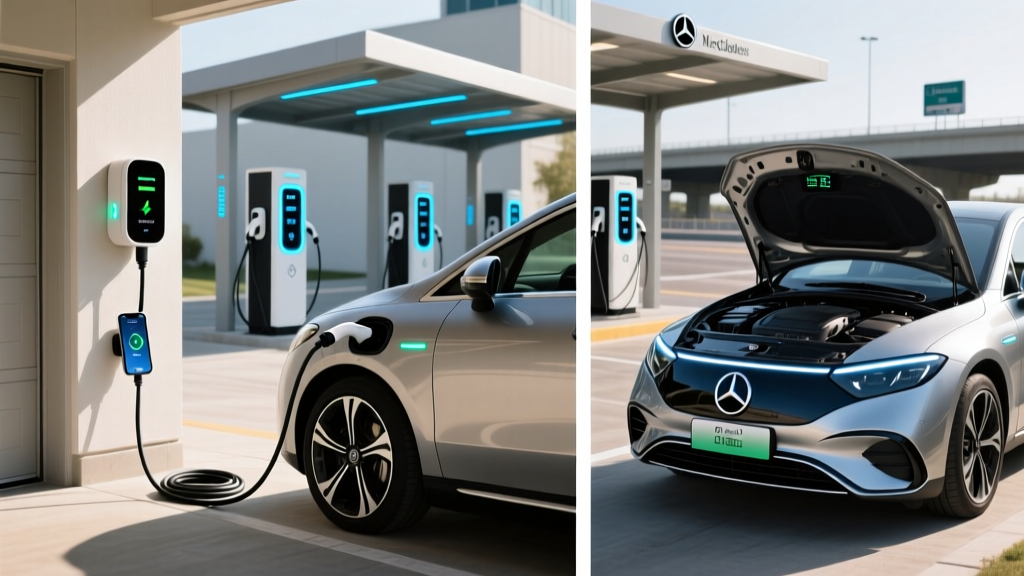
If you own or are shopping for a Mercedes-Benz electric vehicle — whether that's an EQE sedan, EQS luxury flagship, EQB compact SUV, or the G-Class EV — understanding the full Mercedes charging ecosystem is the difference between effortless ownership and daily frustration. Mercedes-Benz has been transitioning its EV lineup toward the North American Charging Standard (NACS), and public infrastructure has shifted dramatically alongside it. This guide covers exactly what you need to charge at home, on the road, and how much it all costs in real-world 2026 dollars.
Mercedes Charging Levels: Speeds, kW, and Miles Added Per Hour
Before anything else, let's clear up the most common EV confusion: kW (kilowatts) measures power — how fast energy flows into your car. kWh (kilowatt-hours) measures energy — how much your battery holds. Think of kW as the width of a hose and kWh as the size of the bucket. A Mercedes EQS 450+ has a 108.4 kWh usable battery; how quickly you fill it depends entirely on the kW rate of your charger.
| Level | Voltage | Power (kW) | Miles of Range Added Per Hour | Best For |
|---|---|---|---|---|
| Level 1 (120V) | 120V / 12A | ~1.4 kW | 3–5 mi/hr | Emergency top-ups, overnight trickle |
| Level 2 (240V) | 240V / 32–48A | 7.7–11.5 kW | 22–38 mi/hr | Daily home charging |
| DC Fast Charge | 400V–800V DC | 50–200+ kW | 150–500+ mi/hr (peak) | Road trips, rapid top-ups |
For context, a Mercedes EQE 350+ (EPA-estimated 305 miles of range, 90.6 kWh usable battery) charging on a Level 2 home station at 11.5 kW will go from 10% to 80% in roughly 6.5 hours — perfect for overnight charging. That same car on a 170 kW DC fast charger hits 10–80% in approximately 32 minutes under ideal conditions, though real-world charge curves taper significantly above 80% State of Charge (SoC).
Home Charger Installation: Electrical Requirements and Costs
Installing a Level 2 home charger is the single biggest quality-of-life upgrade for any Mercedes EV owner. But the total cost depends heavily on your home's electrical panel, the distance from panel to charger location, and local permitting requirements.
Electrical Requirements
Most Level 2 chargers recommended for Mercedes EVs require a 240V dedicated circuit at either 40A or 60A, depending on the charger's output. A 48A charger (delivering 11.5 kW) needs a 60A breaker — NEC code requires the circuit breaker to be rated at 125% of the continuous load. Your panel must have two adjacent open slots and sufficient remaining capacity (typically 200A total panel service is recommended for homes with an EV charger plus standard appliances).
What Electrical Upgrades Might I Need?
If your home has a 100A panel (common in pre-2000 construction), you'll likely need a panel upgrade to 200A, which adds $1,500–$3,000 to the project. Even with a 200A panel, if you're running an electric stove, dryer, and HVAC, a load calculation by a licensed electrician may reveal you need a smart panel or load-management device to avoid tripping the main breaker. Some Mercedes owners opt for a charger with built-in load management (like the Emporia Vue integration or Wall Connector power-sharing) to avoid panel upgrades entirely.
| Cost Component | Typical Range | Notes |
|---|---|---|
| Level 2 Charger (Equipment) | $400–$750 | 40A–48A smart charger, NACS or CCS1 |
| Electrician Labor | $300–$1,500 | Depends on run distance, wall type, conduit |
| Electrical Permit | $50–$200 | Varies by municipality |
| Panel Upgrade (if needed) | $1,500–$3,000 | 100A → 200A service upgrade |
| Total (no panel upgrade) | $750–$2,450 | Most homes with 200A service |
| Total (with panel upgrade) | $2,250–$5,450 | Older homes with 100A panels |
Always hire a licensed electrician and pull a permit. Unpermitted EV charger installations can void home insurance claims and create fire hazards. The NEC requires GFCI protection for outdoor receptacles, and most jurisdictions now require a hardwired connection or a NEMA 14-50 receptacle installed to code with proper torque specifications.
Which Connector Is Compatible With My Mercedes EV?
Mercedes-Benz has been in a connector transition period. Here's the definitive breakdown for 2026 model-year vehicles:
| Mercedes Model (2025–2026 MY) | Native Connector | Tesla Supercharger Access | Adapter Needed? |
|---|---|---|---|
| EQS Sedan (2025+ refresh) | NACS | Yes, native | No |
| EQE Sedan / SUV (2025+) | NACS | Yes, native | No |
| EQB (2025+) | NACS | Yes, native | No |
| G 580 EQ Technology (2025+) | NACS | Yes, native | No |
| EQS / EQE (2022–2024) | CCS1 | Yes, with adapter | CCS1-to-NACS adapter (~$200–$250) |
| EQB (2022–2024) | CCS1 | Yes, with adapter | CCS1-to-NACS adapter (~$200–$250) |
For 2025 and newer Mercedes EVs, the native NACS port means you can plug directly into Tesla Superchargers (now open to non-Tesla vehicles) and the growing number of NACS-equipped Electrify America, EVgo, and ChargePoint stations. If you own an earlier CCS1-equipped Mercedes, a CCS1-to-NACS adapter is essential for accessing the Supercharger network. Mercedes-Benz has offered these adapters to some owners; check with your dealer or the Mercedes me app for availability. For home charging, nearly all Level 2 stations now ship with NACS connectors, though CCS1-equipped wall chargers remain available.
Recommended Home Chargers for Mercedes EVs
Not all Level 2 chargers are equal. Here are three proven options that pair well with Mercedes-Benz electric vehicles, evaluated on power output, cable length, smart features, and build quality:
ChargePoint Home Flex (NACS)
- Power: Up to 12 kW (50A) / configurable down to 16A
- Cable: 23 feet
- Smart Features: Wi-Fi, app scheduling, Alexa, load sharing
- Price: ~$599
- Best For: Flexible amperage for older panels; excellent app
Tesla Wall Connector (NACS)
- Power: Up to 11.5 kW (48A)
- Cable: 24 feet
- Smart Features: Wi-Fi, OTA updates, power sharing, NACS native
- Price: ~$420
- Best For: Best value; seamless for NACS-equipped Mercedes
Emporia Level 2 Smart Charger (NACS)
- Power: Up to 11.5 kW (48A)
- Cable: 24 feet
- Smart Features: Energy monitoring, solar integration, load management
- Price: ~$399
- Best For: Solar homes; detailed energy tracking
For most Mercedes EV owners with a NACS-equipped vehicle (2025+ models), the Tesla Wall Connector offers the best value at $420 with 48A output and a 24-foot cable — long enough for most garage configurations. If your panel is tight on capacity, the ChargePoint Home Flex lets you dial the amperage down to match your circuit, avoiding a panel upgrade.
How Much Does Mercedes Charging Cost Per Mile vs. Gas?
This is where EV ownership economics become compelling — but the numbers vary significantly depending on where and when you charge. Below is a realistic cost comparison using a Mercedes EQE 350+ (3.0–3.5 miles per kWh efficiency, approximately 100 MPGe combined per fueleconomy.gov) versus a comparable Mercedes E 350 gas sedan (25 MPG combined).
| Charging/Fuel Scenario | Cost per kWh or Gallon | Cost Per Mile (EQE EV) | Cost Per Mile (E 350 Gas) |
|---|---|---|---|
| Home (off-peak utility rate) | $0.10–$0.14/kWh | $0.03–$0.05 | — |
| Home (standard rate) | $0.15–$0.20/kWh | $0.05–$0.07 | — |
| Public Level 2 (ChargePoint, etc.) | $0.25–$0.40/kWh | $0.08–$0.13 | — |
| DC Fast Charge (EA, EVgo) | $0.35–$0.55/kWh | $0.11–$0.18 | — |
| Gasoline (national avg.) | $3.40/gallon | — | $0.14 |
The takeaway: Home charging during off-peak hours makes the EQE roughly 70–75% cheaper per mile than the gas E 350. Even public DC fast charging at premium rates ($0.48/kWh) costs roughly the same per mile as gasoline. The break-even point heavily favors EVs if you can charge at home. According to the U.S. Department of Energy, the average EV driver who charges primarily at home saves $800–$1,200 annually on fuel compared to a 25 MPG gas vehicle.
Mercedes Charging Times: 10–80% by Model and Charger Type
Here's what to expect in real-world charging sessions across the current Mercedes-Benz EV lineup. Times assume optimal battery temperature (preconditioned) and a stable charge connection.
| Model | Battery (usable kWh) | Level 2 (11.5 kW) 10–80% | DC Fast (peak kW) 10–80% |
|---|---|---|---|
| EQE 350+ Sedan | 90.6 kWh | ~6.3 hours | ~32 min (170 kW peak) |
| EQE 350 4MATIC SUV | 90.6 kWh | ~6.3 hours | ~32 min (170 kW peak) |
| EQS 450+ Sedan | 108.4 kWh | ~7.5 hours | ~31 min (200 kW peak) |
| EQS 580 4MATIC SUV | 108.4 kWh | ~7.5 hours | ~31 min (200 kW peak) |
| EQB 300 4MATIC | 66.5 kWh | ~4.6 hours | ~32 min (100 kW peak) |
| G 580 EQ Technology | 116.0 kWh | ~8.1 hours | ~32 min (200+ kW peak) |
Note that the EQS sedan's 200 kW peak charge rate is impressive, but sustained charging averages closer to 130–150 kW across the full 10–80% window. Mercedes' thermal management system is robust — in testing, the EQS maintains strong charge rates even in 90°F+ heat — but cold weather (below freezing) will slow DC fast charging by 20–30% unless you precondition via the Mercedes me app before arriving at the charger.
Public Mercedes Charging: Networks, Reliability, and the Mercedes me App
Mercedes-Benz has invested in its own Mercedes-Benz High Power Charging Network, with stations strategically placed along major U.S. corridors. These stations feature 400 kW chargers (among the fastest publicly available), dedicated pull-through lanes for trailers, and amenities. As of 2026, over 100 Mercedes-branded charging hubs are operational across the U.S.
Beyond Mercedes' own network, your primary public options include:
- Tesla Superchargers (now open to NACS-equipped Mercedes EVs natively; CCS1 models need an adapter) — 15,000+ stalls in the U.S.
- Electrify America — transitioning many stations to NACS; CCS1 still available
- EVgo — expanding NACS connectors; strong urban coverage
- ChargePoint — dominant for Level 2 public charging (retail, workplace, parking garages)
The Mercedes me app integrates route planning with charging stops, battery preconditioning, and payment across multiple networks. For EQS and EQE models equipped with MBUX, the navigation system automatically routes through chargers and initiates battery preconditioning when a DC fast charger is set as your destination — a critical feature that can shave 5–10 minutes off your charging stop.
Safety, Code, and Installation Best Practices
EV charging involves sustained high-current draw — far more demanding than typical household appliances. Cutting corners here is a genuine fire risk. Follow these non-negotiable guidelines:
- Dedicated circuit: Your Level 2 charger must have its own dedicated breaker — never share a circuit with other appliances.
- GFCI protection: Required for outdoor installations per NEC 2023+ code. Hardwired chargers with built-in ground-fault protection satisfy this requirement.
- NEMA 14-50 torque: If using a receptacle instead of hardwiring, the outlet must be torqued to manufacturer spec. Loose connections on 14-50 outlets have caused documented fires. Use a commercial-grade outlet (Hubbell, Bryant) — not a residential-grade one from a big-box store.
- Outdoor rating: If your charger is mounted outside, ensure it carries a NEMA 4 or NEMA 4X rating for weather resistance. All chargers recommended above meet this standard.
- Permit and inspection: Every jurisdiction requires a permit for EV charger installation. The inspection ensures proper grounding, wire gauge, and breaker sizing. Skipping this step can void your homeowner's insurance.
Frequently Asked Questions
How much does it cost to install a home EV charger for my Mercedes?
Expect $750–$2,450 for a standard installation in a home with adequate 200A panel capacity. If your home needs a panel upgrade from 100A to 200A, add $1,500–$3,000, bringing the total to $2,250–$5,450. The charger itself costs $400–$750; the remainder is electrician labor and permitting.
How fast will each charging level add range to my Mercedes EV?
Level 1 (120V) adds 3–5 miles per hour — essentially overnight trickle charging. Level 2 (240V, 48A) adds 22–38 miles per hour depending on your vehicle's efficiency, fully replenishing most Mercedes EVs overnight. DC fast charging adds 150–500+ miles per hour at peak rates, though sustained rates taper as the battery fills.
Which connector does my Mercedes EV use — NACS or CCS1?
Model-year 2025 and newer Mercedes EVs (EQS, EQE, EQB, G 580) use the NACS connector natively and can access Tesla Superchargers without an adapter. Model-year 2022–2024 Mercedes EVs use CCS1 and require a CCS1-to-NACS adapter (approximately $200–$250) for Supercharger access.
How much does charging cost per mile compared to gas?
Home charging at off-peak rates ($0.12/kWh) costs roughly $0.03–$0.05 per mile in a Mercedes EQE. A comparable gas Mercedes E 350 at 25 MPG and $3.40/gallon costs $0.14 per mile. That's a 65–75% fuel savings with home charging. Even public DC fast charging at $0.48/kWh roughly matches gasoline on a per-mile basis.
What electrical upgrades might my home need for an EV charger?
Homes with 100A electrical panels (common in pre-2000 construction) typically need a 200A panel upgrade ($1,500–$3,000). Even with 200A service, a load calculation may reveal you need a smart load-management device if you simultaneously run electric heating, a dryer, and an EV charger. A licensed electrician can perform this calculation during a site visit. Per NEC guidelines, the charger circuit must be sized at 125% of the continuous load.
Does the Mercedes me app help with charging?
Yes. The Mercedes me app enables remote charge monitoring, scheduled charging (to take advantage of off-peak utility rates), battery preconditioning before DC fast charging, and integrated route planning that automatically directs you to compatible chargers. Setting a DC fast charger as your navigation destination triggers automatic battery preconditioning, which warms the battery to optimal temperature and can reduce charging time by 15–25% in cold weather.