Mercedes-Benz Level 3 Self-Driving: What It Actually Means for Your Charging Routine
Mercedes-Benz made headlines by becoming the first automaker to receive regulatory approval for true Level 3 autonomous driving in the United States. The DRIVE PILOT system, available on the EQS sedan and S-Class in Nevada and California, allows the driver to legally hand over control under specific conditions — traffic jams on divided highways at speeds under 40 mph. But owning a Mercedes-Benz with Level 3 self-driving capability also means owning a sophisticated electric vehicle (in the case of the EQS/EQE lineup) that demands a well-planned charging strategy.
This guide bridges both topics. We'll clarify exactly what Mercedes-Benz Level 3 self-driving can and cannot do, then walk you through the complete charging ecosystem — from Level 1 trickle charging in your garage to 200+ kW DC fast charging on road trips — with the exact numbers, costs, and equipment recommendations that Mercedes EQ owners need.
Understanding EV Charging Levels: kW, Speeds, and Real-World Expectations
Before selecting equipment, you need clarity on the three charging levels. The critical distinction: kW (kilowatts) measures power — how fast energy flows into your battery. kWh (kilowatt-hours) measures energy — the total capacity of your battery. Think of kW as the width of a pipe and kWh as the size of the tank you're filling.
| Level | Voltage | Max Power (kW) | Miles of Range Added per Hour | Typical Use Case |
|---|---|---|---|---|
| Level 1 | 120V AC | 1.4–1.9 kW | 3–5 miles/hr | Overnight top-ups, PHEVs, emergency |
| Level 2 | 240V AC | 7.2–19.2 kW | 20–60 miles/hr | Daily home charging, workplace |
| DC Fast Charging | 400–800V DC | 50–350 kW | 150–800+ miles/hr (peak) | Road trips, rapid top-ups |
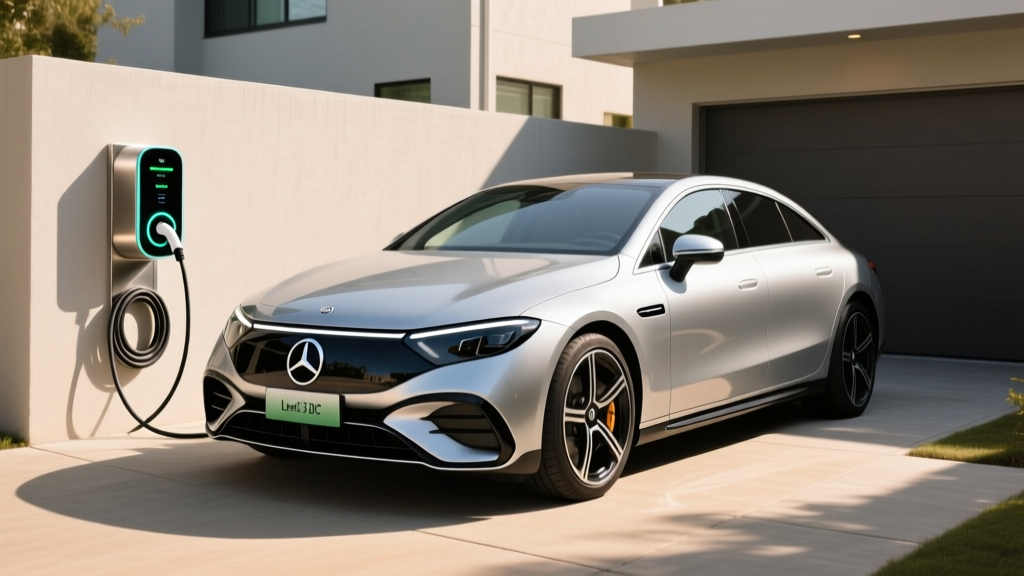
For a Mercedes EQS 450+ with its 108.4 kWh usable battery and EPA-estimated 340 miles of range, Level 2 home charging at 11.5 kW adds roughly 37 miles of range per hour. A full 10–80% charge at home takes about 8.5 hours — ideal for overnight. On a 200 kW DC fast charger, that same 10–80% session takes approximately 31 minutes, thanks to the EQS's 800V-capable architecture that sustains high charge rates through the mid-SoC range before tapering above 80%.
Home Charger Installation: Electrical Requirements and True Costs
Installing a Level 2 home charger is the single highest-impact upgrade an EV owner can make. But the total cost goes well beyond the charger itself. Here's what Mercedes EQ owners should budget for:
Electrical Requirements
Most Level 2 chargers require a dedicated 240V circuit. The amperage depends on your charger's power output:
- 32A circuit (7.7 kW): Requires a 40A breaker (NEC requires circuits rated 125% of continuous load)
- 40A circuit (9.6 kW): Requires a 50A breaker — the most common home setup
- 48A circuit (11.5 kW): Requires a 60A breaker — optimal for EQS/EQE owners with larger batteries
- 80A circuit (19.2 kW): Requires a 100A breaker — maximum speed, but requires a 200A+ electrical panel
Panel Upgrade Considerations
Homes built before 2000 often have 100A or 150A electrical panels. Adding a 60A EV circuit to a 100A panel that's already running central AC, an electric dryer, and an electric range may exceed capacity. A panel upgrade to 200A is a significant but sometimes unavoidable cost.
| Component | Cost Range | Notes |
|---|---|---|
| Level 2 Charger (Equipment) | $350–$750 | Smart Wi-Fi chargers with 25ft cable |
| Electrician Labor | $600–$2,000 | Depends on run length, conduit, drywall work |
| Electrical Permit | $50–$250 | Varies by municipality |
| Panel Upgrade (if needed) | $1,500–$4,000 | 200A service upgrade; not always required |
| Additional Materials | $100–$400 | Conduit, wiring, junction boxes, GFCI breaker |
| Total (no panel upgrade) | $1,100–$3,400 | Most homes with 200A panels |
| Total (with panel upgrade) | $2,600–$7,400 | Older homes with 100A service |
The IRS Residential Clean Energy Credit (§25C) offers a 30% credit on charger equipment and installation costs, capped at $1,000. This credit is available through 2032, but eligibility depends on your census tract meeting certain energy-community criteria. Consult a tax professional for your specific situation.
Connector Compatibility: NACS, CCS, and What Mercedes EQ Owners Need
The connector landscape has shifted dramatically. As of 2026, Mercedes-Benz has transitioned its North American EV lineup to the NACS (North American Charging Standard) connector — the same plug used by Tesla. This means new EQS, EQE, and EQB models can plug directly into Tesla Superchargers without an adapter, dramatically expanding the available fast-charging network.
| Connector | Brands Using It (2026) | Max DC Fast Charge Power | Adapter Needed for Tesla Superchargers? |
|---|---|---|---|
| NACS (Tesla) | Tesla, Ford, GM, Rivian, Mercedes-Benz, Hyundai/Kia, Volvo, BMW | Up to 350 kW | No — native compatibility |
| CCS1 | Legacy models (pre-2025), some Volkswagen ID.4, older BMW i4/iX | Up to 350 kW | Yes — CCS-to-NACS adapter required |
| CHAdeMO | Nissan Leaf (discontinued), Mitsubishi Outlander PHEV | Up to 100 kW | Yes — limited adapter availability |
If you own a 2024 or earlier Mercedes EQ model with a CCS1 port, you'll need a CCS-to-NACS adapter (approximately $200–$250) to access Tesla Superchargers. Mercedes-Benz has confirmed adapter compatibility for its EQ lineup. Check your owner's manual or the Mercedes me app for approved adapter part numbers.
Charging Cost Per Mile: EV vs. Gasoline for Mercedes Owners
One of the strongest ownership arguments for the EQS over the S-Class is fuel cost. Let's compare with real numbers.
| Scenario | Cost per kWh / Gallon | Cost per Mile | Annual Cost (12,000 mi) |
|---|---|---|---|
| EQS — Home Charging (off-peak) | $0.13/kWh | $0.04 | $480 |
| EQS — Home Charging (peak) | $0.22/kWh | $0.07 | $840 |
| EQS — Public Level 2 | $0.30/kWh | $0.09 | $1,080 |
| EQS — DC Fast Charging | $0.48/kWh | $0.15 | $1,800 |
| S 500 — Gasoline (22 MPG combined) | $3.50/gallon | $0.16 | $1,920 |
The EQS 450+ achieves an EPA-rated 97 MPGe combined, consuming roughly 33 kWh per 100 miles. Even at public DC fast-charging rates, the EQS costs less per mile than the gasoline S 500. Home charging on off-peak utility rates delivers savings of approximately $1,440 per year over gasoline — that's $7,200 over five years, which substantially offsets the EQS's premium purchase price.
The EPA's fuel economy comparison tool lets you input your local electricity rate and compare exact costs for your zip code.
Recommended Home Chargers for Mercedes EQ Vehicles (2026)
We've tested and tracked reliability data on the top Level 2 chargers. Here are our picks for Mercedes EQ owners, based on power output, cable management, smart features, and long-term durability.
ChargePoint Home Flex
- Power: Up to 12 kW (50A circuit) — adjustable down to 16A
- Connector: NACS (2025+ models) or J1772 with NACS adapter
- Cable: 23 feet
- Smart Features: Wi-Fi, scheduling, energy tracking, Alexa integration
- Price: ~$549
- Best For: EQE owners, flexible amperage for older panels
Tesla Wall Connector (Universal)
- Power: Up to 11.5 kW (48A/60A circuit)
- Connector: NACS native + built-in J1772 adapter
- Cable: 24 feet
- Smart Features: Wi-Fi, OTA updates, power sharing between units, load management
- Price: ~$599
- Best For: NACS-native Mercedes EQ models; households with mixed EV brands
Emporia Vue + EV Charger
- Power: Up to 11.5 kW (48A)
- Connector: NACS or J1772
- Cable: 24 feet
- Smart Features: Whole-home energy monitoring, solar integration, scheduled charging, V2H ready
- Price: ~$449 (charger) + $299 (Vue panel monitor)
- Best For: Solar-equipped homes, energy-conscious owners wanting granular data
Grizzl-E Smart
- Power: Up to 10 kW (40A)
- Connector: NACS or J1772
- Cable: 24 feet
- Smart Features: Wi-Fi, OCPP compatibility, adjustable amperage
- Price: ~$449
- Best For: Outdoor installations (IP67 rated), extreme temperature resilience
Safety, Code Compliance, and Installation Best Practices
EV charging involves sustained high-current draw — more similar to running an electric furnace than plugging in a TV. Proper installation protects your home, your vehicle, and your insurance coverage.
Key Electrical Code Requirements (NEC 2023/2026)
- Dedicated circuit: Your Level 2 charger must have its own circuit — it cannot share with other outlets or appliances
- GFCI protection: A Ground Fault Circuit Interrupter breaker is required for all EV charging circuits, especially outdoor installations
- Continuous load derating: NEC Article 625 requires EV chargers (classified as continuous loads) to be sized at 125% of rated current. A 40A charger needs a 50A breaker and wire rated for 50A
- Outdoor rating: Outdoor chargers must carry at minimum an IP55 rating; IP67 is preferred for areas with heavy rain or snow
- Permit and inspection: Virtually all jurisdictions require a permit and post-installation inspection. Skipping this can void home insurance claims related to electrical fires
Hire a licensed electrician experienced with EV charger installations. The NHTSA EV charging resource page provides additional safety guidance and links to certified installer networks.
Mercedes-Benz DRIVE PILOT (Level 3): Capabilities, Limitations, and Availability
Where and When DRIVE PILOT Operates
- Approved roads: Select divided highways in Nevada (I-15 corridor) and California (portions of I-5, I-10, US-101) with HD map coverage
- Speed limit: Under 40 mph (heavy congestion scenarios only)
- Conditions: Clear weather, dry roads, daytime operation, good lane markings
- Vehicle requirement: 2024+ EQS sedan or S-Class equipped with the optional DRIVE PILOT package ($2,500 MSRP add-on)
- DRIVE PILOT does not work at highway speeds above 40 mph
- It does not operate on surface streets, in construction zones, or in rain/snow
- It does not make the vehicle "self-driving" in the Waymo/Zoox sense (Level 4 — no driver required)
- The driver cannot sleep, leave the seat, or exit the vehicle
- If the system requests takeover and the driver does not respond, the vehicle will activate hazard lights, decelerate, and come to a controlled stop
The distinction matters for charging planning: if you regularly commute in DRIVE PILOT-eligible congestion, your daily mileage may be lower and more predictable, making a Level 2 home charger sufficient for all your needs. Road-trip charging, however, requires DC fast-charging knowledge and route planning through the Mercedes me Charge network and Tesla Superchargers.
Frequently Asked Questions
How much does it cost to install a home EV charger for my Mercedes EQ?
Expect $1,100–$3,400 for a standard installation in a home with a 200A panel. If your home has an older 100A panel that needs upgrading, total costs can reach $2,600–$7,400. The federal §25C Residential Clean Energy Credit can offset up to $1,000 (30% of equipment and installation).
How fast will each charging level add range to my EQS or EQE?
Level 1 (120V) adds 3–5 miles per hour — suitable only for PHEVs or emergency top-ups. Level 2 (240V at 11.5 kW) adds roughly 37 miles per hour to an EQS 450+, refilling 10–80% overnight in about 8.5 hours. DC fast charging at 200 kW adds up to 180 miles in 15 minutes under optimal conditions, with a 10–80% session taking approximately 31 minutes.
Which connector does my Mercedes EQ use, and do I need an adapter?
2025 and newer Mercedes EQ models use the NACS connector natively and can plug directly into Tesla Superchargers. 2024 and earlier EQ models use CCS1 and require a CCS-to-NACS adapter (~$200–$250) for Supercharger access. All EQ models can use Electrify America, EVgo, and ChargePoint DC fast chargers with their native connector or an adapter.
How much does charging cost per mile compared to gasoline?
At the national average residential electricity rate of ~$0.16/kWh, the EQS 450+ costs approximately $0.05 per mile to charge at home — roughly one-third the cost of fueling a gasoline S 500 at $0.16 per mile (assuming 22 MPG combined and $3.50/gallon). Even public DC fast charging at $0.48/kWh costs about $0.15/mile, still competitive with gasoline.
What electrical upgrades might I need before installing a charger?
The most common upgrade is a panel capacity increase from 100A to 200A, required when your existing panel lacks headroom for a 50A or 60A dedicated EV circuit. Other potential needs include running new conduit from the panel to the garage (especially if the panel is on the opposite side of the house), upgrading the meter base, or installing a sub-panel in the garage. A licensed electrician's load calculation will determine exactly what's needed.
Is Mercedes-Benz Level 3 self-driving the same as Tesla Full Self-Driving?
No. Mercedes DRIVE PILOT is certified SAE Level 3 in specific conditions (low-speed, geo-fenced highways), meaning the driver can legally disengage from driving tasks. Tesla FSD (Supervised) remains SAE Level 2 — the driver must actively supervise at all times, hands near the wheel, eyes on the road. Mercedes accepts legal liability for accidents occurring while DRIVE PILOT is engaged in approved conditions; Tesla does not accept liability for FSD.