Understanding Mercedes-Benz High-Power Charging in 2026
If you own or are shopping for a Mercedes-Benz EV — whether it's an EQE sedan, EQS SUV, or the newer MMA-platform models — understanding the brand's high-power charging ecosystem is essential to maximizing your ownership experience. Mercedes-Benz has invested heavily in its own Mercedes-Benz High-Power Charging Network, a global rollout of ultra-fast DC stations capable of delivering up to 400 kW per stall, alongside continued compatibility with third-party networks like Electrify America, EVgo, and Tesla Superchargers via NACS adapters.
This guide covers everything a Mercedes-Benz EV owner needs to know: charging speeds across all three levels, real-world 10–80% times for current EQ models, home Level 2 installation costs and electrical requirements, connector compatibility, and how your per-mile charging cost compares to gasoline.
Charging Levels Explained: Speeds in kW and Miles Per Hour
Every Mercedes-Benz EV sold in the US supports three tiers of charging. Here is what each delivers in practical terms:
| Level | Voltage | Max Power (kW) | Miles of Range Added Per Hour | Typical Use Case |
|---|---|---|---|---|
| Level 1 | 120V AC | 1.4 kW | 3–5 mi/hr | Emergency/top-up via standard outlet |
| Level 2 | 240V AC | 7.2–11.5 kW | 20–44 mi/hr | Home daily charging, workplace |
| DC Fast Charge | 400V–800V DC | 170–320 kW (model dependent) | 180–600+ mi/hr (at peak) | Road trips, Mercedes-Benz High-Power stations |
Most current Mercedes-Benz EVs — including the 2025–2026 EQE 350 (90.6 kWh usable battery) and EQS 450 (107.8 kWh usable) — accept Level 2 AC charging at up to 9.6 kW via their onboard charger. The EQS and newer MMA-platform vehicles with 800V architecture can accept DC fast charging at up to 320 kW at compatible stations, while the 400V EQE tops out around 170 kW peak.
Real-world charging speed depends on battery state of charge (SoC), ambient temperature, and the station's available power. Peak kW rates are only sustained roughly between 10% and 40% SoC; above 80%, the charge curve tapers significantly to protect battery health. Expect a 20–80% session to average roughly 60–70% of the advertised peak rate.
Mercedes-Benz High-Power Charging Network: What's Available Now
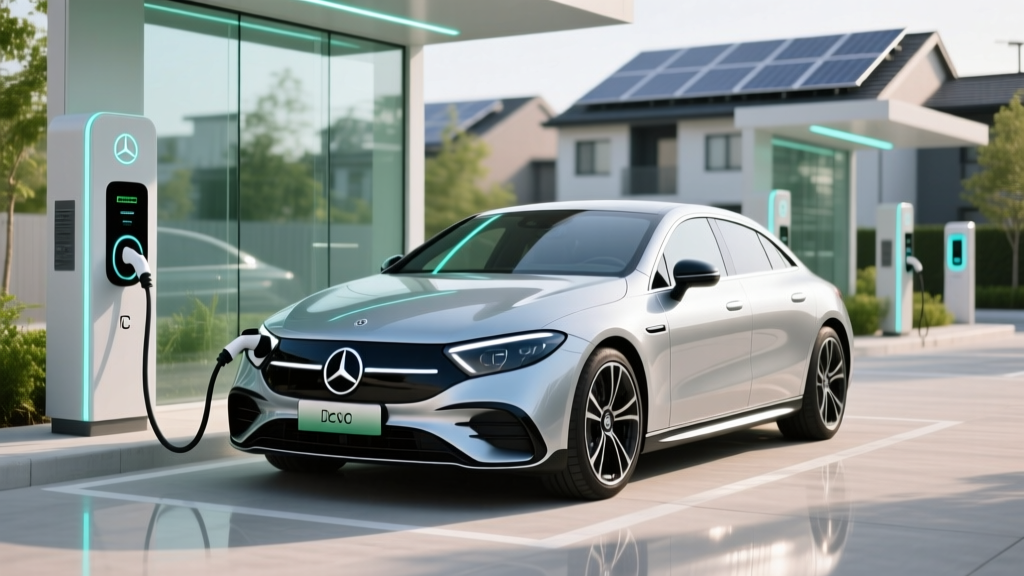
The Mercedes-Benz High-Power Charging Network began its North American rollout in late 2023 with a flagship station in Sandy Springs, Georgia, and has expanded through 2025–2026 to include locations across major metro areas and highway corridors. These stations feature:
- Up to 400 kW per charger (CCS1 and NACS connectors at most locations)
- Canopy-covered stalls with wide pull-through lanes for trailers
- Plug & Charge functionality — no app or RFID card needed for Mercedes me connect users; billing is automatic
- Integrated navigation routing via MBUX — the car preconditions the battery when you navigate to a High-Power station
As of early 2026, Mercedes-Benz operates or has announced roughly 60+ High-Power Charging hubs in the US, with plans for over 2,500 individual chargers across North America by 2027. These stations are open to all EVs, but Mercedes-Benz owners receive preferred reservation slots via the Mercedes me Charge app at select locations.
According to Mercedes-Benz USA's official charging page, the network targets pricing competitive with Electrify America, typically $0.35–$0.48/kWh depending on location and time of day, though specific pricing varies by station.
Real-World DC Fast Charging Times for Mercedes-Benz EVs
Here is what 10–80% charging looks like for current models under optimal conditions (battery preconditioned, station delivering full rated power):
| Model | Battery (kWh usable) | Peak DC Rate (kW) | 10–80% Time | Architecture |
|---|---|---|---|---|
| 2026 EQS 450+ Sedan | 107.8 | 200 | ~31 min | 400V |
| 2026 EQE 350+ Sedan | 90.6 | 170 | ~32 min | 400V |
| 2026 EQS SUV 450 | 108.4 | 200 | ~32 min | 400V |
| 2026 CLA EV (MMA platform) | 85 (est.) | 250+ | ~22 min (announced) | 800V |
Home Level 2 Charging: Installation Costs and Electrical Requirements
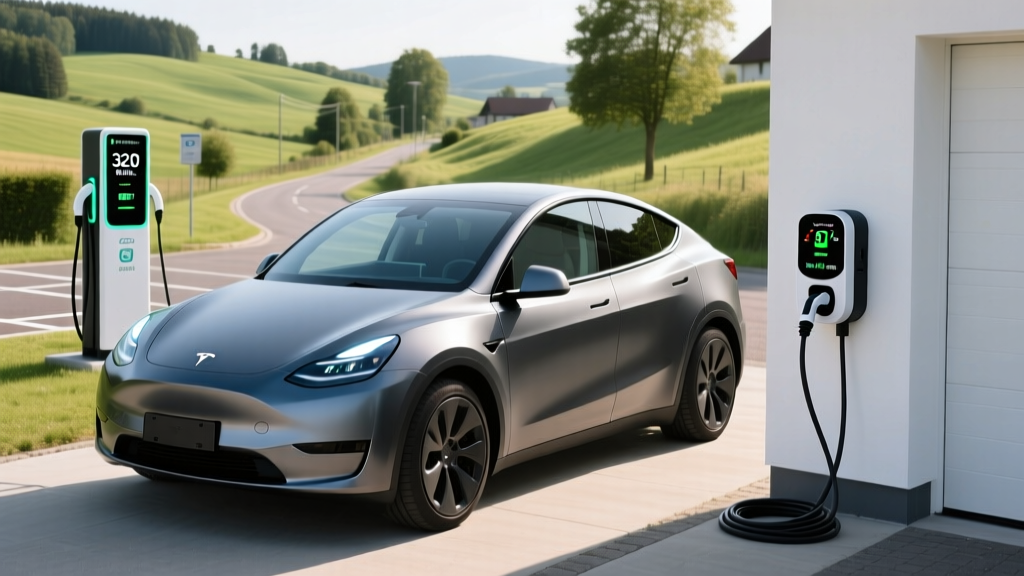
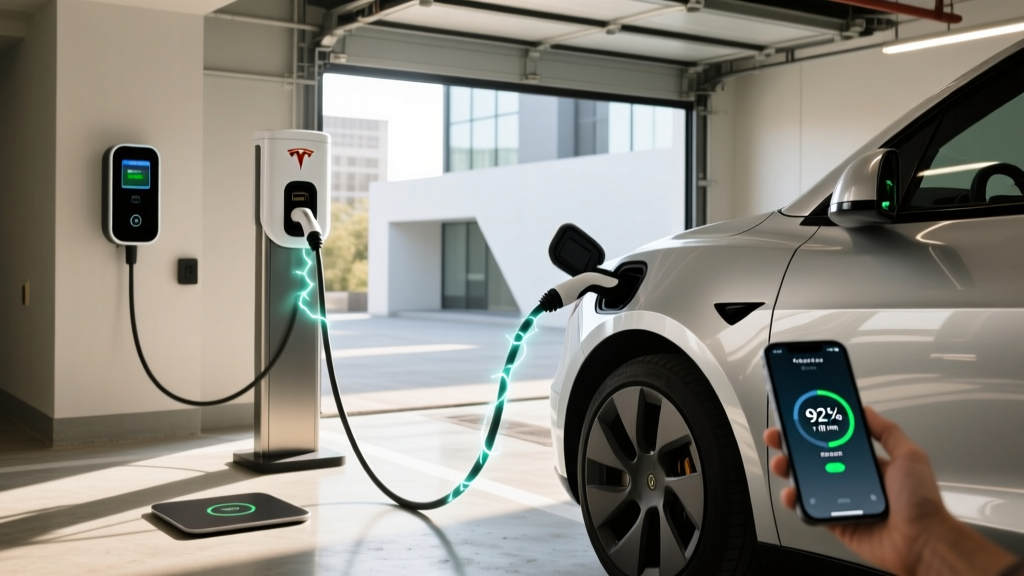
For daily driving, a home Level 2 charger is the backbone of Mercedes-Benz EV ownership. Here is what a typical installation involves:
Electrical requirements:
- A dedicated 240V circuit on your electrical panel
- Most Mercedes-Benz EVs accept up to 9.6 kW on Level 2 AC, which requires a 50-amp circuit (40 amps continuous draw)
- Some chargers and future models may support 11.5 kW, requiring a 60-amp circuit (48 amps continuous)
- NEMA 14-50 outlet (for portable/plug-in chargers) or hardwired connection (for higher-amperage units)
| Component | Typical Cost Range | Notes |
|---|---|---|
| Level 2 Charger (equipment) | $400–$800 | Smart Wi-Fi-enabled units; see recommendations below |
| Electrician labor | $500–$2,000 | Depends on panel-to-garage distance, conduit runs, wall material |
| Electrical permit | $50–$200 | Required in most jurisdictions; ensures code compliance |
| Panel upgrade (if needed) | $1,500–$4,000 | Needed if your panel is 100A or at capacity; upgrading to 200A is common |
| Total (no panel upgrade) | $950–$3,000 | Most homes with 200A service |
| Total (with panel upgrade) | $2,450–$7,000 | Older homes with 100A or 150A panels |
Safety and code considerations:
- The circuit must be dedicated — no sharing with other appliances
- A GFCI breaker is required by the 2023 NEC for EV outlets in garages (some jurisdictions have adopted this; confirm locally)
- Outdoor installations require a charger rated NEMA 4 or NEMA 4X for weather resistance
- Hardwired installations avoid the NEMA 14-50 receptacle, which has been associated with thermal issues under sustained high-load EV charging — many electricians now recommend hardwired for 48A+ circuits
- Always pull a permit and schedule inspection; unpermitted work can void homeowner's insurance claims
Connector Compatibility: NACS, CCS1, and What Your Mercedes-Benz Needs
The connector landscape shifted dramatically in 2024–2025 when most automakers, including Mercedes-Benz, committed to adopting the North American Charging Standard (NACS) — the Tesla-designed connector — on future vehicles. Here is where things stand for 2026:
| Model / Platform | Built-in Connector | Tesla Supercharger Access | Adapter Needed? |
|---|---|---|---|
| 2022–2026 EQS, EQE, EQB (current gen) | CCS1 | Yes (via adapter) | CCS-to-NACS adapter (~$200–$250) |
| 2026+ MMA platform (new CLA EV, upcoming models) | NACS (native) | Yes (native) | None for Tesla; NACS-to-CCS adapter for older CCS stations |
| All models at Mercedes-Benz High-Power stations | Both CCS1 and NACS available | N/A | None |
If you own a current-generation EQS or EQE with a CCS1 port, you can access Tesla Supercharger V3 and V4 stalls using a CCS-to-NACS adapter. Mercedes-Benz has offered these adapters through its accessories channel, and third-party options from brands like Lectron and A2Z are also available. For DC fast charging at CCS-native networks (Electrify America, EVgo, Mercedes-Benz High-Power), no adapter is needed.
CHAdeMO, the older Japanese DC standard used by the Nissan Leaf, is effectively discontinued for new vehicles and is irrelevant for Mercedes-Benz owners.
Cost to Charge: Per-Mile Electricity vs. Gasoline
One of the strongest ownership arguments for a Mercedes-Benz EV is the per-mile fuel cost. Here is a realistic comparison using the 2026 EQS 450+ sedan (rated at approximately 97 MPGe combined, or roughly 34 kWh/100 miles per fueleconomy.gov):
| Scenario | Rate | Cost Per Mile (EQS EV) | Cost Per Mile (S 500 Gas, 24 MPG combined) |
|---|---|---|---|
| Home charging (off-peak utility rate) | $0.13/kWh | $0.044 | — |
| Home charging (avg US residential) | $0.17/kWh | $0.058 | — |
| Public Level 2 (workplace/retail) | $0.25/kWh | $0.085 | — |
| DC Fast Charging (Mercedes-Benz HPC) | $0.42/kWh | $0.143 | — |
| Gasoline (S 500, premium) | $4.10/gal | — | $0.171 |
Even at DC fast-charging rates, the EQS undercuts the gasoline S 500 on a per-mile basis. With home off-peak charging — which most owners use for 80%+ of their charging — the cost advantage is roughly 4:1. Over 15,000 miles per year, home-charging the EQS costs approximately $660–$870, while fueling the S 500 costs roughly $2,560 at $4.10/gallon premium.
Some utilities offer dedicated EV time-of-use (TOU) rates as low as $0.08–$0.10/kWh during overnight hours (typically 11 PM – 6 AM), further widening the gap. Check with your local utility for EV-specific rate plans.
Recommended Home Level 2 Chargers for Mercedes-Benz EVs
Based on compatibility, build quality, smart features, and real-world reliability, here are our top Level 2 charger picks for Mercedes-Benz EQ owners:
ChargePoint Home Flex
- Power: Up to 12 kW (50A circuit) / configurable down to 16A
- Connector: J1772 (CCS-compatible for AC charging)
- Cable length: 23 feet
- Smart features: Wi-Fi, app scheduling, Alexa, energy tracking
- Price: ~$550–$650
- Best for: Flexible amperage for homes with limited panel capacity
Wallbox Pulsar Plus
- Power: Up to 11.5 kW (48A, 60A circuit)
- Connector: J1772
- Cable length: 25 feet
- Smart features: Wi-Fi + Bluetooth, app control, power-sharing between two units
- Price: ~$500–$600
- Best for: Compact size, dual-charger garages
Emporia Level 2 EV Charger
- Power: Up to 11.5 kW (48A)
- Connector: J1772
- Cable length: 24 feet
- Smart features: Wi-Fi, energy monitoring, integrates with Emporia home energy system
- Price: ~$400–$500
- Best for: Budget-conscious buyers who want smart energy monitoring
Tesla Wall Connector (with J1772 adapter)
- Power: Up to 11.5 kW (48A)
- Connector: NACS native (use with J1772 adapter for CCS-port Mercedes)
- Cable length: 24 feet
- Smart features: Wi-Fi, OTA updates, power-sharing
- Price: ~$450 (charger) + ~$50 (adapter)
- Best for: Mixed households with Tesla + Mercedes-Benz EVs
All of these chargers deliver enough power to fully replenish a Mercedes-Benz EQE or EQS battery overnight (8–12 hours from near-empty). Since most daily driving uses 30–60 miles, a nightly top-up on any of these units takes 1–3 hours.
Maximizing Your Mercedes-Benz Charging Experience
A few practical tips drawn from real-world ownership:
- Always precondition before DC charging. Navigate to the charger using MBUX. The car will warm or cool the battery to optimal temperature, which can shave 10–15 minutes off a 10–80% session in cold weather.
- Set charge limits for daily use. Mercedes-Benz recommends charging to 80% SoC for daily driving to extend long-term battery health. Use the 100% setting only for road trips.
- Leverage Mercedes me Charge. The integrated service aggregates billing across Electrify America, EVgo, ChargePoint, and the Mercedes-Benz High-Power Network into a single account with Plug & Charge at supported stations.
- Monitor your charge curve. If you notice sustained DC charging speeds well below the rated peak, check for battery temperature warnings in the MBUX display, and ensure the station is delivering its full rated output (some shared-power stations split kW between two stalls).
The IRS §30D federal tax credit of up to $7,500 may apply to new Mercedes-Benz EV purchases, though eligibility depends on MSRP caps ($55,000 for sedans, $80,000 for SUVs/vans), buyer income limits, and battery critical-mineral sourcing requirements. Additionally, the Alternative Fuel Infrastructure Tax Credit (§30C) was extended and can cover up to $1,000 of home charger equipment and installation costs for qualifying taxpayers — consult a tax professional for your specific eligibility.
Frequently Asked Questions
How much does it cost to install a home EV charger for my Mercedes-Benz?
For a typical home with a 200-amp electrical panel, expect $950–$3,000 total (charger + electrician + permit). If your home has an older 100-amp panel that needs upgrading to 200 amps, total costs can reach $2,450–$7,000. Always get a load calculation from a licensed electrician before committing.
How fast will each charging level add range to a Mercedes-Benz EV?
Level 1 (120V) adds roughly 3–5 miles per hour — essentially useless for daily needs but fine for emergencies. Level 2 (240V) adds 20–44 miles per hour depending on the charger's amperage and the car's onboard charger. DC fast charging at a Mercedes-Benz High-Power station can add 180+ miles in 15 minutes at peak rate, though sustained speeds taper above 50% SoC.
Which connector does my Mercedes-Benz EV use, and do I need an adapter?
Current-generation EQ models (EQS, EQE, EQB through 2025–2026) use CCS1. Newer MMA-platform models (starting with the 2026 CLA EV) use NACS natively. If you have a CCS1-equipped Mercedes, you'll need a CCS-to-NACS adapter (~$200–$250) to use Tesla Superchargers. Mercedes-Benz High-Power stations offer both CCS1 and NACS connectors, so no adapter is needed there.
How much does charging cost per mile vs. gasoline?
Charging a Mercedes-Benz EQS at home on an average US electricity rate of $0.17/kWh costs roughly $0.058 per mile. Fueling a comparable gasoline S 500 at $4.10/gallon premium costs about $0.171 per mile — nearly three times more. Even DC fast charging at $0.42/kWh ($0.143/mile) undercuts gasoline.
What electrical upgrades might I need for a home charger?
The most common upgrade is a panel replacement from 100A to 200A service ($1,500–$4,000). Other potential needs include: running new conduit from the panel to the garage (adds $500–$1,500 if the distance is long), upgrading from a NEMA 14-50 receptacle to a hardwired connection for higher-amperage chargers, and adding a GFCI breaker to meet current NEC code. Your electrician will identify these during the initial assessment.