If you own or are shopping for a Mercedes-Benz EV in 2026, understanding the Mercedes-Benz charging network—along with your home and public charging options—is critical to making the ownership experience seamless. This guide covers the full charging ecosystem for current EQ models (EQA, EQB, EQE Sedan, EQE SUV, EQS Sedan, EQS SUV), from Level 1 trickle charging to the expanding Mercedes-Benz High Power Charging network, with exact numbers on costs, speeds, and electrical requirements.
Understanding EV Charging Levels: Speeds in kW and Miles Per Hour
Before diving into the Mercedes-Benz charging network specifics, you need a firm grasp of the three charging levels. The distinction between kW (kilowatts) and kWh (kilowatt-hours) is the single most important EV literacy point: kW measures the rate of power delivery (like water pressure from a hose), while kWh measures total energy stored in your battery (like the size of the tank). A 100 kWh battery charged at 10 kW takes 10 hours; charged at 100 kW, it takes roughly 1 hour.
| Level | Voltage | Max Power (kW) | Miles Added/Hour | Typical Use |
|---|---|---|---|---|
| Level 1 | 120V AC | 1.4–1.9 kW | 3–5 mi/hr | Overnight trickle, emergency top-up |
| Level 2 | 240V AC | 7.2–19.2 kW | 20–60 mi/hr | Home daily charging, workplace |
| DC Fast | 400–800V DC | 50–350+ kW | 150–600+ mi/hr | Road trips, rapid top-ups |
For a Mercedes-Benz EQS 450+ with its 108.4 kWh usable battery, Level 1 charging adds roughly 4 miles per hour—meaning a full charge from empty would take over 26 hours. Level 2 at 11 kW (the onboard charger limit for most EQ models) adds about 33 miles per hour, filling the pack in roughly 10 hours. DC fast charging at the EQS's peak rate of 200 kW can take the battery from 10% to 80% in approximately 31 minutes, according to Mercedes-Benz USA specifications.
The Mercedes-Benz Charging Network: High Power Charging Hubs
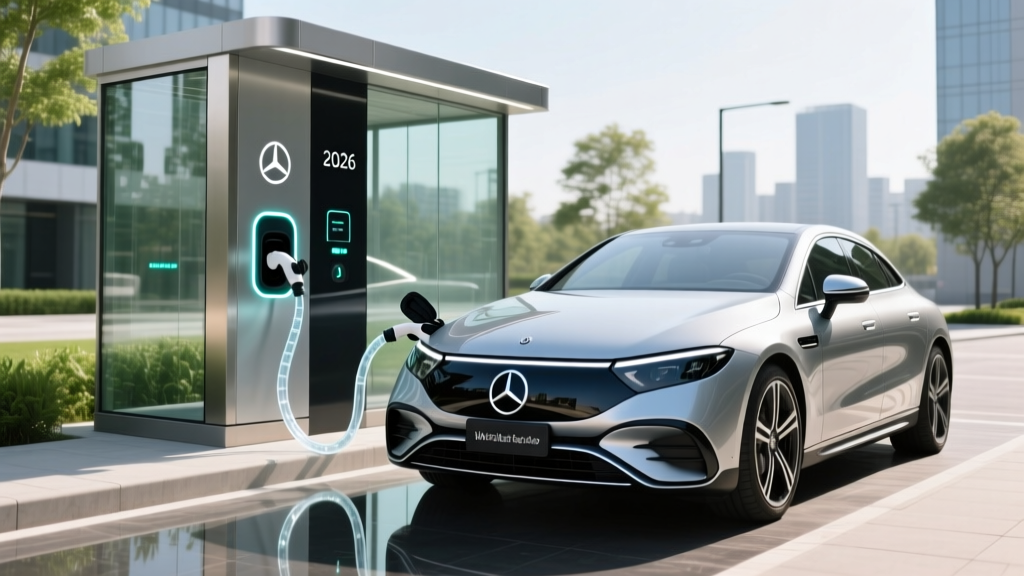
Mercedes-Benz has been rolling out its proprietary High Power Charging (HPC) network across North America since 2023, with significant expansion through 2025 and into 2026. These hubs feature chargers capable of delivering up to 400 kW via liquid-cooled cables, though your actual charge rate depends on your vehicle's onboard acceptance rate.
As of early 2026, the Mercedes-Benz HPC network includes locations in major metropolitan areas including Atlanta, Los Angeles, the Bay Area, Washington D.C., and expanding into the Midwest and Southeast. Hubs are strategically placed near Mercedes-Benz dealerships and high-traffic corridors. Key features include:
- NACS connectors (Tesla-style) as the standard, following Mercedes-Benz's adoption of the North American Charging Standard for 2025+ model-year vehicles
- CCS1 connectors still available at many stations for 2024 and earlier EQ models
- Plug & Charge functionality for Mercedes me-connected vehicles—no app or RFID card needed
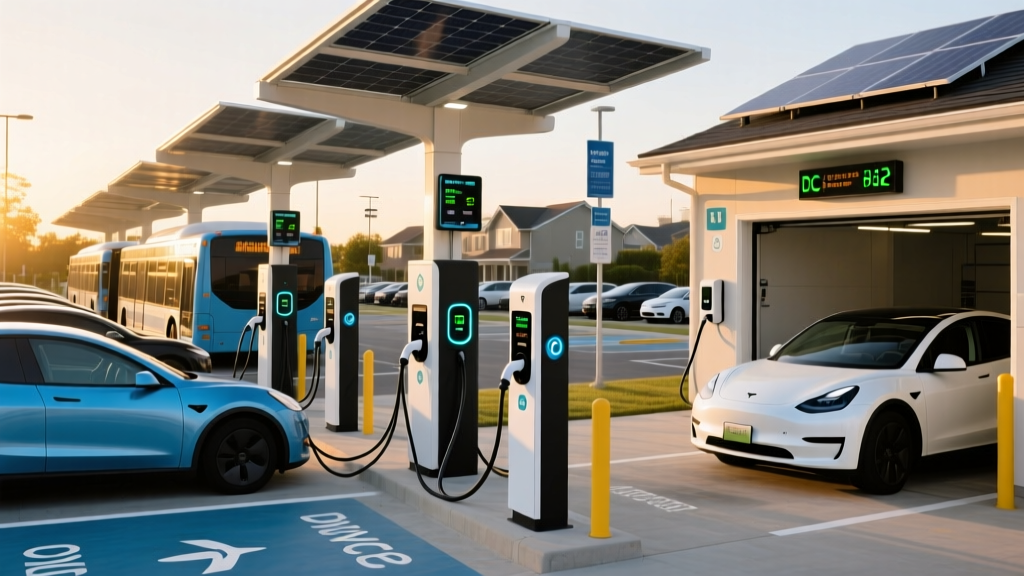
- Solar canopies at select flagship locations, reducing grid dependency
- Reservable charging slots via the Mercedes me app at premium locations
Non-Mercedes EVs can use these stations, but Mercedes owners receive preferential pricing and reservation access. Expect pricing in the range of $0.35–$0.48/kWh at HPC hubs, depending on location and time of day.
Home Charger Installation: Electrical Requirements and Costs
Home charging is where most Mercedes-Benz EV owners do 80% or more of their charging. Installing a Level 2 home charger requires a dedicated 240V circuit, typically at 40A or 50A, depending on the charger's maximum output.
Electrical Requirements for Mercedes-Benz Home Charging
Most EQ models have an 11 kW onboard AC charger, which means they can accept up to approximately 48A on a 240V circuit. However, the National Electrical Code (NEC) requires that continuous loads (like EV charging) use no more than 80% of a circuit's rated capacity. So a 48A charge rate requires a 60A breaker and circuit. Many homeowners opt for a 40A circuit (delivering up to 32A / 7.7 kW), which is sufficient for overnight charging and easier on older electrical panels.
Panel upgrade reality: Homes built before 2000 often have 100A or 150A main service panels. Adding a 60A EV circuit may exceed available capacity, especially if you also run central AC, an electric oven, and a dryer. A panel upgrade from 100A to 200A typically costs $1,500–$3,500. Homes with 200A service usually have sufficient headroom. Always have a licensed electrician perform a load calculation before committing to a circuit size.
| Component | Low Estimate | High Estimate | Notes |
|---|---|---|---|
| Level 2 Charger (hardware) | $400 | $800 | 40A–48A smart charger |
| Electrical panel upgrade | $0 | $3,500 | Only if 100A→200A needed |
| Dedicated 240V circuit + wiring | $600 | $2,000 | Depends on run length from panel |
| Permit and inspection | $100 | $400 | Varies by municipality |
| Electrician labor | $500 | $1,500 | 2–6 hours typical |
| Total (no panel upgrade) | $1,600 | $4,700 | Most homes with 200A service |
| Total (with panel upgrade) | $3,100 | $8,200 | Older homes with 100A service |
The IRS Residential Clean Energy Credit (IRC §25C) covers 30% of home EV charger hardware and installation costs up to $1,000 through 2032—confirm eligibility with a tax professional, as income and location-based restrictions apply.
Connector Compatibility: NACS, CCS1, and Adapter Requirements
The connector landscape shifted dramatically in 2024–2025 when Mercedes-Benz, along with most major automakers, adopted the NACS (North American Charging Standard) connector—originally developed by Tesla—for new vehicles. Here's what that means for your EQ model:
| Model Year | Built-in Connector | Tesla Supercharger Access | CCS Network Access | Adapter Needed? |
|---|---|---|---|---|
| 2025–2026 EQ models | NACS | Native (no adapter) | NACS-to-CCS adapter required | CCS adapter (~$200–$350) |
| 2022–2024 EQ models | CCS1 | CCS-to-NACS adapter required | Native (no adapter) | NACS adapter (~$200–$300) |
Mercedes-Benz offers an official NACS-to-CCS adapter through its accessories channel, and third-party options from brands like Lectron and A2Z are available. For 2025+ EQ owners with native NACS ports, the CCS adapter is important if you plan to use Electrify America or older ChargePoint stations that haven't yet added NACS cables.
CHAdeMO, the legacy Japanese DC fast-charging standard, is effectively obsolete for Mercedes-Benz owners. No EQ model has ever used CHAdeMO, and new installations of CHAdeMO connectors have nearly ceased.
Cost to Charge: Home vs. Public vs. DC Fast Charging
Charging economics depend heavily on where and when you plug in. Here's a realistic breakdown for a Mercedes-Benz EQS 450+ (108.4 kWh battery, EPA-estimated 390 miles of range):
| Scenario | $/kWh | Full Charge Cost | Cost/Mile | Annual (12k mi) |
|---|---|---|---|---|
| Home (off-peak utility rate) | $0.12 | $13.01 | $0.033 | $400 |
| Home (average US rate) | $0.17 | $18.43 | $0.047 | $568 |
| Mercedes HPC hub (DC fast) | $0.42 | $45.53 | $0.117 | $1,402 |
| Electrify America / public DC | $0.48 | $52.03 | $0.133 | $1,601 |
| Gas equivalent (25 MPG, $3.40/gal) | — | $14.79* | $0.136 | $1,632 |
*Per-gallon equivalent energy cost for comparison. A gallon of gasoline contains ~33.7 kWh of energy.
Home charging at off-peak rates delivers by far the lowest cost per mile—roughly one-quarter the cost of gasoline. Even public DC fast charging at premium rates roughly matches the cost of gas for a vehicle of this size. The key takeaway: if you can charge at home, an EQ model will save you $1,000–$1,200 annually on fuel compared to a comparable S-Class with a turbocharged inline-six.
Charging Time Examples for Mercedes-Benz EQ Models
Real-world charging times vary based on battery size, state of charge, ambient temperature, and the charger's actual output. The figures below assume optimal conditions (battery preconditioned, moderate ambient temperature):
- EQB 350 4MATIC (66.5 kWh battery, 200 kW peak DC): 10–80% in ~32 minutes at a 200+ kW charger; 0–100% on Level 2 (11 kW) in ~6.5 hours
- EQE 350+ Sedan (90.6 kWh battery, 170 kW peak DC): 10–80% in ~32 minutes at a 170+ kW charger; 0–100% on Level 2 in ~9 hours
- EQS 450+ Sedan (108.4 kWh battery, 200 kW peak DC): 10–80% in ~31 minutes at a 200+ kW charger; 0–100% on Level 2 in ~10.5 hours
- EQS 580 SUV 4MATIC (108.4 kWh battery, 200 kW peak DC): 10–80% in ~33 minutes; heavier vehicle means slightly longer sustain times
Charging curve reality: Peak kW rates are only sustained between roughly 10–40% state of charge. Above 50%, the rate tapers significantly. Above 80%, charging slows dramatically to protect battery longevity—often dropping below 50 kW. This is why manufacturers quote 10–80% times rather than 0–100%. On a road trip, plan to charge from 10–80% and move on rather than waiting for the last 20%, which can take as long as the first 70%.
Cold weather (below 32°F / 0°C) can increase charging times by 25–40% if the battery isn't preconditioned. Always use the Mercedes me app to set a departure time and precondition the battery before arriving at a DC fast charger.
Recommended Home Charging Equipment for Mercedes-Benz EVs
The following Level 2 chargers are well-suited for Mercedes-Benz EQ models, selected for reliability, power output, smart features, and build quality:
ChargePoint Home Flex (NACS)
- Power: Up to 12 kW (50A circuit, 40A delivery) on 240V
- Connector: NACS (also available in J1772 with adapter)
- Cable length: 23 feet
- Smart features: Wi-Fi, scheduling, energy tracking, Alexa integration
- Price: ~$649
- Best for: Most EQ owners; adjustable amperage from 16A–50A to match your circuit
Wallbox Pulsar Plus (NACS)
- Power: Up to 11.5 kW (48A delivery on 60A circuit)
- Connector: NACS (2025+ version)
- Cable length: 25 feet
- Smart features: Wi-Fi + Bluetooth, load balancing, Power Sharing for dual-charger setups
- Price: ~$599
- Best for: Homes with limited panel capacity; Power Sharing lets two chargers share one circuit
Mercedes-Benz Wallbox (OEM)
- Power: Up to 11 kW (48A on 60A circuit)
- Connector: NACS (2025+ models)
- Cable length: 20 feet
- Smart features: Mercedes me integration, Plug & Charge, RFID
- Price: ~$799 (often discounted through dealerships)
- Best for: Owners who want seamless app integration and brand-matched aesthetics
For homes with a 40A circuit (the most common installation), any of these chargers will deliver 7.7–9.6 kW—more than enough to fully recharge any EQ model overnight. The ChargePoint Home Flex's adjustable amperage makes it the most versatile if you move or upgrade your panel later.
Safety and Electrical Code Considerations
EV charger installation isn't a DIY project. Here's what your licensed electrician must address:
- Dedicated circuit: Your Level 2 charger must have its own dedicated breaker—no sharing with other outlets or appliances
- GFCI protection: NEC 2020 and later require GFCI (Ground Fault Circuit Interrupter) protection for all EV charging outlets. Many modern chargers have built-in GFCI; confirm compatibility with your electrician to avoid nuisance tripping
- Outdoor rating: If installing outdoors, the charger must carry a NEMA 4 (or higher) weather-resistance rating. All three chargers recommended above are outdoor-rated
- Wire gauge: A 50A circuit requires 6 AWG copper wire; a 60A circuit requires 4 AWG. Longer wire runs may need larger gauge to prevent voltage drop
- Permit and inspection: Virtually all jurisdictions require an electrical permit and post-installation inspection. Unpermitted work can void home insurance and create liability issues
- Hardwired vs. plug-in: Hardwired installations (no NEMA 14-50 outlet) are generally preferred for circuits above 40A, as high-amperage receptacles are a known failure point if not torqued to spec
According to NHTSA and the National Fire Protection Association, properly installed EV chargers carry extremely low fire risk—but unpermitted or DIY installations with undersized wiring or improper connectors are the primary source of EV charging-related electrical incidents.
Frequently Asked Questions
How much does it cost to install a home EV charger for my Mercedes-Benz?
Expect $1,600–$4,700 for a standard installation in a home with adequate 200A panel capacity, including the charger hardware ($400–$800), wiring and labor ($1,100–$3,500), and permit fees ($100–$400). If your home has an older 100A panel and needs an upgrade to 200A, add $1,500–$3,500, bringing the total to $3,100–$8,200. Always get a load calculation from a licensed electrician before committing.
How fast will each charging level add range to my EQ model?
Level 1 (120V) adds roughly 3–5 miles per hour—usable only for overnight trickle or emergencies. Level 2 (240V) at 11 kW adds approximately 30–35 miles per hour for an EQS, fully recharging overnight. DC fast charging at 200 kW adds 150–200+ miles in 15–20 minutes, depending on state of charge and battery temperature.
Which connector is compatible with my Mercedes-Benz EV?
2025 and 2026 model-year EQ vehicles use the NACS connector natively. Model years 2022–2024 use CCS1. If you have a 2025+ NACS vehicle and need to use a CCS-only public charger, you'll need a NACS-to-CCS adapter ($200–$350). Older CCS1 vehicles need a CCS-to-NACS adapter to use Tesla Superchargers or newer NACS stations.
How much does charging cost per mile compared to gasoline?
Home charging at average US electricity rates ($0.17/kWh) costs approximately $0.04–$0.05 per mile in an EQS—about one-third the cost of gasoline for a comparable luxury sedan. Public DC fast charging at $0.42–$0.48/kWh costs roughly $0.12–$0.13 per mile, which is comparable to gasoline at current prices. The savings multiply if you have access to off-peak utility rates or solar panels.
What electrical upgrades might I need before installing a home charger?
The most common upgrade is a panel replacement from 100A to 200A service ($1,500–$3,500), required when your existing panel lacks capacity for a dedicated 40A–60A circuit. Some homes may also need a service lateral upgrade from the utility ($2,000–$5,000 in rare cases). Homes with 200A or larger panels typically need only a new dedicated circuit. See the Department of Energy's home charging guide for additional details.
Can I use Tesla Superchargers with my Mercedes-Benz EV?
Yes, if you have a 2025 or newer EQ model with a native NACS port, you can use Tesla Superchargers directly—no adapter required. For 2022–2024 EQ models with CCS1 ports, you'll need a CCS-to-NACS adapter. Mercedes-Benz has confirmed Supercharger compatibility through the Mercedes me app, which can route you to available Supercharger stalls.
Does the Mercedes-Benz charging network offer free charging?
Mercedes-Benz has periodically offered complimentary charging credits with new EQ vehicle purchases—typically 2,000–3,000 kWh of free charging on partner networks. As of 2026, check with your dealer for current promotional offers. The Mercedes-Benz HPC network itself charges market rates ($0.35–$0.48/kWh), with Mercedes owners receiving a small discount and reservation priority.