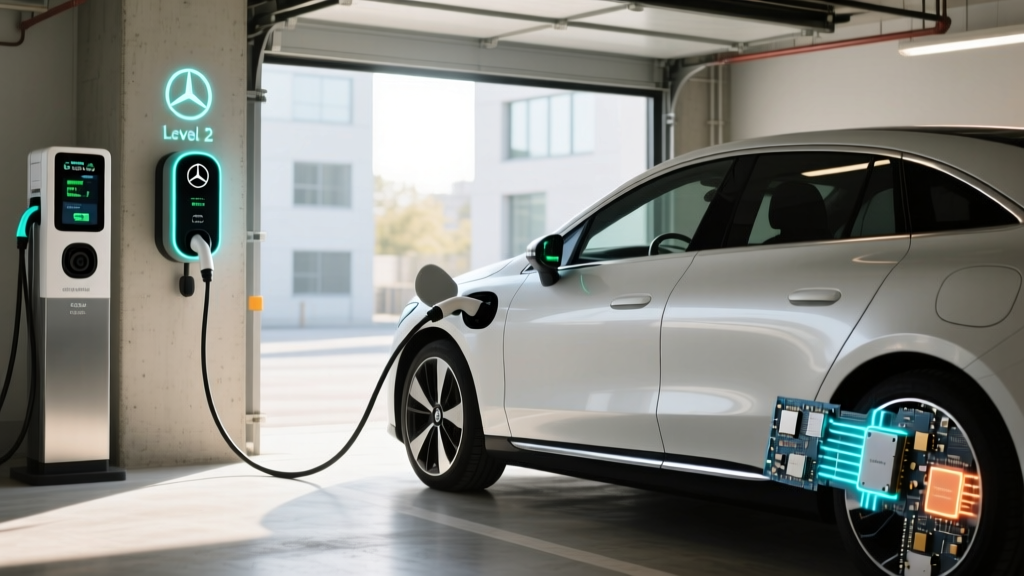
Owning a Mercedes-Benz electric vehicle — whether it's an EQS sedan, EQE SUV, or the upcoming MMA-based compact — requires a clear charging strategy. The luxury EV lineup carries large battery packs (90–107.8 kWh usable), which means Level 2 home charging is essentially mandatory if you want to wake up with a full battery. Public DC fast charging fills the gaps on road trips, but connector compatibility is shifting fast as Mercedes-Benz transitions from CCS1 to NACS (Tesla's connector) across its EV fleet.
This guide breaks down exactly what you need: charging speeds in kilowatts (kW) and miles added per hour, home installation requirements and real costs, connector compatibility by model year, what you'll actually pay per mile, and the specific wall chargers that pair best with a Mercedes-Benz EV.
Mercedes-Benz EV Lineup: Battery Sizes and Charging Specs
Before sizing a charger, you need to know what's behind the badge. Here's how the current and recently updated Mercedes-Benz EQ lineup stacks up on battery capacity and onboard charger ratings:
| Model | Battery (usable kWh) | Onboard AC Charger | Peak DC Rate | 10–80% DC Time |
|---|---|---|---|---|
| EQS Sedan (2025–2026) | 107.8 kWh (NMC) | 9.6 kW / 22 kW option | 200 kW | ~31 min |
| EQS SUV (2025–2026) | 107.8 kWh (NMC) | 9.6 kW / 22 kW option | 200 kW | ~31 min |
| EQE Sedan (2025–2026) | 90.6 kWh (NMC) | 9.6 kW / 22 kW option | 170 kW | ~32 min |
| EQE SUV (2025–2026) | 90.6 kWh (NMC) | 9.6 kW / 22 kW option | 170 kW | ~32 min |
| EQB (2025–2026) | 66.5 kWh (NMC) | 9.6 kW | 100 kW | ~32 min |
Key takeaway: Every current Mercedes-Benz EQ model comes standard with a 9.6 kW onboard AC charger. That means a 40-amp Level 2 circuit (delivering up to 9.6 kW) is the minimum you should install to fully utilize the car's AC charging capability. Models equipped with the optional 22 kW onboard charger benefit from a 60-amp / 14.4 kW home circuit, though 22 kW home chargers are rare in residential settings.
Charging Levels Explained: Speeds for Mercedes-Benz EVs
Understanding the difference between kilowatts (kW — the rate of power delivery) and kilowatt-hours (kWh — the energy stored in your battery) is essential. Think of kW as the diameter of a hose and kWh as the size of the bucket you're filling. Here's how each level performs with a Mercedes-Benz EV:
| Level | Power (kW) | Miles of Range Added/Hour | Use Case |
|---|---|---|---|
| Level 1 (120V / 12A) | ~1.4 kW | ~3–5 mi/hr | Emergency / overnight trickle only |
| Level 2 (240V / 40A) | 9.6 kW | ~25–35 mi/hr | Primary home charging |
| Level 2 (240V / 48A) | 11.5 kW | ~30–40 mi/hr | Faster home charging (capped at 9.6 kW by most EQ models) |
| DC Fast (150–200 kW) | Up to 200 kW peak | ~180–250 mi in 30 min | Road trips, highway corridors |
Real-world charging time example: An EQS Sedan with a 107.8 kWh battery charging on a 9.6 kW Level 2 circuit needs roughly 11.2 hours to go from 0–100%. If you drive 40 miles daily (consuming ~12 kWh), you only need about 1.25 hours of Level 2 charging to replenish that usage. Level 1, by contrast, would require 8–9 hours just to recover 40 miles of range — making it impractical as a daily solution for these large-battery vehicles.
Home Charger Installation: Electrical Requirements and Real Costs
Installing a dedicated Level 2 home charger for a Mercedes-Benz EV involves more than plugging into an outlet. Here's what the electrical work actually requires and what you should budget.
Electrical Requirements
- Voltage/Amperage: 240V dedicated circuit, minimum 50-amp breaker (for a 40A continuous-load charger) or 60-amp breaker (for a 48A charger)
- Wire gauge: 6 AWG copper for 50A circuits; 4 AWG for 60A circuits (NEC 80% continuous-load rule applies)
- Dedicated circuit: The charger must be on its own breaker — no shared circuits with dryers, ovens, or HVAC
- GFCI protection: Required by NEC 2020+ for EV outlets (625.54); hardwired units may require GFCI breaker depending on local code
- Outdoor rating: If mounted outside or in an unconditioned garage, the charger must carry a NEMA 4 or NEMA 4X rating
Panel Upgrade Considerations
Most Mercedes-Benz EQ owners will need a 200-amp electrical panel minimum. If your home has a 100-amp panel (common in pre-1990 construction), adding a 50-amp EV circuit may require a panel upgrade to 200A — or even a service upgrade from the utility. A licensed electrician will perform a load calculation (NEC Article 220) to determine if your panel can handle the additional draw.
Installation Cost Breakdown
| Component | Typical Cost Range | Notes |
|---|---|---|
| Level 2 Charger (hardware) | $400 – $800 | Smart Wi-Fi chargers; see equipment picks below |
| Electrician labor (standard install) | $600 – $1,800 | Short run from panel; no panel upgrade |
| Electrician labor (long run/conduit) | $1,500 – $3,500 | Detached garage, long wire runs, trenching |
| Electrical permit | $50 – $350 | Varies by municipality |
| Panel upgrade (100A → 200A) | $1,500 – $4,000 | Only if needed; older homes |
| Utility service upgrade | $3,000 – $8,000+ | Rare; only for very old or undersized service |
Total typical install (no panel upgrade): $1,000 – $2,600
Total with panel upgrade: $2,500 – $6,600+
Always get at least two quotes from licensed electricians and confirm they pull a permit. Unpermitted work can void homeowners insurance and create fire-code liability. Check whether your utility offers rebates for Level 2 installations — many utilities cover $250–$500 of the equipment or labor cost.
Connector Compatibility: NACS vs CCS1 for Mercedes-Benz EVs
The connector landscape is shifting, and Mercedes-Benz is in the middle of a transition. Here's where each model stands:
| Connector | Mercedes-Benz Models | Adapter Needed? | Network Access |
|---|---|---|---|
| CCS1 (Combined Charging System) | All EQ models through 2025 model year | NACS-to-CCS adapter for Tesla Superchargers | Electrify America, EVgo, ChargePoint, Ionity (Europe) |
| NACS (Tesla standard) | Expected on redesigned models from 2026 MY onward (MMA platform) | CCS-to-NACS adapter for legacy CCS stations | Tesla Supercharger network + CCS networks via adapter |
| CHAdeMO | Not used by Mercedes-Benz | N/A | N/A — legacy standard, being phased out |
For current Mercedes-Benz EQ owners (2024–2025 models): Your vehicle has a CCS1 port. You can charge natively at Electrify America, EVgo, and ChargePoint DC fast stations. To access Tesla Superchargers, you'll need a NACS-to-CCS adapter — Mercedes-Benz has indicated compatibility with approved adapters, and third-party options from Lectron and A2Z are available for $150–$250. Always verify adapter firmware compatibility with your specific model year.
For upcoming MMA-platform vehicles (2026+): These are expected to ship with native NACS ports, giving direct Supercharger access. You'll need a CCS-to-NACS adapter only when using older Electrify America or EVgo stations that haven't added NACS cables yet.
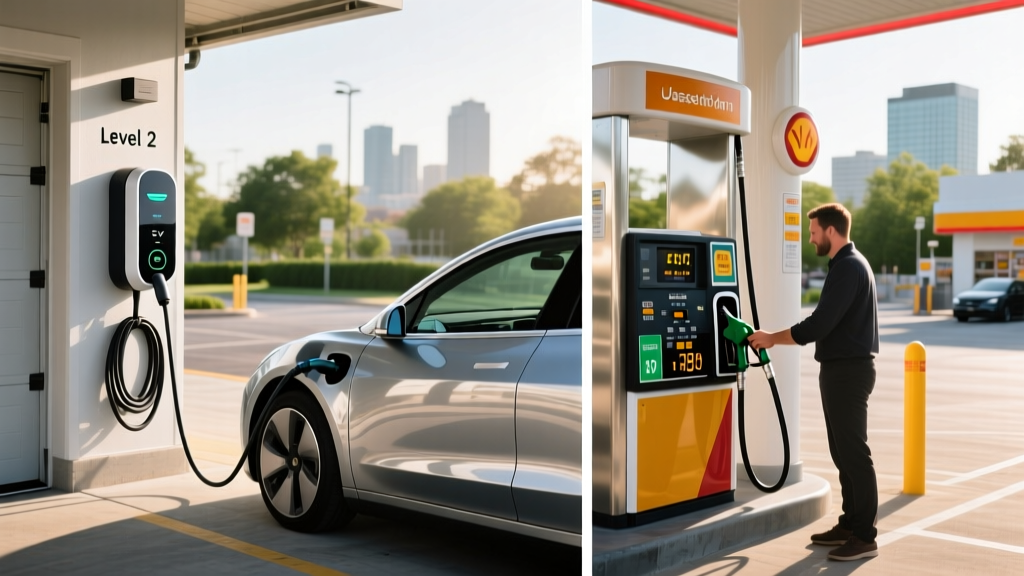
Cost to Charge: Home vs Public vs Gas Comparison
Mercedes-Benz EQ vehicles are large, heavy luxury EVs — efficiency typically ranges from 2.5 to 3.5 miles per kWh depending on the model, driving style, and weather. Here's how charging costs compare across scenarios, using the EQS Sedan (~3.0 mi/kWh combined) as the baseline:
| Charging Scenario | Rate ($/kWh) | Cost for 300 mi | Cost per Mile |
|---|---|---|---|
| Home (off-peak utility rate) | $0.08 – $0.13 | $8.00 – $13.00 | $0.027 – $0.043 |
| Home (standard residential rate) | $0.14 – $0.18 | $14.00 – $18.00 | $0.047 – $0.060 |
| Public Level 2 (ChargePoint, etc.) | $0.25 – $0.49 | $25.00 – $49.00 | $0.083 – $0.163 |
| DC Fast (Electrify America / EVgo) | $0.35 – $0.56 | $35.00 – $56.00 | $0.117 – $0.187 |
| Tesla Supercharger (with adapter) | $0.25 – $0.36 | $25.00 – $36.00 | $0.083 – $0.120 |
| Gas equivalent (S-Class, 22 MPG, $3.50/gal) | — | $47.73 | $0.159 |
The bottom line: Home charging at off-peak rates is roughly 70–80% cheaper per mile than fueling a comparable gas-powered S-Class. Even DC fast charging at the high end ($0.56/kWh) is competitive with or slightly below gasoline on a per-mile basis. The economics only work if you charge at home most of the time — relying exclusively on public DC fast charging erases much of the cost advantage.
Mercedes-Benz also offers Mercedes me Charge, which provides access to multiple public networks through a single account, often with negotiated rates lower than drive-up pricing. Check your myMercedes app for current pricing tiers in your area.
Recommended Home Chargers for Mercedes-Benz EVs
Given the 9.6 kW standard onboard charger across the EQ lineup, a 48-amp Level 2 charger is the sweet spot — it maxes out the car's AC charging capability while leaving headroom for the optional 22 kW onboard charger if equipped. Here are three tested picks:
ChargePoint Home Flex
- Power output: Up to 11.5 kW (48A, 240V) — adjustable down to 16A
- Connector: J1772 (CCS-compatible for AC charging)
- Cable length: 23 feet
- Smart features: Wi-Fi, app scheduling, energy tracking, Alexa integration
- Price: ~$699
- Best for: Most Mercedes-Benz EQ owners; flexible amperage lets you match your circuit
Emporia Level 2 EV Charger
- Power output: Up to 11.5 kW (48A, 240V)
- Connector: J1772
- Cable length: 24 feet
- Smart features: Wi-Fi, energy monitoring, solar integration, time-of-use scheduling
- Price: ~$399
- Best for: Budget-conscious buyers who want smart features; pairs well with solar panels
Wallbox Pulsar Plus
- Power output: Up to 11.5 kW (48A, 240V)
- Connector: J1772
- Cable length: 25 feet
- Smart features: Wi-Fi + Bluetooth, app control, Power Sharing (two chargers on one circuit)
- Price: ~$649
- Best for: Compact form factor; two-EV households using Power Sharing
Note on the Mercedes-Benz Wallbox: Mercedes-Benz offers its own branded Wallbox Home (manufactured by a third party) rated at up to 11 kW. It's a solid unit but typically priced at $800–$1,000 with no significant feature advantage over the ChargePoint or Wallbox Pulsar Plus. Unless you value the Mercedes branding on your garage wall, you'll save $100–$300 with an equivalent third-party unit.
Public Charging Strategy for Mercedes-Benz Owners
On road trips, your Mercedes-Benz EQ vehicle's DC fast charging capability determines how long you're stopped. Here's what to expect in practice:
DC fast charging curve reality: The "peak 200 kW" figure for the EQS only applies between roughly 10–30% state of charge. Above 50%, the rate tapers to ~100 kW; above 80%, it drops to ~50 kW or less. This is normal lithium-ion battery physics — the battery management system (BMS) throttles current to protect cell health and manage heat. A 10–80% charge in 31 minutes is the realistic benchmark, not 0–100%.
Preconditioning matters: If you set a DC fast charger as your navigation destination in the MBUX system, the vehicle will precondition the battery to the optimal temperature before arrival. In cold weather (below 40°F), preconditioning can cut your 10–80% time by 5–10 minutes compared to arriving with a cold battery. Always navigate to the charger rather than just driving there.
Network reliability: As of 2026, the most reliable DC fast networks for CCS-equipped Mercedes-Benz vehicles remain Electrify America (particularly their newer 350 kW stalls) and Tesla Superchargers (with a NACS-to-CCS adapter). According to fueleconomy.gov, the EQS Sedan achieves a combined MPGe of 97 (35 kWh/100mi), making it one of the more efficient large luxury EVs on the market.
Safety and Code Considerations
EV charging involves sustained high-current draw — often for 8–12 hours at a time. This is fundamentally different from intermittent loads like a dryer or oven. Here's what the National Electrical Code (NEC) and best practices require:
- Dedicated circuit: Your EV charger must be on a dedicated breaker. Sharing a circuit with other appliances creates tripping hazards and fire risk under continuous load.
- Continuous-load derating: The NEC defines EV charging as a continuous load (over 3 hours). A 40A charger requires a 50A breaker (40A × 125% = 50A). A 48A charger requires a 60A breaker.
- GFCI protection: NEC 625.54 requires GFCI protection for EV receptacles (NEMA 14-50 outlets used for plug-in chargers). Hardwired installations may have different requirements depending on local amendments — your electrician will know.
- Outdoor installations: Use a NEMA 4-rated (weatherproof) charger enclosure. Ensure the cable can retract or hang without contacting the ground where it could be damaged or become a trip hazard.
- Cable management: Mercedes-Benz EQ vehicles use a Type 1 (J1772) AC inlet. Ensure your charger's cable length reaches the vehicle's charge port (located on the rear passenger-side fender) without stretching across a driveway or walkway.
The National Highway Traffic Safety Administration (NHTSA) maintains guidance on EV charging safety, and your local building department will inspect the installation before issuing a final approval. Never skip the inspection — it protects your home and your warranty coverage.
Frequently Asked Questions
How much does it cost to install a home EV charger for a Mercedes-Benz?
A standard Level 2 installation (50-amp circuit, short wire run, no panel upgrade) typically costs $1,000–$2,600 including the charger hardware, electrician labor, and permit. If your home needs a panel upgrade from 100A to 200A, add $1,500–$4,000. Always get multiple quotes from licensed electricians.
How fast will each charging level add range to my Mercedes-Benz EQ?
Level 1 (120V) adds roughly 3–5 miles of range per hour — far too slow for daily use with a 90–108 kWh battery. Level 2 at 9.6 kW (the standard onboard charger rate) adds 25–35 miles per hour, fully replenishing a day's driving in 1–2 hours. DC fast charging at 150–200 kW adds 180–250 miles in approximately 30 minutes.
Which connector does my Mercedes-Benz EV use?
All current Mercedes-Benz EQ models (2024–2025) use a CCS1 connector for DC fast charging and a J1772 inlet for AC Level 2 charging. Upcoming MMA-platform vehicles (expected 2026+) will transition to NACS. If you want to use Tesla Superchargers with a current CCS-equipped model, you'll need a NACS-to-CCS adapter.
How much does charging a Mercedes-Benz EQ cost per mile compared to gas?
Home charging at off-peak rates ($0.10/kWh) costs roughly $0.03–$0.04 per mile in an EQS Sedan. A comparable gas-powered S-Class at 22 MPG and $3.50/gallon costs $0.16 per mile — about 4–5× more. Even DC fast charging at $0.48/kWh averages $0.16 per mile, matching gasoline.
What electrical upgrades might I need for a home charger?
Homes with a 200-amp panel can typically support a 50-amp EV circuit without upgrades. Homes with 100-amp panels (common in pre-1990 construction) may need a panel upgrade to 200A ($1,500–$4,000) or, in rare cases, a full utility service upgrade ($3,000–$8,000+). Your electrician will perform an NEC Article 220 load calculation to determine what's needed.
Can I use a Tesla Supercharger with my Mercedes-Benz EQ?
Yes, with a NACS-to-CCS adapter. Current Mercedes-Benz EQ models have CCS1 ports, so you'll need an adapter ($150–$250) to connect to Tesla's NACS-equipped Superchargers. Verify that your adapter supports DC fast charging (not just AC) and that its firmware is compatible with your vehicle's model year. Mercedes-Benz has confirmed Supercharger compatibility through approved adapters.
Sources: fueleconomy.gov (EPA efficiency data), Mercedes-Benz USA EV specifications, IRS §30D clean vehicle credit guidance.