Mercedes-Benz Charging at a Glance: What You Need to Know
If you own or are shopping for a Mercedes-Benz EV — the EQE sedan, EQE SUV, EQS sedan, EQS SUV, or the newer CLA EV — charging logistics are the single biggest factor in daily satisfaction. Mercedes has built some of the most refined electric luxury vehicles on the market, with usable battery capacities ranging from 89 kWh (EQE) to 107.8 kWh (EQS) and DC fast-charge peaks up to 200 kW. But none of that engineering matters if your home electrical setup can't deliver a full overnight charge or you're stranded at a broken public charger.
This guide walks through every layer of Mercedes-Benz charging: the three charging levels and what they deliver in real miles per hour, home installation costs (including the panel upgrade nobody warns you about until the electrician's quote arrives), connector compatibility as the industry shifts from CCS1 to NACS, and exact cost-per-mile figures compared to premium gasoline.
Charging Levels Explained: Speeds, Times, and Real Range Added
Every Mercedes-Benz EV sold in the US supports three charging tiers. The table below uses the 2025 EQS 580 4MATIC (107.8 kWh usable, EPA 345 miles) as the baseline, but the speed tiers apply across the EQ lineup with minor variation based on battery size.
| Level | Voltage / Amperage | Max Power (kW) | Miles Added per Hour | Best Use Case |
|---|---|---|---|---|
| Level 1 (120V) | 120V / 12A | ~1.4 kW | ~3–4 mi/hr | Emergency top-off, PHEVs |
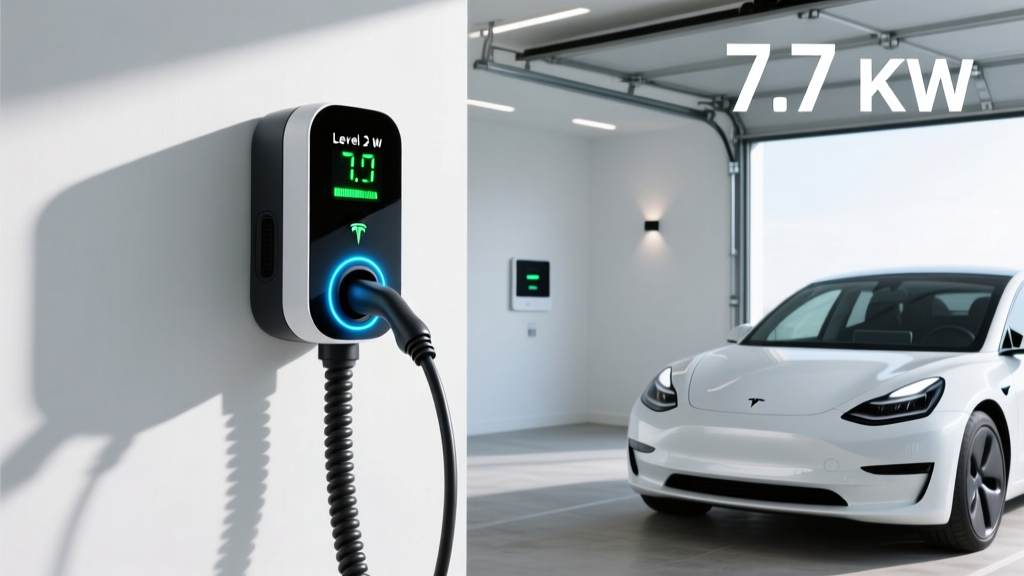
| Level 2 (240V) | 240V / 32–48A | 7.7–11.5 kW | ~20–32 mi/hr | Daily home charging |
| DC Fast Charge | 400V–800V DC | 170–200 kW peak | ~180–250 mi in 30 min | Road trips, rapid top-ups |
Real-world charging time examples (10–80% SoC):
- EQE 350+ (89 kWh usable): DC fast charge at 170 kW peak → 10–80% in approximately 32 minutes. Level 2 at 11.5 kW → ~6.5 hours for a full charge.
- EQS 580 4MATIC (107.8 kWh usable): DC fast charge at 200 kW peak → 10–80% in approximately 31 minutes. Level 2 at 11.5 kW → ~8.5 hours for a full charge.
- EQE SUV 350 4MATIC (90.6 kWh usable): DC fast charge at 170 kW peak → 10–80% in approximately 30 minutes.
Charging curve reality check: Mercedes-Benz EVs peak at their maximum kW only between roughly 10–40% State of Charge. Above 50%, the rate tapers progressively. By 80%, you're typically at 40–60 kW. This is why manufacturers quote 10–80% times rather than 0–100% — the final 20% can take as long as the first 70%.
Home Charger Installation: Costs, Electrical Requirements, and Panel Upgrades
Mercedes-Benz EVs accept up to 11.5 kW on Level 2 (240V, 48A). To deliver that, you need a dedicated 60-amp circuit (EVSE code requires the circuit to be rated 125% above the continuous load, so a 48A charger needs a 60A breaker). Most homes can support this, but older panels may not have the spare capacity.
| Component | Typical Cost Range | Notes |
|---|---|---|
| Level 2 EVSE (charger unit) | $500 – $1,200 | 40A–48A, 240V, hardwired or NEMA 14-50 |
| Electrician labor (standard install) | $600 – $1,500 | Run from panel to garage/carport, ~20–50 ft |
| Permit and inspection | $100 – $300 | Varies by municipality |
| Electrical panel upgrade (if needed) | $1,500 – $3,500 | Required if panel is 100A or lacks spare slots |
| Total (no panel upgrade) | $1,200 – $3,000 | Typical for homes with 200A service |
| Total (with panel upgrade) | $2,700 – $6,500 | Older homes, 100A service, or distant runs |
What electrical upgrades might you need? Homes built before 2000 often have 100-amp or 150-amp main panels that are already near capacity with HVAC, electric range, and dryer loads. Adding a 60A dedicated circuit for an 11.5 kW charger may push total calculated load above the panel's rating. A licensed electrician will perform a load calculation per NEC Article 220. If you're over the limit, you'll need a service upgrade to 200A — the single biggest variable in home charging cost.
Safety and code requirements:
- Dedicated circuit: Your EVSE must be on its own breaker — never shared with other appliances.
- GFCI protection: NEC 2020 and later require GFCI protection for all EV receptacles. Hardwired EVSE units have this built in.
- Outdoor rating: If your charger is mounted outside (driveway, carport), the unit must carry a NEMA 4 or IP65 rating for weather resistance.
- Cable management: Wall-mounted units should keep cables off the ground to prevent trip hazards and water damage.
Connector Compatibility: NACS, CCS1, and the Mercedes-Benz Transition
Mercedes-Benz EVs sold in the US through model year 2024 shipped with the CCS1 (Combined Charging System) connector. Beginning with the 2025 model year, Mercedes-Benz started transitioning to the NACS (North American Charging Standard, commonly called the Tesla connector) on new vehicles. This matters enormously for where and how you charge.
| Connector | Mercedes-Benz Models | Network Access | Adapter Needed? |
|---|---|---|---|
| CCS1 (J1772 combo) | 2022–2024 EQE, EQS, EQE SUV, EQS SUV | Electrify America, EVgo, ChargePoint, Ionity | NACS-to-CCS adapter required for Tesla Superchargers |
| NACS (Tesla-style) | 2025+ CLA EV, upcoming models | Tesla Supercharger network, growing CCS networks via adapter | CCS1-to-NACS adapter for legacy chargers |
| J1772 (Level 2) | All model years | Universal for Level 2 public and home charging | Built-in on CCS1 vehicles; NACS adapter included |
Adapter strategy for CCS1 owners: Mercedes-Benz offers an official NACS adapter (approximately $250) that allows 2022–2024 EQ models to access Tesla Supercharger V3 and V4 stalls. This dramatically expands your DC fast-charging options, as Tesla operates over 6,000 Supercharger stalls in North America. The adapter supports up to 200 kW DC and 19.2 kW AC. Third-party adapters from Lectron and A2Z EV also work but verify SAE J3400 compliance before purchasing.
Which connector/charger is compatible with my EV? Check your charge port door. If the connector has two large DC pins below the J1772 inlet, you have CCS1. If it's a single slim connector (identical to a Tesla port), you have NACS. For Level 2 home charging, any J1772-compatible EVSE works with both types (NACS vehicles include a J1772-to-NACS adapter in most cases).
Recommended Home Chargers for Mercedes-Benz EVs
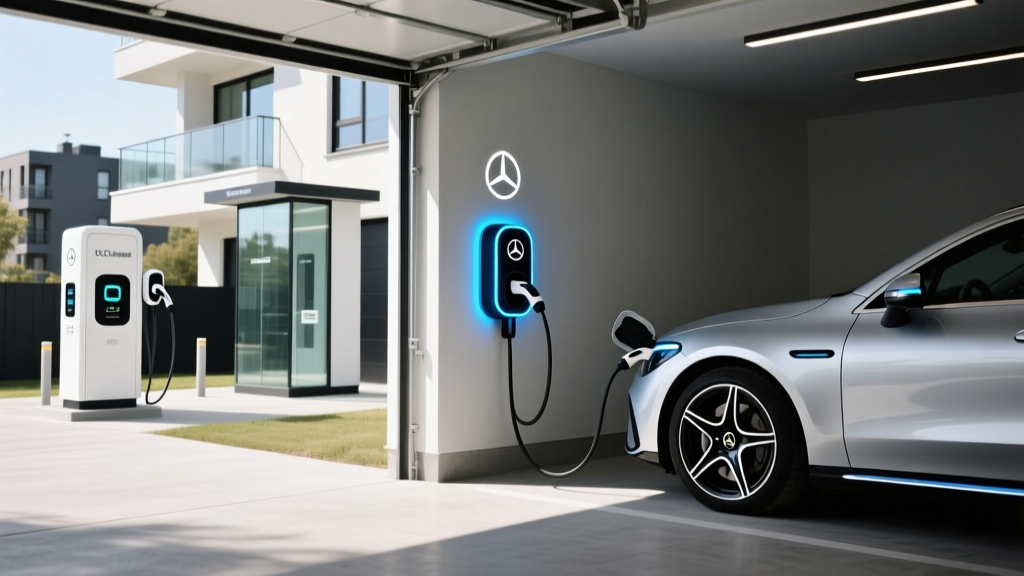
The Mercedes-Benz Wallbox Home (branded charger sold through dealers) is a solid option at 11.5 kW / 48A, but it isn't the only choice. Here are three proven units that pair well with the EQ lineup:
ChargePoint Home Flex
- Power: Up to 12 kW (50A) / 240V
- Connector: J1772 (NACS adapter available)
- Cable length: 23 ft
- Smart features: Wi-Fi, app scheduling, Alexa integration, energy tracking
- Price: ~$699
- Best for: Owners who want detailed app analytics and adjustable amperage (can dial down to 16A–50A to match panel capacity)
Emporia Level 2 EV Charger
- Power: Up to 11.5 kW (48A) / 240V
- Connector: J1772
- Cable length: 24 ft
- Smart features: Wi-Fi, app control, solar integration, load management
- Price: ~$399
- Best for: Budget-conscious install with smart load management (pairs with Emporia Vue energy monitor to avoid panel overload)
Tesla Wall Connector (Gen 3)
- Power: Up to 11.5 kW (48A) / 240V
- Connector: NACS (native); J1772 adapter for CCS1 vehicles
- Cable length: 24 ft
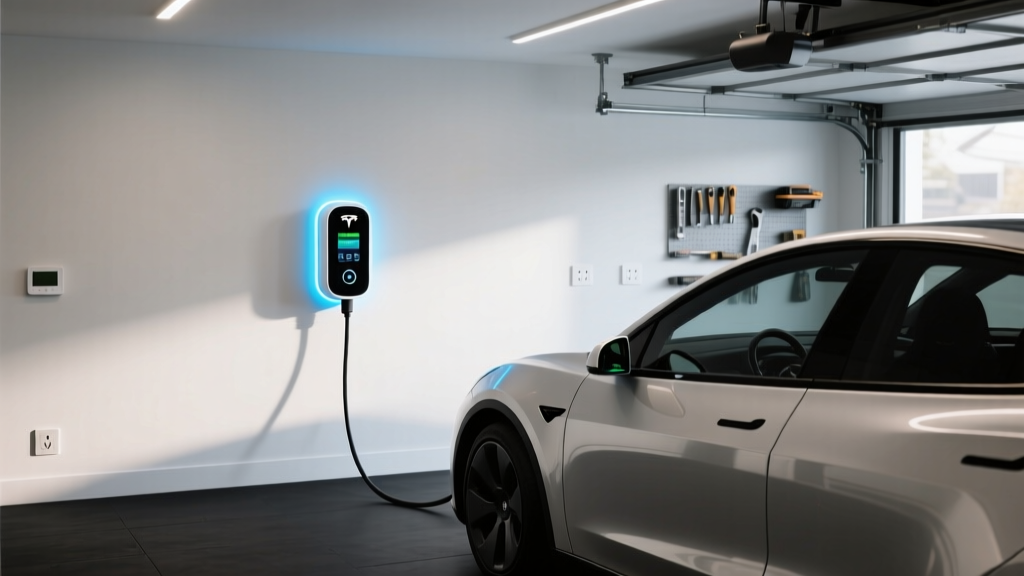
- Smart features: Wi-Fi, OTA updates, power sharing between units, access control
- Price: ~$450
- Best for: NACS-equipped 2025+ Mercedes models or households with both Tesla and Mercedes EVs
All three units support hardwired installation (preferred for 48A+) and NEMA 14-50 plug-in (limited to 40A / 9.6 kW on a 50A circuit). Hardwired installs avoid the GFCI breaker requirement for receptacles, saving $50–$100 on the electrical bill and eliminating nuisance trips.
Cost to Charge: Home vs. Public vs. Gas — the Real Numbers
Charging economics depend on your local electricity rate, time-of-use plan, and whether you're at home or on the road. Here's how Mercedes-Benz charging costs compare across scenarios, using the EQE 350+ (EPA 3.0 mi/kWh) as the baseline:
| Scenario | Rate ($/kWh) | Cost per 100 Miles | Cost per Mile |
|---|---|---|---|
| Home (off-peak, TOU plan) | $0.08 – $0.12 | $2.67 – $4.00 | $0.03 – $0.04 |
| Home (standard rate, no TOU) | $0.14 – $0.18 | $4.67 – $6.00 | $0.05 – $0.06 |
| Public Level 2 (ChargePoint, etc.) | $0.20 – $0.35 | $6.67 – $11.67 | $0.07 – $0.12 |
| DC Fast Charge (Electrify America) | $0.35 – $0.55 | $11.67 – $18.33 | $0.12 – $0.18 |
| Tesla Supercharger (via adapter) | $0.28 – $0.40 | $9.33 – $13.33 | $0.09 – $0.13 |
| Gas equivalent (premium, 25 MPG) | $4.20/gallon | $16.80 | $0.17 |
How much does charging cost per mile vs gas? At home on a time-of-use plan, a Mercedes EQE costs roughly 3–4 cents per mile to "fuel" — compared to 17 cents per mile for a comparable gas-powered Mercedes E-Class requiring premium fuel at 25 MPG combined. Even on the most expensive DC fast chargers, the EQE undercuts gasoline on a per-mile basis. Over 15,000 annual miles, home charging saves approximately $1,800–$2,100 per year versus premium gasoline.
Mercedes-Benz Me Charge benefit: New EQ vehicles come with complimentary or discounted charging on partner networks (typically Electrify America) for a limited period — check your model year's specifics. The Mercedes me app handles payment, routing to chargers, and preconditioning the battery for faster DC charging on arrival.
Public Charging Networks: Where Mercedes-Benz EVs Charge Best
Mercedes-Benz has partnered with Electrify America and MN8 Energy to build its own high-power charging network (Mercedes-Benz High Power Charging), with planned stations across major US corridors. These stations feature 400 kW chargers capable of delivering the EQS's full 200 kW peak rate without bottlenecking. As of 2026, stations are operational in select metro areas including Atlanta, Los Angeles, and the Southeast corridor.
For CCS1-equipped models (2022–2024), the most reliable public networks remain:
- Electrify America: Widest CCS1 coverage, 150–350 kW chargers, reliable in urban areas. Pricing: $0.35–$0.48/kWh depending on region.
- Tesla Supercharger (with adapter): 6,000+ stalls, V3 at 250 kW (your EQ will pull its max ~170–200 kW). Pricing: $0.28–$0.40/kWh. Best reliability record of any network.
- EVgo: Growing CCS1 presence, often in retail locations. Pricing: $0.30–$0.45/kWh.
Preconditioning tip: When you set a DC fast charger as your navigation destination in the MBUX system, the vehicle automatically begins warming the battery to its optimal charging temperature (roughly 95–104°F). In cold weather, this can shave 5–10 minutes off your 10–80% charge time and improve peak charge rate by 20–30%. Always navigate to your charger rather than just driving there.
Battery Health and Long-Term Charging Best Practices
Mercedes-Benz EQ vehicles use NMC (nickel manganese cobalt) lithium-ion battery packs. NMC chemistry offers excellent energy density (giving the EQS its 345-mile EPA range in a manageable package) but is more sensitive to high state-of-charge stress than LFP chemistry.
Daily charging recommendations for NMC batteries:
- Set your home charger to stop at 80% for daily driving. The MBUX system lets you configure a charge limit.
- Charge to 100% only when you need the full range for a road trip, and try to depart shortly after reaching 100% rather than letting it sit full.
- Avoid DC fast charging exclusively — a mix of Level 2 and occasional DC fast is ideal. Frequent DC-only charging accelerates degradation by roughly 1–2% additional capacity loss over 5 years based on industry fleet data.
- In extreme cold (below 20°F), plug in whenever possible. The thermal management system uses grid power to maintain battery temperature, preserving range and longevity.
Mercedes-Benz battery warranty: All EQ models carry an 8-year / 100,000-mile high-voltage battery warranty. Mercedes guarantees the battery will retain at least 70% of its original capacity during the warranty period. If degradation drops below that threshold, Mercedes will repair or replace the pack. Real-world data from early EQS owners (2022 models at 40,000+ miles) shows approximately 3–5% capacity loss — well within warranty margins.
Frequently Asked Questions
How much does it cost to install a home EV charger for a Mercedes-Benz?
A standard Level 2 installation (48A, hardwired, 20–40 ft run from a 200A panel) costs $1,200–$3,000 including the charger unit, electrician labor, and permit. If your home has a 100A panel or needs a service upgrade, add $1,500–$3,500. Always get a load calculation from a licensed electrician before committing.
How fast will each charging level add range to my Mercedes EQ?
Level 1 (120V) adds roughly 3–4 miles per hour — adequate only for PHEVs or emergency trickle charging. Level 2 (240V, 48A) adds 20–32 miles per hour, fully replenishing an EQE overnight in about 7 hours. DC fast charging at 170–200 kW can add 180–250 miles in 30 minutes, depending on battery size and starting SoC.
Which connector and charger are compatible with my Mercedes-Benz EV?
Model years 2022–2024 use CCS1. Model year 2025+ vehicles are transitioning to NACS. For home Level 2 charging, any J1772 EVSE works universally (NACS vehicles include an adapter). For DC fast charging, CCS1 owners should purchase the Mercedes NACS adapter (~$250) to access Tesla Superchargers alongside Electrify America and EVgo.
How much does Mercedes-Benz charging cost per mile compared to gas?
Home charging on a time-of-use plan costs 3–4 cents per mile. Public DC fast charging costs 9–18 cents per mile. A comparable gas-powered Mercedes requiring premium fuel at 25 MPG costs roughly 17 cents per mile. Home charging saves $1,800–$2,100 annually over 15,000 miles.
What electrical upgrades might I need for home charging?
If your home has a 200A electrical panel with spare breaker slots, you likely need only a dedicated 60A circuit. Homes with 100A or 150A service, or panels that are already heavily loaded (electric HVAC, range, dryer, water heater), may require a panel upgrade to 200A — costing $1,500–$3,500. A licensed electrician's load calculation per NEC Article 220 is the definitive answer.
Does the Mercedes-Benz EQ lineup qualify for federal EV tax credits?
Federal EV tax credit eligibility under IRS §30D depends on MSRP caps ($55,000 for sedans, $80,000 for SUVs/pickups/vans), buyer income limits ($150K single / $300K joint), and battery critical-mineral sourcing requirements. Most EQ models exceed the sedan MSRP cap; the EQE SUV and EQS SUV may qualify at the $80,000 SUV threshold depending on trim. Point-of-sale transfer is available. Verify current-year eligibility with a tax professional, as sourcing rules change annually.
Can I use a Tesla Supercharger with my Mercedes-Benz EQ?
Yes. CCS1-equipped models (2022–2024) need the official Mercedes NACS adapter. NACS-equipped models (2025+) plug in natively. Supercharger V3 stalls deliver up to 250 kW, though your EQ will draw its own maximum (170–200 kW). Use the Mercedes me app or Tesla app to initiate a session and monitor progress.
Sources: EPA efficiency data from fueleconomy.gov; Mercedes-Benz EQ specifications from Mercedes-Benz USA; IRS §30D credit rules from irs.gov.