If you own or are shopping for a Mercedes-Benz electric vehicle — whether the compact EQB, the midsize EQE Sedan or SUV, or the flagship EQS — understanding your charging options is essential to getting the most from the car. Mercedes offers its own branded wallbox, but the broader aftermarket provides faster, smarter, and often more affordable alternatives. This guide breaks down exactly what every Mercedes-Benz EV owner needs to know about home installation, public charging networks, connector compatibility, and the best equipment for 2026.
Charging Levels Explained: How Fast Does Each Level Add Range?
Every Mercedes-Benz EV sold in the US charges via three tiers. The critical distinction: kW (kilowatts) measures power — how fast energy flows into the battery — while kWh (kilowatt-hours) measures energy capacity, the total amount the battery holds. Think of kW as the flow rate of a hose and kWh as the size of the bucket.
| Level | Voltage | Max Power (kW) | Miles of Range Added per Hour | Typical Use Case |
|---|---|---|---|---|
| Level 1 | 120V AC | 1.4–1.9 kW | 3–5 mi/hr | Emergency / overnight trickle for PHEVs |
| Level 2 | 240V AC | 7.2–11.5 kW | 22–38 mi/hr | Daily home and workplace charging |
| DC Fast | 400V–800V DC | Up to 170 kW (EQS/EQE), 100 kW (EQB) | ~180–220 mi in 30 min (EQS) | Road trips, highway corridors |
Level 1 is essentially useless for a 90+ kWh battery like the EQS — it would take over 50 hours for a full charge. Level 2 at 11.5 kW (48A) is the practical home standard, replenishing an EQS 450's 107.8 kWh usable battery from empty to full in roughly 10 hours, or more realistically, a daily 20–30% top-up in 2–3 hours. DC fast charging is where the EQS and EQE shine: both support up to 170 kW peak on their 400V architectures, while the EQB tops out around 100 kW.
Home Charger Installation: Electrical Requirements and Costs
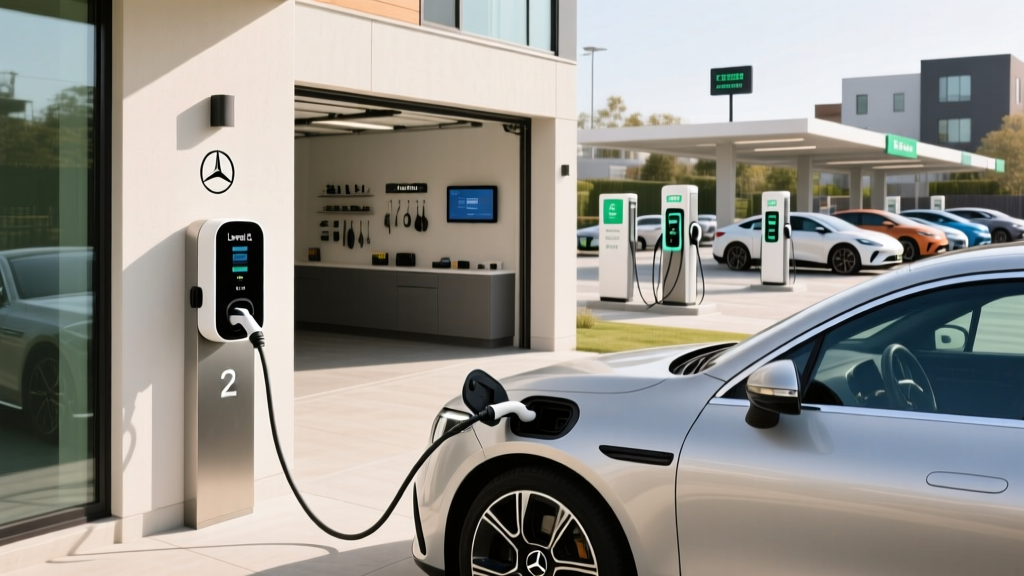
Installing a dedicated Level 2 home charger for your Mercedes-Benz EV requires a 240V circuit, similar to what an electric dryer or oven uses. The Mercedes-Benz Wallbox Home delivers up to 11.5 kW (48A) and requires a dedicated 60A circuit. Most quality aftermarket chargers offer similar or better performance at lower cost. Here's what the installation involves:
Electrical requirements: A 240V, 40A–60A dedicated circuit with a double-pole breaker. Hardwired connections are preferred for circuits above 40A (the NEC requires circuits to be derated to 80% of breaker capacity for continuous loads — a 60A breaker supports 48A continuous draw). If you opt for a plug-in charger using a NEMA 14-50 outlet, you'll need a 50A breaker (40A continuous).
Panel capacity: Most modern homes with 200A service can accommodate a Level 2 charger without a panel upgrade. Older homes with 100A service, or homes already running multiple high-draw appliances (electric heat, tankless water heater, dryer, oven), may need a service upgrade to 200A or a smart panel load-management device like the Emporia Vue or Span drive.
| Item | Typical Range | Notes |
|---|---|---|
| Level 2 Charger (equipment) | $350–$750 | Aftermarket; Mercedes Wallbox Home ~$650 |
| Electrician labor (standard install) | $500–$1,500 | Short run from panel to garage, conduit, wiring |
| Electrical permit | $50–$200 | Varies by municipality |
| Panel upgrade (if needed) | $1,500–$3,500 | 100A→200A service upgrade; not always required |
| Trenching / long conduit runs | $500–$2,000+ | Detached garages, long distances from panel |
| Total (standard install, no panel upgrade) | $900–$2,450 | Most homeowners fall in this range |
| Total (with panel upgrade) | $2,400–$5,950 | Older homes or high-load homes |
Always hire a licensed electrician and pull a permit — unpermitted electrical work can void your homeowner's insurance and create fire risk. The NEC requires GFCI protection for outdoor receptacles and many jurisdictions now require it for indoor EV charging outlets as well. For outdoor installations, ensure your charger carries a NEMA 4 or IP65 weather rating.
Connector Compatibility: NACS, CCS1, and Mercedes-Benz in 2026
Connector standards have shifted significantly. Starting with the 2025 model year, Mercedes-Benz transitioned its North American EVs to the NACS (North American Charging Standard) connector — the same plug used by Tesla. This means 2025 and 2026 EQE, EQS, and EQB models ship with a NACS charge port and gain native access to Tesla's Supercharger network.
If you own a 2022–2024 Mercedes-Benz EV, your vehicle has a CCS1 connector. Mercedes-Benz offers an official NACS adapter (approximately $250) that enables access to Tesla Superchargers. You'll still use CCS1 at Electrify America, EVgo, and ChargePoint DC fast stations, which continue to support both connector types.
| Model Year | Built-in Connector | Tesla Supercharger Access | Adapter Needed? |
|---|---|---|---|
| 2022–2024 | CCS1 | Yes (via adapter) | Mercedes NACS adapter (~$250) or third-party CCS→NACS |
| 2025–2026 | NACS | Yes (native) | CCS adapter needed for non-Tesla DC chargers |
For Level 2 home charging, all chargers sold in North America use a J1772 connector (or NACS for Tesla-specific units). The 2025+ Mercedes NACS port accepts J1772 via a small adapter typically included with the vehicle, and most aftermarket Level 2 chargers now ship with NACS connectors or include both options. Verify the connector before purchasing.
Cost to Charge: Home vs. Public vs. Gas per Mile
One of the strongest ownership arguments for a Mercedes-Benz EV is fuel cost savings — but the math depends heavily on where you charge. According to fueleconomy.gov, the 2026 EQS 450+ achieves approximately 97 MPGe combined, consuming roughly 34 kWh per 100 miles. The EQE 350+ rates around 89 MPGe, consuming roughly 37 kWh/100 mi.
| Charging Scenario | Rate | Cost per 100 Miles | Cost per Mile |
|---|---|---|---|
| Home (off-peak utility rate) | $0.12/kWh | $4.08 | $0.041 |
| Home (national avg electricity) | $0.17/kWh | $5.78 | $0.058 |
| Public Level 2 (ChargePoint, etc.) | $0.25–$0.35/kWh | $8.50–$11.90 | $0.085–$0.119 |
| DC Fast Charging (EA, EVgo) | $0.35–$0.55/kWh | $11.90–$18.70 | $0.119–$0.187 |
| Tesla Supercharger (avg) | $0.28–$0.36/kWh | $9.52–$12.24 | $0.095–$0.122 |
| Gas equivalent (25 MPG, $3.40/gal) | $3.40/gallon | $13.60 | $0.136 |
At home off-peak rates, charging the EQS costs roughly one-third what gasoline would. Even on DC fast chargers at highway rates, the cost is competitive with premium fuel — and most daily charging happens at home, where savings are greatest. A Mercedes-Benz EV owner who charges 80% at home and 20% on public DC fast chargers will see an effective cost per mile around $0.06–$0.07, roughly half the cost of a comparable gas-powered S-Class.
Best Chargers for Mercedes-Benz EVs: Equipment Picks
While Mercedes-Benz sells its own Wallbox Home (11.5 kW, ~$650), several aftermarket units match or exceed its capabilities at competitive prices. Here are top picks for 2026:
ChargePoint Home Flex
Power: Up to 12 kW (50A) / configurable down to 16A
Connector: NACS or J1772 (select at purchase)
Cable length: 23 ft
Smart features: Wi-Fi, app scheduling, utility demand-response, energy tracking, Alexa integration
Price: ~$599
Best for: Most Mercedes-Benz EV owners — flexible amperage fits any panel, excellent app, Energy Star certified.
Emporia Level 2 EV Charger
Power: Up to 11.5 kW (48A)
Connector: NACS or J1772
Cable length: 24 ft
Smart features: Wi-Fi, real-time energy monitoring, solar integration, load management with Emporia Vue panel monitor
Price: ~$399
Best for: Budget-conscious buyers and solar-panel owners wanting granular energy data.
Grizzl-E Smart
Power: Up to 10 kW (40A)
Connector: J1772 (NACS adapter available)
Cable length: 24 ft
Smart features: Wi-Fi, OCPP-compatible, adjustable amperage, rugged aluminum enclosure
Price: ~$449
Best for: Cold-climate and outdoor installations — rated to -40°F, built in Canada, exceptionally durable.
Mercedes-Benz Wallbox Home
Power: Up to 11.5 kW (48A)
Connector: J1772 (NACS for 2025+ models)
Cable length: 20 ft
Smart features: Basic app connectivity, RFID authorization, integrated cable management
Price: ~$650
Best for: Owners who want brand-matched aesthetics and Mercedes dealer support. Fewer smart features than ChargePoint.
For most 2025–2026 Mercedes-Benz EV owners, the ChargePoint Home Flex in NACS configuration is our top recommendation — it matches the Mercedes onboard charger's 11.5 kW maximum, offers the longest cable, and provides the best scheduling and energy-tracking features. The Emporia is a strong value pick, especially if you already use an Emporia Vue home energy monitor.
DC Fast Charging on the Road: Networks and Speeds
Mercedes-Benz EVs integrate navigation-based battery preconditioning — when you route to a DC fast charger via the MBUX system, the car warms or cools the battery to optimal temperature before arrival, enabling faster charging from the start. This is especially important in cold weather, where an un-preconditioned battery may accept only 50–70 kW instead of its 170 kW peak.
With the 2025+ NACS transition, Mercedes owners now have access to:
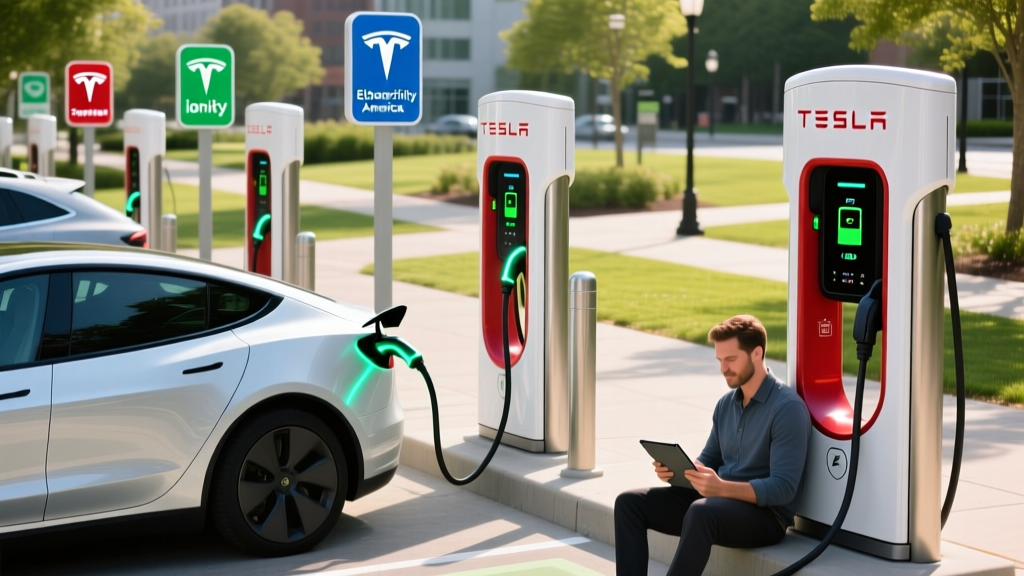
- Tesla Superchargers: 15,000+ V2 (150 kW) and V3/V4 (250–350 kW) stalls nationwide. The EQS/EQE will peak around 170 kW at V3/V4 stalls.
- Electrify America: 350 kW-capable CCS1 stalls (use your CCS adapter for 2025+ models, or plug directly for 2022–2024).
- EVgo and ChargePoint: Growing networks with mixed 50–350 kW DC stalls.
Mercedes-Benz also offers its Mercedes me Charge service, which aggregates multiple networks and offers pricing plans. The included complimentary charging period (typically 2 years or a set kWh amount with new vehicle purchase) can significantly offset early ownership costs. Check your specific model's current offers on the Mercedes-Benz EV page.
Safety, Electrical Code, and Smart Features
Home EV charging is safe when installed correctly. Key requirements and best practices:
- Dedicated circuit: Your Level 2 charger must have its own dedicated breaker — never share a circuit with other appliances.
- GFCI protection: Required for outdoor outlets by NEC 2023 and later. Many jurisdictions now require it indoors for EV receptacles as well. Hardwired chargers often have built-in ground-fault protection, eliminating the need for a GFCI breaker.
- Outdoor rating: If installing outside, choose a charger rated NEMA 4 (weather-resistant) or IP65. All picks above meet this standard.
- Cable management: Use a wall-mounted cable organizer to prevent tripping hazards and cord damage. Never run a charging cable across a driveway or sidewalk.
- Smart scheduling: Use your charger's app to schedule charging during off-peak utility hours (typically 11 PM–6 AM), reducing cost by 30–50% compared to peak rates. The Mercedes-Benz vehicle settings also allow you to set departure-time preconditioning and charge limits.
- Charge limit: For daily driving, set your Mercedes to charge to 80% SoC to maximize long-term battery health. Use 100% only for long trips. The NMC battery chemistry in the EQE and EQS degrades faster when held at 100% for extended periods.
Mercedes-Benz EV Charger FAQ
How much does it cost to install a home EV charger for a Mercedes-Benz?
A standard Level 2 installation (short conduit run, no panel upgrade) costs $900–$2,450 including equipment, electrician labor, and permit. Homes requiring a 200A panel upgrade should budget $2,400–$5,950 total. Get 2–3 quotes from licensed electricians; many utilities also offer rebates of $250–$500 for Level 2 installation.
How fast will each charging level add range to my Mercedes EQE or EQS?
Level 1 (120V) adds roughly 3–5 miles per hour — impractical for daily use. Level 2 at 11.5 kW adds approximately 32–38 miles per hour, enough for a full overnight charge. DC fast charging at 170 kW peak adds roughly 180–220 miles in a 30-minute session (10–80%).
Which connector does my Mercedes-Benz EV use?
2022–2024 models use CCS1. 2025–2026 models use NACS natively. Mercedes sells a NACS adapter (~$250) for older models to access Tesla Superchargers, and a CCS adapter for newer models to use Electrify America and other CCS1 stations.
How much does charging cost per mile compared to gas?
Home charging at $0.12/kWh costs roughly $0.04/mile for the EQS — about one-third the cost of premium gasoline at $0.14/mile. Public DC fast charging at $0.40/kWh costs roughly $0.14/mile, roughly comparable to gas. Most owners charge 80%+ at home and see blended costs around $0.06/mile.
What electrical upgrades might I need for a Mercedes-Benz home charger?
Most homes with 200A electrical service need only a new 60A double-pole breaker and conduit run — no panel upgrade. Homes with 100A service or heavy existing loads may need a service upgrade ($1,500–$3,500) or a smart load-management device that dynamically reduces charger draw when other appliances activate.
Can I use a Tesla Supercharger with my Mercedes-Benz EV?
Yes. 2025–2026 Mercedes-Benz EVs have native NACS ports and connect directly. 2022–2024 CCS1-equipped models require the Mercedes NACS adapter. All Supercharger V2 (150 kW) and V3/V4 (250–350 kW) stalls are compatible, though the Mercedes onboard limit of 170 kW (EQS/EQE) or 100 kW (EQB) caps actual charging speed.
For current federal tax credit eligibility on new Mercedes-Benz EVs and charger installation credits, consult the IRS §30D clean vehicle credit page and the §30C alternative fuel vehicle refueling property credit for home charger installation (up to $1,000 credit, subject to income and census-tract eligibility). Always verify with a tax professional before purchasing.