If you've been following the commercial electric vehicle space, you've likely encountered the term MCS charging — the Megawatt Charging System. It's a high-power charging standard designed not for your commuter sedan, but for Class 8 semi-trucks, electric buses, and heavy-duty fleet vehicles that need hundreds of kilowatt-hours pushed into massive battery packs in under an hour. But as MCS infrastructure develops, its trickle-down effects on public charging networks and connector ecosystems will matter to everyday EV owners too.
This guide breaks down exactly what MCS is, how it compares to the DC fast charging you use today, what the power and connector specifications look like, and how the broader charging landscape — from Level 1 home outlets to 350 kW public chargers — fits together in 2026.
What Is the Megawatt Charging System (MCS)?
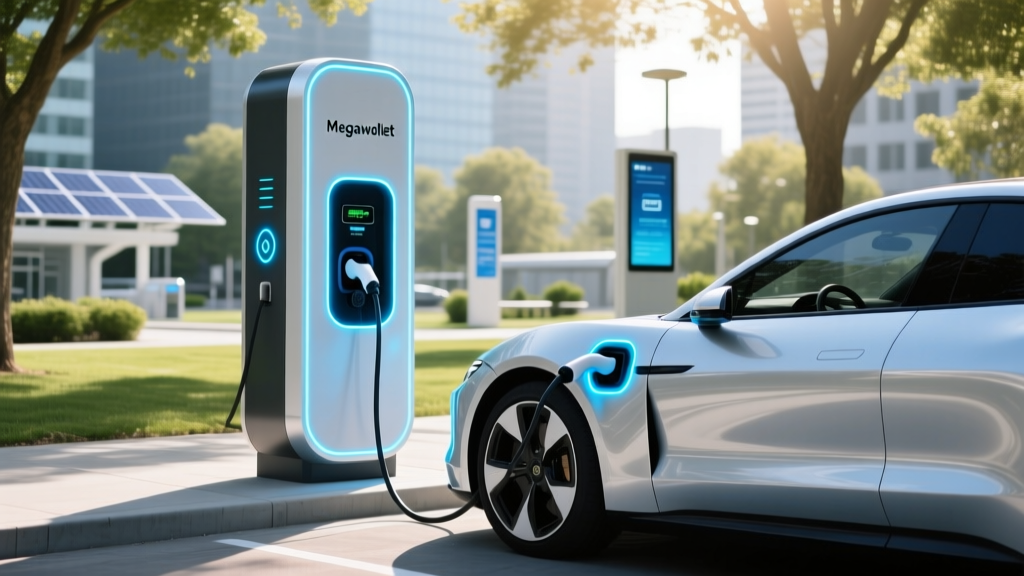
The Megawatt Charging System is an open standard developed by CharIN (Charging Interface Initiative) to enable DC charging at power levels between 1 megawatt (1,000 kW) and 3.75 megawatts (3,750 kW). For context, the fastest consumer DC fast chargers currently peak at 350–400 kW. MCS operates at up to 10 times that rate.
The target vehicles are heavy-duty: electric semi-trucks like the Tesla Semi (which uses a proprietary connector but aligns with MCS power class goals), the Freightliner eCascadia, the Volvo VNR Electric, and emerging platforms from Daimler Truck, PACCAR, and Traton Group. These vehicles carry battery packs ranging from 200 kWh to over 900 kWh and need to recharge during federally mandated 30-minute driver rest breaks.
- Voltage range: 200–1,250 V DC
- Current range: Up to 3,000 A continuous
- Maximum power: 3.75 MW (3,750 kW)
- Connector: Purpose-built MCS connector (distinct from CCS, NACS, or CHAdeMO)
- Communication: ISO 15118 with Plug & Charge capability
- Cable: Liquid-cooled to manage thermal load at extreme current
The MCS connector itself is physically larger than any consumer connector — it has to be, given the cable gauge and cooling requirements for 3,000 amps. You will not see an MCS plug on a passenger car. But the infrastructure buildout — utility upgrades, high-capacity grid connections, and depot-scale charging plazas — will shape the public charging network that passenger EV drivers rely on.
How MCS Compares to Consumer DC Fast Charging
Understanding MCS requires grounding it against the charging speeds available to passenger EVs today. Here's the full spectrum:
| Level | Power (kW) | Miles of Range per Hour | Typical Use Case |
|---|---|---|---|
| Level 1 (120V household) | 1.0–1.9 kW | 3–5 mi/hr | Overnight trickle, PHEVs |
| Level 2 (240V home/public) | 3.3–19.2 kW | 12–70 mi/hr | Daily home charging, workplace |
| DC Fast (50–150 kW) | 50–150 kW | 150–400 mi/hr | Road-trip stops, older stations |
| DC Ultra-Fast (250–400 kW) | 250–400 kW | 600–1,200 mi/hr | Modern highway chargers (EA, Tesla V4) |
| MCS (Megawatt) | 1,000–3,750 kW | N/A (HD trucks only) | Fleet depots, truck corridors |
A critical distinction: kW (kilowatts) measures power — the rate of energy delivery. kWh (kilowatt-hours) measures energy — the total amount stored in a battery. A 350 kW charger delivering power for one hour would provide 350 kWh of energy. Most passenger EV batteries hold between 60 and 120 kWh usable. MCS exists because a 900 kWh semi-truck battery charging at 350 kW would still take over two hours — far too long for commercial freight logistics.
Why MCS Charging Matters to Passenger EV Owners
You will never plug your Hyundai Ioniq 5 or Ford F-150 Lightning into an MCS connector. So why should you care?
Grid infrastructure upgrades. MCS charging depots require utility-grade power connections — the kind of medium-voltage distribution that also enables clusters of 350 kW consumer chargers. When a truck stop installs MCS alongside passenger DC fast chargers, the site gets a transformer and feeder upgrade that benefits everyone. The National Renewable Energy Laboratory (NREL) has been studying co-located charging corridor designs that pair MCS truck charging with consumer ultra-fast stations.
Charging network economics. Electrify America, Tesla, and emerging networks like WattEV (focused on heavy-duty) are building corridor infrastructure that serves both segments. Higher total throughput at a site — combining megawatt-class truck charging with 350 kW consumer stalls — improves the business case for rural and highway locations that are currently charging deserts.
Standards convergence. The MCS development process has refined high-power connector design, liquid-cooling techniques, and ISO 15118 Plug & Charge protocols that are filtering into next-generation consumer chargers. The 400 kW chargers rolling out in 2025–2026 borrow thermal management approaches pioneered for MCS.
Consumer Charging Levels: Home Installation & Costs in 2026
While MCS develops for freight, the real daily charging experience for EV owners happens at home on Level 2. Here's what a 2026 home installation actually requires and costs.
Electrical Requirements for Level 2 Home Charging
A typical Level 2 home charger runs on a 240V dedicated circuit, drawing between 16A and 80A depending on the unit. Most homeowners install a 40A or 48A circuit, which delivers 9.6 kW or 11.5 kW respectively — enough to fully recharge a 75–85 kWh battery overnight (8–10 hours).
Key electrical specs your electrician will evaluate:
- Circuit amperage: Must be rated 125% above the charger's continuous draw (a 48A charger requires a 60A breaker)
- Panel capacity: Most homes need a 200A main panel; older homes with 100A service may require a panel upgrade
- Wire gauge: Typically 6 AWG copper for 40–50A circuits, 4 AWG for 60A
- GFCI protection: Required by NEC 2023/2026 for EV charging circuits in garages
- Dedicated circuit: EV chargers cannot share a circuit with other major appliances
Home Charger Installation Cost Breakdown
| Component | Low Estimate | High Estimate | Notes |
|---|---|---|---|
| Level 2 Charger (hardware) | $300 | $750 | Smart WiFi units (ChargePoint, Emporia, Wallbox) |
| Electrician labor (standard install) | $400 | $1,200 | Varies by run length, conduit, wall type |
| Permit & inspection | $50 | $300 | Municipality-dependent |
| Panel upgrade (if needed) | $1,500 | $4,000 | 100A → 200A service upgrade |
| Total (no panel upgrade) | $750 | $2,250 | Most modern homes |
| Total (with panel upgrade) | $2,250 | $6,250 | Older homes, 100A panels |
The panel upgrade is the cost variable that catches buyers off guard. If your home was built before 1990 or has a 100A main breaker, expect the higher range. Homes with 200A panels and nearby garage subpanels can often complete the install on the lower end. Always get a licensed electrician to assess your panel before purchasing hardware.
Connector Compatibility: NACS, CCS, and the MCS Connector
The North American charging connector landscape has consolidated significantly since Tesla opened its Supercharger network. Here's where things stand in 2026 — and where MCS fits.
| Connector | Max Power | Vehicle Brands | Adapter Needed? |
|---|---|---|---|
| NACS (J3400) | Up to 400 kW DC | Tesla, Ford, GM, Rivian, Volvo, Polestar, Hyundai, Kia (2025+) | CCS vehicles need CCS→NACS adapter for Superchargers |
| CCS1 | Up to 350 kW DC | Legacy: VW ID.4 (pre-2025), BMW iX, some Stellantis models | NACS→CCS adapter for Tesla Supercharger access |
| CHAdeMO | Up to 100 kW DC (rare 400 kW) | Nissan Leaf, Mitsubishi Outlander PHEV (legacy) | Limited adapter options; network declining |
| MCS (Megawatt) | 1,000–3,750 kW DC | Class 8 trucks: Freightliner, Volvo VNR, Tesla Semi, PACCAR | Not compatible with passenger EVs — separate ecosystem |
NACS (now formally SAE J3400) has won the North American passenger vehicle connector war. By 2026, virtually every new EV sold in the US ships with a NACS port or includes a CCS-to-NACS adapter in the box. CCS infrastructure remains operational but is no longer being expanded as a primary standard. CHAdeMO is effectively sunset for new vehicles.
MCS exists in an entirely separate ecosystem. The connector is physically incompatible with any consumer vehicle, and MCS stations are being deployed at fleet depots, truck stops (Pilot/Flying J, Love's), and freight corridors — not at retail shopping centers or highway rest areas where you'd charge a passenger car.
Level 2 Charger Recommendations for Home Use
These are the units we recommend based on real-world testing, reliability data, and feature sets as of 2026:
Emporia Vue EV Charger
- Power: 48A / 11.5 kW (240V)
- Connector: NACS (J3400)
- Cable length: 24 ft
- Smart features: WiFi, energy monitoring via Emporia app, solar integration, scheduled charging
- Price: ~$399
- Best for: Budget-conscious buyers wanting full smart features and energy tracking
ChargePoint Home Flex (2nd Gen)
- Power: Up to 50A / 12 kW (configurable 16–50A)
- Connector: NACS (J3400)
- Cable length: 23 ft
- Smart features: WiFi, Alexa/Google Home, ChargePoint app scheduling, load sharing for multi-unit installs
- Price: ~$549
- Best for: Flexibility across panel capacities; proven reliability track record
Wallbox Pulsar Max
- Power: 48A / 11.5 kW (240V)
- Connector: NACS (J3400)
- Cable length: 25 ft
- Smart features: WiFi + Bluetooth, Power Sharing (two chargers on one circuit), myWallbox app
- Price: ~$499
- Best for: Two-EV households needing load-balanced dual charging
Tesla Wall Connector
- Power: 48A / 11.5 kW (240V)
- Connector: NACS (native Tesla)
- Cable length: 24 ft
- Smart features: WiFi, over-the-air updates, Power Sharing, integrates with Tesla app
- Price: ~$450
- Best for: Tesla owners wanting seamless ecosystem integration; also works with all NACS-equipped EVs
All units listed above are UL-listed, rated for indoor/outdoor use (NEMA 4), and compatible with hardwired installation on a dedicated 60A breaker. Hardwired is strongly preferred over plug-in (NEMA 14-50) for reliability and code compliance — many jurisdictions now require hardwired or GFCI-protected receptacles for EV circuits, and GFCI breakers for 14-50 outlets can nuisance-trip with certain chargers.
Cost to Charge: Home vs. Public vs. Gas per Mile
The economic case for home charging remains overwhelming. Here's how costs compare across scenarios for a typical EV getting 3.5 miles per kWh (roughly 29 kWh/100mi — representative of a 2026 midsize crossover like the Hyundai Ioniq 5 or Tesla Model Y):
| Scenario | Rate | Cost per Mile | Annual Cost (12,000 mi) |
|---|---|---|---|
| Home Level 2 (off-peak utility rate) | $0.09/kWh | $0.026/mi | $312 |
| Home Level 2 (avg. US residential) | $0.17/kWh | $0.049/mi | $588 |
| Public Level 2 (network pricing) | $0.25–$0.49/kWh | $0.071–$0.140/mi | $852–$1,680 |
| DC Fast Charging (public) | $0.35–$0.65/kWh | $0.100–$0.186/mi | $1,200–$2,232 |
| Gasoline (28 MPG avg. at $3.30/gal) | $3.30/gallon | $0.118/mi | $1,416 |
Home charging on an off-peak rate is roughly 4–5× cheaper per mile than gasoline. Even public DC fast charging at premium pricing is competitive with gas on a per-mile basis. The key insight: if you can charge at home, the fuel savings are massive. If you rely entirely on public DC fast charging, the advantage over gas shrinks significantly — and in some markets with high per-kWh pricing (California peak rates, some Electrify America locations), it can briefly exceed gasoline cost per mile.
For commercial trucking — the MCS market — the calculus is different. Fleet operators charging at depot on negotiated commercial rates ($0.06–$0.10/kWh) can fuel an electric semi for roughly $0.10–$0.15 per mile, compared to $0.55–$0.70 per mile for diesel at current prices. That's a 4–5× per-mile advantage, which is why MCS infrastructure investment is accelerating despite the high upfront station cost ($500K–$2M per site).
Charging Time Examples: 10–80% by Battery Size
Real-world charging times depend on battery size, charge curve, and state of charge. Here are representative 10–80% times at various power levels — remembering that peak kW is never sustained across the full session due to charge-curve taper above ~50–60% SoC:
| Battery Size | Example Vehicle | 11.5 kW Level 2 | 150 kW DC | 250–350 kW DC |
|---|---|---|---|---|
| 60 kWh (usable) | Chevrolet Equinox EV | ~4.5 hrs | ~28 min | ~18 min |
| 84 kWh (usable) | Tesla Model Y / Ioniq 5 | ~6 hrs | ~38 min | ~20 min |
| 115 kWh (usable) | Ford F-150 Lightning Ext. | ~8 hrs | ~52 min | ~28 min |
| 200 kWh (usable) | GMC Sierra EV / Silverado | ~14 hrs | ~90 min | ~45 min |
| 550–900 kWh | Class 8 Semi (eCascadia) | N/A | 4–6+ hrs | 2–3 hrs |
That last row illustrates exactly why MCS exists. Even at 350 kW — the fastest consumer DC rate — a 900 kWh semi-truck battery takes nearly three hours to go from 10–80%. At 1,000 kW (1 MW), that same session drops to roughly 45–55 minutes. At the MCS maximum of 3.75 MW, it could theoretically reach 80% in under 20 minutes — aligning with mandatory driver rest periods and enabling single-shift freight operations.
MCS Deployment Timeline & Where It's Being Built
As of early 2026, MCS installations are in pilot and early commercial phases. Key deployments include:
- WattEV — Building 40+ MW truck charging plazas along I-5 and I-10 in California, combining MCS stalls with solar and battery storage. First sites operational in Bakersfield and Fontana.
- Greenlane — A joint venture between Daimler Truck, PACCAR, and NextEra Energy Resources, deploying MCS-capable depot charging for fleet customers in Southern California and the Pacific Northwest.
- TeraWatt Infrastructure — Developing multi-megawatt charging sites for drayage and regional haul trucks at port-adjacent locations (Port of Long Beach, Port of Oakland).
- Pilot/Flying J + Volvo — Co-developing truck charging corridors with MCS-compatible infrastructure along major freight routes in the Southeast and Midwest.
These are not consumer-facing stations. You won't find them on PlugShare or the Tesla app. They're fleet and depot infrastructure, often behind fences with negotiated access agreements. But their grid connections and utility partnerships are laying groundwork that will eventually support co-located consumer ultra-fast charging.
Safety & Electrical Code Considerations
Whether you're installing a Level 2 home charger today or evaluating a future MCS-adjacent site, electrical safety fundamentals apply:
- Dedicated circuit required: EV chargers must be on their own breaker — never shared with dryers, ranges, or HVAC.
- GFCI protection: NEC 625 (2023 and 2026 editions) requires ground-fault protection for EV charging. Hardwired installations handle this within the charger's internal electronics; receptacle-based installs require a GFCI breaker.
- Outdoor rating: Any charger installed outside must be rated NEMA 4 (weatherproof) or NEMA 4X (corrosion-resistant for coastal areas).
- Permit and inspection: Virtually all jurisdictions require an electrical permit for EV charger installation. Skipping this voids homeowner insurance coverage for electrical fires and creates problems at resale.
- Load management: If your panel is near capacity, consider a smart charger with built-in load management (like the Emporia or Wallbox Power Sharing) that dynamically reduces charge rate when other circuits are drawing heavily — avoiding the need for a panel upgrade.
Frequently Asked Questions
Will MCS charging ever be available for passenger cars?
No. MCS is designed exclusively for heavy-duty commercial vehicles. The connector is physically incompatible with passenger EVs, and the power levels (1,000–3,750 kW) would destroy a consumer vehicle's battery management system. Passenger EVs will continue using NACS at up to 400–500 kW as battery architectures evolve.
How much does it cost to install a home EV charger?
A standard Level 2 home installation costs $750–$2,250 total (equipment, electrician, and permit) if your electrical panel has sufficient capacity. If a panel upgrade from 100A to 200A is needed, add $1,500–$4,000, bringing the total to $2,250–$6,250. Always get a licensed electrician's load calculation first.
How fast will each charging level add range?
Level 1 (120V) adds 3–5 miles per hour. Level 2 (240V, 48A) adds roughly 30–40 miles per hour for a typical midsize EV. DC fast charging at 150 kW adds roughly 400–600 miles per hour (peak), while 350 kW chargers can add over 1,000 miles per hour at peak — though charge-curve taper means your average rate across a 10–80% session is significantly lower than the peak number.
Which connector is compatible with my EV?
If you bought a new EV in 2025 or later, it almost certainly has a NACS (J3400) port. Older CCS-equipped vehicles (pre-2025 VW ID.4, BMW iX, etc.) can use a CCS-to-NACS adapter to access Tesla Superchargers. CHAdeMO vehicles (Nissan Leaf) have limited and declining charging infrastructure. MCS is for heavy-duty trucks only and is not compatible with any passenger vehicle.
How much does charging cost per mile vs. gas?
Home charging on off-peak electricity costs roughly $0.025–$0.05 per mile — about 4–5× cheaper than gasoline at $3.30/gallon in a 28 MPG vehicle ($0.12/mi). Public DC fast charging at $0.35–$0.65/kWh costs $0.10–$0.19/mi, which is roughly comparable to gasoline. The savings case for EVs depends heavily on home charging access.
What electrical upgrades might I need for a home charger?
The most common upgrade is a panel replacement from 100A to 200A service ($1,500–$4,000). You may also need a service lateral upgrade from your utility if the wires from the pole to your meter are undersized. Some homes need conduit runs through finished walls or attic spaces, which increases labor cost. A smart charger with load management can sometimes avoid a panel upgrade entirely by dynamically limiting charge rate.
Sources: CharIN MCS Standard, U.S. DOE Alternative Fuels Data Center, National Renewable Energy Laboratory, manufacturer specifications. Pricing and availability reflect 2026 market conditions. Always consult a licensed electrician for installation specifics and verify current utility rates in your area.