If you have been following the rollout of electric heavy-duty trucks, commercial vans, and next-generation electric pickups, you have likely encountered the term MCS charger. The Megawatt Charging System (MCS) is a new high-power charging standard developed to deliver far more energy than today's passenger-car DC fast chargers — think 1,000 kW and above, compared to the 150–350 kW typical of CCS or NACS stations. But MCS is not just a bigger number on a spec sheet. It represents an entirely new charging ecosystem designed for vehicles with massive battery packs, and its implications ripple outward to the passenger EV world as well.
This guide explains exactly what MCS is, how it compares to the Level 1, Level 2, and DC fast charging you already know, what it costs to install, and whether your EV can use it. We will also cover the home-charging fundamentals every EV owner needs, because understanding the full charging spectrum — from a 120-volt wall outlet to a megawatt-grade depot charger — is essential for making smart purchase and installation decisions.
What Is the Megawatt Charging System (MCS)?
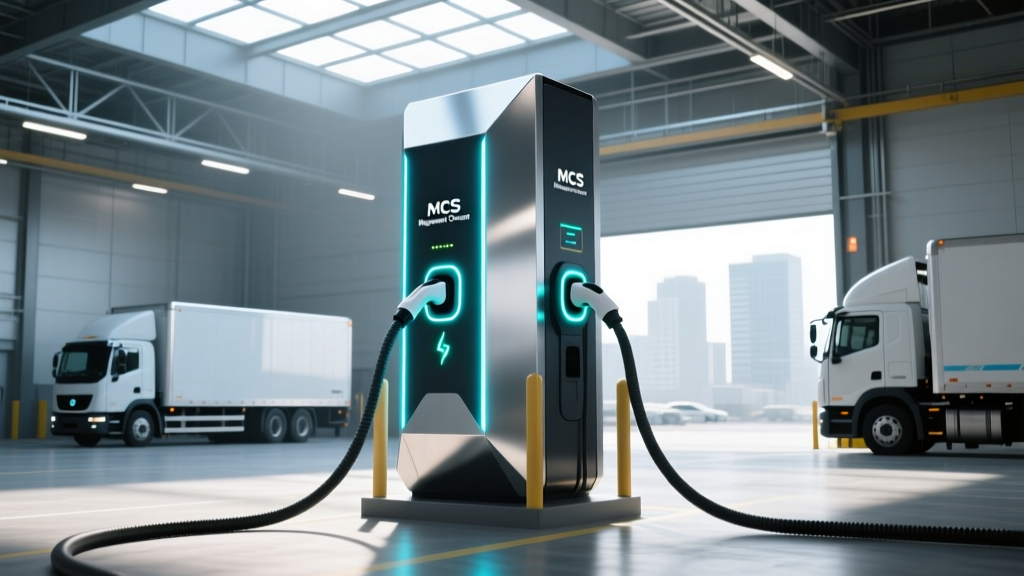
The Megawatt Charging System is a charging connector and protocol standard developed by CharIN, the same industry body behind CCS. MCS was designed specifically for battery-electric commercial vehicles — Class 8 semi-trucks, large delivery vans, electric buses, and eventually heavy-duty pickups — that carry battery packs ranging from 200 kWh to over 1,000 kWh and need to recharge quickly during mandated driver rest breaks or depot downtime.
The MCS connector specification supports:
- Voltage: 200–1,250 V DC (optionally up to 1,500 V)
- Current: up to 3,000 A continuous
- Maximum power: up to 3.75 MW (3,750 kW)
To put that in perspective, a Tesla V4 Supercharger peaks around 350 kW. An MCS charger operating at full specification delivers more than ten times that power. The goal is to add hundreds of miles of range to an electric semi in 30 minutes — matching the 30-minute rest window that federal hours-of-service regulations require for commercial drivers.
Who Is Building MCS Chargers?
As of 2026, companies like ABB, Siemens, Tritium, and ChargePoint have announced or deployed MCS-capable hardware, primarily at fleet depots and along freight corridors in California, Texas, and the Pacific Northwest. The U.S. Department of Energy has funded pilot installations through its National Electric Vehicle Infrastructure (NEVI) and heavy-duty corridor programs. Public MCS stations remain rare — most current installations serve private fleets — but the standard is expected to expand as electric trucks from Tesla (Semi), Freightliner (eCascadia), Volvo (VNR Electric), and Peterbilt reach broader adoption.
Charging Levels Explained: From Level 1 to MCS
Before we go deeper on MCS, it is worth grounding yourself in the full spectrum of EV charging. Every EV owner interacts with Levels 1 and 2 daily, and DC fast charging on road trips. MCS sits above all of these as a fourth tier for commercial applications.
| Level | Voltage | Max Power (kW) | Miles of Range Added per Hour | Typical Use Case |
|---|---|---|---|---|
| Level 1 | 120V AC | 1.4–1.9 kW | 3–5 mi/hr | Overnight home charging (low daily mileage) |
| Level 2 | 240V AC | 7.2–19.2 kW | 20–60 mi/hr | Home, workplace, destination charging |
| DC Fast (CCS/NACS) | 400–900V DC | 50–350 kW | 150–1,200+ mi/hr (peak) | Highway road trips, quick top-ups |
| MCS (Megawatt) | 200–1,500V DC | 750–3,750 kW | 2,000–6,000+ mi/hr (peak, theoretical for passenger EVs) | Heavy-duty trucks, buses, fleet depots |
Can My Passenger EV Use an MCS Charger?
The short answer: not yet, and probably not directly. MCS uses a physically larger, heavy-duty connector designed for vehicles with high-voltage architectures (typically 800V–1,250V) and battery management systems capable of accepting multi-hundred-kilowatt or megawatt-level charge rates. Most passenger EVs on the road in 2026 — including the Tesla Model Y, Hyundai IONIQ 5, Ford Mustang Mach-E, and Chevrolet Equinox EV — use either the NACS (North American Charging Standard) or CCS1 connector and max out between 150 and 350 kW on DC fast charging.
| Connector | Max Power | Vehicle Types | Notable Brands Using It (2026) | Adapter Available? |
|---|---|---|---|---|
| NACS (Tesla) | ~350 kW (DC) | Passenger cars, SUVs, light trucks | Tesla, Ford, GM, Rivian, Hyundai, Kia, BMW, Mercedes | CCS-to-NACS adapters widely available |
| CCS1 | ~350 kW (DC) | Passenger cars, SUVs, light trucks | Volkswagen, some legacy models, Electrify America stations | NACS-to-CCS adapters available |
| CHAdeMO | ~100 kW (DC) | Older EVs (legacy) | Nissan Leaf (older model years), Mitsubishi | Limited; mostly phased out |
| MCS | Up to 3,750 kW (DC) | Class 6–8 trucks, buses, heavy commercial | Tesla Semi, Freightliner eCascadia, Volvo VNR Electric | No MCS-to-NACS adapter exists; different voltage class |
There is currently no adapter that allows a NACS- or CCS-equipped passenger vehicle to plug into an MCS connector. The voltage and current levels involved would exceed the ratings of passenger-EV onboard wiring, contactors, and battery management systems. That said, the MCS protocol (the communication handshake between charger and vehicle) is based on the same ISO 15118 standard used by CCS and NACS, so future passenger vehicles with sufficiently robust architectures could theoretically support a scaled-down MCS connector variant. No automaker has announced such a vehicle for the U.S. market as of early 2026.
Home EV Charger Installation: Costs, Electrical Requirements, and What to Expect
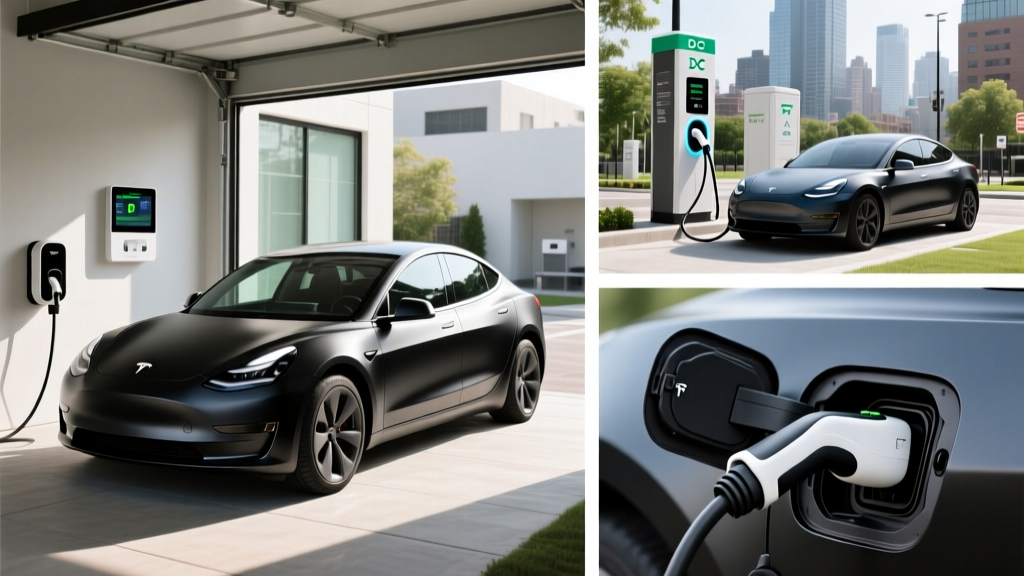
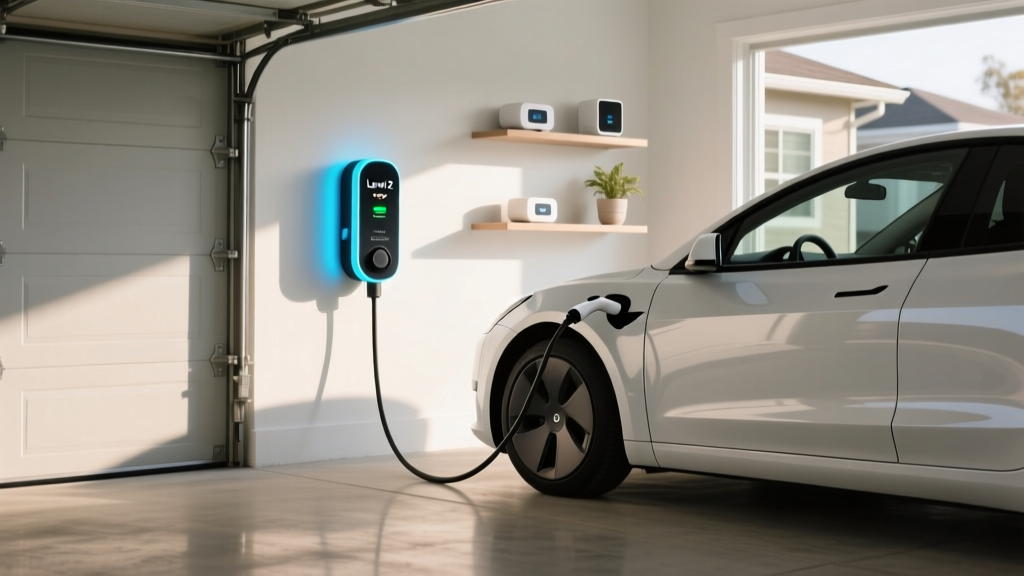
While MCS chargers belong to the commercial and fleet world, Level 2 home charging is where the vast majority of EV owners do 80–90% of their charging. Here is exactly what is involved in getting a Level 2 charger installed at your home.
Electrical Requirements
A Level 2 home charger requires a dedicated 240-volt circuit, similar to what powers an electric dryer or oven. The most common configurations are:
- 40-amp circuit / 32-amp continuous — delivers up to 7.7 kW; suitable for most EVs and the minimum recommended for new installations
- 50-amp circuit / 40-amp continuous — delivers up to 9.6 kW; ideal for vehicles with larger batteries (100+ kWh) or faster onboard chargers
- 60-amp circuit / 48-amp continuous — delivers up to 11.5 kW; required to max out vehicles like the Tesla Model S/X or Ford F-150 Lightning (extended range)
- 80-amp circuit / 64-amp continuous — delivers up to 15.3–19.2 kW; requires hardwiring and a robust electrical panel; compatible with the Tesla Wall Connector at maximum output
National Electrical Code (NEC) requires that continuous loads (like EV charging) use no more than 80% of the circuit's rated amperage. So a 40A breaker supports 32A continuous charging; a 50A breaker supports 40A continuous.
Do I Need a Panel Upgrade?
This is the question that separates a $500 installation from a $3,000+ project. Most homes built after 2000 have a 200-amp electrical panel, which typically has enough spare capacity for a 40–60A EV circuit. Older homes with 100-amp or 150-amp panels may need an upgrade to 200A, which costs between $1,500 and $3,500 depending on your utility's requirements and whether a new meter or service drop is needed.
Your electrician will perform a load calculation (NEC Article 220) that tallies your existing circuits, HVAC, water heater, and other major loads. If the total approaches your panel's rated capacity, an upgrade or a smart panel device (like the SPAN smart panel or a load-management relay) may be required.
Installation Cost Breakdown
| Component | Low End | High End | Notes |
|---|---|---|---|
| Level 2 Charger Equipment | $250 | $700 | Varies by brand, power output, and smart features |
| Electrician Labor (install circuit + charger) | $300 | $1,500 | Depends on run length from panel to garage/driveway |
| Permit & Inspection | $50 | $300 | Required in most jurisdictions; varies by municipality |
| Panel Upgrade (if needed) | $1,500 | $3,500 | Only if existing panel lacks capacity |
| Total (no panel upgrade) | $600 | $2,500 | Typical range for most homeowners |
| Total (with panel upgrade) | $2,100 | $6,000 | Older homes or high-power installs |
The federal Residential Clean Energy Credit covers 30% of the cost of home EV charging equipment and installation (up to $1,000 per year for the equipment portion under current IRS guidance), which can offset $180–$750 of a standard installation. Check with a tax professional for eligibility based on your specific situation.
Recommended Level 2 Home Chargers for 2026
Since MCS chargers are not relevant to passenger-EV home use, here are the best Level 2 chargers currently available, selected for reliability, power output, and smart features.
Tesla Wall Connector (Gen 4)
- Power Output: up to 11.5 kW (48A) on a 60A circuit
- Connector: NACS (native); J1772 adapter included for non-Tesla EVs
- Cable Length: 24 feet
- Smart Features: Wi-Fi, OTA updates, power sharing between two units, access control, scheduling via Tesla app
- Price: ~$475
- Best For: Tesla owners or households with mixed NACS/J1772 vehicles
ChargePoint Home Flex
- Power Output: up to 12 kW (50A) on a 60A circuit; configurable from 16A to 50A via dip switches
- Connector: NACS (2025+ models) or J1772 (older stock); NACS adapter included with J1772 version
- Cable Length: 23 feet
- Smart Features: Wi-Fi, Alexa integration, charge scheduling, energy tracking via ChargePoint app, works with utility demand-response programs
- Price: ~$550–$700
- Best For: Non-Tesla EV owners who want flexible amperage and utility integration
Emporia Vue Smart EV Charger
- Power Output: up to 11.5 kW (48A) on a 60A circuit
- Connector: J1772 (NACS adapter available separately)
- Cable Length: 24 feet
- Smart Features: Integrates with Emporia Vue energy monitor for whole-home energy tracking, solar-aware charging, time-of-use scheduling
- Price: ~$350–$400
- Best For: Budget-conscious buyers with solar panels or those who want detailed energy monitoring
Grizzl-E Smart
- Power Output: up to 10 kW (40A) on a 50A circuit
- Connector: J1772 (NACS adapter available)
- Cable Length: 24 feet
- Smart Features: OCPP-compatible, works with multiple apps, ruggedized aluminum enclosure rated for extreme cold (-40°F)
- Price: ~$400–$500
- Best For: Cold-climate installations and outdoor mounting where durability matters
How Much Does EV Charging Cost per Mile vs. Gas?
One of the strongest arguments for electrification is the per-mile fuel cost advantage. Here is how home, public, and DC fast charging compare to gasoline — and where MCS fits into the commercial picture.
| Charging/Fuel Scenario | Cost per kWh or Gallon | Vehicle Efficiency | Cost per Mile |
|---|---|---|---|
| Home Level 2 (off-peak TOU rate) | $0.08–$0.12/kWh | 3.5 mi/kWh (typical EV) | $0.023–$0.034 |
| Home Level 2 (standard rate) | $0.14–$0.18/kWh | 3.5 mi/kWh | $0.040–$0.051 |
| Public Level 2 (network pricing) | $0.20–$0.35/kWh | 3.5 mi/kWh | $0.057–$0.100 |
| DC Fast Charging ( Electrify America, EVgo, etc.) | $0.35–$0.55/kWh | 3.5 mi/kWh | $0.100–$0.157 |
| MCS Depot Charging (fleet/commercial) | $0.10–$0.20/kWh (negotiated fleet rate) | 2.0 mi/kWh (Class 8 truck) | $0.050–$0.100 |
| Gasoline (25 MPG combined, $3.40/gal) | $3.40/gallon | 25 MPG | $0.136 |
| Diesel (6 MPG, $4.10/gal — Class 8 truck) | $4.10/gallon | 6 MPG | $0.683 |
For passenger EVs, home charging at off-peak rates delivers fuel costs at roughly one-quarter to one-fifth the per-mile cost of gasoline. Even DC fast charging on road trips is often cheaper per mile than gas, though the gap narrows at premium network rates. For commercial fleets, MCS depot charging at negotiated utility rates can cut fuel costs by 75–85% compared to diesel — a massive operational advantage that justifies the significant infrastructure investment.
Charging Time Examples: How Long to Charge Common EV Batteries
Understanding charge times requires distinguishing between kW (power — how fast energy flows) and kWh (energy — how much the battery holds). A 100 kWh battery charged at 10 kW takes roughly 10 hours (100 ÷ 10 = 10). In practice, DC fast charging slows down above 80% state of charge due to the battery's charge curve taper, so 10–80% times are the most useful real-world metric.
| Vehicle | Battery (kWh usable) | Peak DC Rate (kW) | 10–80% at Peak DC | Level 2 at 11.5 kW (0–100%) |
|---|---|---|---|---|
| Tesla Model Y Long Range | 75 kWh | 250 kW | ~25 min | ~6.5 hr |
| Hyundai IONIQ 5 (Long Range) | 77.4 kWh | 238 kW | ~18 min | ~6.7 hr |
| Ford F-150 Lightning (Extended) | 131 kWh | 150 kW | ~41 min | ~11.4 hr |
| Chevrolet Silverado EV (400 mi) | 200 kWh | 350 kW | ~35 min | ~17.4 hr |
| Freightliner eCascadia (typical) | 438 kWh | ~1,000 kW (MCS) | ~25–30 min (estimated) | N/A (not practical on Level 2) |
Safety, Code, and Installation Best Practices
Whether you are installing a 40A Level 2 charger at home or evaluating MCS infrastructure for a fleet depot, electrical safety is non-negotiable.
Home Level 2 Safety Requirements
- Dedicated circuit: Your EV charger must be on its own breaker — never shared with other appliances.
- GFCI protection: NEC 2020 and later requires GFCI protection for all outdoor receptacles. Hardwired chargers avoid this requirement (and the nuisance tripping that GFCI breakers sometimes cause with EVSEs), which is why most electricians recommend hardwiring.
- Outdoor rating: If your charger is mounted outside, it must be rated NEMA 4 (weatherproof). All chargers listed above carry NEMA 4 or IP65 ratings.
- Wire gauge: A 60A circuit requires 6 AWG copper wire (or 4 AWG aluminum). Your electrician will size wire based on run length and local code.
- Permit and inspection: Most jurisdictions require a permit for any new 240V circuit. Skipping this step can void your homeowner's insurance in the event of an electrical fire.
MCS and Commercial Charger Safety
MCS installations involve medium-voltage utility connections, liquid-cooled cables, and sophisticated thermal management systems. These are designed, permitted, and maintained by specialized engineering firms — not general electricians. Safety standards are governed by NFPA 70 (NEC) Article 625 and UL 2202 (EV charging system equipment). Fleet operators must also consider cable management for heavy-gauge MCS cables, which can weigh 15–25 pounds and require assisted handling or robotic cable management systems.
The MCS Roadmap: What Comes Next?
The MCS standard is expected to evolve in three phases:
- 2024–2026 (current): Pilot deployments at fleet depots and select highway corridors. Hardware from ABB, Siemens, and Tritium reaching commercial availability. Focus on Class 8 trucks and transit buses.
- 2027–2029: Broader corridor build-out along major freight routes (I-5, I-10, I-80, I-95). Wireless MCS (inductive charging at up to 500 kW) under testing for opportunity charging at loading docks and bus stops.
- 2030+: Potential MCS-derived connector variants for high-performance passenger EVs with 800V+ architectures. Vehicles like the Porsche Macan EV (800V) and Lucid Air (900V+) already push the boundaries of CCS/NACS; a future passenger-MCS variant could deliver 500–750 kW charge rates if battery chemistry keeps pace.
For now, passenger EV owners should focus on optimizing their Level 2 home setup and understanding the DC fast-charging networks available to them. MCS is a commercial-vehicle solution solving a commercial-vehicle problem — but the technology and infrastructure lessons it produces will eventually filter down to every EV on the road.
Frequently Asked Questions
How much does it cost to install a home EV charger?
A typical Level 2 home charger installation costs between $600 and $2,500 when no panel upgrade is needed. This includes the charger unit ($250–$700), electrician labor ($300–$1,500 depending on wire run distance), and a permit ($50–$300). If your home needs a 200A panel upgrade, add $1,500–$3,500, bringing the total to $2,100–$6,000. The federal Residential Clean Energy Credit can offset 30% of equipment costs (up to $1,000).
How fast will each charging level add range?
Level 1 (120V) adds 3–5 miles per hour. Level 2 (240V, 40A) adds roughly 25–35 miles per hour for a typical EV. DC fast charging at 150–350 kW can add 150–1,200+ miles per hour at peak rate, though real-world 10–80% sessions average 18–40 minutes depending on battery size and charge curve. MCS chargers deliver 2,000+ miles per hour for heavy-duty trucks but are not compatible with passenger vehicles.
Which connector and charger is compatible with my EV?
Check your vehicle's charge port. As of 2026, most new EVs sold in North America use NACS (Tesla, Ford, GM, Hyundai, Kia, Rivian, BMW, and others). Some older or carryover models still use CCS1 (Volkswagen ID.4 from prior model years). CHAdeMO is limited to the Nissan Leaf and a few legacy models. MCS is exclusively for heavy-duty commercial vehicles and is not backward-compatible with any passenger EV connector.
How much does charging cost per mile compared to gas?
Home charging at off-peak rates costs approximately $0.02–$0.03 per mile — roughly one-quarter the cost of gasoline at $3.40/gallon and 25 MPG ($0.14/mile). Public DC fast charging at $0.35–$0.55/kWh costs $0.10–$0.16 per mile, still competitive with or cheaper than gas. For commercial trucks, MCS depot charging at fleet utility rates can deliver per-mile costs 75–85% lower than diesel.
What electrical upgrades might I need for a home charger?
If your home has a 200A panel with sufficient spare capacity, you likely need only a new dedicated 240V circuit — no panel upgrade required. Homes with 100A or 150A panels, or those with significant existing loads (electric heat, hot tub, workshop), may need a panel upgrade to 200A or a load-management device. An electrician will perform an NEC Article 220 load calculation to determine your exact requirements. In rare cases, the utility may need to upgrade your service drop, adding $500–$2,000 and several weeks of lead time.
Will MCS chargers ever be available for passenger cars?
Not in their current form. The MCS connector is physically larger and rated for current levels (up to 3,000A) that would damage passenger-EV charge ports and battery systems. However, the MCS communication protocol is compatible with CCS/NACS at the software level, and a future scaled-down MCS variant for 800V+ passenger vehicles is technically feasible. No automaker has announced such a product as of 2026.