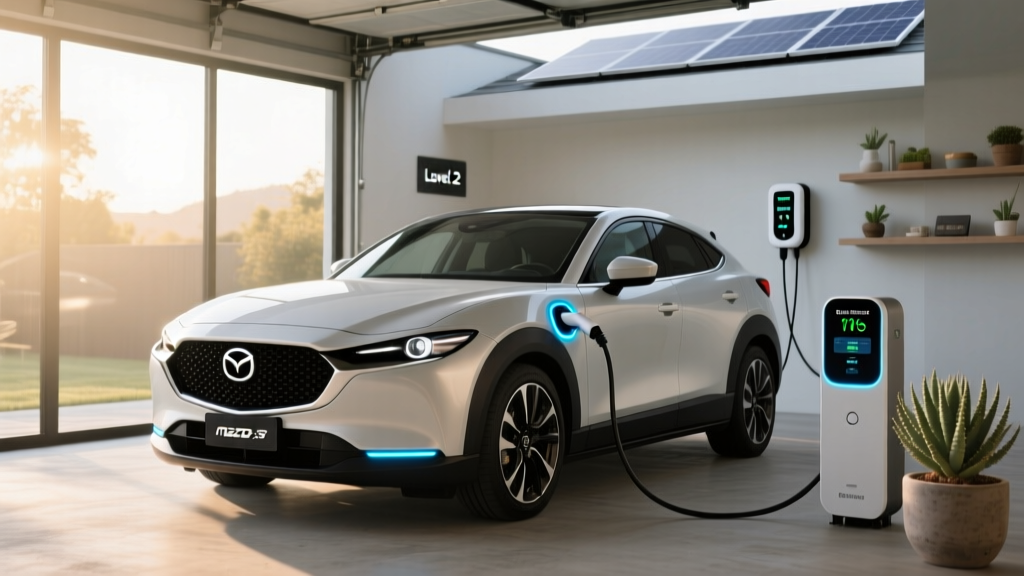
The Mazda MX-30 occupies a unique niche in the EV market: a stylish, intentionally small-battery commuter car. For 2026, Mazda continues to offer the MX-30 EV with its 35.5 kWh battery pack, prioritizing a lighter footprint and sustainable interior materials over maximum distance. However, understanding the Mazda MX-30 range and its charging profile is critical before plugging in at home or on the road.
Because the battery is roughly half the size of a Tesla Model Y's or Hyundai Ioniq 5's, the MX-30 charges significantly faster on standard equipment but requires more strategic planning for longer trips. This guide breaks down exactly what it takes to charge the MX-30 at every level, what home installation actually costs, and how its per-mile economics compare to gas.
The Real Story: Mazda MX-30 Range and Battery Specs
The 2026 Mazda MX-30 is powered by a 35.5 kWh lithium-ion battery pack (approximately 32 kWh usable). The EPA rates the front-wheel-drive MX-30 at 100 miles of range. While that figure is modest by modern standards, it aligns with Mazda's philosophy of "right-sizing" the battery for urban and suburban commuting, reducing vehicle weight and upstream manufacturing emissions.
EPA vs. Real-World Range Expectations
EPA Sticker: 100 miles
Real-World City/Suburban: ~90–100 miles (regen braking helps in stop-and-go traffic)
Real-World Highway (70+ mph): ~75–85 miles (aerodynamic drag reduces efficiency)
Cold Weather (below 32°F): ~60–75 miles (no heat pump on US trims; cabin heating draws heavily from the pack)
The MX-30's efficiency is rated at roughly 100 MPGe combined (about 33–35 kWh/100 miles). The 107 kW (143 hp) electric motor provides peppy acceleration—a claimed 0–60 mph time of around 8.7 seconds—but the real advantage of the smaller battery is how quickly it replenishes.
Charging Levels: How Fast Will Each Level Add Range?
Before looking at times, it is essential to understand the difference between kW (kilowatts, the rate of power flow) and kWh (kilowatt-hours, the total energy stored in the battery). Think of kW as the speed of water flowing from a hose, and kWh as the total gallons in the bucket.
| Charging Level | Voltage / Amperage | Power (kW) | Miles of Range Added Per Hour | 0–100% Time (MX-30) |
|---|---|---|---|---|
| Level 1 (Standard Outlet) | 120V / 12A | ~1.4 kW | ~3–4 miles | ~24–28 hours |
| Level 2 (Home/Public AC) | 240V / 32A–40A | 6.6 kW (MX-30 max) | ~18–20 miles | ~5.5 hours (0–100%) |
| DC Fast Charging | 400V+ DC | Up to 50 kW | ~100+ miles (in 30 min) | ~36 min (10–80%) |
Key Takeaway: The MX-30's onboard charger is capped at 6.6 kW. Even if you plug into a 48-amp (11.5 kW) home charger, the car will only draw 6.6 kW. This means a full overnight charge from empty is easily achievable on a standard Level 2 home setup.
Home Charger Installation: Costs, Electrical Requirements, and Permits
Because the MX-30's battery is small, you do not need a high-amperage, hardwired wall connector to wake up to a full charge every morning. A 240V outlet or a 32-amp wall unit is more than sufficient. However, installation costs depend heavily on your home's existing electrical infrastructure.
Electrical Requirements and Panel Upgrades
For a dedicated Level 2 circuit, you will need a 240V, 40-amp or 50-amp breaker (to safely support a 32A or 40A continuous load). The single biggest variable in installation cost is whether your electrical panel has the capacity for a new double-pole breaker.
- 100-amp panels: Common in older homes. Adding a 40A EV circuit may max out your panel, requiring a $2,000–$4,000 service upgrade to 200 amps.
- 200-amp panels: Usually have enough headroom for a 40A EV circuit without a full service upgrade, though a "load calculation" by a licensed electrician is required by code.
- Smart panels / load management: Devices like the NeoCharge Smart Splitter or Emporia Load Management can avoid a panel upgrade by sharing power with an existing appliance (like a dryer).
| Item | Low Estimate | High Estimate | Notes |
|---|---|---|---|
| Level 2 Charger (Hardware) | $350 | $700 | 32A–40A smart Wi-Fi units |
| Electrician Labor & Materials | $500 | $2,000 | Depends on run length from panel to garage |
| Permit & Inspection | $100 | $300 | Required by most local jurisdictions |
| Panel Upgrade (if needed) | $2,000 | $4,500 | 100A to 200A service upgrade |
| Total (No Panel Upgrade) | $950 | $3,000 | Average: ~$1,500 |
Safety and NEC Code Considerations
EV charging is a continuous load (running for 3+ hours), which triggers specific National Electrical Code (NEC) requirements:
- Dedicated Circuit: Your EVSE (charger) must be on its own dedicated breaker. You cannot share it with other outlets.
- GFCI Protection: The 2026 NEC continues to require Ground Fault Circuit Interrupter protection for indoor and outdoor EV receptacles. Many modern hardwired wall connectors have this built-in, but if you install a NEMA 14-50 receptacle, the breaker itself may need to be a GFCI type (adding $100–$150 to the panel cost).
- Outdoor Rating: If your charger is mounted outside, the unit must be NEMA 4 rated (weatherproof), and any receptacle must have an in-use weather cover.
Connector Compatibility: CCS, NACS, and the 2026 Landscape
The EV charging landscape has shifted dramatically. For the 2026 model year, Mazda has begun transitioning its North American EV lineup to the NACS (Tesla-style) connector, starting with newer platforms. However, the MX-30 (carried over from its original architecture) typically ships with the CCS1 (Combo) port in the US market.
| Connector Standard | Native MX-30 Support? | Adapter Required? | Network Access |
|---|---|---|---|
| CCS1 (Combo) | Yes (Native) | No | Electrify America, EVgo, ChargePoint |
| NACS (Tesla) | No (on MX-30) | Yes (CCS-to-NACS) | Tesla Superchargers (Magic Dock or adapter) |
| CHAdeMO | No | Yes (Expensive/Rare) | Legacy Nissan stations (phasing out) |
Adapter Note: If you plan to use Tesla Superchargers with a CCS-equipped MX-30, you will need a third-party CCS-to-NACS adapter (such as the Lectron or A2Z adapter, typically $150–$200). Always verify the adapter is rated for the voltage and amperage of DC fast charging.
Cost to Charge: Per-Mile Economics vs. Gas
The MX-30's efficiency (approx. 33 kWh/100 miles) makes it one of the cheaper EVs to fuel, especially on home electricity rates.
| Scenario | Price per kWh | Cost per 100 Miles | Cost per Mile |
|---|---|---|---|
| Home (Off-Peak / EV Rate) | $0.12 | $3.96 | $0.040 |
| Home (Standard Avg) | $0.17 | $5.61 | $0.056 |
| Public Level 2 | $0.35 | $11.55 | $0.116 |
| DC Fast Charging | $0.55 | $18.15 | $0.182 |
| Gas Car (25 MPG @ $3.40/gal) | N/A | $13.60 | $0.136 |
At home, the MX-30 costs roughly 4 to 6 cents per mile to fuel—less than half the cost of a 25 MPG gas car. However, frequent reliance on DC fast charging can push your per-mile cost above that of gasoline, negating the economic advantage.
Recommended Home Charging Equipment for the MX-30
Since the MX-30 caps at 6.6 kW, you don't need the most expensive 48A chargers on the market. A high-quality 32A or 40A unit is ideal.
Emporia Level 2 EV Charger
- Power: 48A (11.5 kW) – MX-30 will use 6.6 kW
- Price: ~$399
- Features: Built-in energy monitoring, Wi-Fi, load management (can prevent panel upgrades).
- Best For: Data-driven owners and homes with tight panel capacity.
ChargePoint Home Flex
- Power: Configurable up to 50A (12 kW)
- Price: ~$599
- Features: NEMA 14-50 plug or hardwired, excellent app, Alexa integration.
- Best For: Reliability and long cable length (23 ft).
Grizzl-E Smart
- Power: 40A (9.6 kW)
- Price: ~$449
- Features: Rugged, NEMA 4 outdoor rating, OCPP compatible.
- Best For: Outdoor installations and extreme climates.
Mazda MX-30 Ownership: Warranty, Incentives, and Verdict
Mazda provides an 8-year/100,000-mile warranty on the MX-30's high-voltage battery, covering defects and capacity loss below a certain threshold (typically 70% retention). The standard vehicle warranty is 3 years/36,000 miles.
Regarding the Federal §30D Tax Credit: As of 2026, the MX-30's eligibility for the full $7,500 credit is highly restricted due to stringent battery component and critical mineral sourcing rules enacted by the IRS. Furthermore, the buyer must meet income caps ($150k single / $300k joint) and the vehicle must be under the MSRP cap ($55k for sedans/hatchbacks). Always verify current eligibility with a tax professional before purchase.
Frequently Asked Questions
Does the Mazda MX-30 support fast charging?
Yes, but it is capped at approximately 50 kW via DC Fast Charging. This allows a 10–80% charge in about 36 minutes. While slower than 200+ kW EVs, the smaller battery means you still add range relatively quickly.
Is the Mazda MX-30 good for road trips?
The 100-mile EPA range makes road trips challenging. You will need to stop every 60–80 miles on the highway to charge for 20–30 minutes. It is best suited as a primary commuter car with a second vehicle for long trips, or for drivers who rarely exceed 70 miles in a day.
Can I charge the MX-30 on a standard 120V outlet?
Yes. Level 1 charging (120V) will add about 3–4 miles of range per hour. A full charge from empty takes roughly 24 hours. This is viable only if your daily driving is under 20 miles and the car is parked for long periods.
Does the MX-30 have a heat pump?
US-spec MX-30 models generally do not include a heat pump, relying on resistive heating. This causes a significant range drop (20–35%) in freezing temperatures compared to mild weather.
Data sources: EPA / Fueleconomy.gov, Mazda USA Specifications.