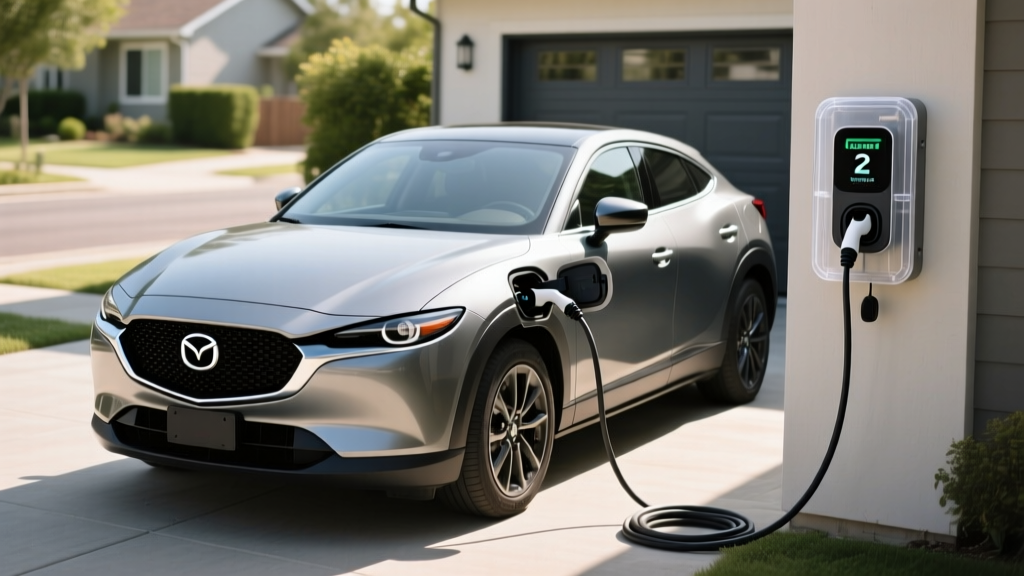
The Mazda MX-30 occupies a unique and controversial spot in the EV market. With a deliberately small battery, Mazda positioned this crossover as an urban commuter rather than a road-trip machine. If you're researching the Mazda MX-30 range and how to keep it charged efficiently, this guide covers everything from real-world mileage expectations to home charger installation, public charging logistics, and the exact cost per mile compared to gasoline.
Before we get into charging infrastructure, let's establish what the MX-30 actually delivers — because its range profile dictates everything about how you'll charge it.
Mazda MX-30 Range: EPA Sticker vs. Real-World Reality
The Mazda MX-30 (final U.S. model year was 2023, and it was sold exclusively in California) carries a 35.5 kWh battery pack — of which roughly 32 kWh is usable. The EPA rated it at 100 miles of range with a combined efficiency of 124 MPGe (roughly 27 kWh/100 miles). On paper, that's the lowest range of any modern EV sold in the U.S.
| Spec | Value |
|---|---|
| EPA Range | 100 miles |
| Battery (usable) | ~32 kWh (NMC chemistry) |
| EPA Efficiency | 124 MPGe (27 kWh/100 mi) |
| Max DC Fast Charge | ~50 kW (CCS1) |
| 10–80% DC Fast Charge | ~36 minutes |
| Level 2 Charge Rate | 6.6 kW (onboard charger) |
| Motor Output | 143 hp / 200 lb-ft torque |
| 0–60 mph | ~8.7 seconds |
| Original MSRP (2023) | $33,470 (base) – $36,470 (Premium Plus) |
| Battery Warranty | 8 years / 100,000 miles |
Mazda's rationale for the small battery was urban sustainability — a lighter, smaller battery has a lower manufacturing carbon footprint. That philosophy makes sense if your daily round-trip commute is under 60 miles and you have reliable home charging. It makes far less sense if you need flexibility for longer trips or lack overnight charging access.
Charging Levels Explained: How Fast Each Adds Range to the MX-30
Understanding the three charging levels is essential, especially with a smaller battery where charge time directly affects your daily usability. The key distinction every EV owner must internalize: kW (kilowatts) measures power — how fast energy flows into the battery. kWh (kilowatt-hours) measures energy — the total capacity of the battery itself. Think of kW as the width of a pipe and kWh as the size of the tank.
| Level | Power Source | Max kW to MX-30 | Miles Added/Hour | Full Charge Time (0–100%) |
|---|---|---|---|---|
| Level 1 (120V) | Standard household outlet | ~1.2–1.4 kW | ~4–5 miles/hr | ~22–26 hours |
| Level 2 (240V) | Home wallbox or public L2 | 6.6 kW (onboard limit) | ~22–24 miles/hr | ~5 hours |
| DC Fast Charge | Public CCS1 station | ~50 kW peak | N/A (session-based) | ~36 min (10–80%) |
The MX-30's relatively small battery actually makes Level 1 charging more viable than it would be for a long-range EV. If you drive 30 miles per day and plug into a standard 120V outlet overnight (roughly 10 hours), you'll recover 40–50 miles — more than enough to replenish a typical commute. However, Level 2 is strongly recommended for anyone who occasionally drives more than 50 miles in a day or wants the flexibility of a full charge by morning regardless of starting state of charge.
The MX-30's DC fast charging tops out around 50 kW — modest by 2026 standards where many EVs accept 150–350 kW. But because the battery is only ~32 kWh usable, the 10–80% session still completes in roughly 36 minutes. The charge curve tapers significantly above 80% state of charge, so DC fast charging past that point is rarely worth the wait.
Home Charger Installation: Electrical Requirements, Costs & Gotchas
Installing a Level 2 home charger is the single most impactful upgrade for MX-30 ownership. Here's what the electrical work actually involves and what you'll pay.
Electrical Requirements for a Level 2 Charger
A Level 2 charger requires a 240-volt dedicated circuit, similar to what an electric dryer or oven uses. For the MX-30, a 40-amp circuit delivering up to 32 amps of continuous current (7.7 kW) is more than sufficient — the car's onboard charger caps at 6.6 kW anyway. A NEMA 14-50 outlet or a hardwired wallbox are the two installation options.
Your electrical panel must have enough spare capacity to handle the new circuit. Most modern 200-amp panels have adequate headroom. However, older homes with 100-amp service or panels already near capacity may require a panel upgrade — a significant added cost that many buyers overlook during initial budgeting.
Installation Cost Breakdown
| Component | Low Estimate | High Estimate | Notes |
|---|---|---|---|
| Level 2 Charger (Equipment) | $250 | $650 | Varies by brand, smart features, cable length |
| Electrician Labor (simple run) | $400 | $1,200 | Depends on distance from panel to garage/driveway |
| Permit & Inspection | $50 | $250 | Required in most jurisdictions; varies by locality |
| Panel Upgrade (if needed) | $1,500 | $4,000+ | Only if existing panel lacks capacity; 100A → 200A |
| Total (no panel upgrade) | $700 | $2,100 | Typical scenario for most homes |
| Total (with panel upgrade) | $2,200 | $6,100+ | Older homes or high-load panels |
The federal government offers a 30% tax credit (up to $1,000) for home EV charging equipment and installation under the Alternative Fuel Vehicle Refueling Property Credit. Check IRS guidelines for current eligibility, as income and census-tract requirements apply.
Safety & Code Considerations
Any Level 2 installation must comply with the National Electrical Code (NEC Article 625). Key requirements include:
- Dedicated circuit: The charger must have its own breaker — no sharing with other appliances.
- GFCI protection: Required for outdoor receptacles and recommended for garages in many jurisdictions.
- Outdoor rating: If installing outside, the charger must carry a NEMA 4 (or higher) weatherproof rating.
- Proper wire gauge: A 40-amp circuit typically requires 8 AWG copper wire; a 50-amp circuit requires 6 AWG. Your electrician will size this to your specific run length and charger amperage.
- Permit and inspection: Skipping this risks insurance claim denials and code violations. Always pull a permit.
Connector Compatibility: What Plugs Into the MX-30?
The Mazda MX-30 uses the CCS1 (Combined Charging System) connector standard — the J1772 plug for Level 1/Level 2 AC charging, with two additional DC pins below for fast charging. This was the dominant U.S. standard when the MX-30 was sold.
| Connector | Used By | MX-30 Compatible? | Adapter Needed? |
|---|---|---|---|
| J1772 (Level 1/2 AC) | Most non-Tesla EVs, public L2 stations | Yes — native | No |
| CCS1 (DC Fast) | Electrify America, EVgo, ChargePoint DC | Yes — native | No |
| NACS (Tesla) | Tesla vehicles, 2025+ Ford/GM/Rivian/etc. | No — not native | NACS-to-CCS adapter (~$200–$250) for Supercharger access |
| CHAdeMO | Nissan Leaf (legacy) | No | N/A — CHAdeMO networks are shrinking |
As the industry shifts toward NACS (North American Charging Standard) through 2025–2026, MX-30 owners may find CCS1-only stations becoming less common while NACS/Tesla Supercharger networks expand. A quality NACS-to-CCS adapter from a reputable manufacturer like Lectron or A2Z can unlock Tesla Supercharger access — a significant practical advantage given the Supercharger network's reliability. Confirm adapter compatibility with your specific station network before purchasing, as not all Supercharger stalls support non-Tesla vehicles via adapter.
Charging Cost: MX-30 Cost Per Mile vs. Gasoline
One of the strongest arguments for the MX-30 — especially given its small battery — is the extremely low cost to "fill up." Let's run the numbers across common charging scenarios and compare against a gasoline equivalent.
The MX-30 consumes approximately 0.27 kWh per mile (based on its 27 kWh/100 mi EPA rating). A comparable gas-powered subcompact crossover averaging 28 MPG combined provides our baseline.
| Scenario | Rate | MX-30 Cost/Mile | Gas Car Cost/Mile | Savings/Mile |
|---|---|---|---|---|
| Home (off-peak utility rate) | $0.10/kWh | $0.027 | $0.125 | $0.098 |
| Home (average U.S. rate) | $0.16/kWh | $0.043 | $0.125 | $0.082 |
| Public Level 2 | $0.30/kWh | $0.081 | $0.125 | $0.044 |
| DC Fast Charge (public) | $0.48/kWh | $0.130 | $0.125 | –$0.005 |
At home on off-peak rates, the MX-30 costs roughly 2.7 cents per mile — about 78% cheaper than gasoline at $3.50/gallon. Over 12,000 annual miles, that's approximately $1,176 in savings compared to the gas equivalent. However, note that at premium DC fast-charging rates, the MX-30 can actually cost slightly more per mile than a fuel-efficient gas car. This is why home charging is economically essential for MX-30 ownership.
To fully charge the MX-30's ~32 kWh usable battery from empty at home ($0.16/kWh): approximately $5.12. The same range in a 28 MPG gas car at $3.50/gallon: approximately $12.50.
Recommended Level 2 Chargers for the Mazda MX-30
Since the MX-30's onboard charger maxes at 6.6 kW, you don't need a 48-amp charger to get full speed — a 32-amp unit delivers the car's maximum. However, installing a 40- or 48-amp charger is smart future-proofing for your next EV. Here are proven options:
Emporia Level 2 EV Charger
- Power: Up to 48 amps (11.5 kW on 60A circuit)
- Connector: J1772 (CCS-compatible)
- Cable length: 24 feet
- Smart features: Wi-Fi, app scheduling, energy monitoring, solar integration
- Price: ~$399
- Best for: Budget-conscious buyers who want smart features and energy tracking
ChargePoint Home Flex
- Power: Configurable 16–50 amps (up to 12 kW)
- Connector: J1772 (CCS-compatible)
- Cable length: 23 feet
- Smart features: Wi-Fi, Alexa integration, ChargePoint app, scheduling
- Price: ~$549
- Best for: Flexible amperage configuration for older electrical panels
Tesla Wall Connector (with J1772 adapter)
- Power: Up to 48 amps (11.5 kW)
- Connector: NACS native (J1772 adapter ~$50 for MX-30)
- Cable length: 24 feet
- Smart features: Wi-Fi, OTA updates, power sharing with second unit
- Price: ~$475 (+ adapter)
- Best for: Households with both Tesla and non-Tesla EVs
For MX-30-only households, the Emporia or ChargePoint Home Flex represent the strongest value. If you plan to upgrade to a NACS-equipped EV in the future, the Tesla Wall Connector with an adapter gives you a bridge solution today and a native solution tomorrow.
Public Charging Strategy for a 100-Mile-Range EV
Owning an EV with 100 miles of EPA range requires a deliberate public-charging strategy. Here's what works in practice:
Destination charging is your ally. Many workplaces, shopping centers, and grocery stores offer free or low-cost Level 2 charging. Even 2–3 hours on a 6.6 kW public Level 2 charger adds 44–66 miles — enough to extend your effective daily radius significantly. Apps like PlugShare and the ChargePoint app map these locations.
DC fast charging is for emergencies, not routine use. At ~50 kW peak, the MX-30's DC charging is slow by current standards, and the cost per mile at public DC rates ($0.40–$0.55/kWh) often exceeds gasoline. Reserve DC fast charging for the rare day you need to exceed your range envelope.
Preconditioning matters. If your MX-30 supports battery preconditioning for DC charging (via navigation to a charge station), use it. A cold battery charges significantly slower than a warm one — preconditioning can shave 5–10 minutes off a 10–80% session in cool weather.
Frequently Asked Questions
How much does it cost to install a home EV charger for the Mazda MX-30?
For a typical installation without a panel upgrade, expect to pay $700–$2,100 total (charger + electrician labor + permit). If your home needs a panel upgrade from 100A to 200A service, add $1,500–$4,000+. The 30% federal Alternative Fuel Vehicle Refueling Property Credit (up to $1,000) can offset part of this cost if you meet income and location requirements per IRS guidelines.
How fast will each charging level add range to the MX-30?
Level 1 (120V) adds roughly 4–5 miles per hour. Level 2 (240V) adds about 22–24 miles per hour, limited by the MX-30's 6.6 kW onboard charger. DC fast charging at ~50 kW can add approximately 60 miles of range in a 36-minute session (10–80%).
Which connector and charger is compatible with my MX-30?
The MX-30 uses a CCS1 connector natively. Any J1772 Level 2 charger or CCS1 DC fast charger will plug in directly. For Tesla Supercharger access, you'll need a NACS-to-CCS adapter. CHAdeMO stations are not compatible.
How much does charging the MX-30 cost per mile vs. gas?
At home on average electricity rates ($0.16/kWh), the MX-30 costs about 4.3 cents per mile — roughly 65% cheaper than a 28 MPG gas car at $3.50/gallon (12.5 cents/mile). At public DC fast-charging rates ($0.48/kWh), the cost rises to ~13 cents/mile, which is roughly equivalent to gasoline.
What electrical upgrades might I need for a Level 2 charger?
You'll need a dedicated 240V circuit (typically 40 amps for a 32-amp charger). If your electrical panel is a 200-amp service with available breaker slots and capacity, no upgrade is needed. Homes with 100-amp panels or panels already near maximum load may require a panel upgrade to 200 amps — a $1,500–$4,000 job. A licensed electrician can perform a load calculation to determine your exact needs.
Is the Mazda MX-30 still available new in 2026?
No. Mazda discontinued the MX-30 in the U.S. market after the 2023 model year. It was sold exclusively in California. Used examples are available, and the information in this guide applies to those vehicles. The battery warranty (8 years/100,000 miles) remains in effect for qualifying used purchases — verify remaining coverage with a Mazda dealer using the VIN.