Maryland's EV Charger Rebate: What You Need to Know Before You Install
If you own or plan to buy an electric vehicle in the Old Line State, the Maryland EV charger credit (officially the Maryland Electric Vehicle Supply Equipment Tax Credit) can substantially reduce what you pay to charge at home. The state offers a tax credit covering up to 40% of the combined cost of qualified EV charging equipment and installation, with a maximum credit of $700 for residential installations. Combined with a federal alternative fuel vehicle refueling property credit (up to $1,000 under IRS §30C, subject to census-tract eligibility), you can knock a meaningful dent into the total cost of a Level 2 home charging setup.
But the credit only matters if you understand the real costs of going from a standard wall outlet to a dedicated 240V charging station — and whether your home's electrical panel can handle it. This guide breaks down charging speeds, installation expenses, equipment recommendations, and the math behind per-mile charging costs for Maryland drivers in 2026.
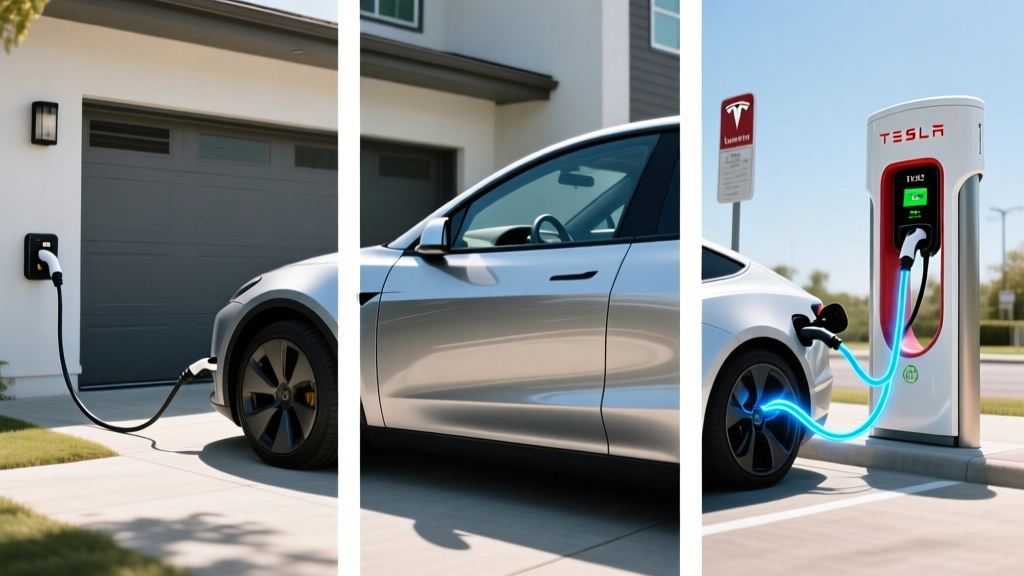
Charging Levels Explained: How Fast Will Each Level Add Range?
EV charging is measured in kW (kilowatts), which is the rate of power delivery — think of it as the width of the pipe. The energy stored in your battery is measured in kWh (kilowatt-hours), which is the total volume of electricity. A 75 kWh battery charged at 7.2 kW takes roughly 10.4 hours from empty to full (minus losses). Here is how the three charging levels compare in practical terms:
| Level | Voltage | Power (kW) | Miles of Range Added per Hour | Typical Use Case |
|---|---|---|---|---|
| Level 1 | 120V AC | 1.2–1.9 kW | 3–5 miles | Overnight top-off, PHEVs, low-mileage drivers |
| Level 2 | 240V AC | 3.3–19.2 kW | 12–75 miles | Home primary charging, workplace, public destinations |
| DC Fast Charging | 400–800V DC | 50–350 kW | 150–1,200+ miles (peak rate) | Road trips, highway corridors, commercial fleets |
Real-world charging time examples (10–80% State of Charge):
- 60 kWh battery (e.g., base Nissan Leaf, Chevrolet Equinox EV): ~9 hours on a 7.2 kW Level 2 charger; ~25–35 minutes on a 150 kW DC fast charger (depending on charge-curve taper above 80%).
- 82 kWh battery (e.g., Tesla Model Y Long Range, Ford Mustang Mach-E Extended Range): ~11 hours at 7.2 kW; ~8 hours at 11.5 kW; ~22–30 minutes on a 250 kW DC fast charger.
- 100+ kWh battery (e.g., GMC Sierra EV, Rivian R1S Max Pack): ~14 hours at 7.2 kW; ~20–40 minutes on a 350 kW DC fast charger with 800V architecture.
Most Maryland EV owners find that a 40-amp or 48-amp Level 2 home charger (delivering 9.6–11.5 kW) fully replenishes their battery overnight, which covers daily driving needs for all but the highest-mileage commuters.
Home Installation Costs: Equipment, Electrician, and the Panel-Upgrade Question
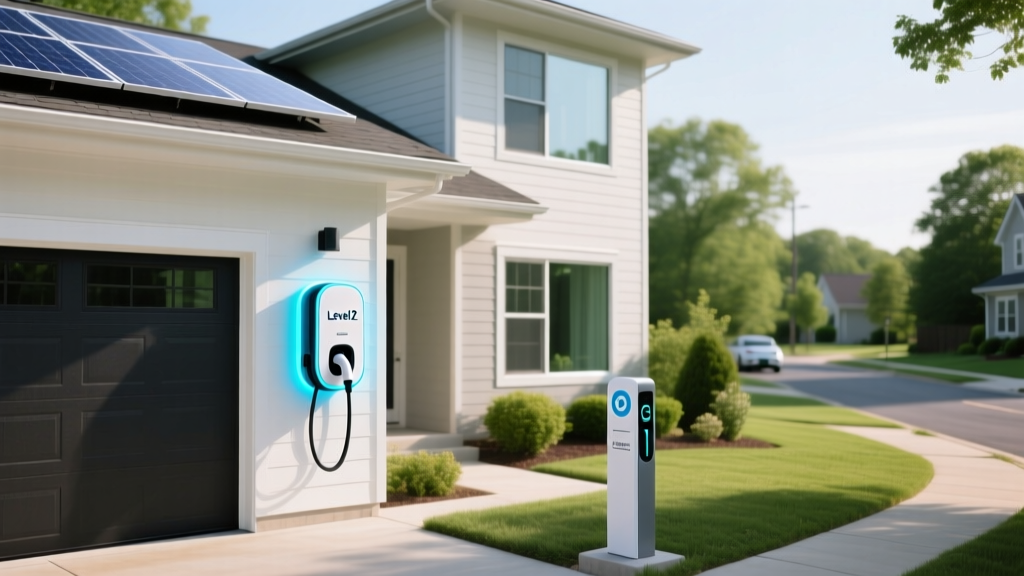
The total cost to install a home Level 2 EV charger in Maryland typically falls between $1,200 and $3,500, but can exceed $5,000 if your electrical panel needs upgrading. Here is where the money goes:
| Cost Component | Low End | High End | Notes |
|---|---|---|---|
| Level 2 Charging Equipment (hardwired or NEMA 14-50 plug) | $350 | $750 | Smart chargers with Wi-Fi and load management cost more |
| Electrician Labor (run 240V circuit, mount unit) | $500 | $2,000 | Depends on distance from panel to garage/driveway; conduit and drywall work add cost |
| Electrical Permit (county/municipal) | $50 | $200 | Required in all Maryland jurisdictions; inspection included |
| Panel Upgrade (100A → 200A service) | $1,500 | $4,000+ | Needed if existing panel lacks capacity for a 40–60A dedicated circuit |
| Total (no panel upgrade) | $900 | $2,950 | |
| Total (with panel upgrade) | $2,400 | $6,950+ |
Electrical requirements for a typical Level 2 install:
- Circuit: Dedicated 240V circuit, typically 40A, 50A, or 60A breaker (the charger should draw no more than 80% of the breaker's rated capacity per NEC continuous-load rules — so a 50A breaker supports a 40A charger delivering 9.6 kW).
- Wire gauge: 6 AWG copper for 50A circuits; 4 AWG for 60A circuits (longer runs may require upsizing to reduce voltage drop).
- Outlet type (if not hardwired): NEMA 14-50 is the most common residential 240V receptacle for EV charging.
- GFCI protection: NEC 2020 and later require GFCI protection for 240V receptacles used for EV charging in garages and outdoors. Hardwired installations may avoid this requirement — your licensed electrician will determine compliance.
- Outdoor rating: If your charger mounts outside, it must carry a NEMA 4 or NEMA 4X weather-resistance rating.
Maryland EV Charger Credit: Eligibility and How to Claim
The Maryland Electric Vehicle Supply Equipment (EVSE) Tax Credit applies to both the equipment and installation costs of qualified home charging equipment. Here is what you need to qualify:
- Credit amount: 40% of the total cost of qualified EVSE and installation, up to a maximum credit of $700 for residential property.
- Equipment requirement: The charger must be listed by a nationally recognized testing laboratory (UL, ETL) and designed to deliver Level 2 or higher charging (240V AC or DC).
- Property type: Must be installed at your primary residence in Maryland.
- Claim process: File Maryland Form 500CR (Business Tax Credits) or the appropriate individual credit form with your state tax return. Retain all receipts, equipment specifications, and the electrician's invoice.
- Federal overlap: The IRS §30C Alternative Fuel Vehicle Refueling Property Credit may provide an additional credit of up to $1,000 (30% of cost), but it is limited to property placed in service in eligible census tracts (low-income or non-urban areas). Check your address eligibility on the IRS §30C page.
Example savings calculation: If your total Level 2 charger purchase and installation costs $2,200, the Maryland credit covers 40% × $2,200 = $700 (hitting the cap). If your census tract also qualifies for the federal §30C credit, you could claim an additional 30% × $2,200 = $660, bringing your net cost down to roughly $840 for a complete home charging setup.
Which Connector Is Compatible With Your EV?
The connector landscape has shifted significantly. As of 2026, nearly all new EVs sold in North America either ship with the NACS (North American Charging Standard) port — the connector Tesla has used for years — or include a CCS-to-NACS adapter. Here is a compatibility breakdown by brand:
| Brand | Native Connector | Adapter Needed for Tesla Superchargers? | Adapter Needed for CCS Stations? |
|---|---|---|---|
| Tesla (all models) | NACS | No | Yes — Tesla sells a CCS adapter (~$175) |
| Ford (F-150 Lightning, Mach-E) | NACS (2025+) | No | Check — adapter may be included |
| General Motors (Blazer EV, Equinox EV, Silverado EV) | NACS (2025+) | No | Adapter available |
| Hyundai / Kia (Ioniq 5, EV6, EV9) | CCS1 | Yes — adapter required | No |
| Rivian (R1S, R1T) | NACS | No | Yes — adapter available |
| Volkswagen (ID.4, ID.7) | CCS1 | Yes — adapter required | No |
| BMW (i4, i5, iX) | CCS1 (2025 models transitioning to NACS) | Check model year | No (CCS models) |
| Nissan (Leaf — legacy, Ariya) | CHAdeMO (Leaf) / CCS1 (Ariya) | Yes — adapter required | No (Ariya) |
What this means for your home charger purchase: Most Level 2 home chargers sold in 2026 come with a NACS connector or include a CCS adapter in the box. If you own a CCS-equipped vehicle (Hyundai, Kia, VW, older BMWs), verify that the charger you buy either has a CCS connector or includes the appropriate adapter. The J1772 connector, once the universal Level 2 standard, is now legacy — most new chargers include a J1772-to-NACS adapter for backward compatibility.
Cost to Charge: Home Electricity vs. Public Stations vs. Gas
Maryland's residential electricity rates average around $0.15–$0.17 per kWh in 2026, though utility-specific time-of-use (TOU) plans from Pepco, BGE, and Potomac Edison can drop off-peak rates to $0.08–$0.11 per kWh for overnight charging. Public DC fast charging networks (Electrify America, EVgo, Tesla Supercharger) typically charge $0.32–$0.55 per kWh depending on location and membership tier.
| Scenario | Rate ($/kWh or $/gal) | Vehicle Efficiency | Cost Per Mile |
|---|---|---|---|
| Home Level 2 (off-peak TOU) | $0.10/kWh | 3.0 mi/kWh (e.g., Tesla Model Y) | $0.033 |
| Home Level 2 (standard rate) | $0.16/kWh | 3.0 mi/kWh | $0.053 |
| Public DC Fast Charging | $0.44/kWh | 3.0 mi/kWh | $0.147 |
| Gasoline Car (30 MPG combined) | $3.40/gal (MD avg) | 30 MPG | $0.113 |
| Gasoline Car (22 MPG combined, e.g., midsize SUV) | $3.40/gal | 22 MPG | $0.155 |
The takeaway: Charging at home on an off-peak TOU plan costs roughly one-third to one-quarter of what you would spend on gasoline per mile. Even at standard residential rates, home charging is cheaper per mile than a 30 MPG gas car. However, relying exclusively on public DC fast charging erases most of the cost advantage — it is more expensive per mile than a fuel-efficient hybrid. Home charging is where the economics work best, which is exactly why the Maryland EV charger credit exists.
Recommended Level 2 Home Chargers for Maryland Homes
Here are five chargers worth considering, each selected for reliability, connector flexibility, and smart features that help you manage electrical load and track costs:
ChargePoint Home Flex
- Power output: Up to 12 kW (50A) — adjustable down to 16A for homes with limited panel capacity
- Connector: NACS (2026 version); J1772 adapter included
- Cable length: 23 feet
- Smart features: Wi-Fi, Alexa integration, scheduling for off-peak TOU rates, detailed cost tracking in app
- Price: ~$599
- Best for: Flexible amperage adjustment if your electrician recommends a lower-draw circuit
Emporia Level 2 EV Charger
- Power output: Up to 11.5 kW (48A)
- Connector: J1772 (NACS adapter available separately)
- Cable length: 24 feet
- Smart features: Wi-Fi, solar integration (pairs with Emporia Vue energy monitor), TOU scheduling, load management
- Price: ~$399
- Best for: Budget-conscious buyers who want energy monitoring and solar integration
Tesla Wall Connector
- Power output: Up to 11.5 kW (48A)
- Connector: NACS native; J1772 adapter included for non-Tesla vehicles
- Cable length: 24 feet
- Smart features: Wi-Fi, over-the-air updates, power sharing between two Wall Connectors on one circuit, access control
- Price: ~$475
- Best for: Tesla owners and households with multiple NACS-equipped EVs
Grizzl-E Smart
- Power output: Up to 10 kW (40A)
- Connector: J1772 (NACS adapter included in 2026 kit)
- Cable length: 24 feet
- Smart features: Wi-Fi, OCPP-compatible, adjustable amperage (16A/24A/32A/40A), IP67 outdoor rating
- Price: ~$449
- Best for: Outdoor installations and Canadian/Maryland cold-weather durability
EnelX JuiceBox 48
- Power output: Up to 11.5 kW (48A)
- Connector: J1772 (NACS adapter sold separately)
- Cable length: 25 feet
- Smart features: Wi-Fi, app-based scheduling, energy-use reporting, smart-grid compatible
- Price: ~$499
- Best for: Drivers who want a long cable and proven smart-scheduling for TOU rate optimization
Safety, Permits, and Code Considerations for Maryland Installations
Every Level 2 EV charger installation in Maryland requires a permit from your county or municipal building department and a subsequent inspection. Skipping the permit risks voiding your home insurance coverage, failing a future home sale inspection, and disqualifying you from the Maryland EV charger credit (which requires proof of permitted installation).
Key code and safety requirements:
- Dedicated circuit: Your EV charger must be on its own dedicated circuit — it cannot share a breaker with other appliances. NEC Article 625 governs EV charging installations.
- GFCI protection: Required for all 240V receptacles in garages and outdoor locations per NEC 2020+. Hardwired chargers (no plug) may not require a GFCI breaker, which can simplify installation and reduce nuisance trips.
- Outdoor installations: Must use equipment rated NEMA 4 or higher for weather resistance. Conduit must be rated for wet locations.
- Load management: If your panel is near capacity but you want to avoid a costly upgrade, consider a smart charger with dynamic load management (e.g., ChargePoint Home Flex or Emporia with Vue panel monitor). These devices monitor your home's total electrical draw in real time and throttle the charger's amperage when other large loads (AC, dryer, oven) are running — keeping you within your panel's safe capacity without a full upgrade.
- Utility incentives: Some Maryland utilities (BGE, Pepco) offer additional rebates or TOU rate plans specifically for EV owners. Check with your utility before installation — some require pre-approval or a dedicated meter for the EV circuit to qualify for discounted rates.
Frequently Asked Questions
How much does it cost to install a home EV charger in Maryland?
Expect to pay $900–$2,950 for a standard Level 2 installation (equipment, electrician, and permit) if your electrical panel has adequate capacity. If you need a panel upgrade from 100A to 200A service, add $1,500–$4,000. The Maryland EV charger credit can reimburse up to $700 (40% of total cost), and the federal §30C credit may add up to $1,000 in eligible census tracts.
How fast will each charging level add range?
Level 1 (120V) adds 3–5 miles of range per hour — sufficient for plug-in hybrids or low-mileage BEV drivers. Level 2 (240V, 40–48A) adds 25–35 miles per hour for most EVs, fully replenishing a 75–85 kWh battery overnight. DC fast charging adds 150–1,200+ miles per hour at peak rates, though the charge curve tapers significantly above 80% State of Charge, so real-world 10–80% sessions take 18–40 minutes depending on the vehicle and charger.
Which connector or charger is compatible with my EV?
For 2025–2026 model year vehicles, Tesla, Ford, GM, Rivian, and several others use the NACS connector natively. Hyundai, Kia, Volkswagen, and some BMW models still use CCS1. The Nissan Leaf uses the legacy CHAdeMO connector. Most 2026 home chargers ship with NACS or include adapters. Confirm your vehicle's port type before purchasing a charger, and check whether the manufacturer includes a cross-standard adapter.
How much does EV charging cost per mile compared to gas?
Home charging on Maryland's off-peak TOU rates costs approximately $0.03–$0.05 per mile for a typical EV (3.0 mi/kWh efficiency). Gasoline at $3.40/gallon costs $0.11 per mile at 30 MPG and $0.15 per mile at 22 MPG. Public DC fast charging at $0.44/kWh costs roughly $0.15 per mile — comparable to a gas-powered SUV. The cost savings of EV ownership depend heavily on access to affordable home charging.
What electrical upgrades might I need before installing a charger?
The most common upgrade is a panel replacement from 100A to 200A service ($1,500–$4,000), needed when your existing panel cannot accommodate a new 40–60A breaker. Older homes may also need aluminum-to-copper wiring updates, a new grounding rod, or conduit runs through finished walls. A licensed electrician should perform a load calculation (NEC Article 220) to determine whether your panel has headroom. If it does not, consider a lower-amperage charger (e.g., 32A instead of 48A) or a dynamic load-management system to avoid a panel upgrade entirely.