The Ford Mustang Mach-E Select remains one of the most accessible long-range electric crossovers on the market. With an EPA-estimated 250 miles of range from its 75.7 kWh usable Standard Range battery (and up to 320 miles on the Extended Range pack), the Select trim delivers real daily usability. But hitting those numbers consistently — and recovering range quickly when depleted — depends entirely on your charging strategy.
This guide walks through exactly how to charge a Mach-E Select at home and on the road, including real install costs, electrical requirements, equipment picks, and the per-mile economics versus a comparable gas crossover. Whether you're a new owner or shopping for one, this is the charging blueprint.
Mach-E Select Range and Battery: The Baseline Numbers
Before sizing a charger, you need to know what you're filling. The 2025–2026 Mustang Mach-E Select comes in two battery configurations:
| Spec | Standard Range (RWD) | Extended Range (RWD/eAWD) |
|---|---|---|
| Usable Battery Capacity | 75.7 kWh (LFP) | 91 kWh (NMC) |
| EPA Range | 250 mi | 320 mi (RWD) / 290 mi (eAWD) |
| Real-World Highway (70 mph, 65°F) | ~215–225 mi | ~270–285 mi |
| Cold-Weather Highway (25°F) | ~175–195 mi | ~220–245 mi |
| Max DC Fast Charge Rate | ~150 kW peak | ~170 kW peak |
| 10–80% DC Fast Charge | ~32 min | ~36 min |
| Onboard AC Charger | 10.5 kW (48A capable) | 10.5 kW (48A capable) |
| Starting MSRP | ~$39,995 (before incentives) | |
The shift to an LFP (lithium iron phosphate) chemistry for the Standard Range pack is significant: LFP tolerates daily charging to 100% without the degradation concerns of NMC. If your Select has the Standard Range pack, Ford recommends charging to 100% regularly. The Extended Range NMC pack is best kept between 20–80% for daily use, topping to 100% only before long trips.
Charging Levels Explained: How Fast Will Each Add Range?
EV charging comes in three tiers. The critical distinction: kW (kilowatts) measures power — how fast energy flows into the battery. kWh (kilowatt-hours) measures energy — the total capacity of the battery itself. Think of kW as the flow rate of a hose and kWh as the size of the bucket.
| Level | Voltage / Power | Miles of Range Added Per Hour | Full Charge Time (75.7 kWh) | Best For |
|---|---|---|---|---|
| Level 1 (120V) | 120V / 1.2–1.4 kW | 3–5 mi/hr | ~55–65 hours | Overnight top-ups, low-mileage days |
| Level 2 (240V) | 240V / 7.7–11.5 kW | 25–38 mi/hr | ~7–10 hours | Daily home charging, overnight full refill |
| DC Fast Charge | 400V+ / 50–170 kW | 150–250+ mi/hr (to 80%) | 10–80% in ~32 min | Road trips, rapid replenishment |
The Mach-E Select's 10.5 kW onboard AC charger is the bottleneck for Level 2 charging — even if you plug into an 11.5 kW (48A) wallbox, the car will only accept up to 10.5 kW. This still delivers roughly 35 miles of range per hour of charging, which is more than sufficient for overnight replenishment.
Home Charger Installation: Electrical Requirements and Costs
Installing a Level 2 home charger is the single highest-impact upgrade for EV ownership. Here's what's involved for a Mach-E Select owner:
Electrical Requirements
- Circuit: A dedicated 60-amp breaker (for a 48A continuous charger) or 50-amp breaker (for a 40A charger)
- Voltage: 240V, single-phase (standard US residential split-phase)
- Wire gauge: 6 AWG copper (for 60A circuit) or 8 AWG (for 50A circuit) — run in conduit
- Panel capacity: Your main service panel needs enough spare capacity. A 200-amp panel is standard in modern homes; older 100-amp panels may require an upgrade.
- Permit: Required in virtually all US jurisdictions for new 240V circuits
Panel Upgrade Considerations
If your home has a 100-amp main panel or limited breaker slots, adding a 60-amp EV circuit may push total calculated load beyond code limits. A panel upgrade to 200 amps typically costs $1,500–$3,000 and should be factored into your budget. A licensed electrician will perform a load calculation during the estimate — ask for this explicitly.
Installation Cost Breakdown
| Component | Simple Install (panel nearby, short run) | Complex Install (long run, conduit, panel upgrade) |
|---|---|---|
| Level 2 Charger (Equipment) | $400–$700 | $400–$700 |
| Electrician Labor | $500–$1,200 | $1,500–$3,000 |
| Materials (wire, conduit, breaker) | $100–$300 | $300–$800 |
| Permit & Inspection | $50–$200 | $50–$200 |
| Panel Upgrade (if needed) | — | $1,500–$3,000 |
| Total Estimated Cost | $1,050–$2,400 | $3,750–$7,700 |
For most homeowners with a 200-amp panel and a garage or driveway within 50 feet of the panel, expect to spend $1,200–$2,500 total. Get at least three quotes and verify the electrician is licensed and will pull a permit — unpermitted work can void home insurance and cause issues at resale.
Safety and Code Considerations
- Dedicated circuit: The EV charger must have its own breaker — never share with other appliances
- GFCI protection: NEC 2020+ requires GFCI protection for outdoor receptacles; hardwired chargers may bypass this requirement (consult your local AHJ)
- Outdoor rating: If installing outside, the charger must carry a NEMA 4 or NEMA 4X rating for weather resistance
- Cable management: Ensure the charging cable doesn't stretch across walkways or driveways — trip hazards violate code in many jurisdictions
Connector Compatibility: NACS, CCS, and the Mach-E
Ford made a pivotal move for the 2025 model year: all new Mustang Mach-E vehicles ship with the NACS (North American Charging Standard) port, granting native access to Tesla's Supercharger network without an adapter. If you're buying a 2025–2026 Mach-E Select, you'll have NACS.
For 2021–2024 Mach-E owners with the CCS1 port, Ford offers a complimentary NACS adapter (for eligible original owners) or you can purchase one. This adapter enables Supercharger access but adds slight charge-port bulk.
| Connector | 2021–2024 Mach-E | 2025–2026 Mach-E | Network Access |
|---|---|---|---|
| NACS (Tesla) | Via adapter | Native port | Tesla Supercharger (17,000+ stalls) |
| CCS1 | Native port | Via adapter (if needed) | Electrify America, EVgo, ChargePoint DC |
| CHAdeMO | Not compatible | Not compatible | Largely legacy — being phased out |
| J1772 (Level 2 AC) | Native | Via NACS adapter (included) | Public Level 2, home chargers |
Key takeaway: The 2025+ NACS-native Mach-E Select has the broadest DC fast-charging access of any non-Tesla EV. You can pull into Superchargers and CCS networks alike (with a CCS adapter for the latter), covering over 95% of public DC infrastructure in the US.
Cost to Charge: Per-Mile Economics vs Gas
One of the strongest arguments for the Mach-E Select is fuel cost. Here's how charging costs compare to a gas crossover averaging 26 MPG combined (like the Ford Edge or Honda Passport):
| Scenario | Rate | Cost for Full Charge (75.7 kWh) | Cost Per Mile (250 mi range) | Gas Equivalent at 26 MPG, $3.40/gal |
|---|---|---|---|---|
| Home Off-Peak (utility TOU rate) | $0.08–$0.12/kWh | $6.06–$9.08 | $0.024–$0.036/mi | $0.131/mi |
| Home Standard Rate | $0.14–$0.18/kWh | $10.60–$13.63 | $0.042–$0.055/mi | $0.131/mi |
| Public Level 2 (workplace/mall) | $0.20–$0.35/kWh | $15.14–$26.50 | $0.061–$0.106/mi | $0.131/mi |
| DC Fast Charge (Electrify America, EA Pass+) | $0.36–$0.48/kWh | $27.25–$36.34 | $0.109–$0.145/mi | $0.131/mi |
| Tesla Supercharger (varies by location) | $0.25–$0.40/kWh | $18.93–$30.28 | $0.076–$0.121/mi | $0.131/mi |
At home on off-peak rates, the Mach-E Select costs roughly 3–4 cents per mile to "fuel" — about a quarter of the gas equivalent. Even on DC fast chargers during road trips, costs are comparable to or slightly below gas. The Mach-E Select's efficiency of roughly 3.0–3.3 miles per kWh (per EPA data) is competitive for the crossover segment.
For an owner driving 12,000 miles per year with 80% home charging and 20% DC fast charging, annual fuel cost is approximately $480–$720, versus $1,570 for the gas equivalent. That's $850–$1,090 in annual fuel savings before considering reduced maintenance (no oil changes, less brake wear from regen).
Recommended Home Chargers for the Mach-E Select
Given the Mach-E Select's 10.5 kW onboard charger, a 48-amp Level 2 wallbox maximizes your AC charging speed. Here are proven picks:
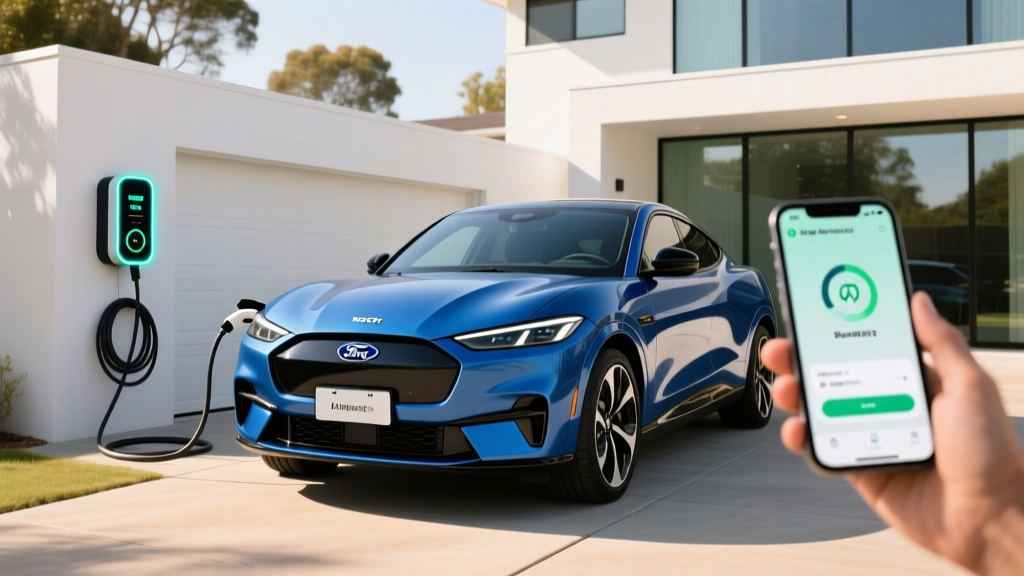
Ford Connected Charge Station
Power: 48A / 11.5 kW (240V)
Connector: NACS (2025+ models) or CCS (older)
Cable: 25 ft
Smart Features: FordPass integration, scheduled charging, energy tracking
Price: ~$600–$700 (sometimes included with vehicle purchase)
Verdict: Best Ford ecosystem integration. Scheduled charging syncs with utility TOU rates via FordPass.
ChargePoint Home Flex
Power: Up to 50A / 12 kW (240V, adjustable)
Connector: NACS or J1772 (configurable)
Cable: 23 ft
Smart Features: Wi-Fi, app scheduling, Alexa, energy reports, amperage dip-switch adjustable
Price: ~$550–$650
Verdict: Most versatile — adjustable amperage lets you match your circuit without buying a different unit. Works with any EV.
Tesla Wall Connector
Power: Up to 48A / 11.5 kW (240V)
Connector: NACS native
Cable: 24 ft
Smart Features: Wi-Fi, OTA updates, power sharing (multiple units on one circuit), load management
Price: ~$420–$475
Verdict: Best value for NACS-native vehicles. Clean design, excellent reliability. No app scheduling — relies on vehicle-side scheduling via FordPass.
All three chargers will fully replenish the Mach-E Select Standard Range battery (75.7 kWh) overnight in approximately 7.5–9 hours. For Extended Range (91 kWh), expect 9–10.5 hours. Hardwired installation is recommended over a plug-in NEMA 14-50 receptacle for maximum reliability and to avoid GFCI nuisance tripping issues documented with some 240V outlets.
Public Charging Strategy: Maximizing Mach-E Select Range on the Road
For road trips, the Mach-E Select's DC fast-charging capability is adequate but not class-leading. Here's how to plan:
- Precondition every time: Set a navigation destination to a charging station in the FordPass/sync system. The car will warm or cool the battery to optimal temperature, shaving 5–10 minutes off your charge session.
- Target 10–80%: Charging past 80% on DC is painfully slow. Plan to arrive at chargers around 10–15% SoC and leave at 80%.
- Use PlugShare or the FordPass app: Filter for NACS Superchargers or CCS stations with 150+ kW stalls to maximize your charge rate.
- Expect real-world session times: A 10–80% charge on a 150 kW+ station takes approximately 30–38 minutes depending on battery temperature and starting SoC.
The Mach-E Select's NACS access (2025+ models) is a significant road-trip advantage. Tesla's Supercharger network remains the most reliable and geographically comprehensive DC fast-charging system in the US, with consistent uptime and accurate stall availability in-app.
Federal Tax Credit and Charging Incentives
The IRS §30D clean vehicle tax credit can offset up to $7,500 of the Mach-E Select's purchase price — but eligibility depends on several factors that change frequently:
- MSRP cap: SUVs/crossovers must be under $80,000 (Mach-E Select qualifies)
- Buyer income cap: AGI must not exceed $150,000 (single) / $300,000 (joint)
- Battery sourcing: Critical minerals and battery components must meet escalating domestic-content thresholds — verify current-year compliance on fueleconomy.gov
- Point-of-sale transfer: As of 2024+, you can transfer the credit to the dealer at purchase, reducing the sale price directly rather than waiting for tax filing
For home charging equipment, the §30C Alternative Fuel Vehicle Refueling Property Credit covers 30% of charger and installation costs (up to $1,000) — but only if you live in a qualifying census tract (rural or low-income areas). Check IRS guidance for your ZIP code.
Frequently Asked Questions
How much does it cost to install a home EV charger?
For a standard 48A Level 2 charger on a 60-amp 240V circuit, expect $1,200–$2,500 if your electrical panel has sufficient capacity and the charger is within 50 feet. If a panel upgrade is needed, costs can reach $4,000–$7,000+. Always get a load calculation from a licensed electrician before committing.
How fast will each charging level add range to the Mach-E Select?
Level 1 (120V): 3–5 miles per hour. Level 2 (240V, 48A): approximately 35 miles per hour. DC fast charging: 150–250+ miles per hour up to 80% SoC, tapering significantly above that. A full overnight Level 2 charge refills the Standard Range pack in about 7.5 hours.
Which connector is compatible with my Mach-E Select?
2025–2026 Mach-E Select models have a native NACS port, compatible with Tesla Superchargers and any NACS-equipped station. 2021–2024 models have CCS1 and need a NACS adapter for Supercharger access. For home Level 2 charging, NACS-native models use a NACS connector; older CCS models use J1772 (with the Ford-supplied adapter).
How much does charging cost per mile vs gas?
At home on average electricity rates ($0.14/kWh), the Mach-E Select costs roughly 4–5 cents per mile. A comparable gas crossover at 26 MPG and $3.40/gallon costs about 13 cents per mile. Home charging saves approximately $850–$1,100 per year for a driver covering 12,000 miles annually.
What electrical upgrades might I need for a home charger?
You'll need a dedicated 50A or 60A breaker on a 240V circuit. If your main panel is 100 amps or has limited breaker slots, a panel upgrade to 200 amps ($1,500–$3,000) may be required. Homes built after 2000 with 200-amp service rarely need upgrades. Your electrician's load calculation will determine this definitively.
Can I charge my Mach-E Select to 100% every day?
If your Select has the Standard Range LFP battery (75.7 kWh), yes — Ford recommends charging LFP packs to 100% at least weekly for accurate SoH calibration. If you have the Extended Range NMC pack (91 kWh), keep daily charges at 80% and only charge to 100% before long trips to minimize long-term degradation.