The Ford Mustang Mach-E GT pairs 480 horsepower with a usable 91 kWh NMC lithium-ion battery, but its performance tuning comes at an efficiency cost. If you own or are shopping for a Mach-E GT, understanding how to charge it properly at home and on the road is essential to extracting real value from Ford's electric pony car.
This guide covers the Mach-E GT's real-world range expectations, breaks down every charging level with exact speeds, walks through home Level 2 installation costs and electrical requirements, and recommends specific 2026 charger hardware. We'll also compare charging costs to gasoline so you know exactly what you're spending per mile.
Ford Mustang Mach-E GT Range: EPA vs. Real World
The 2026 Ford Mustang Mach-E GT carries an EPA-estimated range of 280 miles on its extended-range battery pack. That's 40 miles fewer than the Select and Premium trims with the same battery, a direct consequence of the GT's stickier tires, stiffer suspension, and more aggressive powertrain calibration.
- EPA Combined: 280 miles
- Highway driving (70-80 mph): ~230–250 miles
- Cold weather (below 32°F): ~190–220 miles (20–30% loss)
- Moderate city/suburban (45-65 mph, 60°F): ~260–280 miles
The Mach-E GT's NMC battery is thermally managed with active liquid cooling and heating, which helps mitigate cold-weather losses compared to passively cooled packs. Preconditioning the battery before DC fast charging is critical for achieving peak charge rates.
The 91 kWh usable battery capacity (approximately 98.8 kWh gross) uses NMC (nickel manganese cobalt) chemistry, which offers high energy density but requires careful thermal management. Ford provides an 8-year/100,000-mile battery warranty covering capacity loss below 70% of original — standard for the segment.
Charging Levels Explained: Speeds and Range Recovery
Understanding the difference between kW (kilowatts — the rate of power delivery) and kWh (kilowatt-hours — the total energy stored in the battery) is essential. Think of kW as how fast water flows through a hose, and kWh as the size of the bucket you're filling. The Mach-E GT's 91 kWh bucket can be filled at different flow rates depending on your charging equipment.
| Level | Power (kW) | Miles Added/Hour | 0–80% Time | Best For |
|---|---|---|---|---|
| Level 1 (120V) | 1.0–1.4 kW | 3–4 mi/hr | ~70+ hours | Emergency/trickle only |
| Level 2 (240V) | 7.7–19.2 kW | 21–52 mi/hr | ~4.5–10 hours | Daily home charging |
| DC Fast (CCS/NACS) | Up to 150 kW peak | ~185–230 mi/hr (peak) | ~45 min (10–80%) | Road trips |
The Mach-E GT's onboard AC charger maxes out at 10.5 kW on Level 2, meaning even if you install a 48-amp (11.5 kW) home charger, the car will only draw 10.5 kW. For DC fast charging, Ford rates the GT at a peak of 150 kW, though sustained rates taper significantly above 80% state of charge (SoC) to protect the NMC battery. Expect a realistic 10–80% session to take approximately 45 minutes at a properly rated 150 kW+ station.
Home Level 2 Charger Installation: Costs and Electrical Requirements
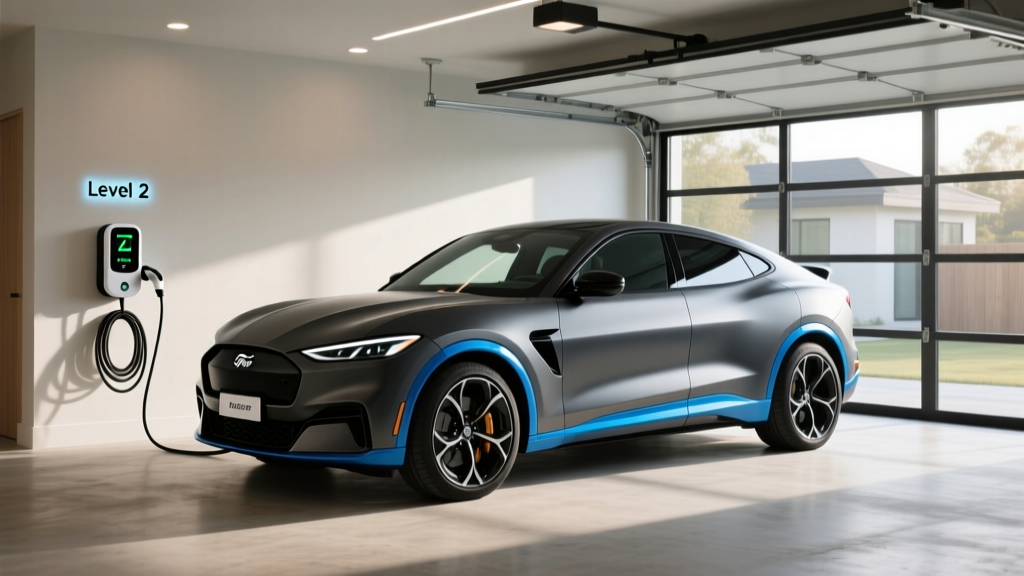
Installing a dedicated Level 2 home charger is the single highest-impact upgrade for Mach-E GT ownership. Here's what the electrical work actually involves.
Electrical Requirements
The Mach-E GT's 10.5 kW onboard charger pairs best with a 240V, 48-amp circuit (which requires a 60-amp breaker per NEC 80% continuous-load rule). This delivers the maximum 11.5 kW the circuit can supply, with the car drawing up to its 10.5 kW limit.
- Voltage: 240V (same as a dryer or oven outlet)
- Amperage: 48A charger on a 60A breaker, or 40A charger on a 50A breaker
- Wire gauge: 6 AWG copper for 60A; 8 AWG for 50A
- Dedicated circuit: Required — cannot share with other appliances
Installation Cost Breakdown
| Component | Low Estimate | High Estimate | Notes |
|---|---|---|---|
| Level 2 Charger (hardware) | $350 | $750 | Smart Wi-Fi chargers, 40–48A |
| Licensed Electrician (labor) | $400 | $1,500 | Depends on panel proximity, conduit run |
| Electrical Permit | $50 | $200 | Varies by municipality |
| Panel Upgrade (if needed) | $1,500 | $4,000 | 100A → 200A service; older homes only |
| Total (no panel upgrade) | $800 | $2,450 | Most homes with 200A service |
| Total (with panel upgrade) | $2,300 | $6,450 | Homes with 100A or maxed-out panels |
Safety and Code Requirements
- Dedicated circuit: NEC requires EV chargers have their own breaker — no sharing
- GFCI protection: Required for outdoor installations and some jurisdictions for indoor garage outlets (2023 NEC update)
- Outdoor rating: If mounting outside, use a NEMA 4-rated (weatherproof) enclosure and charger rated for outdoor use
- Cable management: UL-listed retractors or hooks keep cables off the ground and prevent tripping hazards
- Permit and inspection: Nearly all jurisdictions require an electrical permit and post-installation inspection — skipping this can void homeowner's insurance coverage for electrical fires
Connector Compatibility: NACS, CCS, and the Mach-E
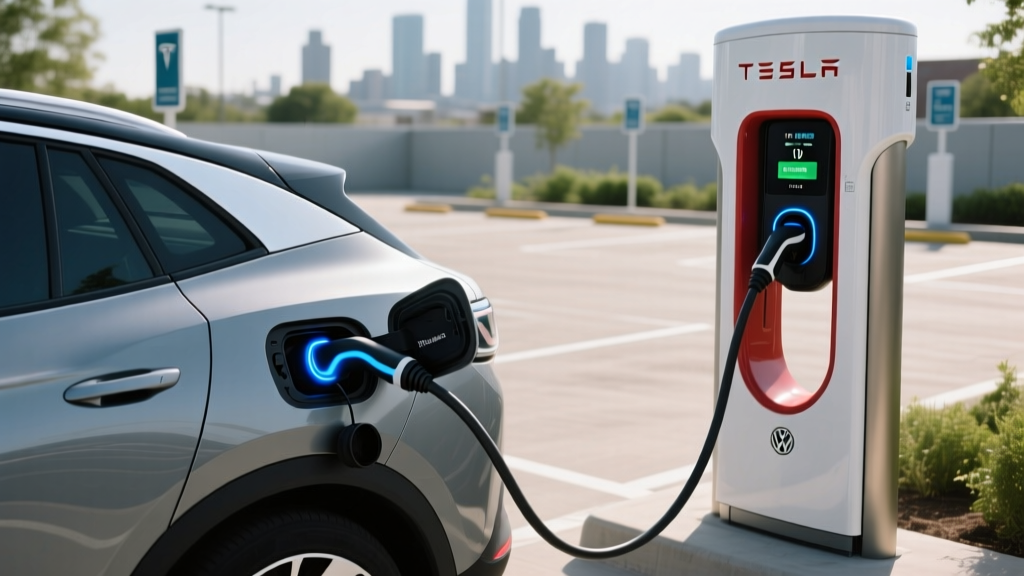
The 2026 Ford Mustang Mach-E GT ships with a NACS (North American Charging Standard) charge port — Ford transitioned from CCS to NACS starting with the 2025 model year. This is a significant advantage for public charging access, as it grants native compatibility with Tesla's Supercharger network (over 25,000 stalls in North America) without an adapter.
| Connector | Native Support? | Adapter Needed? | Network Access |
|---|---|---|---|
| NACS (Tesla) | Yes — built-in | No | Tesla Superchargers, Electrify America (newer stalls), EVgo |
| CCS1 | No | Yes — NACS-to-CCS adapter (~$200–$250) | Legacy Electrify America, ChargePoint, non-Tesla DCFC |
| J1772 (Level 2) | No (NACS port) | Yes — J1772-to-NACS adapter (often included with vehicle) | Public Level 2 stations, non-Tesla destination chargers |
| CHAdeMO | No | Not available (obsolete standard) | Declining network — avoid reliance |
If you purchased a 2022–2024 Mach-E GT with a CCS port, Ford offers a NACS adapter through dealerships, and third-party options from brands like Lectron and A2Z are available. For home Level 2 charging, most NACS-equipped chargers (Tesla Wall Connector, Ford Connected Charge Station) plug directly in.
Charging Cost Per Mile: Mach-E GT vs. Gas Equivalent
The Mach-E GT achieves an EPA-rated 82 MPGe combined (approximately 41 kWh per 100 miles). Let's compare real charging costs against a gasoline performance SUV baseline.
| Scenario | Rate | Cost/Mile (Mach-E GT) | Cost/Mile (22 MPG Gas SUV @ $3.50/gal) |
|---|---|---|---|
| Home Off-Peak | $0.09/kWh | $0.037 | $0.159 |
| Home Standard Rate | $0.16/kWh | $0.066 | $0.159 |
| Public Level 2 | $0.28/kWh | $0.115 | $0.159 |
| DC Fast Charging | $0.48/kWh | $0.197 | $0.159 |
At home on off-peak rates, the Mach-E GT costs roughly 77% less per mile than a comparable gas performance SUV. However, exclusive reliance on DC fast charging actually exceeds gasoline costs per mile — a critical reason why home Level 2 charging is practically mandatory for EV economics to work. Over 15,000 annual miles, home charging at $0.12/kWh saves approximately $1,380 per year compared to gasoline at $3.50/gallon.
Best Home Chargers for the Mach-E GT (2026 Picks)
Since the Mach-E GT's onboard charger caps at 10.5 kW, a 48-amp charger is the sweet spot — it delivers up to 11.5 kW on the circuit, and the car uses what it can. Here are our tested recommendations:
Tesla Wall Connector (Gen 4)
- Power: 48A / 11.5 kW max
- Connector: NACS native
- Cable: 24 ft
- Smart features: Wi-Fi, OTA updates, load sharing, access control
- Price: ~$425
- Best for: NACS-equipped EVs; best value-to-feature ratio
Ford Charge Station Pro
- Power: 48A / 11.5 kW max
- Connector: NACS native (2025+ models)
- Cable: 25 ft
- Smart features: FordPass integration, scheduled charging, V2L capable
- Price: ~$799
- Best for: Ford loyalists wanting deep app integration
ChargePoint Home Flex
- Power: Configurable 16–50A / up to 12 kW
- Connector: NACS or J1772 (select at purchase)
- Cable: 23 ft
- Smart features: Wi-Fi, amperage dial, Alexa, energy tracking
- Price: ~$599
- Best for: Homes with limited panel capacity (dial down amps)
All three chargers require hardwired installation on a dedicated 60-amp breaker (or 50-amp for the ChargePoint dialed to 40A). Hardwired units are preferred over plug-in NEMA 14-50 outlets for continuous high-power charging because they eliminate the receptacle as a failure point and satisfy NEC requirements without GFCI breaker mandates (the charger handles ground-fault protection internally).
Mach-E GT DC Fast Charging: What to Expect on Road Trips
The Mach-E GT's 150 kW peak DC fast-charge rate is adequate but not class-leading. Competitors like the Hyundai Ioniq 5 (peak 240 kW) and Porsche Taycan (peak 270 kW) recharge significantly faster. Here's the realistic curve:
- 10–40% SoC: Sustains near 150 kW peak — fastest portion of the curve
- 40–60% SoC: Tapers to ~110–120 kW
- 60–80% SoC: Drops to ~75–90 kW
- 80–100% SoC: Falls below 40 kW — avoid charging past 80% on road trips
Preconditioning the battery by setting a DC fast-charger destination in the navigation system activates the thermal management system to bring the pack to optimal temperature. In testing, preconditioned Mach-E GT sessions average approximately 45 minutes from 10–80%, adding roughly 210 miles of range. Without preconditioning (or in cold weather below 40°F), expect 55–65 minutes for the same session.
Frequently Asked Questions
How much does it cost to install a home EV charger for the Mach-E GT?
Most homeowners with a 200-amp electrical panel spend between $800 and $2,450 for a complete Level 2 installation including the charger hardware ($350–$750), electrician labor ($400–$1,500), and permits ($50–$200). If your home has a 100-amp panel or is already near capacity, a panel upgrade adds $1,500–$4,000. Always get a load calculation from a licensed electrician before committing.
How fast will each charging level add range to the Mach-E GT?
Level 1 (120V standard outlet) adds about 3–4 miles per hour — only viable for overnight top-ups on low-mileage days. Level 2 (240V home charger at 48A) adds approximately 28–32 miles per hour, fully replenishing the 91 kWh battery in roughly 9 hours. DC fast charging at 150 kW peak adds up to 230 miles per hour at the fastest portion of the curve (10–40% SoC), though the rate tapers significantly above 60%.
Which connector does the 2026 Mach-E GT use?
The 2026 Mach-E GT uses the NACS (North American Charging Standard) connector, giving it native access to Tesla Superchargers and an expanding network of NACS-equipped public stations. For legacy CCS stations, a NACS-to-CCS adapter is required (~$200–$250). For Level 2 public stations with J1772 connectors, a J1772-to-NACS adapter is needed — Ford typically includes one with the vehicle.
How much does charging the Mach-E GT cost per mile vs. gas?
At a national average residential rate of $0.16/kWh, the Mach-E GT costs approximately $0.066 per mile to charge at home. A comparable 22 MPG gasoline performance SUV at $3.50/gallon costs $0.159 per mile. Home charging saves roughly $0.09 per mile, or about $1,380 over 15,000 annual miles. However, exclusive reliance on DC fast charging at $0.48/kWh pushes costs to $0.197/mile — more expensive than gasoline.
What electrical upgrades might I need for a home charger?
The most common upgrade is a panel service increase from 100A to 200A, required when your existing panel cannot accommodate an additional 60-amp continuous load. Older homes (pre-1990) and homes with significant existing loads (electric heat, hot tub, double oven) are most likely to need this. Your electrician will perform an NEC Article 220 load calculation. Secondary upgrades may include running new conduit from the panel to the garage (if the panel is on the opposite side of the house) or upgrading the meter base if the utility requires it.
Sources: EPA Fuel Economy — Ford Mustang Mach-E, Ford Motor Company — 2026 Mustang Mach-E Specifications, IRS §30D Clean Vehicle Credit Guidelines