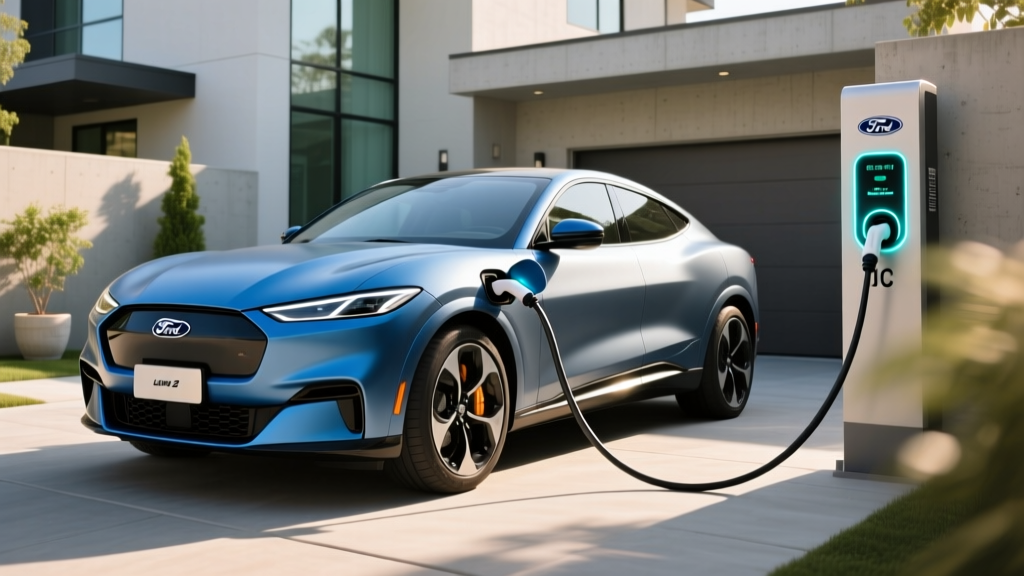
The Ford Mustang Mach-E remains one of the most popular mainstream electric SUVs on the road, but owners and prospective buyers consistently ask one question above all others: how long does it actually take to charge? The answer depends heavily on which battery pack your Mach-E has, what charging equipment you're using, and whether you're charging at home or on the road.
This guide breaks down Mach-E charging times across every level — from a standard 120V wall outlet to a 150 kW DC fast charger — with exact numbers, real-world caveats, and the home installation details you need to budget correctly.
Mach-E Battery Packs and Why They Change Charging Speed
Before we get to times, you need to know which battery you're working with. Ford offers two usable battery capacities for the current-generation Mach-E, and the size directly determines how long any charge session takes:
- Standard Range (SR): ~70 kWh usable (LFP chemistry, 2024+ models)
- Extended Range (ER): ~91 kWh usable (NMC chemistry)
A larger battery holds more energy, which means a full 10–80% session takes longer even at the same charge rate. The SR pack's LFP chemistry also tolerates regular charging to 100% better than NMC, which shifts your daily charging strategy. Both packs accept a peak DC fast-charge rate of 150 kW, though the ER sustains higher rates longer due to its greater capacity absorbing the same power input.
Charging Levels Explained: kW, Miles Per Hour, and Mach-E Times
EV charging is measured in kW (kilowatts), which is the rate of power delivery — think of it as the width of the hose filling your battery. Your battery capacity is measured in kWh (kilowatt-hours), which is the total volume of energy it stores. These are not interchangeable: kW is speed, kWh is the tank.
| Level | Voltage / Amps | Power (kW) | Miles of Range Per Hour | 0–100% Time (ER Pack) |
|---|---|---|---|---|
| Level 1 (120V household) | 120V / 12A | ~1.4 kW | ~3–4 mi/hr | ~65+ hours |
| Level 2 (240V home/public) | 240V / 32–48A | 7.7–11.5 kW | ~20–32 mi/hr | ~8–11 hours |
| DC Fast Charge | 400V+ architecture | Up to 150 kW peak | ~250+ mi/hr (at peak) | 10–80% in ~45 min |
The Mach-E's onboard charger is rated at 10.5 kW (single-phase, 48A). This means even if you plug into a 60A Level 2 circuit capable of delivering 14.4 kW, the car will only accept 10.5 kW. Matching your home charger to this ceiling avoids overspending on equipment you can't fully use.
Mach-E DC Fast Charging: The Real 10–80% Numbers
On a 150 kW DC fast charger — the kind found at Electrify America, EVgo, and an increasing number of Tesla Supercharger stations now open to non-Tesla vehicles — the Mach-E peaks at 150 kW but does not sustain that rate for the entire session. Here's what the charge curve actually looks like:
- 10–30% SoC: Peak rate near 150 kW; fastest segment of the curve
- 30–60% SoC: Sustains roughly 100–130 kW as battery management moderates heat
- 60–80% SoC: Tapers to 50–70 kW to protect cell longevity
- Above 80%: Drops sharply below 30 kW — not worth waiting at a public station
Extended Range (91 kWh) — 10–80% in approximately 45 minutes on a 150 kW charger. The Standard Range (70 kWh) pack completes 10–80% in roughly 38 minutes under the same conditions, because there's less total energy to add despite the same peak rate.
Home Charging Installation: Requirements, Costs, and Panel Gotchas
Most Mach-E owners will do 85–95% of their charging at home on a Level 2 station. Here's what that actually requires and what it costs.
Electrical Requirements for Mach-E Home Charging
To get the Mach-E's maximum 10.5 kW Level 2 rate, you need a 240V circuit rated at 60 amps (EVSE set to 48A continuous draw, which is 80% of the breaker rating per NEC code). If your electrical panel has capacity, this is straightforward. If it doesn't, costs escalate quickly.
| Item | Simple Install (panel adjacent) | Complex Install (long run / panel upgrade) |
|---|---|---|
| Level 2 EVSE (48A hardwired) | $500–$750 | $500–$750 |
| Electrician labor (240V/60A circuit) | $400–$800 | $1,200–$2,500 |
| Electrical permit | $50–$150 | $50–$200 |
| Panel upgrade (100A → 200A) if needed | N/A | $1,500–$3,500 |
| Total Estimated Cost | $950–$1,700 | $3,250–$6,950 |
Panel upgrade reality check: Homes built before 1990 often have 100-amp service panels. Adding a 60A EV circuit to an already-loaded 100A panel may require a full service upgrade to 200A. This is the single biggest variable in home charging cost and is not always obvious until an electrician performs a load calculation. Get a quote that includes this assessment before committing.
Some utilities offer rebates of $250–$500 for Level 2 charger installation, and certain states provide additional incentives. Check with your local utility and your tax professional about eligibility — the federal Alternative Fuel Vehicle Refueling Property Credit (30C) may cover up to 30% of home charging equipment and installation costs (capped at $1,000), subject to census-tract eligibility requirements.
Connector Compatibility: NACS, CCS, and the Tesla Adapter Situation
Ford made a pivotal decision in 2024: all new Mach-E models ship with the NACS (North American Charging Standard) port, replacing the CCS1 connector used on 2021–2023 models. This matters enormously for where and how you charge.
| Model Year | Built-In Port | Tesla Supercharger Access | CCS Station Access |
|---|---|---|---|
| 2021–2023 | CCS1 | Via Ford-provided NACS adapter | Native (no adapter) |
| 2024–2026 | NACS | Native (no adapter) | Via CCS-to-NACS adapter |
If you own a 2024+ Mach-E, you can plug directly into Tesla Superchargers — the largest DC fast-charging network in the US with over 30,000 stalls. For older CCS1-equipped Mach-Es, Ford provides a NACS adapter (verify availability and compatibility with your specific VIN through your dealer). The key takeaway: regardless of model year, you can access both major networks, but adapter logistics matter on road trips.
Level 2 Home Charger Equipment Picks for the Mach-E
Since the Mach-E caps at 10.5 kW onboard, you want a 48A Level 2 charger on a 60A circuit to maximize that rate. Here are three proven options:
ChargePoint Home Flex
- Power: Up to 12 kW (50A), configurable down to 16A
- Connector: NACS or J1772 (select at purchase)
- Cable length: 23 feet
- Smart features: Wi-Fi, app scheduling, utility integration, load sharing
- Price: ~$550–$650
Best for: Flexible amperage if your panel can't support a full 60A circuit.
Emporia Vue Level 2 Charger
- Power: Up to 11.5 kW (48A)
- Connector: J1772 or NACS
- Cable length: 24 feet
- Smart features: Wi-Fi, app control, energy monitoring, solar integration
- Price: ~$400–$500
Best for: Budget-conscious buyers who still want smart scheduling and energy tracking.
Tesla Wall Connector (NACS)
- Power: Up to 11.5 kW (48A)
- Connector: NACS native
- Cable length: 24 feet
- Smart features: Wi-Fi, OTA updates, power sharing between units, access control
- Price: ~$425–$475
Best for: 2024+ NACS-equipped Mach-E owners who want a clean, single-cable setup.
Charging Cost Per Mile: Mach-E vs. Gasoline Equivalent
One of the strongest ownership arguments for the Mach-E is fuel cost savings — but the actual number depends on where and when you charge. The Mach-E Extended Range AWD achieves roughly 3.0–3.3 kWh per mile (or about 100 MPGe combined per fueleconomy.gov). Here's what that translates to in real dollars:
| Scenario | Rate ($/kWh) | Cost Per Mile | Annual Cost (12,000 mi) |
|---|---|---|---|
| Home off-peak (utility rate) | $0.09/kWh | $0.029 | $348 |
| Home standard rate | $0.15/kWh | $0.048 | $576 |
| Public Level 2 (ChargePoint, etc.) | $0.25/kWh | $0.080 | $960 |
| DC fast charge (Electrify America) | $0.48/kWh | $0.154 | $1,848 |
| Gas equivalent (25 MPG, $3.40/gal) | — | $0.136 | $1,632 |
The takeaway is clear: home charging on off-peak rates is roughly 4.7× cheaper per mile than gasoline. Even standard-rate home charging saves over $1,000 annually. But exclusive reliance on DC fast charging at $0.48/kWh actually exceeds the cost of gas — which is why home charging access is the single most important economic factor in EV ownership.
Safety, Code, and Installation Best Practices
A Level 2 EV charger draws sustained high current for hours — this is fundamentally different from a dryer or oven that cycles on and off. The National Electrical Code (NEC) treats EVSE as a continuous load, meaning the circuit must be rated at 125% of the charger's maximum draw. A 48A charger requires a 60A breaker. Key safety considerations:
- Dedicated circuit: Your EV charger should never share a circuit with other appliances. Period.
- GFCI protection: NEC 2020+ requires GFCI protection for outdoor receptacles. Hardwired EVSE installations typically bypass this requirement and are generally preferred for reliability.
- Outdoor rating: If your charger is mounted outside (garage-less homes, driveways), ensure the unit carries a NEMA 4 or IP65 rating for weather resistance.
- Permit and inspection: Every jurisdiction requires a permit for new 240V circuits. Skipping this can void your homeowner's insurance in the event of an electrical fire. A licensed electrician will pull the permit as part of the job.
- Cable management: A 24-foot cable draped across a driveway is a tripping hazard and a code violation in many municipalities. Plan your charger location around where your car actually parks.
Always get at least two quotes from licensed electricians, and confirm they have specific EVSE installation experience. The load calculation they perform on your panel will determine whether you can proceed as-is or need a service upgrade.
Frequently Asked Questions
How much does it cost to install a home EV charger for the Mach-E?
A straightforward installation (short wire run, adequate panel capacity) typically costs $950–$1,700 including the charger unit, electrician labor, and permit. If your home needs a panel upgrade from 100A to 200A service, total costs can reach $3,250–$6,950. Always get a load calculation first.
How fast will each charging level add range to my Mach-E?
Level 1 (120V) adds roughly 3–4 miles per hour — adequate only for overnight top-ups on the Standard Range pack. Level 2 (240V/48A) adds approximately 25–32 miles per hour, easily refilling the Extended Range pack overnight. DC fast charging at 150 kW adds 10–80% in about 45 minutes for the ER pack, or roughly 38 minutes for the SR pack.
Which connector is compatible with my Mach-E?
Model years 2021–2023 use CCS1 natively and require a Ford-provided adapter for Tesla Superchargers. Model years 2024–2026 use NACS natively, giving direct Supercharger access but requiring a CCS adapter for Electrify America and other legacy CCS stations.
How much does Mach-E charging cost per mile vs. gas?
At home on off-peak rates ($0.09/kWh), the Mach-E costs about $0.03 per mile — roughly 4.5× cheaper than a 25 MPG gas vehicle at $3.40/gallon ($0.14/mi). On public DC fast chargers at $0.48/kWh, costs rise to $0.15 per mile, which actually exceeds gasoline. Home charging is where the economics work.
What electrical upgrades might I need for a Mach-E home charger?
The most common upgrade is a panel service increase from 100A to 200A, required when your existing panel lacks spare capacity for a new 60A circuit. Older homes (pre-1990) are most likely to need this. Your electrician will perform a NEC Article 220 load calculation to determine whether your current panel can support the EV circuit. Other potential needs include replacing a Federal Pacific or Zinsco panel (known safety hazards) or running a new conduit from the panel to the garage.
Does the Mach-E charge to 100% on DC fast chargers?
Technically yes, but the charge rate drops below 30 kW above 80% SoC, making the final 20% painfully slow — often 40+ additional minutes. For road trips, plan your stops around 10–80% sessions and charge at home overnight for the full fill. The LFP Standard Range pack is an exception: Ford recommends periodic 100% charges to maintain accurate state-of-charge calibration.