The 2025–2026 Porsche Macan Electric pairs an 800-volt architecture with a ~100 kWh (usable) NMC battery to deliver rapid DC charging and strong highway efficiency. EPA range varies by trim: the Macan 4 Electric is rated at 308 miles, the Macan Turbo Electric at 288 miles. Real-world Macan Electric range on a 70-mph highway loop typically lands between 250–275 miles, with cold-weather (sub-32°F) driving shaving another 15–25% off that figure. Getting the most from that battery starts with a properly sized home charging setup — not just the sticker on the charger box.
EPA sticker: 308 mi (Macan 4) / 288 mi (Turbo). Expect ~250–275 mi highway, ~210–235 mi in freezing temps with cabin heat. Preconditioning the battery before DC fast charging recovers some of that efficiency and unlocks peak charge rates.
How Charging Levels Translate to Macan Electric Range
A common mistake is confusing kW (power — how fast energy flows) with kWh (energy — how much the battery holds). The Macan's ~100 kWh battery is the tank; kW is how fast you fill it. Here's what each level actually delivers for a vehicle in this efficiency class (~2.5–2.8 mi/kWh):
| Level | Voltage / Amps | Max Power (kW) | Miles of Range / Hour | Best Use |
|---|---|---|---|---|
| Level 1 | 120V / 12A | ~1.4 kW | 3–4 mi/hr | Overnight top-off only |
| Level 2 (home) | 240V / 40–48A | 9.6–11.5 kW | 24–32 mi/hr | Daily home charging |
| Level 2 (max Macan AC) | 240V / 48A | 11 kW | ~30 mi/hr | Optimal home match |
| DC Fast (peak) | 800V architecture | up to 270 kW | ~750+ mi/hr (peak) | Road trips |
On the Macan Electric's onboard AC charger (11 kW standard, with an optional 22 kW unit available in some markets), a 10–80% home charge takes roughly 7–8 hours on an 11 kW Level 2. On a 350-kW-class DC fast charger, Porsche rates the 10–80% session at approximately 21 minutes under ideal thermal conditions — though real-world charging curves taper above 80%, so sessions to 100% stretch considerably longer.
Home Charger Installation: Electrical Requirements & Cost
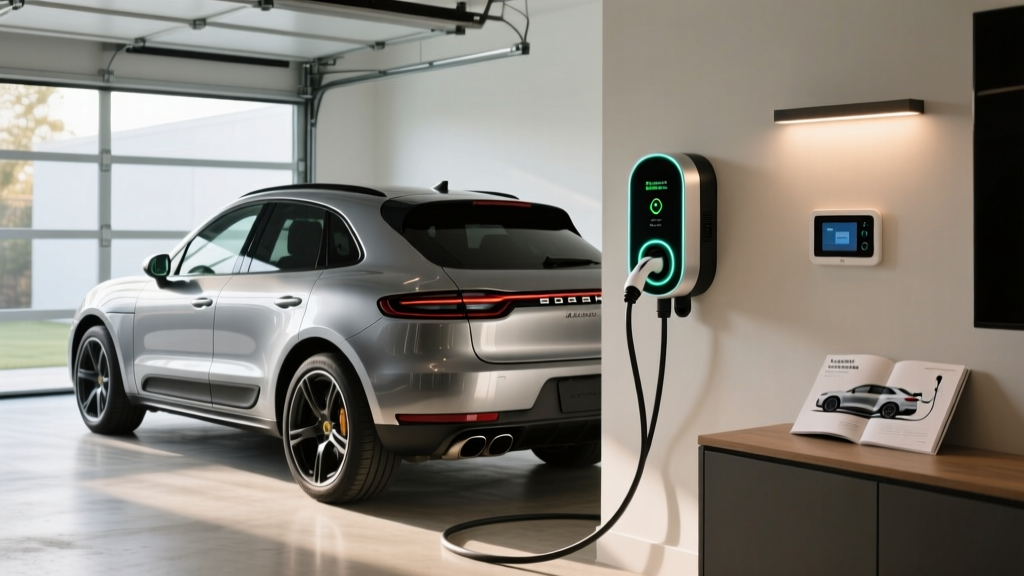
The Macan Electric rewards a properly provisioned 240V circuit. For an 11 kW Level 2 charger, you need a 240V / 60A dedicated circuit (EVSEs are continuous loads under NEC Article 625, so the circuit must be rated 125% above the charger's max draw — a 48A charger requires a 60A breaker). Homes with a 200A service panel usually accommodate this without issue. Older homes on 100A service, or panels already loaded with HVAC, dryer, and range circuits, often require a panel upgrade to 200A — a $1,500–$3,500 job on its own.
| Item | Typical Range | Notes |
|---|---|---|
| Level 2 EVSE (hardware) | $400–$750 | 48A hardwired smart charger |
| Electrician labor (run + termination) | $600–$1,800 | Varies by conduit run length |
| Permit & inspection | $75–$300 | Municipality-dependent |
| Panel upgrade (if needed) | $1,500–$3,500 | 100A → 200A service |
| Total (no panel upgrade) | $1,075–$2,850 | Most 200A-panel homes |
| Total (with panel upgrade) | $2,575–$6,350 | Older or maxed-out panels |
The federal Residential Clean Energy Credit (IRC §25D) does not cover EV chargers after 2022, though the separate Alternative Fuel Vehicle Refueling Property Credit (IRC §30C) offers up to $1,000 for home charger hardware and installation — subject to census-tract eligibility and income rules. Check the IRS §30C page and confirm with a tax professional before counting on it.
Connector Compatibility: NACS, CCS, and the Macan
North American Porsche Macan Electric models ship with a CCS1 (Combined Charging System) port for both AC Level 2 and DC fast charging. However, Porsche has announced adoption of the NACS (Tesla-style) connector for future North American models, and a growing number of networks — including Electrify America and EVgo — are adding NACS cables alongside CCS. If you buy a NACS-equipped home charger today, you'll need a CCS-to-NACS adapter (or vice versa) for the current Macan Electric.
| Connector | Macan Electric (2025–2026 NA) | Adapter Needed? | Networks |
|---|---|---|---|
| CCS1 | Native | No | EA, EVgo, ChargePoint, most non-Tesla |
| NACS (Tesla) | Via adapter | Yes — CCS-to-NACS | Tesla Supercharger (with adapter + Porsche approval) |
| CHAdeMO | Not compatible | N/A (legacy, phasing out) | Rare; mostly older Nissan Leaf infrastructure |
| J1772 (AC only) | Via CCS inlet (AC pins) | No | Public Level 2, destination chargers |
For home Level 2 charging, most NACS or J1772 wall units will work with the Macan's CCS inlet via the standard J1772-to-CCS adapter that ships with many EVSEs — confirm adapter inclusion before purchase.
Cost to Charge: $/kWh and Cost Per Mile vs. Gas
Electricity rates vary dramatically by region and time of day. The Macan Electric's efficiency hovers around 2.6–2.8 mi/kWh (roughly 87–95 MPGe combined per fueleconomy.gov). Here's what that means for your wallet:
| Scenario | $/kWh | Cost / Mile | Cost for 300 mi |
|---|---|---|---|
| Home off-peak (utility TOU rate) | $0.09 | $0.033 | $9.90 |
| Home standard residential | $0.16 | $0.059 | $17.70 |
| Public Level 2 (network) | $0.30 | $0.111 | $33.30 |
| DC fast charger (Ionity/EA peak) | $0.48 | $0.178 | $53.40 |
| Gas equivalent (25 MPG, $3.60/gal) | — | $0.144 | $43.20 |
Home off-peak charging delivers roughly a 77% cost-per-mile reduction versus premium gasoline (which the Macan requires). Even at standard residential rates, you'll save about 60%. The economics flip if you rely exclusively on public DC fast charging at peak rates — a scenario to avoid if daily cost matters.
Recommended Level 2 Chargers for the Macan Electric
These chargers pair well with the Macan's 11 kW AC ceiling, provide smart scheduling for off-peak rates, and carry the safety certifications (UL/ETL) required for permitting:
Power: up to 12 kW (50A, adjustable down to 16A)
Connector: J1772 (works with Macan CCS via adapter)
Cable: 23 ft
Smart features: Wi-Fi, app scheduling, load sharing, Alexa
Price: ~$699
Best for: flexible amperage on limited panels
Power: up to 11.5 kW (48A)
Connector: J1772
Cable: 25 ft
Smart features: Wi-Fi + Bluetooth, app control, Power Sharing
Price: ~$649
Best for: compact size and multi-charger households
Power: up to 11.5 kW (48A)
Connector: J1772
Cable: 24 ft
Smart features: energy monitoring, solar integration, app scheduling
Price: ~$399
Best for: budget-conscious install with solar pairing
Power: up to 10 kW (40A)
Connector: J1772
Cable: 24 ft
Smart features: OCPP, app control, extreme-temp rated (-40°C)
Price: ~$549
Best for: cold-climate garages and outdoor mounts
Hardwired units (vs. NEMA 14-50 plug) are strongly recommended for 48A chargers: NEC 2023 code tightening has made 14-50 receptacle installations under continuous EV load a frequent inspection failure point. A hardwired install also eliminates the ~$80–$150 cost of a quality industrial-grade receptacle.
Safety, Code, and Common Panel-Upgrade Gotchas
A licensed electrician should pull a permit for any Level 2 installation — unpermitted work can void home insurance claims and complicate resale. Key code and safety items:
- Dedicated circuit: The EVSE must be on its own breaker — no shared loads with laundry, HVAC, or workshop equipment.
- GFCI protection: NEC 2023 requires GFCI for 14-50 receptacles used for EV charging; hardwired units sidestep this requirement (most EVSEs have built-in ground-fault protection).
- Outdoor rating: If mounted outside, the unit must carry a NEMA 4 or IP65 rating. Cable management should prevent tripping and UV degradation.
- Wire gauge: A 60A circuit requires 6 AWG copper (or 4 AWG aluminum) in most jurisdictions — your electrician will size per local amendments.
- Panel load calculation: Under NEC 220.82/220.87, the electrician must verify the panel's existing load plus the EV circuit doesn't exceed 80% of the main breaker rating. If it does, a panel upgrade or a smart load-management device (like the Emporia Smart Load Center or Wallbox Power Sharing) may be alternatives to a full service upgrade.
Frequently Asked Questions
How much does it cost to install a home EV charger for the Macan Electric?
Expect $1,075–$2,850 for a standard 48A hardwired Level 2 install on an existing 200A panel (equipment + electrician + permit). If your home needs a panel upgrade from 100A to 200A, add $1,500–$3,500, bringing the total to roughly $2,575–$6,350. The federal §30C credit can offset up to $1,000 of that if your census tract qualifies.
How fast will each charging level add Macan Electric range?
Level 1 (120V): ~3–4 miles per hour. Level 2 at 11 kW (the Macan's AC ceiling): ~30 miles per hour, or a full 10–80% in about 7–8 hours. DC fast charging at a 350-kW-class station: 10–80% in approximately 21 minutes under ideal conditions, though sustained rates taper above 60% SoC.
Which connector is compatible with my Macan Electric?
The 2025–2026 North American Macan Electric uses a CCS1 port natively. A CCS-to-NACS adapter unlocks Tesla Superchargers (confirm Porsche's adapter approval list before purchasing). For home Level 2, any J1772 charger works via the J1772-to-CCS adapter typically included with the vehicle or EVSE.
How much does charging the Macan Electric cost per mile vs. premium gas?
At a $0.09/kWh off-peak home rate, you'll pay roughly $0.033/mile. At standard residential ($0.16/kWh), about $0.059/mile. A comparable gas vehicle at 25 MPG on $3.60/gal premium runs $0.144/mile — making home charging 60–77% cheaper per mile.
What electrical upgrades might I need before installing a Level 2 charger?
The most common upgrade is a panel service increase from 100A to 200A if your existing panel is near capacity. Homes built before 1990 are the most frequent candidates. Alternatives include smart load-management devices that throttle the charger when other major appliances run, potentially avoiding a full panel swap. Your electrician's NEC load calculation will determine the path.
Does the Macan Electric qualify for the $7,500 federal EV tax credit?
Federal §30D credit eligibility depends on MSRP caps ($80,000 for SUVs), buyer income limits, and battery critical-mineral and component sourcing rules that tighten yearly. The Macan Electric's MSRP typically exceeds $80,000 in most trims, which may disqualify it — verify current-year rules on the IRS §30D page and with a tax professional before purchase.