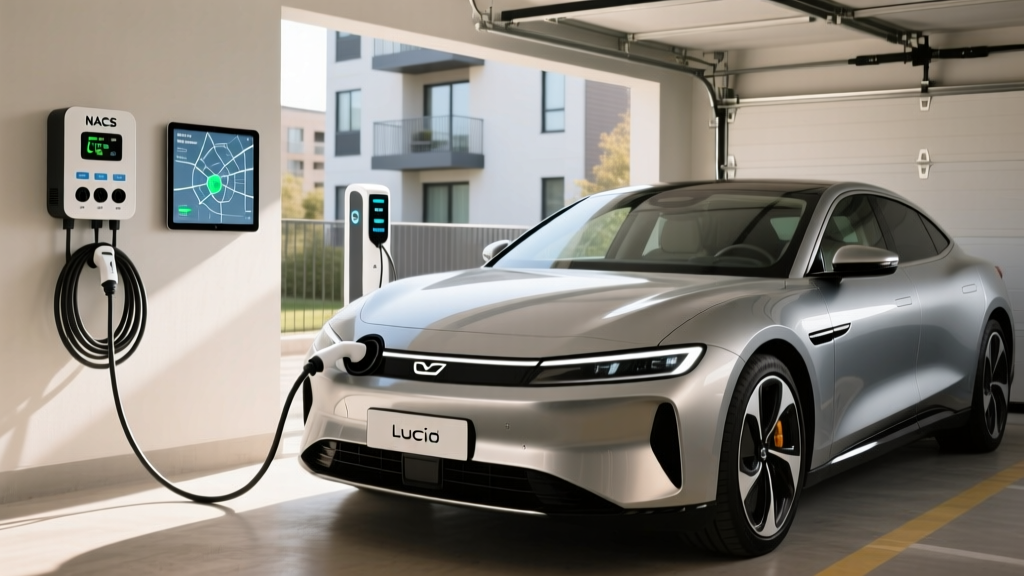
The Lucid Air is one of the most efficient electric sedans on the road, with EPA range figures topping 500 miles and a 900-volt architecture that enables some of the fastest DC charging available. But with Lucid's adoption of the North American Charging Standard (NACS) connector for the 2025 model year and beyond, owners and prospective buyers need a clear picture of how, where, and how fast they can charge. This guide covers every angle: home Level 2 installation, public DC fast charging, adapter compatibility for older CCS-equipped Lucid Airs, and the real cost per mile.
Lucid Air Charging Specs at a Glance
Before we break down each charging scenario, here are the core numbers for the current Lucid Air lineup. Specs vary by trim and battery pack.
| Specification | Air Pure | Air Touring | Air Grand Touring | Air Sapphire |
|---|---|---|---|---|
| Usable Battery (kWh) | 88 kWh | 112 kWh | 112 kWh | 118 kWh |
| Battery Chemistry | NMC | NMC | NMC | NMC |
| EPA Range | 419 mi | 425 mi | 516 mi | 427 mi |
| Architecture | 900V | 900V | 900V | 900V |
| Peak DC Fast Charge | 200 kW | 250 kW | 300 kW | 300 kW |
| 10–80% DC Time (est.) | ~25 min | ~22 min | ~20 min | ~22 min |
| Level 2 AC Max Acceptance | 19.2 kW | 19.2 kW | 19.2 kW | 19.2 kW |
| Connector (2025+ MY) | NACS | NACS | NACS | NACS |
Charging Levels Explained: Speeds and Range Added Per Hour
Every EV owner uses three tiers of charging. Here's how each applies to the Lucid Air's exceptional efficiency — roughly 4.0 to 4.5 miles per kWh depending on trim and driving conditions (per fueleconomy.gov).
| Level | Voltage / Power | Typical kW | Miles of Range Added Per Hour | Best Use Case |
|---|---|---|---|---|
| Level 1 | 120V AC | 1.0–1.4 kW | 4–6 mi/hr | Emergency / trickle top-off |
| Level 2 (standard) | 240V AC, 48A | 11.5 kW | 46–52 mi/hr | Daily home charging |
| Level 2 (max) | 240V AC, 80A | 19.2 kW | 77–86 mi/hr | Full-speed home / workplace |
| DC Fast Charge | 400–900V DC | 200–300 kW peak | ~800–1,200 mi/hr (at peak) | Road trips |
The Lucid Air's onboard charger can accept up to 19.2 kW on AC power — one of the highest in the industry. Most competitors max out at 11.5 kW. This means if you install an 80-amp circuit at home, the Air can charge nearly 70% faster than a typical EV on the same Level 2 equipment.
Home Level 2 Installation: Requirements, Costs, and Electrical Upgrades
Home charging is where Lucid Air owners will do 85–95% of their charging. Because the Air accepts up to 19.2 kW, you have a decision to make: install a standard 48-amp charger (11.5 kW) or invest in an 80-amp circuit to unlock the car's full AC charging capability.
Electrical Requirements
For a 48-amp continuous-draw charger, the National Electrical Code (NEC) requires a circuit rated at 60 amps (EV chargers are considered continuous loads, so the circuit must be rated at 125% of the draw). For an 80-amp charger, you need a 100-amp dedicated circuit.
- 48A charger: 240V, 60A dedicated circuit, 6 AWG copper wire (or 4 AWG aluminum)
- 80A charger: 240V, 100A dedicated circuit, 3 AWG copper wire (or 1 AWG aluminum)
- GFCI protection: Required by NEC 2020+ for EV outlets (a hardwired unit may bypass this requirement in some jurisdictions — check with your electrician)
- Outdoor rating: If your charger is outside, ensure a NEMA 4-rated enclosure
Panel Upgrade Reality
Most US homes built before 2010 have 100-amp or 150-amp main panels. Adding a 100-amp dedicated circuit for an 80A charger may exceed your panel's spare capacity. A licensed electrician will perform a load calculation (NEC Article 220) to determine if an upgrade to a 200-amp panel is necessary. This is one of the most frequently overlooked costs in EV home charging.
| Component | 48A Setup (60A circuit) | 80A Setup (100A circuit) |
|---|---|---|
| Charger Equipment | $400–$700 | $500–$1,000 |
| Electrician Labor (standard run, <30 ft) | $600–$1,200 | $900–$1,800 |
| Permit & Inspection | $100–$300 | $100–$300 |
| Panel Upgrade (if needed) | $1,500–$3,000 | $1,500–$3,000 |
| Total (no panel upgrade) | $1,100–$2,200 | $1,500–$3,100 |
| Total (with panel upgrade) | $2,600–$5,200 | $3,000–$6,100 |
Some utilities and states offer rebates for home charger installation — check with your local provider. The federal Residential Clean Energy Credit (IRC §25C) may cover up to 30% of charger equipment and installation costs, capped at $1,000 per year, through 2032. Eligibility depends on your census tract and income — consult a tax professional.
Connector Compatibility: NACS, CCS1, and Adapter Options
Starting with the 2025 model year, Lucid transitioned the Air to the NACS (Tesla-style) charge port. If you're buying a new Air, you'll plug directly into Tesla Superchargers and the growing number of NACS-equipped public stations. If you own a 2022–2024 Air with a CCS1 port, adapters are your bridge to the NACS network.
| Model Year | Built-In Port | Tesla Supercharger (NACS) | CCS1 Public Stations | CHAdeMO |
|---|---|---|---|---|
| 2022–2024 | CCS1 | Via NACS-to-CCS adapter (Tesla or third-party) | Direct plug | Adapter available, uncommon |
| 2025+ | NACS | Direct plug | Via CCS-to-NACS adapter | Adapter available, uncommon |
For 2022–2024 CCS1 owners: Tesla sells a CCS-to-NACS adapter (approximately $250) that unlocks Supercharger V3 and V4 stalls. Lucid has also indicated support for third-party NACS adapters. Check Lucid's official accessory store for approved adapters to ensure warranty compliance.
For 2025+ NACS owners: The Electrify America, EVgo, and ChargePoint networks are progressively adding NACS cables. During the transition, carrying a CCS1-to-NACS adapter (~$200–$300) ensures access to legacy CCS stations. Most new public DC installations in 2026 include at least one NACS connector.
Recommended Home Charging Equipment for the Lucid Air
Because the Air can accept 19.2 kW on AC, you have an advantage most EV owners don't. Here are chargers matched to the Air's capabilities.
ChargePoint Home Flex (48A)
- Power: Up to 11.5 kW (48A, 240V)
- Connector: NACS or J1772 (select at purchase)
- Cable Length: 24 ft
- Smart Features: Wi-Fi, app scheduling, utility demand-response, Alexa
- Price: ~$550–$650
- Best For: Standard 60A circuits, most homes
Tesla Wall Connector (80A capable)
- Power: Up to 19.2 kW (80A, 240V)
- Connector: NACS (native)
- Cable Length: 24 ft
- Smart Features: Wi-Fi, OTA updates, power sharing with second unit, load management
- Price: ~$450–$500
- Best For: Unlocking Air's full 19.2 kW AC rate on a 100A circuit
Emporia Vue Smart Charger (48A)
- Power: Up to 11.5 kW (48A, 240V)
- Connector: NACS or J1772
- Cable Length: 24 ft
- Smart Features: Integrated energy monitoring, solar integration, app scheduling
- Price: ~$400–$500
- Best For: Solar-home owners, budget-conscious installs
Grizzl-E Smart (48A)
- Power: Up to 11.5 kW (48A, 240V)
- Connector: NACS or J1772
- Cable Length: 24 ft
- Smart Features: Wi-Fi, OCPP compatible, extreme cold rated (-40°F)
- Price: ~$450–$550
- Best For: Cold-climate garages, durable outdoor installs
If your electrical panel supports a 100-amp circuit, the Tesla Wall Connector at 80A is the top pick for the Lucid Air — it's the most affordable path to the car's full 19.2 kW AC potential, adding up to 86 miles of range per hour.
Public DC Fast Charging: Networks, Speeds, and the Charge Curve
The Lucid Air's 900-volt architecture gives it a genuine advantage at DC fast chargers. Where most EVs peak at 400V and require high amperage (generating heat and tapering early), the Air pulls more power at lower current, sustaining higher rates deeper into the charge session.
Here's what to expect at common public charger types:
- Tesla Supercharger V3 (250 kW, NACS): Direct plug for 2025+ Airs. Expect peak rates of 200–250 kW on Grand Touring/Sapphire trims, tapering above 60% SoC. A 10–80% session takes approximately 20–25 minutes.
- Tesla Supercharger V4 (up to 350 kW, NACS): Newer V4 stalls with higher power cabinets can push the Air Grand Touring to its 300 kW peak briefly, though sustained rates settle to 200–250 kW. 10–80% in roughly 18–22 minutes.
- Electrify America 350 kW (CCS1 or NACS): The Air can pull 250–300 kW peak on these dispensers. Availability of NACS cables varies by station — check the EA app before routing.
- 50–150 kW legacy chargers: These will bottleneck the Air. At 50 kW, a 10–80% session on the 112 kWh pack takes roughly 90 minutes. Avoid these on road trips when possible.
Preconditioning matters. The Air's navigation system will precondition the battery when you route to a charger, warming or cooling the pack to its optimal charging temperature. If you arrive at a DC charger without preconditioning (especially in cold weather), peak rates can drop by 30–50% for the first 5–10 minutes. Always navigate to the charger via the car's built-in routing.
Cost to Charge: Per-Mile Economics vs. Gas
The Lucid Air's efficiency is its hidden superpower. At roughly 24–27 kWh per 100 miles (depending on trim and driving), it uses less electricity per mile than nearly any competing luxury EV. Here's how that translates to real costs.
| Scenario | Rate ($/kWh) | Cost for 10–80% (78.4 kWh) | Cost Per Mile (est.) |
|---|---|---|---|
| Home Off-Peak (utility TOU) | $0.08–$0.12 | $6.27–$9.41 | $0.020–$0.032 |
| Home Standard Rate | $0.14–$0.18 | $10.98–$14.11 | $0.035–$0.049 |
| Public Level 2 (workplace/commercial) | $0.20–$0.30 | $15.68–$23.52 | $0.050–$0.075 |
| DC Fast Charge (EA/Tesla) | $0.30–$0.48 | $23.52–$37.63 | $0.075–$0.120 |
Compare to gas: A BMW 5 Series getting 27 MPG combined on $3.60/gallon fuel costs approximately $0.133 per mile. Even charging exclusively on DC fast chargers at $0.40/kWh, the Lucid Air costs roughly $0.10 per mile — and home charging drops that to $0.03–$0.05. Over 15,000 miles per year, home charging saves approximately $1,500–$2,000 annually versus premium gasoline.
Charging Time Examples: From Empty to Road-Ready
How long does it actually take to charge a Lucid Air? These estimates assume the 112 kWh battery (Touring/Grand Touring) and optimal conditions:
- Level 1 (120V, 1.4 kW): 0–100% in approximately 80 hours. Only useful for maintaining charge or emergency trickle. Adds ~5 miles per hour.
- Level 2 at 48A (11.5 kW): 10–80% in approximately 6.8 hours. Ideal overnight charge — plug in at 10 PM, full by 5 AM.
- Level 2 at 80A (19.2 kW): 10–80% in approximately 4.1 hours. Useful for daytime top-ups or high-mileage drivers.
- DC Fast at 300 kW peak (Grand Touring): 10–80% in approximately 20 minutes. Add ~300 miles of range in 20 minutes on a road trip.
- DC Fast at 150 kW (older station): 10–80% in approximately 42 minutes.
Safety, Code, and Installation Best Practices
A Level 2 charger draws sustained high current for hours — this is not a DIY project unless you are a licensed electrician. Key safety and code considerations:
- Dedicated circuit: Your EV charger must have its own dedicated breaker — never share a circuit with other large appliances (dryer, oven, HVAC).
- Hardwired vs. plug-in: Hardwired installations (no plug) are generally preferred for 80A circuits, as NEMA 14-50 receptacles are rated for 50A maximum. For 48A chargers, a NEMA 14-50 outlet provides flexibility to take the charger if you move.
- GFCI breaker: NEC 2020 and later require GFCI protection for EV receptacles. Some jurisdictions waive this for hardwired units. Double-GFCI (breaker + charger internal) can cause nuisance trips — your electrician will manage this.
- Wire gauge and conduit: Undersized wire on a long run causes voltage drop and heat. Your electrician will calculate the correct gauge based on run length.
- Permit and inspection: Nearly all jurisdictions require an electrical permit for EV charger installation. The inspection ensures code compliance and protects your home insurance coverage. Budget $100–$300 and 1–3 weeks for inspection scheduling.
- Outdoor installations: Use a NEMA 4-rated (weatherproof) charger enclosure. Ensure the cable can be retracted or stored to prevent trip hazards and UV degradation.
Frequently Asked Questions
How much does it cost to install a home EV charger for a Lucid Air?
A standard 48A Level 2 installation on an existing 200-amp panel typically costs $1,100–$2,200 including equipment, electrician labor, and permit. An 80A installation (to unlock the Air's full 19.2 kW AC rate) runs $1,500–$3,100. If your panel needs an upgrade to 200A, add $1,500–$3,000. Always get at least two quotes from licensed electricians.
How fast will each charging level add range to my Lucid Air?
Level 1 (120V) adds about 4–6 miles per hour. Level 2 at 48A adds roughly 46–52 miles per hour. Level 2 at 80A (19.2 kW) adds 77–86 miles per hour — the Air's maximum AC rate. DC fast charging at peak rates can add over 300 miles in 20 minutes, though the charge curve tapers significantly above 60% State of Charge.
Which connector and charger is compatible with my Lucid Air?
2025 and newer Lucid Air models come with a NACS port and plug directly into Tesla Superchargers and NACS-equipped public stations. 2022–2024 models have CCS1 ports and require a NACS-to-CCS adapter for Tesla Superchargers. For home Level 2 charging, any NACS (2025+) or J1772 (with adapter, 2022–2024) charger will work. The Tesla Wall Connector (NACS) and ChargePoint Home Flex are top picks.
How much does charging a Lucid Air cost per mile compared to gas?
At home on off-peak electricity ($0.10/kWh), the Lucid Air costs approximately $0.025–$0.032 per mile — roughly 75–80% cheaper than a comparable gas sedan burning premium at $3.60/gallon ($0.13/mile). Even on the most expensive DC fast chargers ($0.48/kWh), the Air costs about $0.12 per mile. Annual savings for a 15,000-mile driver range from $1,000 to $2,000 depending on charging mix.
What electrical upgrades might I need for a Lucid Air home charger?
If you have a 200-amp main panel with adequate spare capacity (determined by an NEC Article 220 load calculation), you may need only a new breaker and wire run. Homes with 100A or 150A panels — common in pre-2010 construction — often require a panel upgrade to 200A, costing $1,500–$3,000. An 80A charger circuit is more likely to trigger a panel upgrade than a 48A circuit. Your electrician will assess this during the initial site visit.
Can I use Tesla Superchargers with an older CCS-equipped Lucid Air?
Yes, with an adapter. Tesla and third-party manufacturers sell CCS-to-NACS adapters (typically $200–$300) that enable 2022–2024 Lucid Air models to charge at Tesla Supercharger V3 and V4 stalls. Lucid's software supports Supercharger routing via the navigation system once the adapter is recognized. Verify adapter compatibility with Lucid's accessory store or owner forums before purchasing.