When shoppers ask which electric vehicle has the longest range, the answer involves more than a single EPA sticker number. A 400-mile battery is only practical if you can replenish it efficiently at home and on the road. This guide ranks the longest-range EVs available for the 2026 model year and pairs each with the exact charging infrastructure—home electrical requirements, connector types, equipment picks, and per-mile costs—you need to actually live with one.
Longest-Range EVs for 2026: The EPA Numbers and Real-World Reality
The EPA combined range estimate is the standard benchmark, but real-world highway driving, cold weather, and battery preconditioning habits typically reduce that figure by 10–25%. Below are the current leaders, sorted by EPA range. All figures reflect the latest data from fueleconomy.gov and manufacturer specifications.
| Vehicle | EPA Range | Battery (kWh usable) | Chemistry | Peak DC kW | 10–80% Time | Base MSRP |
|---|---|---|---|---|---|---|
| Lucid Air Grand Touring | 512 mi | 112 kWh | NMC | 300 kW | ~20 min | $110,000 |
| Chevrolet Silverado EV 4WT | 492 mi | 200 kWh (est.) | NMC | 350 kW | ~30 min | $78,000 |
| Tesla Model S Long Range | 402 mi | 100 kWh | NMC/NCA | 250 kW | ~27 min | $79,990 |
| Mercedes-Benz EQS 450+ | 390 mi | 107.8 kWh | NMC | 200 kW | ~31 min | $105,550 |
| Tesla Model 3 Long Range | 363 mi | 79 kWh | NMC | 250 kW | ~25 min | $47,740 |
| Hyundai Ioniq 6 SEL | 361 mi | 77.4 kWh | NMC | 240 kW | ~18 min | $42,715 |
| Rivian R1T Dual-Motor Max | 352 mi | 149 kWh | NMC | 220 kW | ~42 min | $87,600 |
Charging Levels Explained: kW, Miles Per Hour, and 10–80% Times
The single most important distinction in EV charging is kW (kilowatts) versus kWh (kilowatt-hours). A kWh measures energy stored in your battery—like gallons in a gas tank. A kW measures the rate at which energy flows into the battery—like the flow rate of a gas pump nozzle. A 240 kW DC fast charger can theoretically deliver 240 kWh in one hour, but charging speed tapers as the battery fills to protect cell health.
| Level | Voltage / Amps | Power (kW) | Miles of Range Added Per Hour | Best For |
|---|---|---|---|---|
| Level 1 (120V) | 120V / 12A | ~1.4 kW | 3–5 mi/hr | Overnight top-ups, PHEVs, low-mileage drivers |
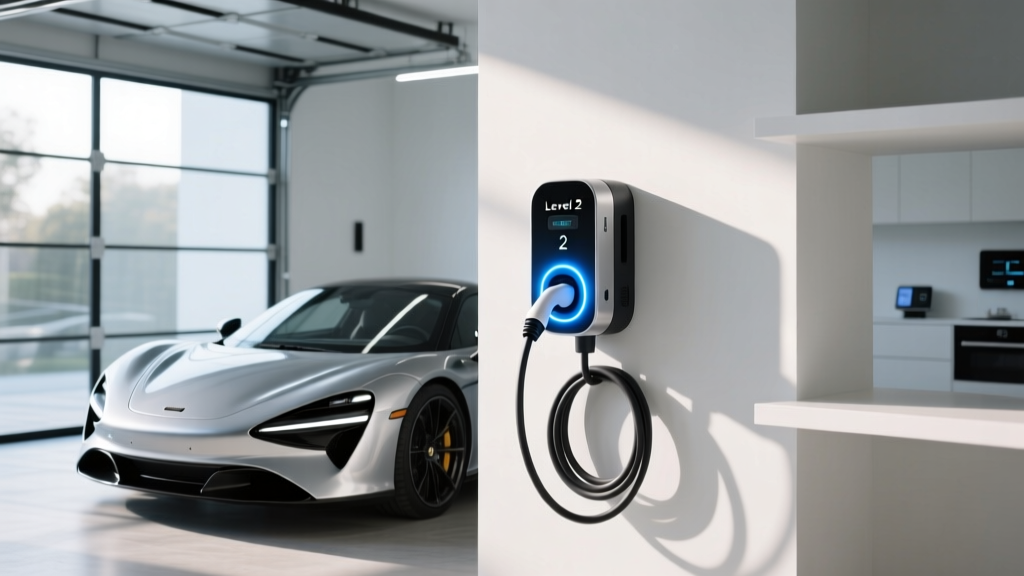
| Level 2 (240V) | 240V / 32–48A | 7.7–11.5 kW | 25–44 mi/hr | Daily home charging, full overnight replenishment |
| DC Fast Charge | 400–800V DC | 50–350 kW | 150–1,200+ mi/hr (peak) | Road trips, rapid top-ups away from home |
For a long-range EV like the Lucid Air (112 kWh battery), Level 1 charging from empty would take over 80 hours—impractical. Level 2 at 11.5 kW replenishes the full battery in roughly 10 hours, making overnight charging viable. DC fast charging from 10–80% takes about 20 minutes at a 300 kW station, but the charge curve tapers sharply above 80%: that last 20% can take as long as the first 80%.
Home Charger Installation: Electrical Requirements and True Costs
Installing a Level 2 home charger is the single biggest quality-of-life upgrade for any long-range EV owner. Here is what it actually requires and costs in 2026.
Electrical Requirements
A standard Level 2 home charger requires a 240-volt dedicated circuit, typically rated for 40–60 amps. The National Electrical Code (NEC) requires that continuous loads (like EV charging, which runs for hours) use no more than 80% of a circuit's rated capacity. So a 48A charger needs a 60A circuit; a 32A charger needs a 40A circuit.
Panel Upgrade Considerations
Many older homes have 100A or 125A main electrical panels that may not have capacity for a 60A EV circuit alongside existing loads (HVAC, electric oven, dryer). A licensed electrician will perform a load calculation per NEC Article 220. If your panel is at or near capacity, you may need:
- A panel upgrade from 100A/125A to 200A ($1,500–$3,500)
- An energy management system or smart load-shedding device ($300–$800) as an alternative to a full upgrade
- A sub-panel installed near the garage ($400–$900)
| Component | Low Estimate | High Estimate | Notes |
|---|---|---|---|
| Level 2 charger unit (hardware) | $300 | $700 | 32A–48A smart chargers; see equipment picks below |
| Electrician labor (wiring + mounting) | $400 | $1,500 | Depends on run length from panel to garage/carport |
| Electrical permit | $50 | $250 | Required in most jurisdictions; varies by locality |
| Panel upgrade (if needed) | $1,500 | $3,500 | Only if load calculation shows insufficient capacity |
| Conduit, wiring materials (copper) | $100 | $500 | Longer runs and outdoor conduit increase cost |
| Total (no panel upgrade) | $850 | $2,950 | Typical install for homes with adequate panel capacity |
| Total (with panel upgrade) | $2,350 | $6,450 | Homes with 100A service or maxed-out panels |
Some utilities offer rebates of $200–$500 for Level 2 charger installation, and the federal Residential Clean Energy Credit may cover up to 30% of equipment and installation costs (capped at $1,000) through 2032—consult a tax professional for eligibility.
Connector Compatibility: NACS, CCS, and CHAdeMO in 2026
The connector landscape has consolidated significantly. Tesla's North American Charging Standard (NACS) is now the dominant connector, with Ford, GM, Rivian, Volvo, Hyundai/Kia, and most other automakers adopting it for new vehicles starting in the 2025–2026 model years. The Combined Charging System (CCS1) remains on some carryover models and most public non-Tesla DC fast chargers. CHAdeMO is effectively legacy—only the Nissan Leaf still uses it.
| Connector | Brands Using It (2026 MY) | Public DC Network Access | Adapter Needed? |
|---|---|---|---|
| NACS (Tesla standard) | Tesla, Ford, GM, Rivian, Volvo, Polestar, Hyundai/Kia (new), Mercedes (new) | Tesla Supercharger network + growing NACS stations on EA, ChargePoint | NACS vehicles may need CCS adapter for older non-Tesla chargers (~$200–$300) |
| CCS1 | VW ID.4 (carryover), BMW iX (carryover), some 2024–2025 models still on lots | Electrify America, EVgo, ChargePoint, most non-Tesla networks | CCS vehicles need NACS adapter (~$200) to access Tesla Superchargers |
| CHAdeMO | Nissan Leaf (legacy only) | Limited and declining; some EA and EVgo stations retain CHAdeMO plugs | No practical adapter to NACS/CCS for DC fast charging |
Key takeaway for long-range EV buyers: If you are purchasing a new 2026 model, it almost certainly ships with NACS. This means access to the Tesla Supercharger network (over 25,000 stalls in North America) without an adapter, which is a significant advantage for road-trip charging reliability. Verify the specific connector with your dealer before purchase.
Cost to Charge: Per-Mile Economics vs. Gasoline
One of the strongest arguments for a long-range EV is the cost-per-mile advantage, but it varies dramatically depending on where and when you charge.
| Scenario | Rate ($/kWh) | Cost to Add 300 Miles* | Cost Per Mile | Equivalent Gas Price (at 30 MPG) |
|---|---|---|---|---|
| Home, off-peak utility rate | $0.08–$0.13 | $6.00–$9.75 | $0.02–$0.03 | $0.60–$0.90/gal |
| Home, standard residential rate | $0.14–$0.20 | $10.50–$15.00 | $0.035–$0.05 | $1.05–$1.50/gal |
| Public Level 2 (workplace, retail) | $0.20–$0.35 | $15.00–$26.25 | $0.05–$0.09 | $1.50–$2.70/gal |
| DC Fast Charging (public) | $0.35–$0.60 | $26.25–$45.00 | $0.09–$0.15 | $2.70–$4.50/gal |
| Gasoline vehicle (30 MPG combined) | $3.50/gal | $35.00 | $0.117 | — |
*Based on a vehicle consuming 3.0 miles/kWh (roughly 112 MPGe), representative of efficient sedans like the Tesla Model 3 or Hyundai Ioniq 6. Trucks and SUVs consume more—plan for 2.0–2.5 mi/kWh.
The economics are clearest when you charge primarily at home on off-peak rates: a long-range EV can cost 70–80% less per mile to "fuel" than a 30 MPG gas car. However, if you rely exclusively on DC fast charging at $0.48–$0.60/kWh (common at Electrify America and EVgo peak rates), your per-mile cost can match or exceed gasoline. Home charging access is the economic linchpin of EV ownership.
Recommended Home Level 2 Chargers for Long-Range EVs
With a large battery (80–200 kWh), you want a charger that can fully replenish overnight without bottlenecking. We recommend 48A units on a 60A circuit for any EV with more than 80 kWh of battery. Below are our top picks for 2026.
ChargePoint Home Flex (NACS or J1772)
- Power: Up to 12 kW (48A @ 240V) — configurable down to 16A for panel-limited homes
- Connector: Available in NACS or J1772 (J1772 with NACS adapter for non-Tesla EVs)
- Cable length: 23 ft
- Smart features: Wi-Fi, scheduling via app, Alexa integration, energy tracking
- Price: ~$550–$650
- Best for: Flexibility across circuit sizes; UL-listed; widely available
Wall Connector Gen 3 (Tesla / NACS native)
- Power: Up to 11.5 kW (48A @ 240V)
- Connector: NACS native; also ships with J1772 adapter for non-Tesla NACS-adopted EVs
- Cable length: 24 ft
- Smart features: Wi-Fi, OTA updates, power sharing (link two units on one circuit), Tesla app integration
- Price: ~$475
- Best for: Tesla owners and NACS-adopted EVs; best value at 48A
Emporia Level 2 EV Charger
- Power: Up to 11.5 kW (48A @ 240V)
- Connector: J1772 (use with NACS adapter for newer EVs)
- Cable length: 24 ft
- Smart features: Wi-Fi, real-time energy monitoring, solar integration, scheduling, load management
- Price: ~$400
- Best for: Budget-conscious buyers who want energy monitoring and solar pairing
For the Rivian R1T Max Pack (149 kWh) or Chevy Silverado EV (200 kWh), even a 48A charger will need 12–17 hours for a full charge from near-empty. In practice, you rarely arrive home below 20%, so overnight replenishment is still sufficient for daily use.
Safety, Code, and Outdoor Installation Requirements
Level 2 EV chargers are high-draw, continuous-load appliances. The NEC and local building codes enforce specific safety requirements:
- Dedicated circuit: Your EV charger must be on its own dedicated breaker—not shared with other outlets or appliances.
- GFCI protection: The NEC (2020 and later editions) requires GFCI protection for all 125V–250V receptacles used for EV charging in garages and outdoors. Hardwired units may not require a GFCI breaker, which avoids nuisance tripping issues reported by some EV owners.
- Outdoor rating: If your charger is mounted outside (carport, driveway wall), it must be rated NEMA 4 or NEMA 4X for weather resistance. All three chargers recommended above carry outdoor ratings.
- Permit and inspection: Most jurisdictions require an electrical permit and a post-installation inspection. This typically costs $50–$250 and protects your home insurance coverage.
- Wire gauge: A 60A circuit typically requires 6 AWG copper wire (THHN in conduit) or 4 AWG if the run exceeds 100 feet to minimize voltage drop. Your electrician will size this correctly.
Hardwired vs. plug-in: A hardwired charger (directly connected to wiring in the wall) avoids the GFCI nuisance-trip issue and is generally preferred for permanent installations. A plug-in unit (NEMA 14-50 outlet) offers portability but requires a GFCI breaker under current code, which some EV owners report trips intermittently during charging sessions.
Frequently Asked Questions
How much does it cost to install a home EV charger?
A typical Level 2 home charger installation costs $850–$2,950 when no panel upgrade is needed, covering the charger unit ($300–$700), electrician labor ($400–$1,500), permit ($50–$250), and wiring materials ($100–$500). If your home's electrical panel lacks capacity and requires an upgrade to 200A service, total costs range from $2,350–$6,450. Always get a load calculation from a licensed electrician before committing.
How fast will each charging level add range?
Level 1 (120V) adds roughly 3–5 miles of range per hour—enough for PHEVs or very low daily mileage. Level 2 (240V, 48A) adds 25–44 miles per hour depending on the vehicle's onboard charger and efficiency, replenishing most EVs overnight. DC fast charging adds 150–1,200+ miles per hour at peak rates, though the charge curve tapers significantly above 80% state of charge, making 10–80% the practical fast-charging window.
Which connector and charger is compatible with my EV?
For 2026 model-year vehicles, most new EVs use the NACS connector (Tesla's standard, now adopted industry-wide). Some carryover 2024–2025 models still use CCS1. The Nissan Leaf remains the only vehicle using CHAdeMO. Check your vehicle's charge port: if it's NACS, a Tesla Wall Connector or ChargePoint Home Flex (NACS version) is ideal. If your EV has CCS1, use a J1772 or CCS-compatible Level 2 charger and purchase a NACS adapter (~$200) for Tesla Supercharger access.
How much does charging cost per mile compared to gas?
Charging at home on off-peak rates ($0.08–$0.13/kWh) costs roughly $0.02–$0.03 per mile in an efficient EV—equivalent to paying $0.60–$0.90 per gallon of gas. At standard residential rates, expect $0.035–$0.05 per mile. Public DC fast charging at $0.35–$0.60/kWh costs $0.09–$0.15 per mile, which is comparable to gasoline at $3.50/gallon in a 30 MPG vehicle. Home charging is where the significant savings materialize.
What electrical upgrades might I need for a home charger?
The most common upgrade is a panel replacement from 100A or 125A to 200A service ($1,500–$3,500) if your existing panel cannot accommodate a dedicated 40–60A circuit. Alternatives include installing a smart load-management device ($300–$800) that dynamically reduces charger amperage when other high-draw appliances activate, or adding a sub-panel near the garage ($400–$900). A licensed electrician's load calculation per NEC Article 220 will determine which path is required.
Does a longer-range EV need a faster home charger?
Not necessarily faster, but a 48A Level 2 charger (11.5 kW) is strongly recommended for any EV with a battery over 80 kWh. A smaller 32A unit (7.7 kW) would need 14+ hours to fully charge a 112 kWh Lucid Air from empty, while a 48A unit does it in under 10 hours. Since most owners arrive home with 30–50% battery remaining, either amperage works for overnight replenishment—but 48A provides headroom for the days you return nearly empty.