If you've just bought—or are shopping for—the EV with longest range on the market, congratulations and caution in equal measure. A 100+ kWh battery pack is an engineering marvel, but it also magnifies every charging decision you make. A Lucid Air Grand Touring (EPA 516 miles, 118 kWh usable) or a Chevrolet Silverado EV 4WT (EPA 492 miles, ~200 kWh pack) will sit at a public DC fast charger far longer than a 60 kWh pack if you pick the wrong network or connector. At home, that same battery can take 40+ hours on a standard 120V outlet—meaning a proper Level 2 installation isn't optional, it's mandatory.
This guide walks through exactly how to keep a long-range EV charged efficiently, covering home install costs, public network realities, connector compatibility, and the real cost per mile versus gasoline. All figures reflect 2026 model-year specs and current utility rates.
Why Long-Range EVs Demand a Smarter Charging Strategy
Big batteries reward planning. The physics are straightforward: a 118 kWh Lucid Air Grand Touring battery needs roughly 95 kWh to go from 10% to 90% State of Charge (SoC). On a 48-amp (11.5 kW) Level 2 home charger, that's about 8.5 hours. On a 350 kW DC fast charger with a good charge curve, 10–80% takes roughly 22–25 minutes, but sustained rates taper above 60% SoC.
Here's what that means in practice:
- Home charging is non-negotiable. Long-range owners who rely on public charging pay 2–4× more per mile and spend hours per week at stations.
- Peak kW ratings mislead. A "350 kW capable" vehicle rarely sustains that rate. Expect 200–250 kW average on a 10–80% session for NMC-chemistry packs with preconditioning.
- Cold weather hits big batteries harder in absolute terms. A 30% range loss on a 516-mile EPA sticker still means ~360 real-world miles, but charging speeds also drop 20–40% without thermal preconditioning.
Charging Levels Explained: kW, Miles per Hour, and Real Times
Before we discuss equipment, let's lock in the distinction that trips up new EV owners: kW (kilowatts) measures power—the rate of energy flow. kWh (kilowatt-hours) measures energy—the total capacity of your battery. Think of kW as how wide the hose is; kWh is how big the bucket is.
| Level | Voltage / Amps | Power (kW) | Miles Added per Hour | 10–80% Time (118 kWh pack) |
|---|---|---|---|---|
| Level 1 (120V household) | 120V / 12A | 1.4 kW | 3–5 mi/hr | ~69 hours |
| Level 2 (240V home) | 240V / 48A | 11.5 kW | 30–44 mi/hr | ~8.5 hours |
| Level 2 (240V / 80A) | 240V / 80A | 19.2 kW | 52–72 mi/hr | ~5 hours |
| DC Fast (150 kW station) | 400–800V DC | 150 kW peak | 400–550 mi/hr | ~45 minutes |
| DC Fast (350 kW station) | 800V DC | 250–350 kW peak | 700–1,200 mi/hr | ~22–25 minutes* |
*Assumes a vehicle with 800V architecture and active battery preconditioning (e.g., Lucid Air, Hyundai Ioniq 5/6, Kia EV6/EV9, Porsche Taycan). NMC packs taper significantly above 80% SoC.
Home Charger Installation: Electrical Requirements and Real Costs
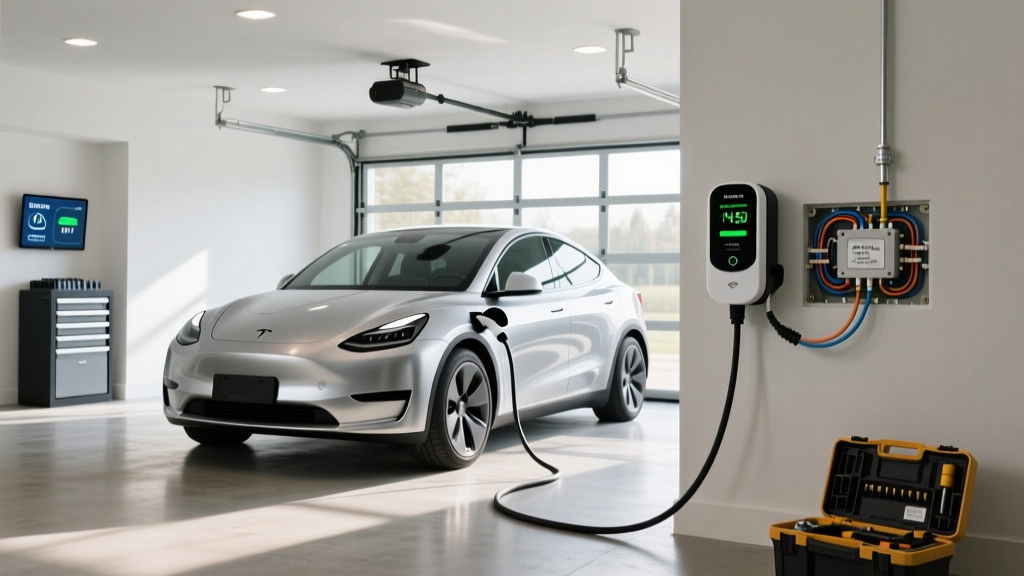
For any EV with longest-range ambitions, a 48-amp (11.5 kW) Level 2 circuit is the practical minimum. A 118 kWh battery charging overnight on a 48A circuit adds ~300+ miles in 8 hours—enough to refill most daily driving. For owners who want faster turnaround (say, returning from a road trip and needing a full pack by morning), an 80A circuit delivering 19.2 kW cuts that roughly in half.
Electrical Requirements at a Glance
- 48A charger: Requires a 60A dedicated breaker (NEC continuous-load rule: circuit must be rated 125% of charger draw). Uses 6 AWG copper wire for runs under ~50 feet.
- 80A charger: Requires a 100A dedicated breaker. Uses 3 AWG copper or 1 AWG aluminum wire.
- Panel capacity: Most modern 200A home panels can accommodate a 60A breaker if load calculations permit. A 100A EV circuit often requires a panel upgrade or a dedicated sub-panel.
| Component | 48A / 60A Circuit | 80A / 100A Circuit |
|---|---|---|
| Level 2 Charger (hardware) | $400–$700 | $600–$1,200 |
| Electrician labor (2–6 hrs) | $500–$1,500 | $800–$2,500 |
| Permit & inspection | $50–$300 | $100–$400 |
| Wiring materials (conduit, wire) | $100–$400 | $200–$700 |
| Total (no panel upgrade) | $1,050–$2,900 | $1,700–$4,800 |
| Panel upgrade (if needed) | +$1,500–$3,500 | +$2,000–$5,000 |
The IRS Residential Clean Energy Credit (IRC §25D) covers 30% of home EV charger hardware and installation costs up to $1,000 for equipment placed in service through 2032. This is separate from the §30D vehicle purchase credit and applies regardless of income caps.
Connector Compatibility: NACS, CCS, and the Adapter Reality
The North American charging connector landscape has consolidated significantly by 2026, but long-range EV buyers still need to verify what's on their vehicle's charge port.
| Connector | Brands Using It (Native) | Adapter Needed For |
|---|---|---|
| NACS (Tesla) | Tesla, Ford, GM, Rivian, Volvo, Polestar, Fisker, Mercedes (2025+), Hyundai/Kia (2026+) | CCS stations require NACS-to-CCS adapter ($150–$300) |
| CCS1 | Legacy VW ID.4, BMW iX (pre-2026), Stellantis, some Hyundai/Kia (pre-2026) | Tesla Superchargers require CCS-to-NACS adapter (often included by OEM) |
| CHAdeMO | Nissan Ariya (some markets), Mitsubishi (discontinued) | Limited network; adapter to CCS or NACS ($200–$400) |
For longest-range EVs specifically: the Lucid Air ships with a NACS port as of the 2025 model year. The Chevrolet Silverado EV uses NACS natively. If you own an older CCS-equipped long-range vehicle (like a 2023 BMW iX xDrive50 with EPA 324 miles), you'll need a CCS-to-NACS adapter to access the 17,000+ Tesla Supercharger stalls now open to non-Tesla vehicles.
Level 2 Charger Equipment Picks for Long-Range Battery Packs
When you're filling a 100–200 kWh battery, charger reliability, cable length, and smart scheduling (for off-peak utility rates) matter more than with smaller packs. Here are three proven options:
ChargePoint Home Flex
- Power: Up to 12 kW (50A) on a 60A circuit, configurable down to 16A
- Connector: NACS or J1772 (CCS via adapter)
- Cable: 23 ft
- Smart features: Wi-Fi, app scheduling, utility demand-response, Alexa
- Price: ~$550–$650
- Best for: Flexible amperage if your panel is tight on capacity
Tesla Wall Connector (Gen 4)
- Power: Up to 11.5 kW (48A) on a 60A circuit
- Connector: NACS native; J1772 adapter included
- Cable: 24 ft
- Smart features: Wi-Fi, OTA updates, Power-Sharing (link multiple units on one circuit), vehicle integration
- Price: ~$475
- Best for: NACS-native vehicles, multi-EV garages
Grizzl-E Smart (United Chargers)
- Power: Up to 11.5 kW (48A), dip-switch configurable to 40/32/24/16A
- Connector: NACS or J1772
- Cable: 24 ft
- Smart features: Wi-Fi, OCPP-compatible, works with multiple utility programs
- Price: ~$500–$600
- Best for: Extreme cold climates (rated to -40°F), outdoor installs
For 80A-capable homes wanting maximum speed, the Emporia Tesla Universal Wall Connector or the Ford Pro 80A Charge Station deliver up to 19.2 kW—but require the 100A breaker and 3 AWG wire discussed above.
Cost to Charge: Home vs. Public vs. Gas
The economic case for a long-range EV hinges on where you charge. A 118 kWh battery charged from 10–90% requires about 95 kWh of energy. Here's what that costs:
| Scenario | Rate ($/kWh) | Total Cost | Cost per Mile (~430 real-world mi) |
|---|---|---|---|
| Home off-peak (utility TOU rate) | $0.09–$0.13 | $8.55–$12.35 | $0.020–$0.029 |
| Home standard rate (no TOU) | $0.16–$0.22 | $15.20–$20.90 | $0.035–$0.049 |
| Public Level 2 (ChargePoint, Blink) | $0.25–$0.49 | $23.75–$46.55 | $0.055–$0.108 |
| DC Fast (Electrify America, EVgo) | $0.35–$0.56 | $33.25–$53.20 | $0.077–$0.124 |
| Tesla Supercharger (member rate) | $0.25–$0.35 | $23.75–$33.25 | $0.055–$0.077 |
| Gasoline equivalent (25 MPG, $3.40/gal) | — | $58.48 | $0.136 |
The takeaway: home off-peak charging delivers fuel costs roughly one-fifth to one-seventh the price of gasoline per mile. Even DC fast charging at peak rates roughly matches or slightly beats gas. But if you exclusively use public Level 2 and DC fast chargers, your "fuel" savings narrow to 20–50% versus gas—a significant erosion of the long-range EV's economic advantage.
Safety, Electrical Code, and Outdoor Installation Rules
EV charging circuits draw sustained high current for hours—this is the most demanding continuous load in a typical home. Key code and safety requirements per the National Electrical Code (NEC):
- Dedicated circuit: Your EV charger must have its own breaker—no shared circuits with dryers, ovens, or HVAC.
- GFCI protection: NEC 2023 and later require GFCI breakers for all 240V EV charging outlets (NEMA 14-50 or hardwired). Hardwired installations with integrated ground-fault protection in the charger unit may satisfy this; confirm with your inspector.
- Outdoor rating: Any charger mounted outside must carry a NEMA 3R or NEMA 4 rating. Look for UL or ETL listing (UL 2594 or UL 2202 for EVSE).
- Cable management: NEC prohibits charging cables from crossing pedestrian walkways. Wall-mounted retractors or J-hooks keep cords off driveways.
- Permit and inspection: Virtually all jurisdictions require a permit for new 240V circuits. The inspection verifies wire gauge, breaker sizing, grounding, and GFCI compliance. Skipping this risks insurance denial in the event of a fire.
Frequently Asked Questions
How much does it cost to install a home EV charger?
A 48-amp Level 2 charger on a new 60A circuit typically costs $1,050–$2,900 fully installed (hardware, electrician, permit, wiring). If your home's electrical panel needs an upgrade from 100A to 200A, add $1,500–$3,500. The IRS §25D credit covers 30% of hardware and installation up to $1,000, which can offset $300–$900 of that total.
How fast will each charging level add range?
Level 1 (120V) adds 3–5 miles per hour—essentially useless for long-range packs. Level 2 (240V, 48A) adds 30–44 miles per hour depending on vehicle efficiency. DC fast charging at 150 kW adds 400–550 miles per hour at peak, and 350 kW stations can add 700–1,200 miles per hour—but only for vehicles with 800V architecture and active thermal preconditioning. Sustained rates taper as the battery fills above 60–80% SoC.
Which connector/charger is compatible with my EV?
Check your vehicle's charge port. As of 2026, most new EVs from Ford, GM, Rivian, Hyundai, Kia, Volvo, and Tesla use the NACS connector natively. Older models from VW, BMW, and Stellantis may still have CCS1. If you have CCS1 and want Supercharger access, you'll need a CCS-to-NACS adapter (typically $150–$250, sometimes included by the automaker). For home Level 2, NACS chargers work with NACS vehicles directly; J1772 chargers require a J1772-to-NACS adapter (often included with the car).
How much does charging cost per mile vs gas?
Home off-peak charging costs $0.02–$0.03 per mile for an efficient long-range EV like the Lucid Air Grand Touring (4.0–4.5 mi/kWh real-world). A comparable gasoline car at 25 MPG and $3.40/gallon costs $0.14 per mile. Public DC fast charging at $0.45/kWh raises EV cost to $0.08–$0.11 per mile—still cheaper than gas but much closer.
What electrical upgrades might I need?
The most common upgrade is a panel replacement (100A → 200A) for homes built before 1990 or those already running electric heat, dryers, and ovens. A licensed electrician performs a load calculation to determine if your existing panel has headroom. Other potential needs: a new conduit run from panel to garage ($200–$600 depending on distance), a sub-panel if the main panel is full, or a smart load-management device (like the Emporia Smart Panel or Span Drive) that dynamically limits charger draw when other appliances cycle on.
Do I need battery preconditioning before DC fast charging?
Yes, especially in cold weather. Most long-range EVs (Lucid, Tesla, Hyundai/Kia E-GMP, Porsche) automatically precondition the battery when you navigate to a DC fast charger in the vehicle's route planner. This warms the NMC or NCA cells to 25–35°C, enabling peak charge rates. Without preconditioning in cold weather, expect 20–40% slower charging and potential power limitation. Always use your car's built-in navigation to route to chargers—it triggers preconditioning automatically.
Sources: EPA range and efficiency data from fueleconomy.gov; IRS §25D home charging credit rules from irs.gov; NEC electrical code requirements from NFPA. All pricing reflects 2026 market estimates and may vary by region and installer.