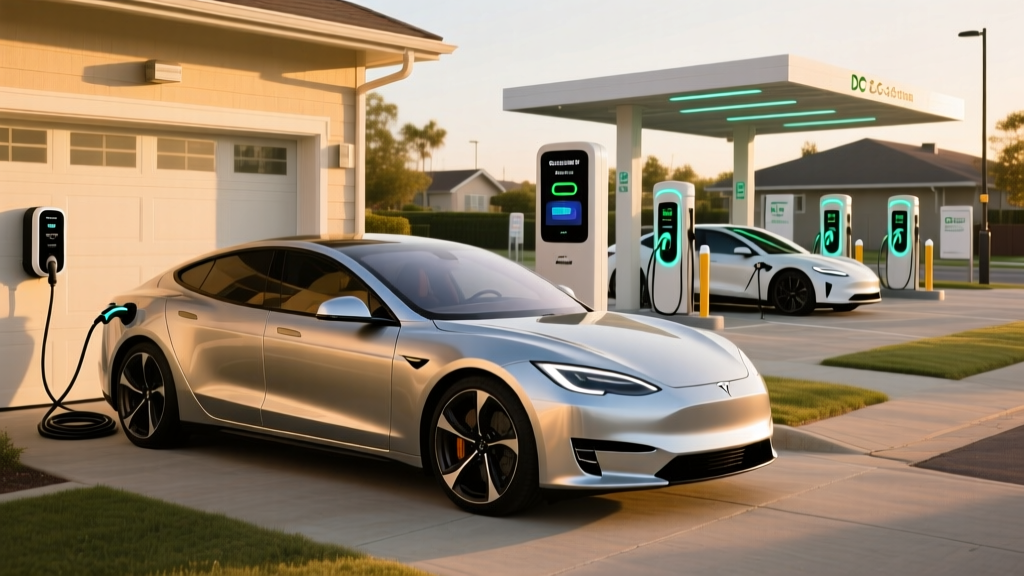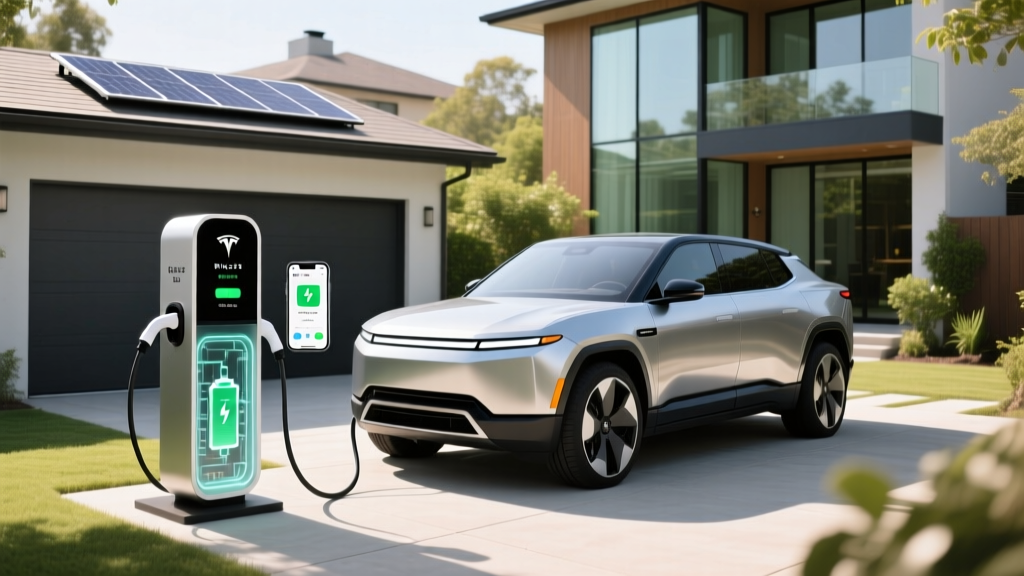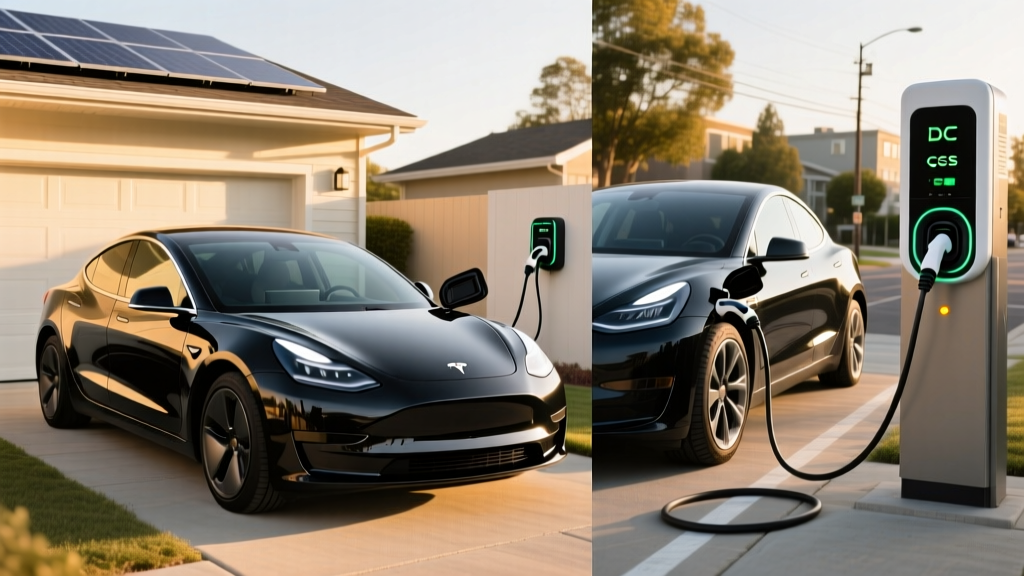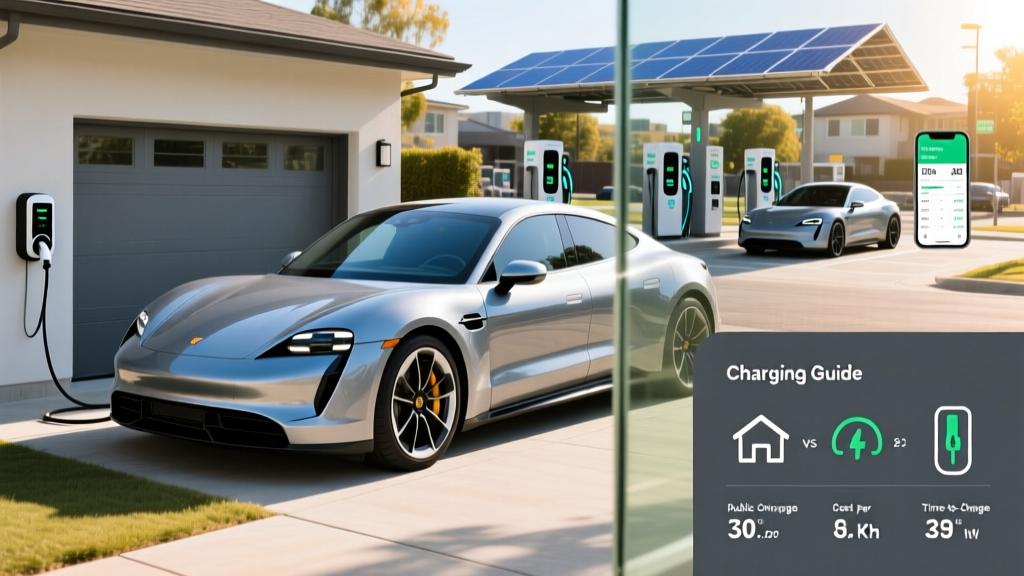
Buying the longest range electric vehicle in 2026 — whether that's the Lucid Air Grand Touring (EPA 512 miles, 118 kWh usable battery) or the Chevrolet Silverado EV 4WT (EPA 492 miles, ~200 kWh pack) — only solves half the ownership equation. The other half is charging infrastructure: how fast you can replenish that massive battery at home, what it costs, and which public networks can actually sustain the 300–350 kW peak rates these vehicles advertise.
This guide breaks down every layer of EV charging — from Level 1 trickle to 350 kW DC fast charging — with exact numbers on speed, cost, and equipment. We'll cover home installation realities (including the panel upgrades that catch many buyers off guard), connector compatibility in a post-NACS-dominant market, and the per-mile economics versus gasoline.
Charging Levels Explained: Speed, Power, and Real-World Range Added
The first distinction every EV owner must internalize: kW (kilowatts) measures power — how fast energy flows into your car. kWh (kilowatt-hours) measures energy — how much your battery holds. A 350 kW charger doesn't deliver 350 kWh; it delivers energy at a rate of 350 kW, and the total energy transferred depends on time. This is the single most common EV literacy gap, and it matters when you're evaluating chargers and electricity bills.
| Level | Voltage | Typical Power (kW) | Miles of Range Added per Hour | Best Use Case |
|---|---|---|---|---|
| Level 1 | 120V AC | 1.0–1.4 kW | 3–5 mi/hr | Overnight top-ups, PHEVs, emergencies |
| Level 2 (Home) | 240V AC | 7.2–11.5 kW | 25–44 mi/hr | Daily home charging, primary method for most owners |
| Level 2 (Public/Commercial) | 240V AC | 11.5–19.2 kW | 44–70 mi/hr | Workplace, destination, apartment charging |
| DC Fast Charge | 400V–800V DC | 50–350 kW | 150–1,200+ mi/hr (at peak) | Road trips, quick replenishment |
For a long-range EV with a 100+ kWh battery, Level 1 is functionally useless for full recharges — it would take over 4 days to fill a Lucid Air's 118 kWh pack. Level 2 at 11.5 kW (a 48A circuit) adds roughly 40 miles per hour of charging, meaning an overnight session of 8 hours recovers about 320 miles — enough for most daily needs even in the longest-range vehicles.
DC fast charging is where the physics get interesting — and where marketing claims need scrutiny. A vehicle advertising "350 kW peak charging" will only sustain that rate for a narrow band of its state of charge (SoC), typically between 10–30%. Above 80%, charging speed tapers dramatically to protect battery chemistry. This is the charge curve, and it means your 10–80% time matters far more than peak kW.
Real-World Charging Times for the Longest Range EVs
Here's what charging actually looks like for some of the longest-range electric vehicles available in 2026:
| Vehicle | Battery (kWh usable) | Peak DC Rate | 10–80% at DC Fast Charger | Level 2 (11.5 kW) 0–100% |
|---|---|---|---|---|
| Lucid Air Grand Touring | 118 kWh (NMC) | ~300 kW (900V architecture) | ~20 minutes (10–80%) | ~10.5 hours |
| Chevrolet Silverado EV 4WT | ~200 kWh (NMC) | ~350 kW (Ultium platform) | ~35–40 minutes (10–80%) | ~17+ hours |
| Rivian R1S (Max Pack) | 149 kWh (NMC) | ~220 kW | ~42 minutes (10–80%) | ~13 hours |
| Tesla Model S Long Range | 100 kWh (NMC) | ~250 kW (V3 Supercharger) | ~25–28 minutes (10–80%) | ~9 hours |
Home Charger Installation: Costs, Electrical Requirements, and Gotchas
Installing a Level 2 home charger is the single highest-impact upgrade an EV owner can make. Here's what it actually requires.
Electrical Requirements
A standard Level 2 home charger runs on a 240V dedicated circuit, similar to what a clothes dryer or electric oven uses. The most common configurations:
- 40A circuit / 32A continuous charge (7.7 kW) — sufficient for most daily needs, requires a 50A breaker
- 48A circuit / 40A continuous charge (9.6 kW) — faster, requires a 60A breaker
- 60A circuit / 48A continuous charge (11.5 kW) — fastest common residential setup, requires a 75A or 80A breaker
The National Electrical Code requires that continuous loads (like EV charging) use no more than 80% of a circuit's rated capacity. So a 48A charger requires a circuit rated for at least 60A.
Panel Upgrade Reality
Many homes built before 2000 have 100A or 150A electrical panels. Adding a 60A EV circuit may push total load beyond the panel's capacity, requiring a panel upgrade to 200A — a significant added cost. Homes with existing 200A panels usually have sufficient headroom, but a licensed electrician must perform a load calculation to confirm.
| Component | Typical Cost Range | Notes |
|---|---|---|
| Level 2 Charger (hardwired, 48A) | $500–$800 | Smart chargers with Wi-Fi at upper end |
| Electrical Permit | $50–$250 | Varies by municipality; some jurisdictions waive for EV installs |
| Electrician Labor (standard install) | $600–$1,500 | Depends on run length from panel to garage/driveway |
| Wiring & Conduit Materials | $200–$600 | Longer runs and underground conduit increase cost |
| Panel Upgrade (if needed) | $1,500–$3,500 | 200A upgrade from 100A/150A panel |
| Total (no panel upgrade) | $1,350–$3,150 | Most common scenario for newer homes |
| Total (with panel upgrade) | $2,850–$6,650 | Older homes or those near panel capacity |
Some utility companies offer rebates of $250–$1,000 for Level 2 installations, and certain states provide additional incentives. Check your local utility's EV program before scheduling work.
Connector Compatibility: NACS, CCS, and the Adapter Landscape
As of 2026, the connector landscape has consolidated significantly around the North American Charging Standard (NACS), originally developed by Tesla. Nearly every major automaker — Ford, GM, Rivian, Volvo, Hyundai, BMW, and others — has adopted NACS as the native port on new vehicles. CCS1 (Combined Charging System) remains on many 2023–2025 models still on the road, and CHAdeMO is effectively legacy (Nissan Leaf being the last major holdout).
| Connector | Brands Using (New Vehicles) | DC Fast Network Access | Adapter Needed? |
|---|---|---|---|
| NACS (Tesla-style) | Tesla, Ford, GM, Rivian, Volvo, Polestar, Hyundai, BMW, Mercedes | Tesla Supercharger + growing third-party NACS stations | CCS-to-NACS adapter (~$200) for legacy CCS stations |
| CCS1 | VW (some 2025 carryover), older Ford/GM/Rivian models | Electrify America, EVgo, ChargePoint | NACS-to-CCS adapter for Supercharger access |
| CHAdeMO | Nissan Leaf (legacy only) | Declining network support | No widely available adapter to NACS |
Adapter reality check: If you own a CCS-equipped vehicle from the 2023–2025 era, Ford and GM provide NACS adapters (often included or available for ~$200–$400) to access Tesla Superchargers. Verify your vehicle's firmware supports adapter-based Supercharger charging before purchasing.
Cost to Charge: Per-Mile Economics vs. Gasoline
The economic case for EVs hinges on charging costs, which vary enormously depending on where and when you plug in. Here are realistic 2026 scenarios:
| Charging Scenario | Avg $/kWh | Cost to Add 300 Miles (Lucid Air, ~3.5 mi/kWh) | Cost Per Mile |
|---|---|---|---|
| Home, off-peak (utility time-of-use rate) | $0.08–$0.12 | $6.86–$10.29 | $0.023–$0.034 |
| Home, standard residential rate | $0.13–$0.18 | $11.14–$15.43 | $0.037–$0.051 |
| Public Level 2 (ChargePoint, workplace) | $0.20–$0.35 | $17.14–$30.00 | $0.057–$0.10 |
| DC Fast Charging (Electrify America, EVgo) | $0.35–$0.55 | $30.00–$47.14 | $0.10–$0.157 |
| Tesla Supercharger (varies by location) | $0.28–$0.42 | $24.00–$36.00 | $0.08–$0.12 |
Gas comparison: A comparable luxury sedan getting 25 MPG combined at $3.50/gallon costs $0.14 per mile. Even DC fast charging at the most expensive public rates is competitive with gasoline, while home off-peak charging delivers fuel costs roughly 75–85% lower than gas.
For the longest range electric vehicles with larger batteries, home charging is essential to capturing these savings. A Silverado EV with a 200 kWh battery would cost $70–$110 to fully charge on the road at DC fast rates — but only $16–$24 at home on off-peak electricity.
Best Level 2 Home Chargers for Long-Range EVs (2026 Picks)
When you own a vehicle with a 100+ kWh battery, charging speed at home matters. A 48A charger replenishes significantly faster than a 32A unit. Here are top picks based on power output, reliability, and smart features:
ChargePoint Home Flex
- Power: Up to 11.5 kW (48A, 240V)
- Connector: NACS or J1772 (select at purchase)
- Cable Length: 23 feet
- Smart Features: Wi-Fi, scheduled charging, energy tracking, Alexa integration
- Price: ~$650–$700
- Best For: Long-range EVs needing max home speed; UL-listed, ENERGY STAR certified
Tesla Wall Connector (Gen 4)
- Power: Up to 11.5 kW (48A, 240V)
- Connector: NACS native
- Cable Length: 24 feet
- Smart Features: Wi-Fi, over-the-air updates, power sharing between multiple units, vehicle integration
- Price: ~$475
- Best For: Tesla and NACS-equipped vehicles; excellent value and reliability
Emporia Vue EV Charger
- Power: Up to 11.5 kW (48A, 240V)
- Connector: J1772 or NACS (select at purchase)
- Cable Length: 24 feet
- Smart Features: Wi-Fi, solar integration, energy monitoring, load management
- Price: ~$400–$500
- Best For: Budget-conscious buyers with solar panels; detailed energy analytics
Important: All three chargers above require hardwired installation for 48A operation. Plug-in (NEMA 14-50 outlet) versions are limited to 40A (9.6 kW) due to NEC derating rules on receptacles. For maximum speed with a long-range EV, hardwire is the way to go.
Safety, Code Compliance, and Outdoor Installation
EV charging involves sustained high-current draw — often 8+ hours continuously. This places demands on your electrical system that typical household circuits never experience. Key safety and code considerations:
- Dedicated circuit: Your EV charger must be on its own dedicated circuit — no sharing with other appliances. This prevents overloads and breaker trips.
- GFCI protection: The 2023 NEC update requires GFCI (Ground Fault Circuit Interrupter) protection for outdoor EV receptacles. Hardwired installations are generally exempt from this requirement, which is another reason hardwiring is preferred.
- Outdoor rating: If your charger is mounted outside, it must carry a NEMA 4 or IP65 weather rating. All three chargers recommended above meet this standard.
- Cable management: Long cables (23–24 feet) should be managed with a holster or hook to prevent tripping hazards and connector damage.
- Utility notification: Many utilities require you to notify them before installing a Level 2 charger, as it adds significant load to the local transformer. Some utilities will upgrade the transformer at no cost if needed.
- Permit and inspection: Nearly all jurisdictions require an electrical permit and post-installation inspection. Skipping this step can void homeowner's insurance coverage for electrical fires.
Preconditioning: The Hidden Key to Fast DC Charging
If you drive one of the longest range electric vehicles and plan to use DC fast chargers on road trips, battery preconditioning is critical. Preconditioning warms (or cools) the battery pack to its optimal charging temperature before you arrive at the station.
Most modern EVs — Tesla, Lucid, Rivian, GM Ultium vehicles, Hyundai/Kia E-GMP platforms — automatically precondition the battery when you navigate to a DC fast charger in the vehicle's built-in navigation system. Arriving without preconditioning can reduce peak charge rates by 30–50%, especially in cold weather. A Lucid Air that could peak at 300 kW when preconditioned might only pull 150–180 kW with a cold battery, adding 10–15 minutes to your stop.
Always route through the car's native navigation to DC fast chargers rather than using a phone app — this triggers the preconditioning sequence automatically.
Frequently Asked Questions
How much does it cost to install a home EV charger?
A typical Level 2 home charger installation costs $1,350–$3,150 when no panel upgrade is needed (covering equipment, electrician labor, permit, and materials). If your home requires a panel upgrade from 100A/150A to 200A, expect total costs of $2,850–$6,650. Always get a load calculation from a licensed electrician before committing.
How fast will each charging level add range?
Level 1 (120V) adds 3–5 miles per hour — impractical for long-range EVs. Level 2 (240V, 48A) adds approximately 35–44 miles per hour depending on vehicle efficiency. DC fast charging adds 150–1,200+ miles per hour at peak rates, but only for a portion of the charging session (typically 10–50% SoC). For a 500-mile EV, expect a 10–80% DC fast charge session to take 20–40 minutes depending on peak rate and battery size.
Which connector/charger is compatible with my EV?
For 2026 models, most new EVs from Ford, GM, Rivian, Tesla, Hyundai, BMW, Volvo, and others use the NACS connector natively. Older 2023–2025 models may have CCS1 ports and require an adapter for Supercharger access. CHAdeMO is legacy-only (Nissan Leaf). Check your vehicle's charge port or consult the manufacturer's spec sheet before purchasing a charger or adapter.
How much does charging cost per mile vs gas?
Home charging on off-peak rates costs approximately $0.02–$0.04 per mile — roughly 75–85% less than a 25 MPG gas car at $3.50/gallon ($0.14/mile). Public DC fast charging costs $0.08–$0.16 per mile, still competitive with or cheaper than gasoline. The savings multiply for long-range EVs that can be charged primarily at home.
What electrical upgrades might I need?
The most common upgrade is a panel replacement from 100A or 150A to 200A ($1,500–$3,500) if your existing panel lacks capacity for a dedicated 60A EV circuit. Other potential upgrades include running new conduit for long wire runs from the panel to the garage, upgrading the utility service drop (rare, handled by the utility), or adding a sub-panel if the main panel is full. A licensed electrician's load calculation will identify all requirements before work begins.
Do I need a smart charger, or is a basic unit fine?
Smart chargers with Wi-Fi connectivity offer scheduled charging (critical for time-of-use electricity rates), energy monitoring, and remote diagnostics. For long-range EV owners paying variable electricity rates, scheduled off-peak charging can save $5–$15 per full charge versus peak-rate charging. The $100–$200 premium for a smart charger pays for itself within months.
Sources: EPA range and efficiency data from fueleconomy.gov; electrical code requirements per NFPA NEC 2023; manufacturer charging specifications from Lucid Motors, General Motors, and Tesla press sites; IRS §30D tax credit eligibility per irs.gov.