Buying the longest range EV on the market — whether that's a Lucid Air Grand Touring with its EPA-estimated 512 miles, a Tesla Model S Long Range at 402 miles, or a Chevrolet Silverado EV 4WT at 460 miles — only solves half the equation. The other half is infrastructure: how you'll replenish that massive 100+ kWh battery pack efficiently, affordably, and safely. A bigger battery means longer charging sessions if your equipment isn't matched to it, making your home charger selection and public charging strategy more critical than with a smaller-battery commuter EV.
This guide walks through every layer of charging a long-range electric vehicle, from the electrical panel in your garage to the 350 kW DC fast chargers on interstate corridors. We'll cover exact speeds, real costs, connector compatibility, and the specific equipment that makes sense for high-capacity battery packs.
Charging Levels Explained: Speeds That Matter for Big Batteries
The single most important distinction in EV charging is between kW (kilowatts — the rate of power delivery, like water pressure) and kWh (kilowatt-hours — the total energy stored, like gallons in a tank). A 118 kWh battery (Lucid Air) charged at 11.5 kW (a typical Level 2 home charger) takes roughly 10 hours from empty to full. That same battery at a 250 kW DC fast charger can recover 300 miles in about 20 minutes. The difference is enormous, and understanding these levels is essential for long-range EV ownership.
| Level | Voltage | Max Power (kW) | Miles of Range Added per Hour | Best Use Case |
|---|---|---|---|---|
| Level 1 | 120V AC | 1.4–1.9 kW | 3–5 mi/hr | Overnight top-off, PHEVs, emergency backup |
| Level 2 | 240V AC | 7.2–19.2 kW | 20–70 mi/hr | Daily home charging, workplace, destinations |
| DC Fast Charge | 400–900V DC | 50–350 kW | 150–900+ mi/hr (peak) | Road trips, rapid top-ups, commercial fleets |
For the longest range EVs with batteries exceeding 100 kWh, Level 1 charging is effectively useless as a primary strategy — it would take 3+ days to fill a Lucid Air from empty. Level 2 at 11.5 kW (48A) is the practical home standard, recovering a full battery overnight. DC fast charging is your road-trip lifeline, and long-range EVs tend to have the most capable DC charge rates: the Lucid Air peaks at ~300 kW on its 900V+ architecture, while the Tesla Model S peaks around 250 kW on V3/V4 Superchargers.
Home Charger Installation: Electrical Requirements and Real Costs
Installing a Level 2 home charger for a long-range EV isn't just about buying a wallbox — it's about ensuring your home's electrical system can sustain high-amperage draw for 8–12 hours at a stretch. Here's what's involved.
Electrical Requirements
Most high-output Level 2 chargers require a 240V dedicated circuit at 40, 48, or 60 amps. A 48A charger (delivering 11.5 kW) needs a 60A breaker, because the National Electrical Code (NEC) requires circuits to be rated at 125% of continuous load. For the fastest home charging of a 100+ kWh battery, a 60A/48A setup is the minimum we recommend.
Your main electrical panel must have enough spare capacity. A 200A panel is standard in modern homes; older homes may have 100A or 150A service. Adding a 60A EV circuit to a 100A panel that's already near capacity will require a panel upgrade to 200A — one of the most expensive variables in EV charger installation.
Installation Cost Breakdown
| Component | Simple Install (panel nearby, no upgrade) | Complex Install (long run, panel upgrade) |
|---|---|---|
| Level 2 Charger (hardware) | $400–$700 | $400–$700 |
| Electrician labor (2–4 hrs simple / 6–12 hrs complex) | $500–$1,200 | $1,500–$3,500 |
| Electrical permit | $50–$200 | $50–$200 |
| Panel upgrade (if needed: 100A → 200A) | $0 | $2,000–$4,500 |
| Conduit, wiring, misc. materials | $100–$300 | $400–$1,200 |
| Total estimated cost | $1,050–$2,400 | $4,350–$10,100 |
The wide range is real. If your panel is in the garage next to where you park, has spare breaker slots, and is rated at 200A, you're looking at a straightforward $1,500–$2,000 job. If your panel is in the basement on the opposite side of the house from your parking spot and needs an upgrade, costs can exceed $8,000. Always get a licensed electrician's assessment before purchasing equipment.
Safety and Code Considerations
- Dedicated circuit: Your EV charger must be on its own breaker — never shared with other appliances.
- GFCI protection: NEC 2020 and later require GFCI breakers for EV charging outlets (though hardwired units may have built-in ground-fault protection).
- Outdoor rating: If your charger is exposed to weather, ensure the unit carries a NEMA 4 (or IP65+) rating and the connector holster is weather-sealed.
- Wire gauge: A 60A circuit typically requires 6 AWG copper wire for runs up to ~50 feet; longer runs may need 4 AWG to prevent voltage drop. Your electrician will calculate this.
- Utility notification: Some utilities require notification when adding a large continuous load; they may offer a dedicated EV meter or time-of-use rate.
Connector Compatibility: NACS, CCS1, and CHAdeMO in 2026
The connector landscape has shifted dramatically. By 2026, the North American Charging Standard (NACS) — originally Tesla's proprietary plug — has become the dominant connector for new EVs. Ford, GM, Rivian, Volvo, Hyundai, and others now ship vehicles with native NACS ports, granting access to Tesla's Supercharger network (over 28,000 stalls in North America). The legacy CCS1 connector remains on vehicles from the 2022–2024 model years and earlier, while CHAdeMO is effectively discontinued on new vehicles (the Nissan Leaf was its last major holdout).
| Connector | Brands Using It (New Vehicles) | Network Access | Adapter Needed? |
|---|---|---|---|
| NACS (Tesla) | Tesla, Ford, GM, Rivian, Hyundai, Kia, Volvo, Polestar, Lucid (2025+), BMW | Tesla Superchargers, Electrify America (select), growing NACS stations | CCS-to-NACS adapter for older CCS stations (~$200–$300) |
| CCS1 | 2024-and-earlier Ford, GM, Hyundai, Kia, VW, BMW, Mercedes, Porsche | Electrify America, EVgo, ChargePoint, Ionity (EU) | NACS-to-CCS adapter for Supercharger access (OEM-provided for some brands) |
| CHAdeMO | Discontinued (Nissan Leaf ended production) | Limited; many stations removing CHAdeMO cables | No practical adapter to NACS/CCS; use existing CHAdeMO stations |
If you're buying a 2026 long-range EV, you'll almost certainly get a NACS port. The Lucid Air, for example, adopted NACS for the 2025 model year, meaning it can now use Tesla Superchargers with a simple adapter for legacy CCS stations. Always verify the exact connector your vehicle ships with before buying a home charger — most Level 2 chargers now offer both NACS and J1772 (the AC charging standard that underlies CCS) connector options.
Charging Cost Per Mile: Home vs. Public vs. Gas
The economic advantage of a long-range EV depends heavily on where you charge. Home charging on a time-of-use (TOU) plan is dramatically cheaper than public DC fast charging, and both are typically cheaper than gasoline on a per-mile basis.
| Scenario | Typical $/kWh | Cost to Add 300 Miles | Cost Per Mile |
|---|---|---|---|
| Home Level 2 (off-peak TOU rate) | $0.08–$0.14 | $8.00–$14.00 | $0.027–$0.047 |
| Home Level 2 (standard residential avg.) | $0.15–$0.20 | $15.00–$20.00 | $0.050–$0.067 |
| Public Level 2 (workplace/destination) | $0.20–$0.35 | $20.00–$35.00 | $0.067–$0.117 |
| DC Fast Charge (EA/EVgo/Supercharger) | $0.32–$0.55 | $32.00–$55.00 | $0.107–$0.183 |
| Gasoline equivalent (30 MPG avg. at $3.50/gal) | — | $35.00 | $0.117 |
According to fueleconomy.gov, the Lucid Air Grand Touring achieves 146 MPGe combined (approximately 3.4 mi/kWh), while the Tesla Model S Long Range achieves 124 MPGe combined (~2.9 mi/kWh). At home off-peak rates, filling the Lucid's 118 kWh usable battery costs roughly $9.44 to $16.52 — versus $35+ to cover the same distance in a 30 MPG gas car at $3.50/gallon.
The takeaway: home charging makes a long-range EV extraordinarily cheap to fuel. Exclusive reliance on DC fast charging narrows the gap with gasoline significantly, which is why Level 2 home installation is a near-mandatory investment for long-range EV ownership.
Charging Times for Long-Range EVs: What to Expect
Bigger batteries take longer to charge — but long-range EVs also tend to support faster peak charge rates. Here's how the math works out for real-world 10–80% charging sessions, the standard metric because charging slows dramatically above 80% to protect battery health (the charge curve taper is a physical limitation of lithium-ion cells, not a software choice).
| Vehicle | Usable Battery (kWh) | Peak DC Rate (kW) | 10–80% DC Fast Time | Level 2 (11.5 kW) 0–100% |
|---|---|---|---|---|
| Lucid Air Grand Touring (2026) | 118 kWh | ~300 kW | ~20 min | ~10.5 hrs |
| Tesla Model S Long Range (2026) | ~95 kWh | ~250 kW | ~25 min | ~8.5 hrs |
| Chevrolet Silverado EV 4WT (2026) | ~200 kWh | ~350 kW | ~35 min | ~17.5 hrs |
| Mercedes-Benz EQS 580 (2026) | ~108 kWh | ~200 kW | ~31 min | ~9.5 hrs |
| BMW iX xDrive50 (2026) | ~105 kWh | ~200 kW | ~34 min | ~9.5 hrs |
Real-world caveat: these DC fast times assume optimal conditions — battery preconditioned to ideal temperature, charger capable of sustaining peak rate, and ambient temperature between 60–80°F. In cold weather (below 32°F), expect 10–80% times to increase by 20–40% unless your vehicle actively preconditioned the battery during navigation to the charger. The Silverado EV's massive 200 kWh pack is an outlier — even at 350 kW peak, filling it takes longer because there's simply more energy to move. This is the trade-off of extreme range: longer charge sessions when you do need to stop.
Best Level 2 Home Chargers for Long-Range EVs (2026 Picks)
For vehicles with 100+ kWh batteries, we recommend chargers that deliver at least 11.5 kW (48A) to ensure a full overnight charge. Here are three proven options.
ChargePoint Home Flex (NACS)
- Power output: Up to 12 kW (50A) on a 60A circuit
- Connector: NACS (also available in J1772)
- Cable length: 23 feet
- Smart features: Wi-Fi, app scheduling, Alexa integration, energy tracking, TOU optimization
- Price: ~$649
- Best for: Long-range EV owners who want flexible amperage settings (dip-switch adjustable from 16A to 50A to match panel capacity)
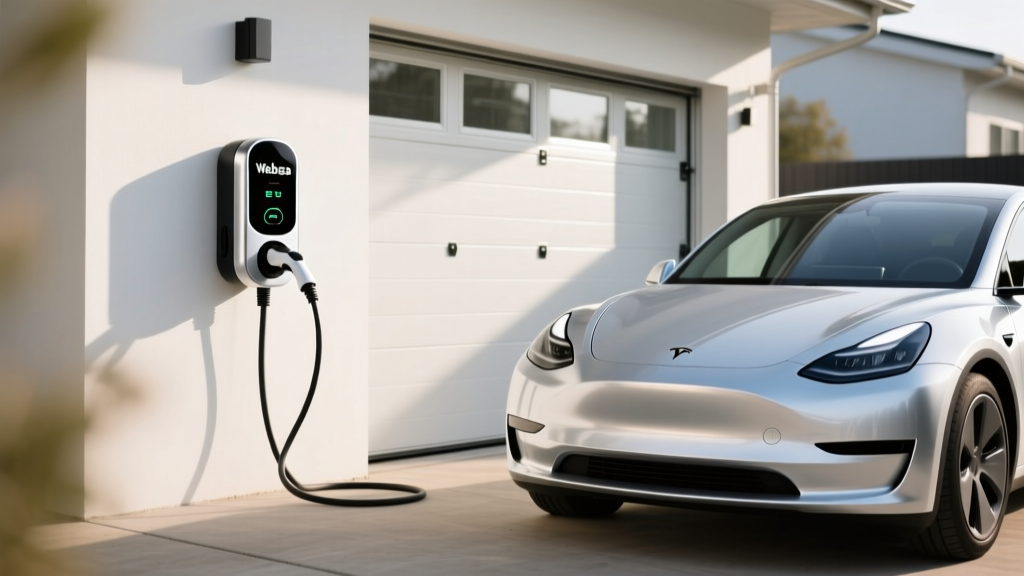
Tesla Wall Connector (Gen 4)
- Power output: Up to 11.5 kW (48A) on a 60A circuit
- Connector: NACS native
- Cable length: 24 feet
- Smart features: Wi-Fi, OTA updates, power-sharing between multiple units, Tesla app integration
- Price: ~$475
- Best for: Tesla owners and NACS-equipped vehicles; best value at this power level; power-sharing is ideal for two-EV households
Emporia Vue EV Charger
- Power output: Up to 11.5 kW (48A) on a 60A circuit
- Connector: J1772 (use adapter for NACS vehicles) or NACS
- Cable length: 24 feet
- Smart features: Integrated whole-home energy monitoring, solar-aware charging, app control, TOU scheduling
- Price: ~$399
- Best for: Budget-conscious buyers with solar panels; the energy monitoring dashboard is the best in the industry for tracking actual charging kWh vs. household load
All three units are hardwired (no plug — eliminates the NEC GFCI breaker requirement for receptacles) and carry NEMA 4 outdoor ratings. For homes with 200A panels, we recommend the ChargePoint at its full 50A setting. For homes with tighter panel capacity, the Tesla Wall Connector's power-sharing feature lets two units split a single 60A circuit dynamically — ideal if you add a second long-range EV down the road.
Public Charging Strategy: Making the Most of Your Range Advantage
The beauty of owning the longest range EV is that you can often skip public chargers entirely on trips under 400 miles. But when you do need to charge, strategy matters.
Preconditioning is non-negotiable. Every long-range EV with active thermal management (which is all of them) will precondition the battery when you navigate to a DC fast charger. This heats or cools the cells to the optimal temperature for accepting maximum charge rate. Navigating to a Supercharger in a Tesla or a compatible fast charger in a Lucid will begin preconditioning 15–30 minutes before arrival. If you arrive at a DC fast charger without preconditioning — say, by driving to one you found on an app rather than through the vehicle's navigation — expect peak charge rates to be 30–50% lower, especially in cold weather.
Charge to 80%, then drive. The charge curve on lithium-ion batteries (both NMC and LFP chemistries) means the last 20% takes nearly as long as the first 60%. On a Lucid Air at a 300 kW charger, going from 10–80% takes ~20 minutes; going from 80–100% adds another 25+ minutes. Unless you absolutely need the full battery for the remaining distance, charge to 80% and move on.
Network reliability varies. According to J.D. Power's EV charging studies, Tesla Superchargers consistently score highest in reliability and satisfaction. Electrify America and EVgo have improved but still see higher downtime rates. For long-range EV owners on road trips, planning stops around Supercharger locations (now open to NACS-equipped Fords, GMs, Rivians, and others) remains the lowest-friction option.
Tax Credits and Incentives for Home Charger Installation
The federal Alternative Fuel Vehicle Refueling Property Credit (IRS Form 8911) covers up to 30% of home EV charger equipment and installation costs, capped at $1,000 per year. This applies to the charger hardware and the electrical work — but not to panel upgrades.
Key eligibility rules for 2026:
- The charger must be installed at your primary residence in the United States.
- The property must be located in an eligible census tract (non-urban or low-income community — check the IRS eligibility tool).
- The credit is non-refundable (it reduces your tax liability but won't generate a refund beyond it).
- Some states and utilities offer additional rebates ($200–$1,500) on top of the federal credit — check your local utility and state energy office.
A $650 ChargePoint Home Flex installed for $1,500 in labor ($2,150 total) could qualify for a $645 federal credit (30% of $2,150), bringing your net cost to roughly $1,505. If your state offers an additional $500 rebate, you're down to about $1,000 all-in — a compelling investment for daily charging savings.
Frequently Asked Questions
How much does it cost to install a home EV charger?
A simple Level 2 installation with a nearby 200A panel and short wire run typically costs $1,050–$2,400 including equipment, electrician labor, and permit. A complex install requiring a panel upgrade, long conduit runs, or structural work can range from $4,350–$10,100. Always get an on-site quote from a licensed electrician before committing to equipment.
How fast will each charging level add range?
Level 1 (120V) adds 3–5 miles per hour — impractical for 100+ kWh batteries. Level 2 (240V, 48A/11.5 kW) adds 30–40 miles per hour for most long-range EVs, fully replenishing overnight. DC fast charging at 250–350 kW can add 200–300 miles in 15–25 minutes, though actual speed depends on battery temperature, state of charge, and the vehicle's charge curve.
Which connector/charger is compatible with my EV?
For 2026 model-year vehicles, NACS is the dominant connector (Tesla, Ford, GM, Rivian, Hyundai, Kia, Lucid, BMW, Volvo). Older CCS1-equipped vehicles can access Superchargers via adapter. Check your vehicle's charge port before purchasing a home charger — most charger manufacturers now offer both NACS and J1772 connector options at the same price.
How much does charging cost per mile vs. gas?
Home charging at off-peak rates ($0.08–$0.14/kWh) costs $0.03–$0.05 per mile for a long-range EV — roughly one-quarter the cost of gasoline at $3.50/gallon in a 30 MPG vehicle ($0.12/mile). Public DC fast charging at $0.40–$0.55/kWh narrows the gap to $0.13–$0.18 per mile, approaching or exceeding gasoline costs depending on your vehicle's efficiency.
What electrical upgrades might I need?
The most common upgrade is a panel replacement from 100A or 150A to 200A service ($2,000–$4,500), required when your existing panel lacks capacity for a dedicated 60A EV circuit. You may also need additional breaker slots, a new grounding electrode, or utility coordination for increased service capacity. Homes built after 2000 with 200A panels usually need no upgrade.
Does a long-range EV need a faster home charger than a short-range one?
Not necessarily faster, but it needs more total charging time. A 48A/11.5 kW charger will fully replenish a Tesla Model S (95 kWh) in about 8.5 hours and a Lucid Air (118 kWh) in about 10.5 hours. Both fit within an overnight window. However, if you drive 300+ miles daily and need to recharge the full battery every night, a 60A/14.4 kW charger (like the ChargePoint at max setting on an 80A circuit) shaves 2+ hours off the session — worth considering if your panel supports it.