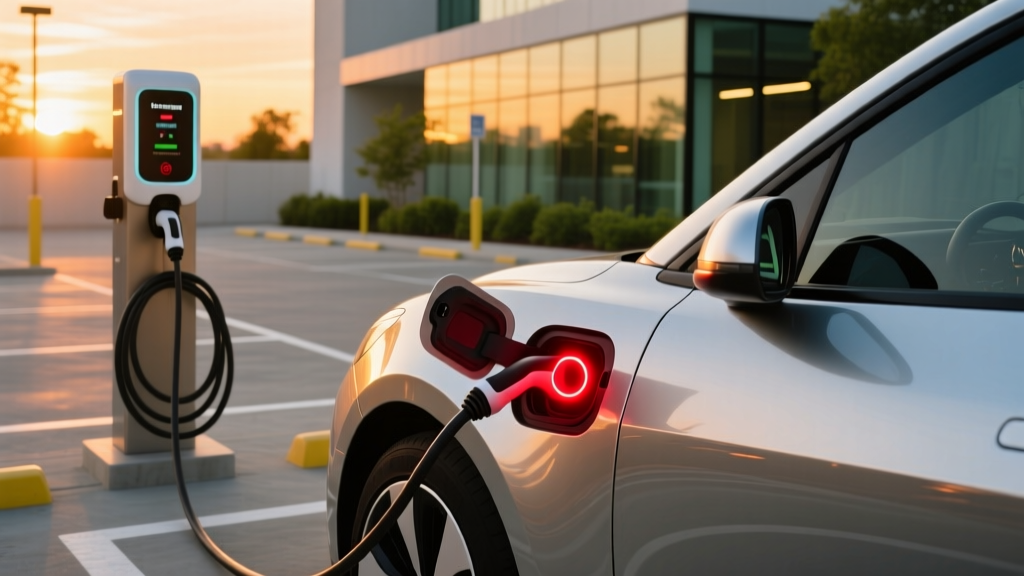
Electric cars with the longest range — like the Lucid Air Grand Touring (EPA 516 miles), Tesla Model S (402 miles), and Chevrolet Silverado EV 4WT (460 miles) — pack massive batteries between 100 and 200+ kWh. That range eliminates most daily anxiety, but it introduces a new problem: replenishing a huge battery takes serious infrastructure. Plugging a 131 kWh Lucid Air into a standard 120V wall outlet would take over five days to fill. This guide breaks down exactly how to charge long-range EVs at home and on the road, what it costs, and what equipment you need.
Charging Levels Explained: Speeds, kW, and Miles Per Hour
Before comparing equipment, you need to understand the three charging levels. The critical distinction: kW (kilowatts) measures power — how fast energy flows into the car. kWh (kilowatt-hours) measures energy — the total capacity of your battery. Think of kW as the width of a hose and kWh as the size of the bucket.
| Level | Voltage | Power (kW) | Miles of Range Added Per Hour | Typical Use |
|---|---|---|---|---|
| Level 1 | 120V AC | 1.0–1.4 kW | 3–5 miles | Overnight top-up, emergency |
| Level 2 | 240V AC | 7.2–19.2 kW | 23–65 miles | Daily home & workplace charging |
| DC Fast Charge | 400–900V DC | 50–350 kW | 150–1,200+ miles (equivalent) | Road trips, rapid replenishment |
For long-range EVs with 100+ kWh batteries, Level 1 is essentially useless as a primary strategy. Level 2 is the daily workhorse. DC fast charging is essential for road trips. Here's what charging times look like for common large-battery EVs:
- Lucid Air (131 kWh battery, 350 kW max DC): 10–80% in ~20 minutes at a 350 kW charger; 11.5 hours on a 11.5 kW Level 2 home charger
- Tesla Model S (100 kWh battery, 250 kW max DC): 10–80% in ~27 minutes at a V3 Supercharger; 10 hours on a 11.5 kW Level 2
- Chevrolet Silverado EV 4WT (200+ kWh battery, 350 kW max DC): 10–80% in ~30 minutes at a 350 kW charger; 18+ hours on a 11.5 kW Level 2
- Rivian R1S Dual-Motor Max Pack (149 kWh battery, 220 kW max DC): 10–80% in ~35 minutes at a 220 kW charger; 14 hours on a 11.5 kW Level 2
Real-world charging curve caveat: Peak kW rates apply only between roughly 10–50% State of Charge (SoC). Above 80%, charging speed tapers significantly to protect battery health. A 350 kW charger may sustain only 50–80 kW past 80%. Always plan road-trip stops around the 10–80% window for the fastest sessions.
Home Charger Installation: Requirements, Costs, and Panel Upgrades
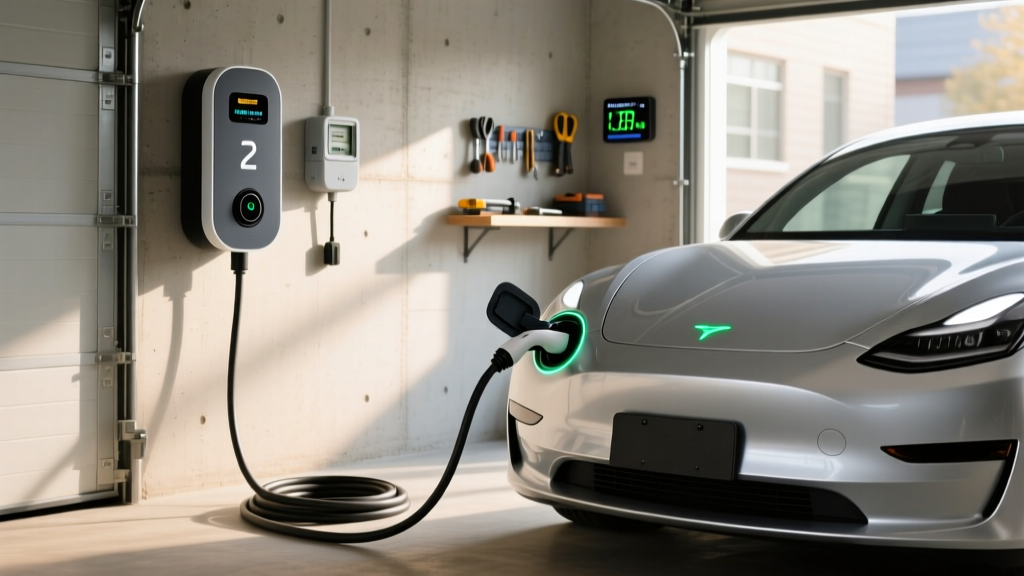
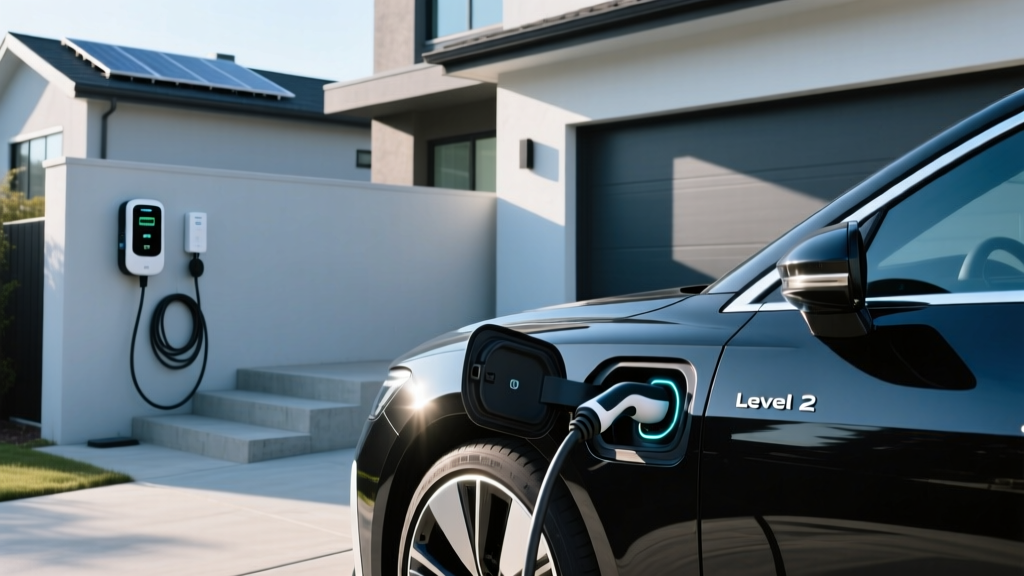
Charging a long-range EV at home requires a dedicated 240V circuit — the same voltage as your electric dryer or oven. Most installations use a NEMA 14-50 outlet or a hardwired wall connector. The electrical requirements depend on the charger's amperage:
- 40-amp circuit (32A continuous, 7.7 kW): Minimum for long-range EVs; adds ~25 miles per hour
- 50-amp circuit (40A continuous, 9.6 kW): The most common home setup; adds ~32 miles per hour
- 60-amp circuit (48A continuous, 11.5 kW): Recommended for 100+ kWh batteries; adds ~38 miles per hour
- 80-amp circuit (64A continuous, 15.2–19.2 kW): Maximum for vehicles like the Hummer EV or Silverado EV with 19.2 kW onboard chargers; adds ~52–65 miles per hour
| Item | Typical Cost Range | Notes |
|---|---|---|
| Level 2 EVSE hardware (wall charger) | $350–$750 | Smart Wi-Fi chargers cost more; basic units start ~$250 |
| Electrician labor (standard install) | $500–$1,500 | Depends on run length from panel to garage |
| Electrical materials (wire, conduit, breaker) | $100–$400 | Longer wire runs and outdoor conduit increase cost |
| Permit & inspection | $50–$250 | Required in most jurisdictions; varies by municipality |
| Panel upgrade (if needed) | $1,500–$3,500 | Only if existing panel lacks capacity |
| Total (no panel upgrade) | $1,000–$2,900 | Most homeowners fall in this range |
| Total (with panel upgrade) | $2,500–$6,400 | Older homes with 100A panels |
The federal government offers a tax credit under IRS Form 8911 for home EV charging equipment: 30% of hardware and installation costs up to $1,000 for residential installations. Check eligibility with a tax professional, as income and census-tract requirements apply.
Connector Compatibility: NACS, CCS1, and CHAdeMO in 2026
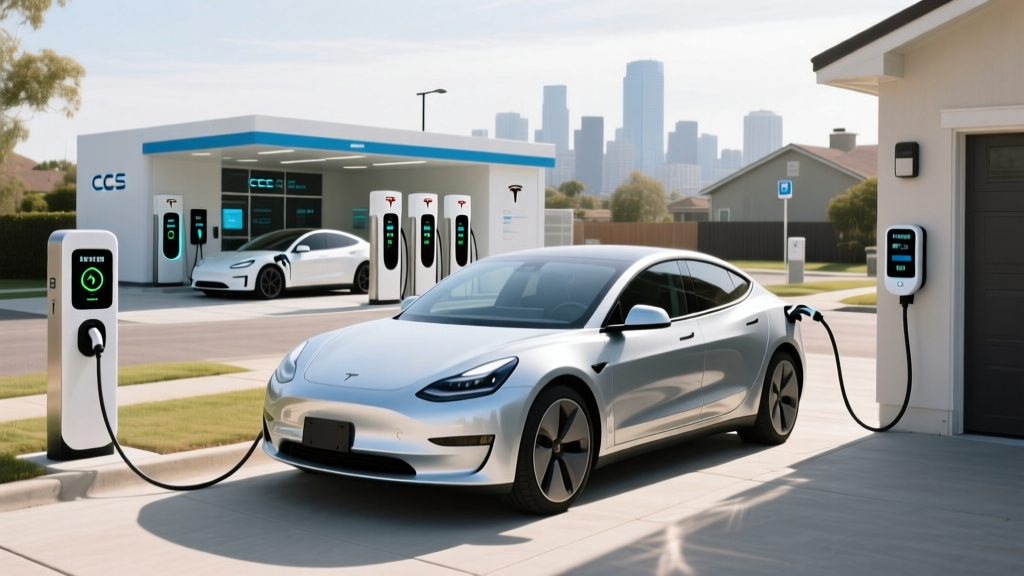
The connector landscape has consolidated significantly. As of the 2025–2026 model years, nearly every automaker has adopted the North American Charging Standard (NACS), originally developed by Tesla. Here's where each brand stands:
| Connector | Brands Using It | Adapter Needed? |
|---|---|---|
| NACS (Tesla-style) | Tesla, Ford, GM, Rivian, Volvo, Polestar, Mercedes-Benz, Hyundai, Kia (2025+), Nissan (2025+), BMW, Toyota, Subaru, Lucid | None for native NACS; CCS-to-NACS adapters available for older CCS vehicles |
| CCS1 | Remaining Stellantis models, some VW Group (transitioning), legacy 2021–2024 models | NACS-to-CCS adapter needed for Tesla Supercharger access |
| CHAdeMO | Discontinued (Nissan Leaf was last major user; 2026 Leaf uses NACS) | Limited public infrastructure; no practical adapter path |
For home Level 2 charging, all vehicles use the J1772 connector (or NACS, which includes J1772 signaling). If you buy a NACS-equipped wall charger and own a CCS1 vehicle, you'll need a NACS-to-J1772 adapter (~$100–$200). Most home charger manufacturers now offer both NACS and J1772 connector options at purchase.
For DC fast charging on the road, Tesla Superchargers (now open to non-Tesla EVs via the "Magic Dock" NACS adapter at select stations or native NACS connection) provide the most reliable network. Electrify America, EVgo, and ChargePoint operate CCS1 and NACS stalls at many locations. According to fueleconomy.gov, always check your vehicle's maximum DC charge rate — plugging into a 350 kW stall won't speed up a car limited to 150 kW.
Charging Cost Per Mile: Home vs. Public vs. Gas
The economics of charging electric cars with the longest range depend heavily on where you charge. Here's a breakdown using real 2026 electricity rates and gas prices:
| Scenario | Rate | Cost per kWh | Cost Per Mile (3.0 mi/kWh EV) | Annual Cost (12,000 mi) |
|---|---|---|---|---|
| Home off-peak (utility time-of-use) | $0.09–$0.13/kWh | $0.11 avg | $0.037 | $444 |
| Home standard rate | $0.14–$0.20/kWh | $0.17 avg | $0.057 | $684 |
| Public Level 2 (workplace/retail) | $0.25–$0.49/kWh | $0.35 avg | $0.117 | $1,404 |
| DC Fast Charge (Electrify America, EVgo) | $0.35–$0.65/kWh | $0.48 avg | $0.160 | $1,920 |
| Tesla Supercharger (member rates) | $0.25–$0.40/kWh | $0.32 avg | $0.107 | $1,284 |
| Gasoline vehicle (25 MPG, $3.40/gal) | $3.40/gallon | — | $0.136 | $1,632 |
| Gasoline vehicle (18 MPG truck, $3.40/gal) | $3.40/gallon | — | $0.189 | $2,268 |
The takeaway: Home charging is dramatically cheaper — roughly 70–75% less per mile than gas. Even DC fast charging is cost-competitive with gasoline. But if you rely exclusively on public DC fast charging, your "fuel" cost can equal or exceed a fuel-efficient gas car. This is why home Level 2 installation isn't optional for long-range EV owners — it's where the economics work.
Long-range EVs tend to be less efficient (heavier vehicles, more kWh per mile). The Lucid Air achieves a remarkable 4.5–5.0 mi/kWh, while the Silverado EV manages roughly 2.0–2.5 mi/kWh. Adjust the above calculations using your vehicle's EPA efficiency rating in kWh/100 miles.
Best Home Chargers for Long-Range EVs: 2026 Equipment Picks
When charging a 100+ kWh battery at home, you want maximum Level 2 power to keep overnight sessions practical. Here are top-performing chargers that deliver the speed and reliability long-range EV owners need:
Tesla Wall Connector (Gen 4)
- Power: Up to 11.5 kW (48A) on a 60A circuit
- Connector: NACS native; J1772 adapter included
- Cable length: 24 feet
- Smart features: Wi-Fi, OTA updates, Power Sharing (load-balance two units on one circuit), Tesla app integration
- Price: ~$475
- Best for: Tesla owners and NACS-equipped vehicles; cleanest ecosystem integration
ChargePoint Home Flex
- Power: Up to 12 kW (50A) on a 60A circuit; adjustable down to 16A
- Connector: J1772 (NACS adapter available separately)
- Cable length: 23 feet
- Smart features: Wi-Fi, Alexa integration, ChargePoint app with scheduling and energy tracking, flexible amperage via DIP switches
- Price: ~$599
- Best for: Non-Tesla EVs; flexible amperage lets you match your panel's capacity
Emporia Vue EV Charger
- Power: Up to 11.5 kW (48A) on a 60A circuit
- Connector: J1772 (NACS version available)
- Cable length: 24 feet
- Smart features: Wi-Fi, energy monitoring via Emporia Vue whole-home panel integration, solar-aware charging, time-of-use scheduling
- Price: ~$399
- Best for: Budget-conscious buyers who want energy monitoring and solar integration
Grizzl-E Smart
- Power: Up to 10 kW (40A) on a 50A circuit
- Connector: J1772 (NACS version available)
- Cable length: 24 feet
- Smart features: Wi-Fi, OCPP protocol (works with utility demand-response programs), adjustable amperage, IP65 outdoor rating
- Price: ~$449
- Best for: Outdoor installations; utility program participants; rugged Canadian-built durability
For 80A charging (19.2 kW): The Ford Charge Station Pro (~$1,200) and the upcoming GM Ultium Home Charger support 80A circuits for vehicles with 19.2 kW onboard chargers (Ford F-150 Lightning extended range, Silverado EV). These require 100A dedicated circuits and 2/0 AWG wire — professional installation is mandatory.
Safety, Code, and Installation Best Practices
EV charging draws sustained high current for hours — this is fundamentally different from a dryer that cycles on and off. The National Electrical Code (NEC) and local building codes have specific requirements:
- Dedicated circuit: Your EV charger must have its own breaker — no sharing with other outlets or appliances
- Continuous load derating: NEC requires circuits to be rated at 125% of continuous load. A 40A charger needs a 50A breaker; a 48A charger needs a 60A breaker
- GFCI protection: 2023 NEC (Article 625.54) requires GFCI protection for all receptacles used for EV charging. Hardwired installations may be exempt depending on jurisdiction
- Outdoor rating: If your charger is mounted outside, both the unit (IP65 or higher) and the outlet cover must be rated for wet locations
- Wire gauge: 6 AWG copper for 50A circuits; 4 AWG for 60A; 2/0 AWG for 100A. Aluminum wire requires larger gauge
- Permit required: Most municipalities require an electrical permit ($50–$250) and a post-installation inspection. Skipping this can void home insurance coverage and create liability
Long-Range EV Charging FAQ
How much does it cost to install a home EV charger?
A typical Level 2 home charger installation costs $1,000–$2,900 including equipment, electrician labor, materials, and permit. If your electrical panel needs an upgrade to 200A service, add $1,500–$3,500. The IRS Alternative Fuel Vehicle Refueling Property Credit (Form 8911) covers 30% of costs up to $1,000 for eligible installations in qualifying census tracts.
How fast will each charging level add range?
Level 1 (120V) adds 3–5 miles per hour. Level 2 (240V, 48A) adds roughly 35–40 miles per hour — enough to fully recharge most long-range EVs overnight. DC fast charging at 250–350 kW can add 150–300 miles in a 20–30 minute session (10–80% SoC), though actual speed depends on your vehicle's maximum charge rate and the charging curve.
Which connector/charger is compatible with my EV?
For 2025–2026 model year vehicles, most brands now use NACS (Tesla's connector). Older CCS1-equipped EVs can access Tesla Superchargers using a NACS-to-CCS adapter. CHAdeMO is effectively discontinued. For home Level 2, all chargers deliver J1772 signaling — choose NACS or J1772 connector heads based on your vehicle's inlet.
How much does charging cost per mile vs gas?
Home off-peak charging costs roughly $0.03–$0.04 per mile — about 70–75% less than a 25 MPG gas car at $3.40/gallon ($0.14/mile). Public DC fast charging costs $0.12–$0.16 per mile, roughly equivalent to gasoline. The savings case for EVs depends overwhelmingly on access to affordable home charging.
What electrical upgrades might I need?
If your home has a 100A or 150A panel and already runs electric heating, cooking, and drying, you may need a panel upgrade to 200A ($1,500–$3,500). Alternatively, smart load-management devices ($200–$400) can dynamically reduce EV charging power when other appliances activate, avoiding a panel upgrade. Your electrician will perform a NEC Article 220 load calculation to determine what's required.
Should I precondition my long-range EV before DC fast charging?
Yes. Battery preconditioning warms the battery pack to optimal temperature for fast charging, which can cut 10–80% charge times by 5–10 minutes in cool weather. Tesla, Lucid, Rivian, and GM vehicles precondition automatically when you navigate to a DC fast charger. If your vehicle doesn't auto-precondition, enable it manually via the app or infotainment before arriving.