Why Long-Range EVs Demand a Smarter Charging Strategy
If you're shopping for the electric vehicle with longest range in 2026, you're likely looking at models like the Lucid Air Grand Touring (EPA 512 miles, 112 kWh usable battery), the Chevrolet Silverado EV 4WT (EPA 492 miles, ~200 kWh pack), or the Tesla Model S Long Range (EPA 402 miles, ~100 kWh). Massive batteries solve range anxiety but create a new challenge: charge anxiety. Pushing 100–200 kWh through a standard 120V wall outlet would take multiple days. A deliberate home and public charging plan isn't optional for long-range EV owners — it's the difference between effortless daily driving and a logistics headache.
This guide covers the three charging levels, real installation costs (including panel upgrades), connector compatibility across every major brand, per-mile charging costs versus gas, and specific equipment recommendations that can actually handle a 100+ kWh battery overnight.
The Three Charging Levels: Speed, Power, and Real-World Range Gains
EV charging is measured in kW (kilowatts), which is the rate of power delivery — think of it as the width of the pipe. The battery capacity is measured in kWh (kilowatt-hours), which is total energy stored — the size of the tank. Confusing these two is the single most common EV literacy mistake. A 112 kWh battery charged at 11.5 kW takes roughly 10 hours from empty; at 250 kW, it takes under 30 minutes to 80%.
| Level | Voltage / Amps | Power (kW) | Miles of Range Added per Hour | Typical Use Case |
|---|---|---|---|---|
| Level 1 | 120V / 12A | ~1.4 kW | 3–5 mi/hr | Overnight trickle; PHEVs; emergency |
| Level 2 (Home) | 240V / 32–48A | 7.7–11.5 kW | 25–44 mi/hr | Daily home charging; workplace |
| Level 2 (Commercial) | 208–240V / 48–80A | 11.5–19.2 kW | 44–70 mi/hr | Fleet depots; high-power home setups |
| DC Fast (CCS/NACS) | 400–800V DC | 50–350 kW | 150–1,200+ mi/hr (peak) | Road trips; corridor travel |
Real-world context for a long-range EV: A Lucid Air Grand Touring with its 112 kWh pack gaining 40 miles overnight on Level 2 (at 11.5 kW, roughly 8 hours of charging) adds about 320 miles — enough for most weekly driving. On a 350 kW DC fast charger, that same vehicle can add ~200 miles in 12 minutes thanks to Lucid's 900V+ architecture and excellent charge curve. The Chevrolet Silverado EV's enormous ~200 kWh pack, however, needs a full 17+ hours on a 11.5 kW Level 2 charger to go from 10% to full — making DC fast charging essential for road trips.
Home Level 2 Installation: Electrical Requirements, Costs, and Panel Upgrades
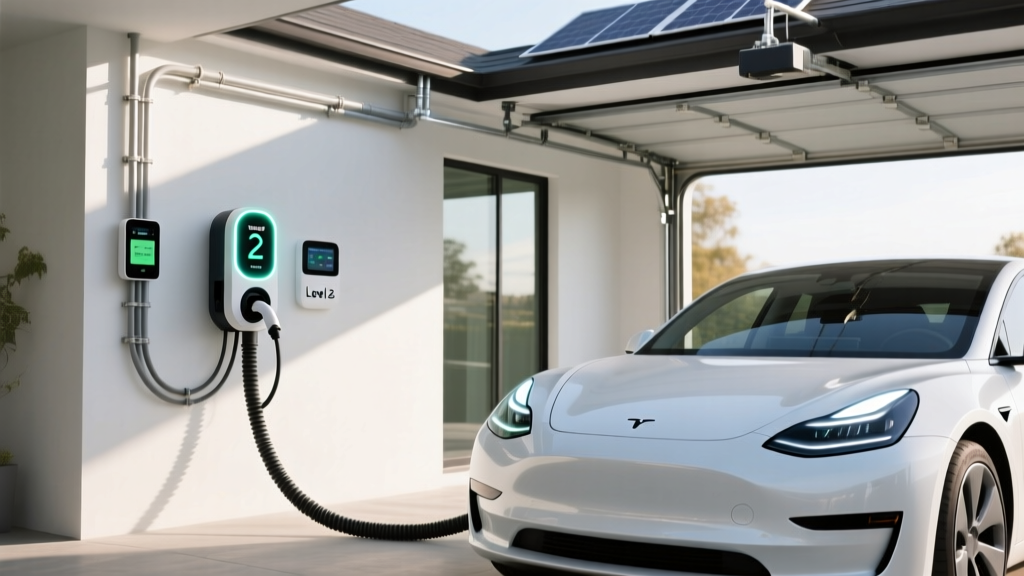
Installing a Level 2 home charger is the single highest-impact upgrade a long-range EV owner can make. Here's what's actually involved.
Electrical Requirements
- Circuit: A dedicated 240V circuit, typically 40A, 50A, or 60A, depending on charger amperage.
- Breaker sizing: EVSE must draw no more than 80% of the circuit rating per NEC Article 625. A 48A charger requires a 60A breaker.
- Wire gauge: 6 AWG copper for 50A circuits; 4 AWG for 60A. Aluminum is cheaper but requires larger gauge.
- Outlet vs. hardwired: NEMA 14-50 outlets allow portability but require GFCI breakers (adding ~$100–$150 and occasional nuisance trips). Hardwired units avoid GFCI requirements and are generally preferred for dedicated EV circuits.
Does Your Panel Need an Upgrade?
This is the cost variable most online guides gloss over. Homes built before 2000 often have 100A or 150A main panels. Adding a 60A EV circuit to an already-loaded 100A panel may exceed capacity — especially if you have electric heat, an electric oven, and a dryer running simultaneously.
- 100A panel: Likely needs an upgrade to 200A. Cost: $1,500–$3,500 depending on utility coordination and meter work.
- 150A panel: May suffice with a load calculation. Some jurisdictions allow "smart" load-management devices (like the Emporia VUE with automatic shedding) to avoid a full upgrade.
- 200A panel: Usually accommodates a 40–60A EV circuit without issue, assuming space for a double-pole breaker.
| Component | Low-End | High-End | Notes |
|---|---|---|---|
| Level 2 EVSE (Equipment) | $350 | $750 | 32A–48A smart chargers |
| Electrician Labor | $400 | $1,500 | Depends on run length, wall/attic routing |
| Permit & Inspection | $50 | $250 | Varies by municipality |
| Electrical Materials (wire, conduit, breaker) | $100 | $400 | Longer runs = more cost |
| Panel Upgrade (if needed) | $1,500 | $3,500 | 100A → 200A service upgrade |
| Total (No Panel Upgrade) | $900 | $2,900 | Most homes with 200A panels |
| Total (With Panel Upgrade) | $2,400 | $6,400 | Older homes needing service upgrade |
The IRS Residential Clean Energy Credit (Form 5695) covers 30% of EVSE equipment and installation costs up to $1,000 through 2032, provided you live in a qualifying census tract. This can offset $270–$870 of a standard install. Always verify eligibility with a tax professional.
Connector Compatibility: NACS, CCS1, CHAdeMO, and Adapter Reality
As of 2026, the North American connector landscape has consolidated heavily around NACS (the Tesla-designed standard, now SAE J3400), but CCS1 and CHAdeMO vehicles are still on the road and still charging.
| Connector | Brands Using It (2026 New Vehicles) | DC Fast Network Access | Adapter Needed? |
|---|---|---|---|
| NACS (J3400) | Tesla, Ford, GM, Rivian, Volvo, Polestar, Mercedes, BMW, Hyundai, Kia, Nissan, Lucid, Toyota, Subaru | Tesla Supercharger + most new Electrify America, EVgo, BP Pulse stalls | CCS→NACS adapters for legacy CCS vehicles ($150–$250) |
| CCS1 | Legacy (2024 and earlier models from most brands); still sold on some commercial vehicles | Electrify America, EVgo, ChargePoint DC, Ionity (EU) | NACS→CCS adapters available but limit charge speed |
| CHAdeMO | Nissan Leaf (discontinued after 2025), Mitsubishi Outlander PHEV (older) | Declining — many networks removing CHAdeMO cables | No practical adapter to NACS for DC fast charging |
Practical advice for long-range EV buyers: If you're purchasing a 2026 model-year vehicle, it almost certainly ships with a NACS port. Home Level 2 charging uses the same J1772-to-NACS connector (or a built-in NACS inlet with J1772 adapter). For public DC fast charging, NACS gives you access to the Tesla Supercharger network — over 25,000 stalls in North America — which remains the most reliable corridor-charging infrastructure per fueleconomy.gov and independent reliability surveys.
Charging Cost Per Mile: Home vs. Public vs. Gas
The cost advantage of an electric vehicle with longest range capability depends heavily on where you charge. A 112 kWh battery is a massive energy store — filling it at expensive DC fast rates costs significantly more than topping off at home overnight.
| Charging Scenario | $/kWh | Cost to Add 300 Miles* | Cost Per Mile |
|---|---|---|---|
| Home (off-peak utility rate) | $0.08–$0.12 | $2.70–$4.05 | $0.009–$0.014 |
| Home (standard residential avg) | $0.16 | $5.40 | $0.018 |
| Public Level 2 (workplace, retail) | $0.25–$0.40 | $8.44–$13.50 | $0.028–$0.045 |
| DC Fast Charging (public) | $0.35–$0.55 | $11.81–$18.56 | $0.039–$0.062 |
| Gasoline (30 MPG avg, $3.40/gal) | — | $34.00 | $0.113 |
*Based on a long-range EV averaging 3.3 miles/kWh (approx. 100 MPGe combined). Actual efficiency varies — the Lucid Air achieves ~4.5 mi/kWh while the Silverado EV achieves ~2.2 mi/kWh.
Even at the most expensive public DC fast-charging rates, a long-range EV costs roughly half per mile compared to a 30 MPG gas vehicle. But the savings multiply when you charge at home: a Lucid Air owner charging exclusively at $0.10/kWh off-peak spends approximately $0.007 per mile — a 94% reduction versus gasoline.
Charging Times for Long-Range Battery Packs
Large batteries demand patience at lower charge levels and reward you at higher ones. Here are realistic 10–80% charge times for common long-range pack sizes.
| Battery Size (kWh Usable) | 11.5 kW Level 2 | 150 kW DC Fast | 250 kW DC Fast | 350 kW DC Fast |
|---|---|---|---|---|
| 85 kWh (e.g., Tesla Model S LR) | ~5.1 hrs | ~32 min | ~22 min | ~18 min* |
| 100 kWh (e.g., Rivian R1S Max) | ~6.1 hrs | ~38 min | ~26 min | ~22 min* |
| 112 kWh (e.g., Lucid Air GT) | ~6.8 hrs | ~42 min | ~20 min** | ~15 min** |
| 200 kWh (e.g., Silverado EV) | ~12.2 hrs | ~75 min | ~50 min | ~38 min* |
*Charge curve taper above 80% SoC means sustained peak rates are not maintained for the full session. **Lucid's 900V+ architecture sustains high charge rates longer than 400V systems, yielding faster real-world times despite similar peak kW ratings.
Key insight on charge curves: Peak kW ratings are marketing numbers. A vehicle that "accepts 250 kW" may only sustain that rate between 10–30% SoC before tapering to 150 kW, then 100 kW, then 50 kW above 80%. This is why 10–80% time is the most honest charging metric. Long-range EVs with 800V+ architectures (Lucid, Hyundai/Kia E-GMP, GM Ultium) sustain peak power longer than older 400V platforms, making a meaningful difference on road trips.
Recommended Home Level 2 Chargers for Long-Range EVs
If you own a 100+ kWh EV, a 32A charger is undersized. You want 48A minimum to ensure a full overnight replenishment. Here are three proven options.
ChargePoint Home Flex (NACS)
- Power Output: Up to 11.5 kW (48A at 240V)
- Connector: NACS (J3400), J1772 adapter included
- Cable Length: 23 ft
- Smart Features: Wi-Fi, Alexa, scheduling, energy tracking, load sharing
- Price: ~$599
- Best For: Reliable daily charging with excellent app ecosystem
Tesla Wall Connector
- Power Output: Up to 11.5 kW (48A at 240V)
- Connector: NACS native; J1772 adapter available separately
- Cable Length: 24 ft
- Smart Features: Wi-Fi, OTA updates, power sharing between multiple units, Tesla app integration
- Price: ~$475
- Best For: Tesla owners and NACS-native vehicles seeking the cleanest integration
Emporia Vue Level 2 Charger
- Power Output: Up to 11.5 kW (48A at 240V); configurable down to match panel capacity
- Connector: NACS (2026 model), J1772 adapter included
- Cable Length: 24 ft
- Smart Features: Integrated whole-home energy monitoring, automatic load shedding (avoids panel upgrades), solar-aware charging, scheduling
- Price: ~$499
- Best For: Homes with tight panel capacity or solar panels; the load-management feature can avoid a $2,000+ panel upgrade
Safety, Code, and Installation Best Practices
Level 2 EV charging draws sustained high current for hours — more like a welder than a dryer. Proper installation isn't just code compliance; it's fire prevention.
- Dedicated circuit: NEC Article 625 requires a dedicated branch circuit for EVSE. Never share with another appliance.
- GFCI protection: Required for receptacle-based (NEMA 14-50) installations per NEC 2020/2023. Hardwired EVSE units do not require an external GFCI breaker (the EVSE has built-in ground-fault protection), which avoids nuisance tripping issues common with GFCI breakers on EV loads.
- Outdoor rating: If your charger is mounted outdoors, ensure the EVSE is NEMA 4 rated (weatherproof). All recommended units above carry outdoor ratings.
- Permit and inspection: Most jurisdictions require an electrical permit for a new 240V circuit. Inspections typically verify wire gauge, breaker sizing, grounding, and proper mounting. Skipping the permit risks insurance claim denial in the event of an electrical fire.
- Cable management: Use a holster or cable reel. A 24-ft charging cable left on a garage floor is a trip hazard and degrades the cable jacket over time.
Always hire a licensed electrician familiar with NEC Article 625. The NHTSA and NFPA both recommend professional installation over DIY for sustained high-current circuits.
Frequently Asked Questions
How much does it cost to install a home EV charger?
A typical Level 2 home installation costs $900–$2,900 if your electrical panel has sufficient capacity. If you need a panel upgrade from 100A to 200A service, total costs range from $2,400–$6,400. The federal Residential Clean Energy Credit covers 30% of equipment and installation up to $1,000 if you're in a qualifying census tract.
How fast will each charging level add range?
Level 1 (120V) adds 3–5 miles per hour — impractical for a 100+ kWh battery. Level 2 (240V, 48A) adds 30–44 miles per hour, replenishing most long-range EVs overnight. DC fast charging at 250 kW can add 150–250 miles in 15–20 minutes depending on the vehicle's architecture and state of charge.
Which connector and charger is compatible with my EV?
Nearly all 2026 model-year EVs sold in North America use the NACS (J3400) connector. If you own a 2023–2025 CCS-equipped vehicle, a CCS-to-NACS adapter ($150–$250) grants access to Tesla Superchargers. CHAdeMO vehicles (older Nissan Leaf, Mitsubishi) have no practical DC adapter path and face declining public infrastructure support.
How much does charging cost per mile compared to gas?
Home charging at off-peak rates costs $0.009–$0.014 per mile for an efficient long-range EV — roughly 90% less than a 30 MPG gasoline car at $3.40/gallon ($0.113/mile). Even public DC fast charging at $0.48/kWh averages $0.05–$0.06 per mile, still a ~50% savings versus gas.
What electrical upgrades might I need for a home charger?
If your home has a 200A panel with available breaker spaces, you likely need nothing beyond the dedicated 240V circuit. Homes with 100A service typically require a panel upgrade ($1,500–$3,500). Smart load-management devices like the Emporia VUE can sometimes avoid a full upgrade by dynamically reducing charger power when other appliances are running — check with your local AHJ (Authority Having Jurisdiction) for approval.
Can I charge a long-range EV with solar panels?
Yes, and it's one of the most cost-effective setups. A typical 10 kW residential solar array produces 35–50 kWh per day depending on location — enough to replenish 120–225 miles of range. Chargers like the Emporia Vue offer solar-aware scheduling that automatically charges when surplus solar is available, driving your effective fuel cost near zero after the solar system payback period.