Why the Longest Range EV 2026 Lineup Demands a Charging Rethink
The 2026 model year brings a new tier of electric vehicles packing 100+ kWh battery packs and EPA range figures exceeding 400 miles. The Lucid Air Grand Touring leads at an EPA-estimated 512 miles with its 118 kWh usable pack, while the Chevrolet Silverado EV 4WT pushes past 400 miles on a massive 200+ kWh battery. Even mainstream models like the Tesla Model S Long Range (402 miles EPA, 100 kWh) and the Rivian R1T Dual-Motor Max (352+ miles, 141 kWh) are stretching the boundaries of what a single charge can deliver.
But here's the practical problem: bigger batteries mean longer charging times if your equipment isn't matched to the task. Plugging a 141 kWh Rivian R1T into a standard Level 1 outlet adds roughly 3 miles per hour — meaning a full charge would take over 46 hours. That's not a typo. To actually live with the longest range EV 2026 models day-to-day, you need to understand charging levels, home electrical requirements, connector compatibility, and real-world costs. This guide covers every number you need.
kW (kilowatts) = power, or the rate at which electricity flows. Think of it as the width of the pipe. kWh (kilowatt-hours) = energy, or the total amount of electricity stored. Think of it as the size of the tank. A 100 kWh battery charged at 10 kW takes 10 hours. The same battery charged at 100 kW takes roughly 1 hour (in ideal conditions). Never confuse these — they're the single most common source of EV charging misunderstanding.
Charging Levels Explained: Speed, Power, and Real-World Range Added
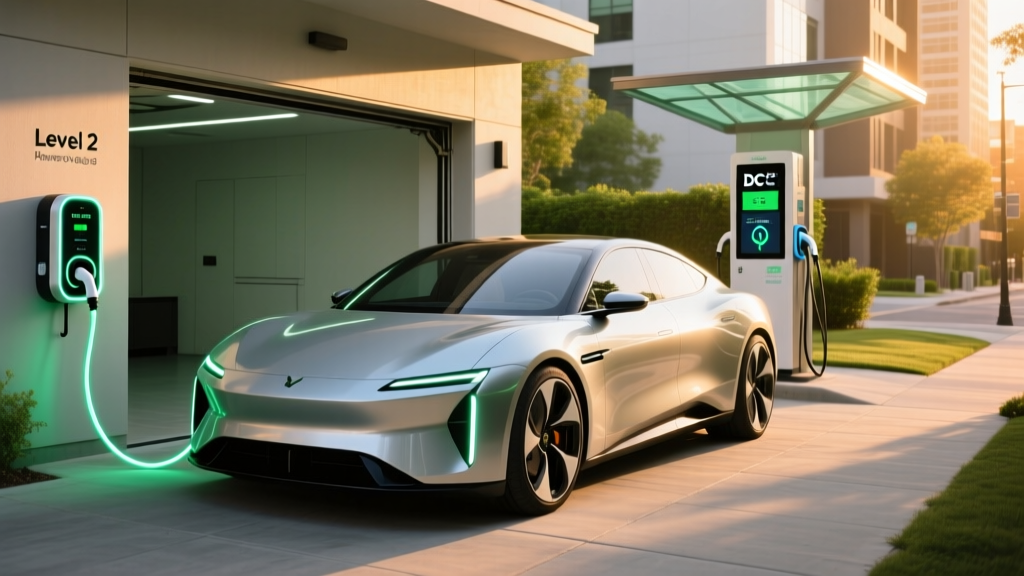
Every EV owner interacts with three charging tiers. The table below shows what each delivers for the large-battery vehicles dominating the 2026 longest-range segment.
| Level | Voltage / Amps | Power (kW) | Miles of Range / Hour | 10–80% Time (100 kWh pack) |
|---|---|---|---|---|
| Level 1 (120V household) | 120V / 12A | 1.4 kW | 3–5 mi/hr | ~50 hours |
| Level 2 (240V home/public) | 240V / 32–48A | 7.7–11.5 kW | 25–44 mi/hr | 7–10 hours |
| DC Fast Charging | 400–900V DC | 50–350 kW peak | 150–1,200+ mi/hr (peak) | 15–40 min (varies) |
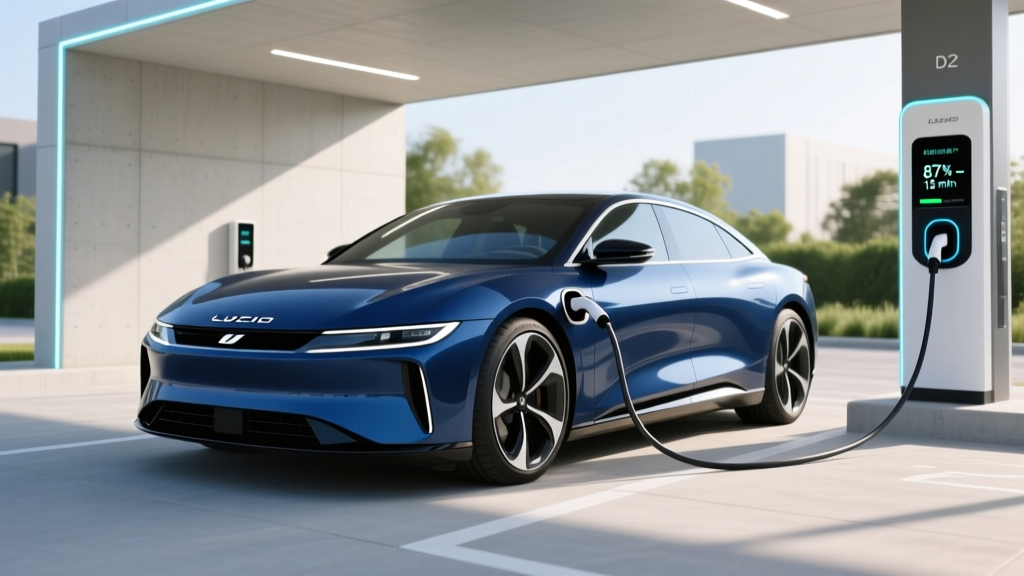
A few real-world caveats: DC fast charging speeds are peak rates, not sustained. Most EVs hit their peak kW between 10–30% state of charge, then taper as the battery fills. A Lucid Air Grand Touring can accept up to 300 kW on a compatible charger and reach 10–80% in roughly 22 minutes, per Lucid's specifications. But that 300 kW peak might only sustain for the first 5–8 minutes before stepping down to 150–180 kW through the mid-range and dropping further above 70%.
For a 200 kWh Chevrolet Silverado EV, even at 350 kW peak, the 10–80% session takes closer to 35–40 minutes because there's simply more energy to move. Always think in total kWh needed, not just peak kW advertised.
Home Charger Installation: Electrical Requirements, Costs, and Gotchas
If you're buying one of the longest range EV 2026 models, a Level 2 home charger is effectively mandatory. Here's what the installation actually involves.
Electrical Requirements
A Level 2 charger requires a 240-volt dedicated circuit, identical in concept to what powers your electric dryer or oven. The most common home setups:
- NEMA 14-50 outlet (240V / 50A): Supports up to 40A continuous charging (9.6 kW). This is the most versatile option — you can plug in a portable charger or a wall-mounted unit.
- Hardwired 60A circuit (240V / 60A): Supports up to 48A continuous charging (11.5 kW). Required for the fastest home charging and eliminates the outlet as a potential failure point.
- Hardwired 80A circuit (240V / 80A): Supports 64A continuous (15.4 kW). Only certain EVs can accept this — the Tesla Model S/X with the optional high-amperage onboard charger is one example.
The Panel Upgrade Reality
Many homes built before 2000 have 100A or 150A main electrical panels. Adding a 50–60A EV circuit may push total load beyond the panel's capacity, especially if you already run electric heat, an electric oven, and a dryer. A licensed electrician will perform a load calculation per NEC Article 220 to determine if your panel can handle the addition.
If an upgrade is needed — typically to a 200A panel — expect to pay $1,500–$3,500 for the panel swap alone, on top of the charger circuit installation. This is the single biggest surprise cost for new EV owners in older homes.
| Component | Simple Install (Panel Nearby) | Complex Install (Long Run / Panel Upgrade) |
|---|---|---|
| Level 2 charger unit (40–48A) | $350–$700 | $350–$700 |
| Electrician labor + materials (wire, conduit, breaker) | $500–$1,200 | $1,500–$3,000 |
| Electrical permit | $50–$200 | $50–$200 |
| Panel upgrade (if needed) | $0 | $1,500–$3,500 |
| TOTAL | $900–$2,100 | $3,400–$7,400 |
The federal residential clean energy credit (IRS Form 5695) covers 30% of home charging equipment and installation costs, up to $1,000. Some utilities and states offer additional rebates — check your local provider for current programs.
Connector Compatibility: NACS, CCS, and the 2026 Landscape
The connector landscape has shifted dramatically. As of 2026, the North American Charging Standard (NACS), originally developed by Tesla, has become the dominant connector for new EVs. Here's where each model in the long-range segment stands:
| Vehicle | Native Connector | Adapter Needed For |
|---|---|---|
| Tesla Model S Long Range | NACS | CCS (Magic Dock at some Superchargers; CCS-to-NACS adapter for third-party DCFC) |
| Lucid Air Grand Touring | CCS1 | NACS-to-CCS adapter for Tesla Superchargers |
| Rivian R1T / R1S Max | NACS | None (native Supercharger access) |
| Chevrolet Silverado EV | NACS | None (native Supercharger access) |
| Hyundai Ioniq 6 Long Range | NACS (2026 models) | CCS adapter for older Electrify America stations |
For home Level 2 charging, nearly all chargers now ship with a NACS connector or offer it as the default. If your EV uses CCS1 (like the current Lucid Air), you'll need either a CCS-equipped home charger or a NACS-to-CCS adapter (~$150–$250). Most 2026-model EVs ship with NACS ports natively.
Charging Cost Per Mile: Home vs. Public vs. Gas
One of the strongest ownership arguments for the longest range EV 2026 lineup is fuel cost savings — but only if you charge strategically. Here's the real math.
| Scenario | Rate | Cost/Mile (3 mi/kWh EV) | Cost/Mile (25 MPG gas car at $3.50/gal) |
|---|---|---|---|
| Home off-peak (utility time-of-use) | $0.08–$0.12/kWh | $0.03–$0.04 | $0.14 |
| Home standard rate | $0.15–$0.20/kWh | $0.05–$0.07 | $0.14 |
| Public Level 2 (ChargePoint, etc.) | $0.25–$0.49/kWh | $0.08–$0.16 | $0.14 |
| DC fast charging (EA, EVgo, Tesla) | $0.35–$0.65/kWh | $0.12–$0.22 | $0.14 |
The takeaway: home charging on an off-peak rate delivers fuel cost savings of 70–75% versus gasoline. But exclusive DC fast charging at premium public rates can actually exceed the per-mile cost of a fuel-efficient gas car. For owners of 400+ mile EVs who charge at home nightly, annual fuel savings typically run $1,200–$1,800 versus a comparable 25 MPG gas vehicle at 15,000 miles/year.
Recommended Home Chargers for Long-Range EVs
When your EV has a 100–200 kWh battery, you want the fastest Level 2 charge your home electrical system can support. Here are three proven units for 2026:
Tesla Wall Connector
- Power: Up to 11.5 kW (48A)
- Connector: NACS native
- Cable: 24 ft
- Smart features: Wi-Fi, OTA updates, power sharing between units, load management
- Price: ~$475
- Best for: Tesla, Rivian, GM, Ford, Hyundai NACS-equipped vehicles
ChargePoint Home Flex
- Power: Up to 12 kW (50A, configurable)
- Connector: NACS or J1772 (configurable)
- Cable: 23 ft
- Smart features: App scheduling, Alexa, energy tracking, flexible amperage settings
- Price: ~$649
- Best for: Multi-EV households, CCS vehicles with adapter
Emporia Vue Level 2
- Power: Up to 11.5 kW (48A)
- Connector: NACS or J1772
- Cable: 24 ft
- Smart features: Whole-home energy monitoring integration, solar-aware charging, scheduling
- Price: ~$399
- Best for: Budget-conscious buyers, solar-panel homes
All three units are hardwired or NEMA 14-50 compatible, UL-listed, and rated for indoor or outdoor installation. For 100+ kWh battery packs, we recommend the 48A configuration on a 60A dedicated circuit to minimize overnight charge times.
Safety, Code, and Installation Best Practices
EV charging draws sustained high current for hours — this isn't like plugging in a vacuum cleaner. Key safety requirements per the National Electrical Code (NEC):
- Dedicated circuit: Your EV charger must have its own breaker — no shared circuits with other appliances.
- GFCI protection: NEC 2020 and later require ground-fault circuit interrupter protection for all EV charging outlets. Hardwired units typically have built-in GFCI.
- Outdoor rating: If mounting outside, ensure the charger carries a NEMA 4 or IP65 rating for weather resistance. All three units above qualify.
- Wire gauge: A 60A circuit requires 6 AWG copper wire (or 4 AWG aluminum). Your electrician will size this correctly based on run length.
- Permit and inspection: Nearly all jurisdictions require an electrical permit for EV charger installation. The inspection ensures code compliance and protects your home insurance coverage. Do not skip this step.
One often-overlooked detail: if you install a NEMA 14-50 outlet, use an industrial-grade receptacle (Hubbell or Bryant brand, ~$75–$100) rather than a standard residential one (~$12). EV charging sustains high current draw for hours, and cheaper receptacles have been known to overheat and melt under continuous load. This is a well-documented issue in EV owner communities and a $65 upgrade that prevents a fire hazard.
Frequently Asked Questions
How much does it cost to install a home EV charger?
A straightforward Level 2 installation with the electrical panel close to the garage typically runs $900–$2,100 including equipment, labor, and permits. If your panel needs upgrading or the wire run is long (through walls, under concrete), costs can reach $3,400–$7,400. The federal clean energy credit covers 30% of the total, up to $1,000.
How fast will each charging level add range?
Level 1 (120V) adds 3–5 miles per hour — adequate only for PHEVs or very low-mileage drivers. Level 2 (240V, 48A) adds 30–44 miles per hour, enough to fully recharge even a 100 kWh battery overnight. DC fast charging adds 150–1,200+ miles per hour at peak, but taper means real sessions deliver 10–80% in 15–40 minutes depending on battery size and charger power.
Which connector/charger is compatible with my EV?
For 2026, most new EVs use NACS natively (Tesla, Rivian, GM, Ford, Hyundai/Kia, Nissan). Some holdouts like Lucid still use CCS1 but provide adapters. Check your vehicle's charge port before buying a home charger — and remember that adapters work for both home Level 2 and public DC fast charging.
How much does charging cost per mile vs gas?
Home charging on off-peak rates costs $0.03–$0.04 per mile — roughly 75% less than gasoline at $3.50/gallon in a 25 MPG vehicle. Public DC fast charging at $0.35–$0.65/kWh costs $0.12–$0.22 per mile, which can approach or exceed gas costs. The economic case for EVs is strongest when you charge at home.
What electrical upgrades might I need?
Homes with 100A or 150A main panels may need a panel upgrade to 200A to safely support a 50–60A EV circuit alongside existing loads. Older homes with knob-and-tube wiring, aluminum branch wiring, or insufficient grounding may need additional remediation. A licensed electrician's load calculation is the definitive answer — get this done before purchasing your charger.
For official data on EV efficiency and range ratings, consult fueleconomy.gov. For federal tax credit rules on home charging equipment, see the IRS residential clean energy credit page.