Buying a long range EV SUV with 300+ miles of EPA range solves one problem — but it creates another. Bigger batteries (typically 80–115 kWh usable) take longer to charge, demand higher-power home equipment, and cost more to fill at public DC fast stations. If you're bringing home a Rivian R1S, Tesla Model X, Hyundai Ioniq 9, or Cadillac Escalade IQ, you need a charging plan matched to the battery size, not a generic EV guide.
This guide covers the exact electrical requirements, equipment, connectors, and costs for keeping a large-battery SUV charged — at home, on road trips, and in the real world where charge curves taper and cold weather bites into range.
Charging Levels Explained: What Each Adds to a Big Battery
EV charging comes in three tiers. The critical distinction: kW (kilowatts) measures power — how fast energy flows. kWh (kilowatt-hours) measures energy — how much the battery holds. A 100 kWh battery charged at 10 kW takes roughly 10 hours. A long range EV SUV with a large pack makes Level 1 practically useless for daily needs.
| Level | Voltage / Amps | Power (kW) | Miles Added/Hour | 10–80% Time (100 kWh Battery) |
|---|---|---|---|---|
| Level 1 (120V) | 120V / 12A | ~1.4 kW | 3–5 mi/hr | ~50+ hours (impractical) |
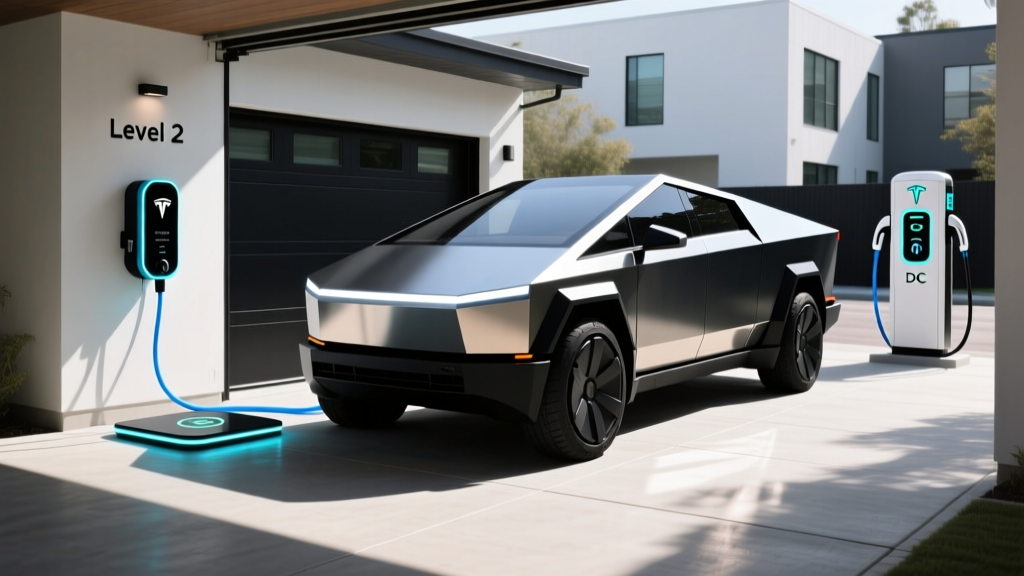
| Level 2 (240V) | 240V / 32A–48A | 7.7–11.5 kW | 22–40 mi/hr | 6–9 hours (overnight) |
| DC Fast Charge | 400V–800V DC | 50–350 kW (peak) | 150–600+ mi/hr (peak) | 18–45 minutes (varies by vehicle) |
Real-world note: DC fast charging never sustains peak kW for the full session. A vehicle rated at 250 kW peak may only hold that rate from 10–30% State of Charge (SoC), then taper to 150 kW, then drop below 50 kW above 80%. That's why manufacturers quote 10–80% times — the final 20% can take as long as the first 70%.
Home Level 2 Installation: Electrical Requirements and Real Costs
For a long range EV SUV, a 48-amp Level 2 charger on a dedicated 60-amp, 240V circuit is the practical minimum. Here's what that involves electrically and financially.
Electrical Requirements
- Circuit: Dedicated 60A breaker, 240V, 6 AWG copper wire (for runs up to ~50 ft; larger gauge for longer runs)
- Charger amperage: 48A continuous draw (National Electrical Code requires circuits rated at 125% of continuous load: 48A × 1.25 = 60A)
- Panel capacity: Your main panel needs spare capacity. A 200A panel with existing loads near 160A may need a load calculation or upgrade to support a 60A EV circuit
- Permit: Required in virtually all US jurisdictions; inspected by local electrical inspector
- GFCI: NEC 2020+ requires GFCI protection for EV receptacles (hardwired chargers may be exempt in some jurisdictions)
Panel Upgrade Reality
Homes built before 2000 often have 100A or 150A main panels already near capacity with HVAC, electric range, and dryer loads. Adding 60A for EV charging may require a panel upgrade to 200A or even a service upgrade from the utility. This is the single biggest cost variable in home EV charging.
| Component | Typical Cost Range | Notes |
|---|---|---|
| Level 2 Charger (48A, hardwired) | $400–$750 | Smart Wi-Fi models at higher end |
| Electrician labor (standard install) | $500–$1,500 | Assumes panel within 30 ft of garage |
| Wire, conduit, breaker | $200–$600 | Varies with run length and local code |
| Permit and inspection | $50–$200 | Local jurisdiction dependent |
| Standard install total | $1,150–$3,050 | Most homes with adequate panel capacity |
| Panel upgrade (100A → 200A) | $1,500–$3,500 | If existing panel can't support 60A addition |
| Service upgrade (utility side) | $2,000–$5,000+ | Rare; older homes with 100A service |
Tip: Some utilities and states offer rebates of $250–$1,000 for home charger installation. The federal Alternative Fuel Vehicle Refueling Property Credit (IRC §30C) covers 30% of home charging equipment and installation costs up to $1,000, subject to income limits and census-tract eligibility. Check current-year IRS guidance — rules change frequently.
Connector Compatibility: NACS, CCS, and the Adapter Landscape
The connector on your long range EV SUV determines which public chargers you can use natively. As of the 2025–2026 model years, the North American Charging Standard (NACS, originally Tesla's proprietary connector) has become the dominant standard, with Ford, GM, Rivian, Hyundai/Kia, Volvo, and others adopting it. CCS1 remains on some legacy models, and CHAdeMO is effectively discontinued for new vehicles.
| Connector | Brands Using (2025–2026 Models) | Tesla Supercharger Access | Adapter Needed? |
|---|---|---|---|
| NACS (native) | Tesla (all), Ford, GM, Rivian, Hyundai/Kia (new), Volvo/Polestar | Native — no adapter | CCS adapter needed for legacy CCS stations |
| CCS1 | VW ID.4 (pre-2025), BMW iX, some legacy models | Requires NACS adapter (Magic Dock or third-party) | Native at Electrify America, EVgo CCS stalls |
| CHAdeMO | Nissan Leaf (discontinued), no new SUVs | No access | Adapters scarce; network declining |
For long range EV SUV buyers: If you're purchasing new in 2025–2026, prioritize NACS-equipped vehicles for the widest fast-charging access. Tesla's Supercharger network has over 25,000 stalls in North America, and most are now open to NACS-equipped non-Tesla vehicles. CCS adapters (NACS-to-CCS) are available from Tesla and third parties for ~$150–$250, letting you use Electrify America and other CCS-only stations.
Charging Time Examples: What to Expect with Large SUV Batteries
A long range EV SUV typically carries 90–115 kWh of usable battery capacity. Here are realistic 10–80% charging times across popular models, based on manufacturer data and independent testing. Note that ambient temperature, battery preconditioning, and station availability all affect real-world results.
| Vehicle (2025–2026) | Usable Battery (kWh) | Peak DC Rate (kW) | 10–80% Time | Level 2 (48A / 11.5 kW) Full Charge |
|---|---|---|---|---|
| Tesla Model X Long Range | ~95 kWh | 250 kW | ~30 min | ~8.5 hours |
| Rivian R1S (Max Pack) | ~141 kWh | 200 kW | ~45 min | ~12.5 hours |
| Hyundai Ioniq 9 | ~110 kWh | 350 kW (800V) | ~20 min | ~10 hours |
| Cadillac Escalade IQ | ~200 kWh | 350 kW (800V) | ~35 min (est.) | ~17+ hours |
| Kia EV9 GT-Line AWD | ~99.8 kWh | 236 kW (800V) | ~24 min | ~9 hours |
Charge curve reality: The Hyundai Ioniq 9 and Kia EV9 use 800V architectures that sustain higher charge rates longer than 400V systems. On a 350 kW-capable station (like an Electrify America or Ionity stall), the Ioniq 9 can accept 200+ kW from 10–55% SoC before tapering. A 400V vehicle like the Rivian R1S peaks at 200 kW but drops to ~120 kW by 50% SoC. Always precondition your battery (most vehicles do this automatically when you navigate to a charger) — a cold battery can cut peak charge rates by 50% or more.
Cost to Charge: Home vs. Public vs. Gas
Electricity pricing varies enormously by location, time of day, and charging tier. Here's a realistic breakdown for a long range EV SUV averaging 2.5–3.0 miles per kWh (the typical efficiency for a large, heavy electric SUV).
| Scenario | Price | Cost per kWh | Cost per Mile (at 2.7 mi/kWh) | Full 100 kWh Fill-Up |
|---|---|---|---|---|
| Home (off-peak / time-of-use) | Varies by utility | $0.08–$0.14 | $0.03–$0.05 | $8–$14 |
| Home (standard rate, no TOU) | National avg | $0.16–$0.20 | $0.06–$0.07 | $16–$20 |
| Public Level 2 (ChargePoint, etc.) | Per kWh or session | $0.25–$0.49 | $0.09–$0.18 | $25–$49 |
| DC Fast (Tesla Supercharger) | Per kWh | $0.25–$0.40 | $0.09–$0.15 | $25–$40 |
| DC Fast (Electrify America / EVgo) | Per kWh | $0.35–$0.55 | $0.13–$0.20 | $35–$55 |
| Gasoline SUV (25 MPG combined) | $3.40/gal (2025 avg) | — | $0.14 | — |
The bottom line: Home charging on an off-peak rate is 3–4× cheaper per mile than gasoline. Public DC fast charging at premium networks approaches or exceeds gas cost per mile — which is why home Level 2 is essential for long range EV SUV ownership economics. According to fueleconomy.gov, a typical large electric SUV achieves 80–100 MPGe combined, translating to roughly $500–$700 annual electricity cost at home rates vs. $2,000–$2,800 in gasoline for a comparable gas SUV.
Recommended Home Chargers for Large-Battery SUVs
A long range EV SUV demands a 48A hardwired charger for practical overnight charging. Here are proven units that deliver reliable power, smart scheduling, and the cable length needed for larger vehicles.
ChargePoint Home Flex (NACS or J1772)
- Power: Up to 50A (12 kW at 240V) — adjustable down to match circuit
- Connector: Available in NACS or J1772 (J1772 requires NACS adapter for Tesla-socket vehicles)
- Cable: 23 ft (flexible for large SUV charge-port locations)
- Smart features: Wi-Fi, app scheduling, utility TOU integration, Alexa
- Price: ~$550–$650
- Best for: Flexible amperage if your panel can't support a full 60A circuit
Tesla Wall Connector (NACS)
- Power: Up to 48A (11.5 kW at 240V)
- Connector: NACS native — charges Teslas and all NACS-equipped vehicles directly
- Cable: 24 ft
- Smart features: Wi-Fi, over-the-air updates, load sharing (two units on one circuit), power-sharing for multiple EVs
- Price: ~$425–$475
- Best for: NACS vehicles; best value at 48A; load-sharing for 2-EV garages
Emporia Vue / Emporia Level 2 Charger
- Power: Up to 48A (11.5 kW at 240V)
- Connector: J1772 (NACS adapter needed for Tesla-socket vehicles)
- Cable: 24 ft
- Smart features: Integrated with Emporia whole-home energy monitor, solar-aware charging, TOU scheduling
- Price: ~$350–$400 (charger); ~$500 with energy monitor bundle
- Best for: Solar owners and energy-monitoring enthusiasts; best budget smart charger
Grizzl-E Smart (United Chargers)
- Power: Up to 40A (9.6 kW at 240V)
- Connector: J1772 or NACS
- Cable: 24 ft
- Smart features: OCPP-compatible, works with multiple apps, extreme cold rated (-40°F)
- Price: ~$450–$550
- Best for: Cold-climate garages and outdoor installs; rugged build quality
Safety, Code, and Outdoor Installation Considerations
EV charging draws high continuous current for hours — more like an electric furnace than a phone charger. Safety and code compliance are non-negotiable.
- Dedicated circuit: Your EV charger must be on its own breaker — never shared with other appliances. Continuous loads over 3 hours require 125% circuit capacity per NEC Article 210.
- Hardwired vs. receptacle: Hardwired installations (no plug) are preferred for 48A+ chargers — they eliminate the NEMA 14-50 receptacle as a failure point. If using a 14-50 outlet, ensure it's an industrial-grade receptacle (Hubbell, Bryant) rated for daily plug/unplug cycles. Cheap 14-50 receptacles have been linked to melting and fire in EV charging applications.
- GFCI protection: NEC 2020 requires GFCI on receptacles used for EV charging. Hardwired chargers may be exempt in some jurisdictions — your electrician will confirm local requirements.
- Outdoor rating: If installing outside or in an unenclosed carport, ensure the charger carries a NEMA 4 (weatherproof) rating. All units listed above are rated for outdoor use.
- Cable management: For large SUVs with charge ports at varying heights and positions (Rivian R1S: front fender; Tesla Model X: rear quarter panel), a 24 ft cable provides necessary reach. Consider a cable retractor or hook to prevent tripping hazards.
- Permit and inspection: Always pull a permit. The inspection verifies wire gauge, breaker sizing, grounding, and GFCI compliance — protecting your home and your insurance coverage.
Frequently Asked Questions
How much does it cost to install a home EV charger for a long range EV SUV?
A standard 48A Level 2 installation with an adequate electrical panel costs $1,150–$3,050 total (charger + electrician + materials + permit). If your home needs a panel upgrade from 100A to 200A, add $1,500–$3,500. Homes requiring a full utility service upgrade can exceed $5,000. Get a load calculation from a licensed electrician before purchasing equipment.
How fast will each charging level add range to my large-battery SUV?
Level 1 (120V) adds 3–5 miles per hour — essentially useless for a 100+ kWh battery. Level 2 (240V, 48A) adds 25–40 miles per hour, enough to fully replenish overnight. DC fast charging at 150–350 kW can add 150–600+ miles per hour at peak, but tapers significantly above 80% SoC. Expect a 10–80% DC fast charge to take 20–45 minutes depending on your vehicle's architecture and the station's output.
Which connector and charger is compatible with my EV SUV?
Check your vehicle's charge port. 2025–2026 models from Tesla, Ford, GM, Rivian, Hyundai, Kia, and Volvo use NACS. Older or specific models (VW ID.4, BMW iX) may still use CCS1. For home charging, buy a wall connector matching your vehicle's native connector. For public charging, a NACS-to-CCS adapter (~$150–$250) provides access to the widest network coverage.
How much does charging cost per mile compared to gasoline?
Home charging on off-peak electricity costs $0.03–$0.05 per mile for a typical large EV SUV — roughly 75% less than a 25 MPG gas SUV at $3.40/gallon ($0.14/mile). Public DC fast charging at $0.35–$0.55/kWh costs $0.13–$0.20/mile, approaching or exceeding gas costs. The economic case for EV ownership depends heavily on reliable home charging access.
What electrical upgrades might my home need for EV charging?
The most common upgrade is a panel replacement from 100A or 150A to 200A service ($1,500–$3,500). Some older homes need a utility-side service upgrade ($2,000–$5,000+). If your panel has spare breaker slots and capacity, you may only need a new 60A breaker and wire run. A licensed electrician performs a load calculation (NEC Article 220) to determine your panel's remaining capacity before recommending upgrades. Per the National Electrical Code, the EV circuit must not push total calculated load beyond 80% of panel rating.
Can I charge my long range EV SUV on a standard 120V outlet?
Technically yes, but practically no. Level 1 charging at 1.4 kW adds about 3–5 miles of range per hour. Fully charging a 100 kWh battery would take 70+ hours. Level 1 is acceptable as an emergency backup or for PHEVs with small batteries, but a long range EV SUV owner needs Level 2 for daily usability.
Does cold weather affect charging speed?
Significantly. Lithium-ion batteries accept charge slower when cold. At freezing temperatures, a battery that normally peaks at 250 kW may be limited to 50–100 kW until it warms. Always use your vehicle's navigation preconditioning feature (navigate to the charger in the car's app or infotainment) — this activates the battery thermal management system and preheats the pack, restoring peak charge rates. Expect 10–80% times to increase 30–50% in sub-freezing conditions without preconditioning, per testing data from sources like Recurrent Auto.