Buying a long range EV — anything pushing 300+ EPA miles on a full charge — is only half the equation. The other half is how you'll actually keep a 75–100 kWh battery full without spending your life at public charging stations. The good news: with the right home setup, the vast majority of your charging happens in your garage or driveway, at a fraction of the cost of gas. The catch: getting that setup right requires understanding your home's electrical capacity, choosing the right equipment, and budgeting for an installation that can range from straightforward to surprisingly expensive.
This guide walks through exactly what it takes to charge long range EVs like the Tesla Model 3 Long Range, Hyundai Ioniq 6, Chevrolet Silverado EV, or Lucid Air at home — with real numbers on speed, cost, and electrical requirements.
The Three Charging Levels: Speeds and What They Mean for Long Range EVs
EV charging operates at three distinct levels, each defined by voltage and power delivery. The distinction between kW (kilowatts — the rate of power delivery, like water pressure) and kWh (kilowatt-hours — the total energy stored in your battery, like tank size) is critical here. Your charger's kW rating determines how fast you add energy; your battery's kWh capacity determines how much it holds.
| Level | Voltage | Power (kW) | Miles of Range Per Hour | 10–80% Time (84 kWh battery) | Best For |
|---|---|---|---|---|---|
| Level 1 | 120V AC | 1.0–1.4 kW | 3–5 mi/hr | ~48 hours | Overnight trickle, emergencies, PHEVs |
| Level 2 | 240V AC | 7.2–19.2 kW | 25–75 mi/hr | 3.5–8 hours | Daily home charging, overnight full charges |
| DC Fast | 400–800V DC | 50–350 kW | 150–300+ mi/hr (peak) | 15–40 minutes | Road trips, quick top-ups away from home |
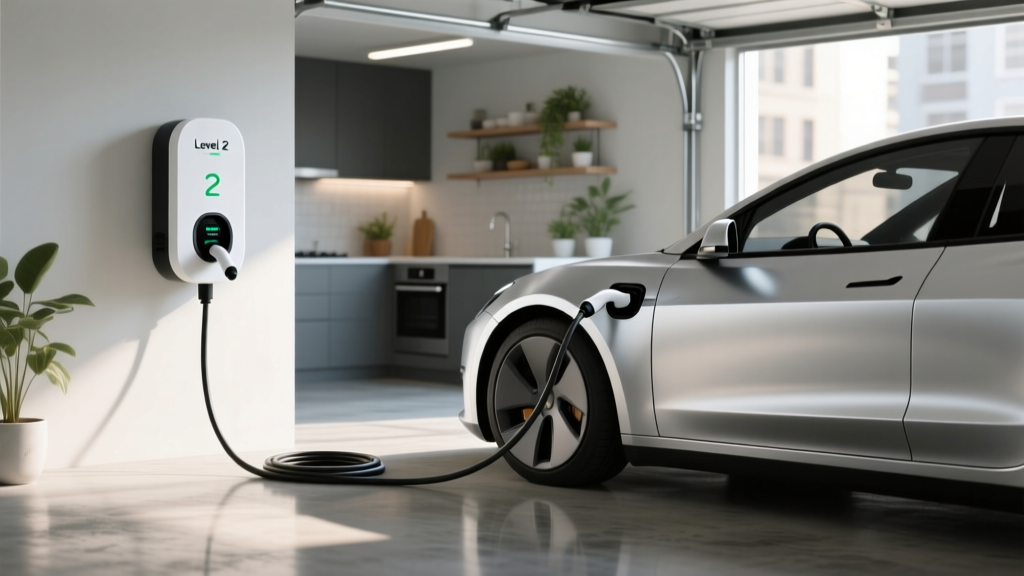
For owners of long range EVs, Level 2 home charging is the backbone. Here's why: a typical long range EV battery (75–100 kWh) needs roughly 8–12 hours on Level 1 to go from 20% to 80% — meaning you'd need to leave it plugged in for nearly a full day. On a 48-amp (11.5 kW) Level 2 circuit, that same charge takes about 5–6 hours. Plug in when you get home at 6 PM, and you're fully topped up by midnight.
Electrical Requirements: What Your Home Needs for Level 2 Charging
Level 2 charging requires a 240-volt circuit — the same voltage your electric dryer or oven uses. The most common home setup is a 240V/40A dedicated circuit, which supports a charger delivering up to 32 amps (9.6 kW) continuous power. EV chargers are classified as continuous loads under the National Electrical Code (NEC), meaning the circuit must be rated for 125% of the charger's maximum draw. So a 32A charger requires a 40A breaker; a 48A charger requires a 60A breaker.
Panel Capacity and Upgrade Considerations
Before installing any Level 2 charger, your electrician will perform a load calculation on your electrical panel. A typical older home may have a 100-amp main panel already running near capacity with HVAC, kitchen appliances, and lighting. Adding a 40A or 60A EV circuit could exceed the panel's safe operating limit.
If an upgrade is needed, expect to move from a 100A to a 200A panel — a significant but not uncommon project. In some cases, utilities offer smart panel solutions or load-management devices (like the Emporia VUE or Span smart panel) that dynamically throttle the charger's draw based on your home's real-time consumption, avoiding a full panel upgrade.
Hardwired vs. Plug-In (NEMA 14-50)
You have two installation options:
- Hardwired: The charger is directly wired into a junction box. This supports higher amperage (up to 48A/11.5 kW on a 60A circuit), eliminates the need for a GFCI breaker (the charger has built-in ground-fault protection), and is generally preferred for permanent installations.
- Plug-in (NEMA 14-50 outlet): A 50A receptacle is installed, and the charger plugs in. This allows portability — you can take the charger when you move — but NEC 2023+ requires a GFCI breaker for the outlet, adding $100–$200 to the electrical work. Maximum continuous draw is 40A (9.6 kW).
Home Charger Installation Costs: The Full Breakdown
The total cost of a Level 2 home charger installation varies widely based on your home's electrical infrastructure, the distance from panel to charger location, and local permit requirements. Here's a realistic breakdown for a 2025/2026 installation:
| Component | Typical Range | Notes |
|---|---|---|
| Level 2 Charger Equipment | $400 – $750 | Smart Wi-Fi chargers (ChargePoint Home Flex, Emporia Level 2, Wallbox Pulsar Plus) |
| Electrician Labor (standard install) | $500 – $1,500 | Panel within 20–40 ft of charger location, conduit through drywall or garage |
| Permit & Inspection | $50 – $300 | Varies by municipality; some jurisdictions bundle with electrical |
| Panel Upgrade (if needed) | $1,500 – $3,500 | 100A → 200A service upgrade; not required in most newer homes |
| GFCI Breaker (NEMA 14-50 plug-in) | $100 – $200 | Required for receptacle installs; not needed for hardwired |
| Conduit & Wiring (long runs) | $200 – $800 | If panel is 50+ feet from garage or requires trenching |
| Total (no panel upgrade) | $950 – $2,550 | Most common scenario for homes with 200A panels |
| Total (with panel upgrade) | $2,500 – $5,500+ | Older homes with 100A service |
Some utilities offer rebates of $250–$500 for home charger installation, and certain states provide additional incentives. Check the Alternative Fuels Data Center for state-specific programs. The federal §30C Alternative Fuel Vehicle Refueling Property Credit covers up to 30% of charger equipment and installation costs (capped at $1,000) for qualifying installations in eligible census tracts — consult a tax professional for your specific eligibility.
Connector Compatibility: NACS, CCS1, and CHAdeMO Explained
The North American charging landscape has largely standardized around the NACS (North American Charging Standard) connector — originally Tesla's proprietary plug, now adopted by Ford, GM, Rivian, Hyundai/Kia, Volvo, BMW, and most other major automakers for 2025+ model-year vehicles.
| Connector | Charging Type | Vehicles Using It (2025–2026) | Adapter Needed? |
|---|---|---|---|
| NACS (Tesla) | AC Level 2 + DC Fast | Tesla (all), Ford (F-150 Lightning, Mustang Mach-E 2025+), GM (Equinox EV, Silverado EV, Blazer EV), Rivian (2025+), Hyundai Ioniq 5/6 (2026+), Kia EV6/EV9 (2026+) | CCS→NACS adapter for older CCS vehicles at Tesla Superchargers |
| CCS1 (Combo) | AC Level 2 + DC Fast | Hyundai/Kia (2024 and earlier), Volkswagen ID.4, BMW iX/i4 (2024–2025), older Ford/GM EVs | NACS→CCS adapter for Tesla Supercharger access |
| CHAdeMO | DC Fast only | Nissan Leaf (legacy); essentially discontinued for new vehicles | No adapter available for CCS/NACS; declining infrastructure |
For home Level 2 charging: Nearly every Level 2 charger sold in 2025–2026 ships with a NACS connector or offers it as a configuration option. If you own a CCS-equipped vehicle, you have two choices: buy a NACS-equipped charger and use a NACS-to-CCS adapter (roughly $100–$200 from manufacturers like Lectron or Tesla), or buy a CCS-equipped charger. The practical difference is minimal — Level 2 AC charging speeds are identical regardless of connector. The connector choice matters far more for DC fast charging on road trips.
Cost to Charge: Home Electricity vs. Public Stations vs. Gas
The economic case for home charging is compelling — especially for long range EVs with large batteries that would be expensive to fill at public DC fast chargers.
| Scenario | Rate / Cost | Cost Per Mile (3.0 mi/kWh efficiency) | Full Charge Cost (84 kWh battery) |
|---|---|---|---|
| Home — Off-Peak TOU Rate | $0.08–$0.13/kWh | $0.03–$0.04/mile | $6.72–$10.92 |
| Home — Standard Residential Rate | $0.14–$0.18/kWh | $0.05–$0.06/mile | $11.76–$15.12 |
| Public Level 2 (workplace, retail) | $0.25–$0.49/kWh | $0.08–$0.16/mile | $21.00–$41.16 |
| DC Fast Charging (Electrify America, Tesla Supercharger) | $0.35–$0.55/kWh | $0.12–$0.18/mile | $29.40–$46.20 |
| Gas Vehicle (25 MPG combined, $3.50/gal) | $3.50/gallon | $0.14/mile | N/A (tank equivalent ~$47–$55) |
At off-peak residential rates, charging a long range EV at home costs roughly 3–4 cents per mile — about one-quarter the per-mile cost of a 25 MPG gas vehicle. Even at standard residential rates without time-of-use optimization, you're still at 5–6 cents per mile. The math strongly favors home charging: a driver covering 12,000 miles per year saves $1,200–$1,700 annually vs. gas, and $600–$1,000 vs. exclusive public DC fast charging.
To maximize savings, request a time-of-use (TOU) rate plan from your utility. Most TOU plans offer dramatically cheaper rates between 9 PM and 6 AM — exactly when your EV is parked at home. Set your charger's schedule to begin charging at 10 PM, and you'll consistently hit the lowest rates.
Best Home Chargers for Long Range EVs: 2025–2026 Picks
Long range EVs with large batteries (75–100+ kWh) benefit from higher-amperage Level 2 chargers that minimize overnight charge time. Here are three well-regarded options across price points:
Tesla Wall Connector (Gen 3)
- Power Output: Up to 11.5 kW (48A) on a 60A circuit
- Connector: NACS (native); CCS vehicles require adapter
- Cable Length: 18 ft or 24 ft options
- Smart Features: Wi-Fi, OTA updates, load sharing (pair two units on one circuit), Power Share with Tesla Powerwall
- Price: ~$420–$475
- Best For: Tesla owners and NACS-equipped 2025+ vehicles; highest power-per-dollar
ChargePoint Home Flex
- Power Output: Up to 12 kW (50A) on a 60A circuit; configurable 16A–50A via DIP switches
- Connector: Available in NACS or CCS1 (J1772) configurations
- Cable Length: 23 ft
- Smart Features: Wi-Fi, app-based scheduling, energy tracking, Alexa integration, flexible amperage lets you match your circuit
- Price: ~$550–$650
- Best For: Flexibility across vehicle brands; strong app ecosystem; future-proof amperage adjustment
Emporia Level 2 EV Charger
- Power Output: Up to 11.5 kW (48A) on a 60A circuit
- Connector: NACS or J1772 options
- Cable Length: 24 ft
- Smart Features: Wi-Fi, detailed energy monitoring, solar integration (pair with Emporia VUE to charge from excess solar), load management
- Price: ~$399–$450
- Best For: Budget-conscious buyers who want smart features; solar-panel homes; best value per kW
For long range EVs with batteries above 80 kWh, I recommend a 48A (11.5 kW) charger on a 60A circuit whenever your panel supports it. The difference between a 32A (7.7 kW) and a 48A (11.5 kW) charger is roughly 3 hours of charge time on a 90 kWh battery — the difference between waking up to 80% and waking up to only 55%.
DC Fast Charging on Road Trips: What Long Range EV Owners Should Know
While home Level 2 handles 90%+ of your charging, road trips require DC fast charging — and the experience varies significantly by vehicle and network.
Long range EVs typically support peak DC charge rates between 150 kW and 350 kW. However, peak rate is not sustained rate. A vehicle that advertises "250 kW peak charging" may only sustain that rate between roughly 10% and 30% State of Charge (SoC), then taper to 150 kW by 50%, and drop below 75 kW past 70%. This charge curve taper is why manufacturers quote 10–80% times rather than 0–100%.
Representative 10–80% DC fast charge times for popular long range EVs:
- Tesla Model 3 Long Range (2025): Peak ~250 kW, 10–80% in approximately 25–28 minutes at a V3/V4 Supercharger
- Hyundai Ioniq 6 Long Range (84 kWh, 800V): Peak ~240 kW, 10–80% in approximately 18–22 minutes at a 350 kW station
- Ford F-150 Lightning Extended Range (131 kWh): Peak ~150 kW, 10–80% in approximately 38–42 minutes
- Lucid Air Grand Touring (112 kWh): Peak ~300 kW (900V+ architecture), 10–80% in approximately 20–24 minutes
For efficient road-trip charging, plan stops at 15–20% SoC and charge only to 70–80%. The last 20% of the battery fills at a dramatically slower rate — it can take as long to go from 80% to 100% as it did from 10% to 80%. If you need a full battery for the next leg, it's usually faster to charge to 80%, drive 150–200 miles, then top up again.
Safety, Electrical Code, and Installation Best Practices
EV charging involves sustained high-current draw over many hours — a more demanding electrical load than most household appliances. Proper installation is non-negotiable.
- Dedicated circuit: Your Level 2 charger must be on its own dedicated circuit — it cannot share a breaker with other outlets or appliances. This prevents overloading and nuisance tripping.
- GFCI protection: Required for all NEMA 14-50 receptacle installations under NEC 2023+. Hardwired chargers have integrated ground-fault protection and do not require a GFCI breaker. Use a breaker specifically rated for EV loads (some older GFCI breakers nuisance-trip with the sustained draw patterns of EV chargers).
- Outdoor rating: If your charger is installed outdoors (carport, driveway pedestal), ensure the unit carries a NEMA 4 or IP65 rating for weather resistance. All chargers listed above meet outdoor installation standards.
- Wire gauge: A 60A circuit requires 6 AWG copper wire (THHN in conduit) or 4 AWG aluminum. A 40A circuit requires 8 AWG copper. Your electrician will size this correctly — but verify they're not undersizing for a long wire run, which increases voltage drop.
- Permit and inspection: Virtually all jurisdictions require a permit for new 240V circuit installations. The inspection ensures the work meets NEC standards — skip this step and you risk voiding homeowner's insurance coverage for electrical fires.
Frequently Asked Questions
How much does it cost to install a home EV charger?
For a typical home with a 200-amp electrical panel, expect to pay between $950 and $2,550 total — including the charger unit ($400–$750), electrician labor ($500–$1,500), and permit ($50–$300). If your home has an older 100-amp panel that needs upgrading to 200A, add $1,500–$3,500. Long wire runs (50+ feet from panel to garage) and trenching can add $200–$800.
How fast will each charging level add range?
Level 1 (120V standard outlet) adds 3–5 miles of range per hour — far too slow for daily use with a long range EV's large battery. Level 2 (240V, 48A) adds approximately 40–45 miles per hour for a typical 3–3.5 mi/kWh efficient long range EV, meaning an overnight session easily covers 250+ miles of range. DC fast charging at 150–350 kW can add 150–300+ miles in 20–30 minutes, though the rate tapers significantly above 80% SoC.
Which connector and charger is compatible with my EV?
If you own a Tesla, a 2025+ Ford, GM, Rivian, or a 2026+ Hyundai/Kia EV, your vehicle uses the NACS connector — buy a NACS-equipped Level 2 charger. If you own a 2024 or earlier Hyundai/Kia, Volkswagen ID.4, or BMW iX/i4, your vehicle uses CCS1 — either buy a CCS1 charger or use a NACS-to-CCS adapter with a NACS charger. Check your vehicle's charge port or consult fueleconomy.gov for your specific model.
How much does charging cost per mile compared to gas?
At home off-peak rates ($0.08–$0.13/kWh), a long range EV achieving 3.0 miles per kWh costs approximately $0.03–$0.04 per mile. A comparable gas vehicle at 25 MPG with $3.50/gallon fuel costs $0.14 per mile — roughly 3.5–4.5x more per mile. Even at public DC fast charger rates ($0.35–$0.55/kWh), EV charging costs $0.12–$0.18 per mile, which is comparable to or slightly above gas. The savings come from consistent home charging.
What electrical upgrades might I need?
The most common upgrade is a panel capacity increase from 100A to 200A, which costs $1,500–$3,500 and is typically needed in homes built before the 1990s. Your electrician will perform a load calculation to determine if your existing panel can handle a 40A or 60A EV circuit alongside your other electrical loads. In some cases, a smart load-management device (like the Emporia VUE or a utility-approved demand-response device) can avoid the panel upgrade entirely by dynamically reducing the charger's draw when other appliances are running. Always hire a licensed electrician — and verify they have specific EV charger installation experience — to ensure your installation meets NEC requirements and passes local inspection.