Owning a long range EV — whether it's a Tesla Model 3 Long Range with 341 miles of EPA range, a Hyundai Ioniq 6 SE at 361 miles, or a Chevrolet Silverado EV 4WT at 460 miles — fundamentally changes your fueling routine. Instead of weekly gas station visits, most charging happens at home. But "home charging" means different things depending on your electrical setup, the charger you install, and the size of the battery you're refilling.
This guide covers everything a long range EV buyer or new owner needs to know: charging levels and the real speeds they deliver, home installation requirements and costs, which connector your vehicle uses, what you'll pay per mile, and specific equipment recommendations. We'll be precise with numbers — because in EV charging, the difference between kilowatts (kW, a measure of power or charge rate) and kilowatt-hours (kWh, a measure of energy or battery capacity) matters enormously for your planning and your electric bill.
Charging Levels Explained: How Fast Will Each Level Add Range?
EV charging is divided into three levels. The speed at which each adds range depends on your vehicle's efficiency (measured in miles per kWh), but the power output of each level is fixed by electrical standards.
| Level | Voltage / Amps | Max Power (kW) | Miles of Range Per Hour | Best For |
|---|---|---|---|---|
| Level 1 | 120V / 12A | 1.4 kW | 3–5 miles | Overnight top-ups, PHEVs, emergencies |
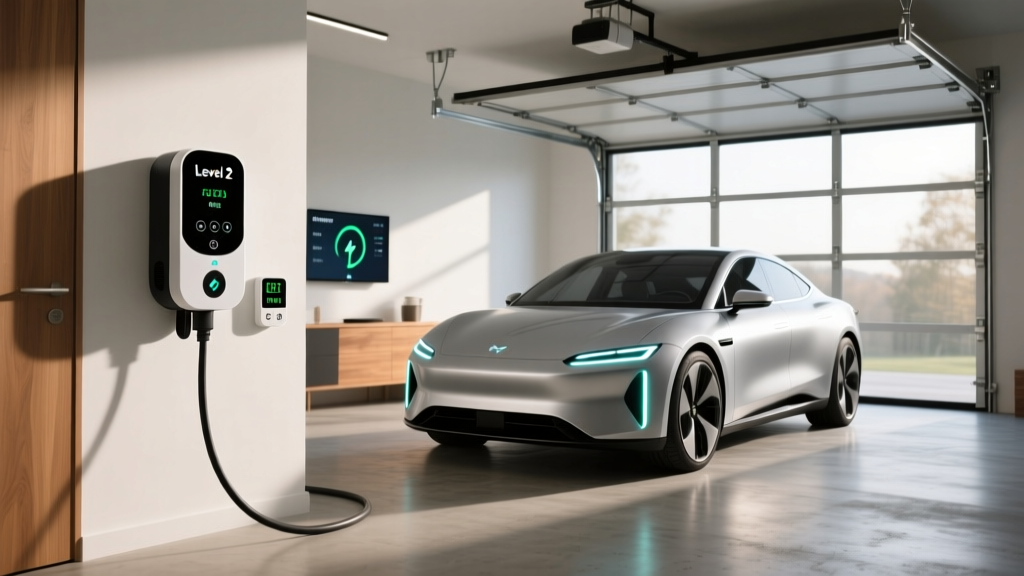
| Level 2 | 240V / 32–48A | 7.7–11.5 kW | 25–44 miles | Daily home charging, full overnight refill |
| DC Fast Charging | 400–800V DC | 50–350 kW | 150–1,000+ miles (equivalent) | Road trips, quick top-ups away from home |
For a long range EV with an 80–100 kWh battery, Level 1 charging is impractical as a primary method — it would take 55–70+ hours to go from 10% to 80%. Level 2 is the workhorse: a 48-amp charger delivering 11.5 kW will refill a 90 kWh battery from 10% to 80% in roughly 5.5 hours, meaning you plug in after work and wake up fully charged. DC fast charging handles road trips, though charge speed tapers significantly above 80% state of charge (SoC) to protect battery health — a phenomenon known as the charge curve.
Home Charger Installation: Electrical Requirements and Costs
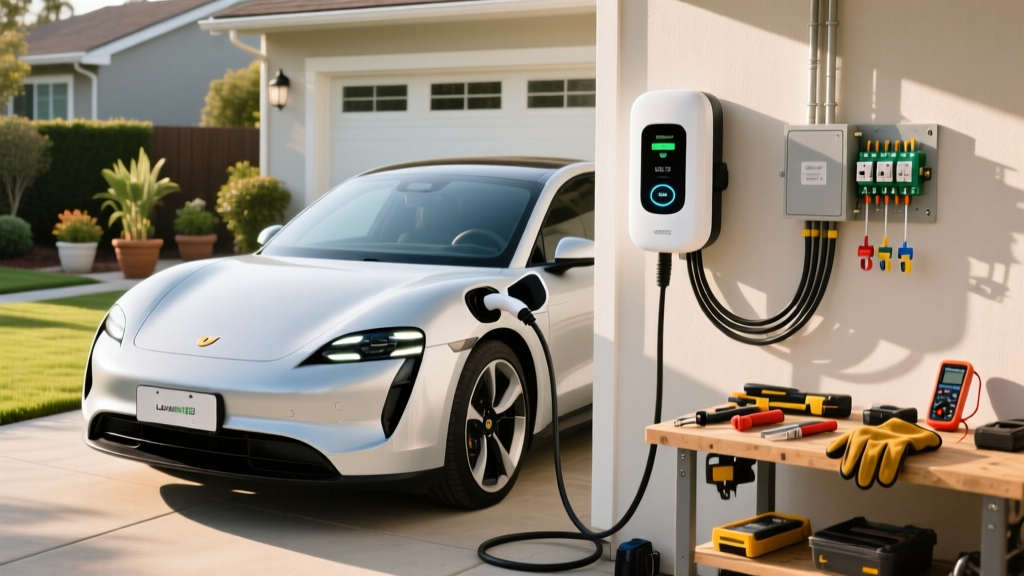
Installing a Level 2 home charger requires a dedicated 240-volt circuit, the same type of outlet your electric dryer uses. Here's what's involved electrically:
- Circuit requirement: A 40-amp charger needs a 50-amp breaker (electrical code requires circuits to be rated at 125% of continuous load). A 48-amp charger needs a 60-amp breaker.
- Wire gauge: Typically 6 AWG copper for 50A circuits, 4 AWG for 60A circuits, run in conduit from your electrical panel to the charger location.
- Panel capacity: Your home's main electrical panel must have enough spare amperage to support the new circuit. Most modern 200-amp panels can accommodate a 50A EV circuit. Older 100-amp panels often cannot.
- Permit: Nearly all jurisdictions require an electrical permit for a new 240V circuit, with an inspection after installation.
Installation Cost Breakdown
| Component | Low End | High End | Notes |
|---|---|---|---|
| Level 2 charger hardware | $300 | $700 | Varies by brand, power, smart features |
| Electrician labor (simple install) | $300 | $800 | Short wire run, panel has capacity |
| Electrician labor (complex install) | $800 | $2,000+ | Long wire run, conduit, drywall repair |
| Electrical permit | $50 | $200 | Varies by municipality |
| Panel upgrade (if needed) | $1,500 | $4,000+ | Required for older 100A panels |
| Total (no panel upgrade) | $650 | $1,700 | Most common scenario |
| Total (with panel upgrade) | $2,150 | $5,700+ | Older homes with 100A service |
The single biggest cost variable is whether your electrical panel can handle the additional load. If you're in a home built after 2000 with a 200-amp panel and the charger location is within 30 feet of the panel, expect to pay $800–$1,200 total. If you need a panel upgrade or a long conduit run through a finished garage or exterior wall, costs climb quickly.
Connector Compatibility: NACS, CCS1, and CHAdeMO
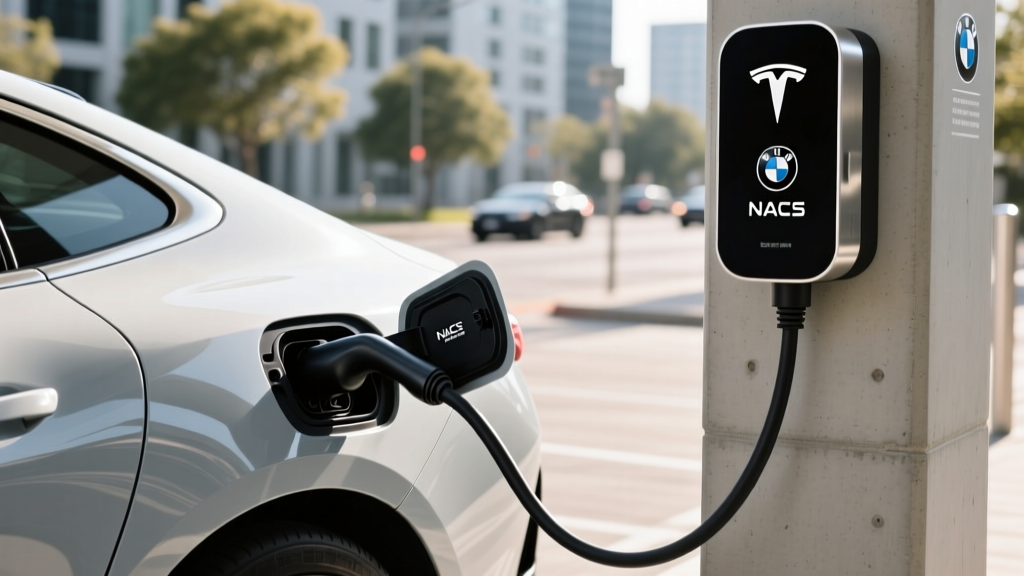
The physical connector your EV uses determines which public chargers you can access and which home charger to buy. As of 2026, the North American market has largely consolidated around two standards, with CHAdeMO fading.
| Connector | Brands Using It | Home Charger Availability | Public DC Fast Network Access |
|---|---|---|---|
| NACS (Tesla / SAE J3400) | Tesla, Ford, GM, Rivian, Volvo, Polestar, Hyundai/Kia (2025+), Mercedes-Benz, BMW, Honda | Widely available; native on Tesla Wall Connector | Tesla Supercharger network (largest in North America, 6,000+ stations) |
| CCS1 (Combined Charging System) | Remaining 2024 and older models from Ford, GM, VW, Hyundai/Kia; some commercial EVs | Widely available from ChargePoint, Emporia, Grizzl-E, etc. | Electrify America, EVgo, ChargePoint (smaller networks, variable reliability) |
| CHAdeMO | Nissan Leaf (legacy only, discontinued after 2025) | Limited availability | Declining network; not recommended for new buyers |
If you're buying a new long range EV in 2026, it almost certainly uses NACS. For CCS1-equipped vehicles, adapters are available — Tesla sells a CCS-to-NACS adapter (~$250) that allows CCS vehicles to charge at Superchargers, and third-party NACS-to-CCS adapters exist for home charging flexibility. Always verify adapter compatibility with your specific model year before purchasing.
Cost to Charge: Home vs. Public vs. Gas
One of the strongest ownership arguments for a long range EV is fuel cost savings — but the savings vary dramatically depending on where and when you charge.
| Charging Scenario | Typical $/kWh | Cost per Mile* | Full Charge (90 kWh) Cost |
|---|---|---|---|
| Home, off-peak (utility rate) | $0.08–$0.14 | $0.02–$0.04 | $7.20–$12.60 |
| Home, standard rate | $0.14–$0.20 | $0.04–$0.06 | $12.60–$18.00 |
| Public Level 2 (workplace, shopping) | $0.20–$0.35 | $0.06–$0.10 | $18.00–$31.50 |
| DC Fast Charging (public) | $0.30–$0.55 | $0.09–$0.16 | $27.00–$49.50 |
| Gas equivalent (30 MPG at $3.50/gal) | — | $0.12 | ~$36.00 (for 310 miles) |
*Cost per mile calculated using a long range EV efficiency of approximately 3.5 miles per kWh (roughly 28–30 kWh/100mi), typical for vehicles like the Tesla Model 3 Long Range, Hyundai Ioniq 6, or BMW i4 eDrive40.
The takeaway: home charging at off-peak rates delivers fuel costs 70–80% below gasoline. Even at standard residential rates, you're paying roughly one-third to one-half of what a comparable gas car costs per mile. However, relying exclusively on DC fast charging at $0.40–$0.55/kWh erases most of the cost advantage — which is why home Level 2 access is so critical for long range EV ownership economics.
According to fueleconomy.gov, the 2025 Tesla Model 3 Long Range achieves 132 MPGe combined, translating to roughly $550 in annual electricity costs at the national average rate of $0.16/kWh and 15,000 miles driven. A comparable gas sedan at 30 MPG combined costs approximately $1,750 annually at $3.50/gallon.
Charging Time Examples for Common Long Range EV Battery Sizes
Long range EVs typically carry batteries between 75 kWh and 110 kWh (usable capacity). Here's how long common charging scenarios take for three representative battery sizes:
| Battery Size (usable) | Level 1 (1.4 kW) | Level 2, 32A (7.7 kW) | Level 2, 48A (11.5 kW) | DC Fast (peak rate) |
|---|---|---|---|---|
| 75 kWh (e.g., Tesla Model 3 LR) | ~37 hours | ~6.8 hours | ~4.6 hours | ~22 min (peak 250 kW) |
| 90 kWh (e.g., Hyundai Ioniq 6 LR) | ~45 hours | ~8.2 hours | ~5.5 hours | ~18 min (peak 350 kW, 800V) |
| 105 kWh (e.g., Silverado EV 4WT) | ~52 hours | ~9.6 hours | ~6.4 hours | ~30 min (peak 200 kW) |
Important caveats on DC fast charging: the peak kW rate is only sustained for a portion of the session. A vehicle rated for 250 kW peak may only sustain that rate between 10–30% SoC, then taper progressively. A "250 kW capable" vehicle might average 150–170 kW across a full 10–80% session. The Hyundai Ioniq 6's 800-volt architecture allows it to sustain higher rates longer than 400-volt competitors, which is why its 10–80% time is among the fastest in production. Cold weather (below 40°F) can add 20–40% to DC fast charging times unless the battery is preconditioned — a feature most long range EVs support via navigation-routed preconditioning.
Recommended Home Level 2 Chargers for Long Range EVs
For a long range EV with a large battery, you want a charger that delivers maximum Level 2 power (48 amps / 11.5 kW) to minimize overnight charge time. Here are top picks across price points:
Tesla Wall Connector (Gen 3)
- Power: 48A / 11.5 kW (hardwired) or 40A / 9.6 kW (NEMA 14-50 plug)
- Connector: Native NACS
- Cable length: 24 feet
- Smart features: Wi-Fi, OTA updates, load sharing between units, Tesla app scheduling
- Price: ~$475
- Best for: Tesla owners; NACS-adopting brand owners (Ford, GM, Rivian, etc.)
Emporia Vue Level 2 Charger
- Power: 48A / 11.5 kW (hardwired) or 40A (plug-in)
- Connector: CCS1 (J1772 + DC pins); NACS adapter available
- Cable length: 24 feet
- Smart features: Wi-Fi, energy monitoring, solar integration, utility demand-response compatible, app scheduling
- Price: ~$399
- Best for: Solar homeowners; CCS1 vehicles; budget-conscious buyers wanting full smart features
ChargePoint Home Flex
- Power: Configurable 16A–50A (up to 12 kW hardwired)
- Connector: CCS1 (J1772); NACS adapter sold separately
- Cable length: 23 feet
- Smart features: Wi-Fi, Alexa integration, ChargePoint network stats, flexible amperage setting
- Price: ~$699
- Best for: Buyers wanting adjustable amperage to match panel capacity; established ecosystem
Grizzl-E Smart
- Power: 40A / 9.6 kW (NEMA 14-50) or 48A hardwired
- Connector: CCS1 (J1772)
- Cable length: 24 feet
- Smart features: Wi-Fi, OCPP protocol, energy tracking, rugged outdoor-rated enclosure
- Price: ~$449
- Best for: Outdoor installations, extreme climates (-40°F rated), no-frills reliability
For NACS-equipped vehicles (the majority of 2025–2026 long range EVs), the Tesla Wall Connector is the default choice at an excellent price point. If you own a CCS1 vehicle or want multi-protocol flexibility, the Emporia Vue offers the best value with full smart features. The ChargePoint Home Flex's adjustable amperage is uniquely useful if your electrician determines your panel can only support a 32A or 40A circuit rather than 48A.
Safety, Code, and Installation Best Practices
Level 2 charger installation is straightforward for a licensed electrician, but several code and safety requirements are non-negotiable:
- Dedicated circuit: Your EV charger must be on its own dedicated circuit — it cannot share with other appliances. This is a National Electrical Code (NEC) Article 625 requirement.
- GFCI protection: The 2020 NEC and later require GFCI (ground-fault circuit interrupter) protection for all EV charging outlets. Hardwired chargers typically have GFCI built into the unit; plug-in chargers require a GFCI breaker, which adds $40–$80 to the installation.
- Outdoor rating: If your charger will be installed outdoors or in an unconditioned garage, ensure it carries a NEMA 4 or IP65 rating for weather resistance. All chargers listed above meet this standard.
- Cable management: A 24-foot charging cable is heavy and cumbersome. Plan for a wall-mounted cable organizer or holster to prevent tripping hazards and cable damage.
- Permit and inspection: Skipping the permit to save $50–$200 is a false economy. An unpermitted installation can void your homeowner's insurance coverage for electrical fires and create problems at resale. The inspection ensures the work meets code.
Frequently Asked Questions
How much does it cost to install a home EV charger?
A typical Level 2 home charger installation costs between $650 and $1,700 when no panel upgrade is needed. This includes the charger hardware ($300–$700), electrician labor ($300–$800 for a straightforward install), and permit fees ($50–$200). If your home has an older 100-amp electrical panel that can't support the additional load, a panel upgrade adds $1,500–$4,000+, bringing the total to $2,150–$5,700 or more.
How fast will each charging level add range?
Level 1 (standard 120V outlet) adds 3–5 miles of range per hour — far too slow for daily use with a large long range battery. Level 2 (240V, 48A) adds 25–44 miles per hour depending on your vehicle's efficiency, enough to fully replenish a 90 kWh battery overnight in 5–6 hours. DC fast charging adds the equivalent of 150–1,000+ miles per hour at peak rates, with 10–80% charges taking 18–30 minutes for most long range EVs.
Which connector and charger is compatible with my EV?
Check your vehicle's charge port. Nearly all 2025–2026 long range EVs from Tesla, Ford, GM, Rivian, Hyundai, Kia, BMW, Mercedes, Volvo, and Honda use the NACS (SAE J3400) connector. Older models and some remaining inventory may still use CCS1. For NACS vehicles, the Tesla Wall Connector is the most cost-effective home charger. For CCS1 vehicles, the Emporia Vue or ChargePoint Home Flex with a J1772 connector is appropriate. CHAdeMO is legacy-only (Nissan Leaf) and not recommended for new purchases.
How much does charging cost per mile compared to gas?
At home off-peak rates of $0.10/kWh and a long range EV efficiency of 3.5 miles/kWh, you'll pay roughly $0.03 per mile — about 75% less than a 30 MPG gas car at $3.50/gallon ($0.12/mile). Even at standard residential rates of $0.16/kWh, EV cost is about $0.046/mile. However, public DC fast charging at $0.40–$0.55/kWh brings the cost to $0.11–$0.16/mile, comparable to or exceeding gasoline. This is why home charging access is the single biggest factor in EV ownership economics.
What electrical upgrades might I need for a home charger?
The most common upgrade is a panel capacity increase from 100A to 200A service, required when your existing panel can't support a new 50A or 60A circuit alongside existing loads. This costs $1,500–$4,000. Other potential upgrades include: replacing a Federal Pacific or Zinsco panel (known fire hazards, often required by insurers), running new conduit for long wire distances (50+ feet from panel to charger), or installing a sub-panel in a detached garage. A smart load-management device ($300–$600) can sometimes avoid a panel upgrade by dynamically reducing EV charging when household demand is high.