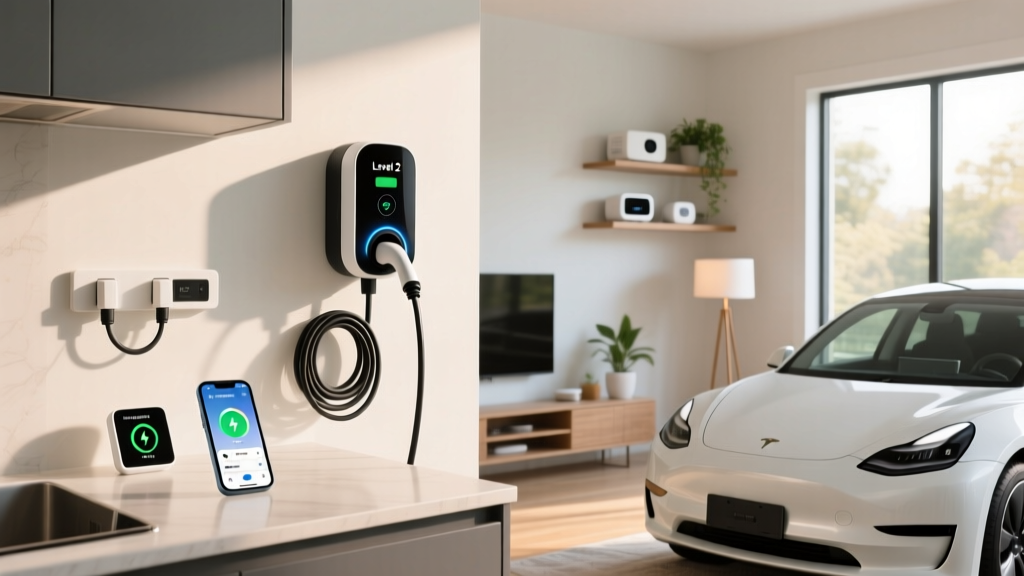
Owning a long range electric car — think EPA ratings of 320+ miles from vehicles like the Tesla Model 3 Long Range (363 mi), Hyundai Ioniq 6 (361 mi), or Chevrolet Silverado EV (440 mi) — unlocks genuine road-trip capability. But that large battery (typically 75–100 kWh usable) also means home charging logistics matter more than ever. Plug into a standard 120V outlet and you could wait three days to refill an 85 kWh pack. Install the right Level 2 station and you wake up full every morning for pennies per mile.
This guide covers exactly what it takes to charge a long range EV at home and on the road: the three charging levels with real miles-per-hour figures, home installation requirements and realistic costs, connector compatibility across 2026 models, what you'll actually pay per mile versus gasoline, and specific charger hardware worth buying.
The Three Charging Levels: Speeds, kW, and Miles Added Per Hour
The single most important distinction in EV charging is kW (kilowatts) versus kWh (kilowatt-hours). Kilowatts measure power — the rate at which energy flows into your battery, like water pressure from a hose. Kilowatt-hours measure energy — the total capacity of your battery, like the size of the tank. A long range EV with an 82 kWh battery charging at 11.5 kW will take roughly 7+ hours from empty. Confusing these two units is the most common EV literacy mistake, and it leads to bad purchasing decisions.
| Level | Voltage / Phase | Power (kW) | Miles of Range Added Per Hour | Typical Use Case |
|---|---|---|---|---|
| Level 1 | 120V AC / 1-phase | 1.2–1.9 kW | 3–5 mi/hr | Overnight trickle, PHEVs, emergency |
| Level 2 (Home/Public) | 240V AC / 1-phase | 7.2–19.2 kW | 22–60+ mi/hr | Daily home charging, workplace, retail |
| DC Fast Charging | 400–800V DC | 50–350 kW | 150–1,000+ mi/hr (at peak) | Road trips, highway corridors |
For a long range electric car with a ~85 kWh battery, Level 1 is functionally useless for daily driving — you'd add perhaps 40 miles overnight. Level 2 at 11.5 kW (48A on a 60A circuit) is the sweet spot: it fully replenishes a 85 kWh pack in about 7.5 hours, meaning any normal overnight window covers even a near-empty battery. DC fast charging is your road-trip solution, not your daily one — it's more expensive per kWh and repeated exclusive use can accelerate battery degradation over time.
Home Charger Installation: Electrical Requirements, Costs, and Panel Upgrades
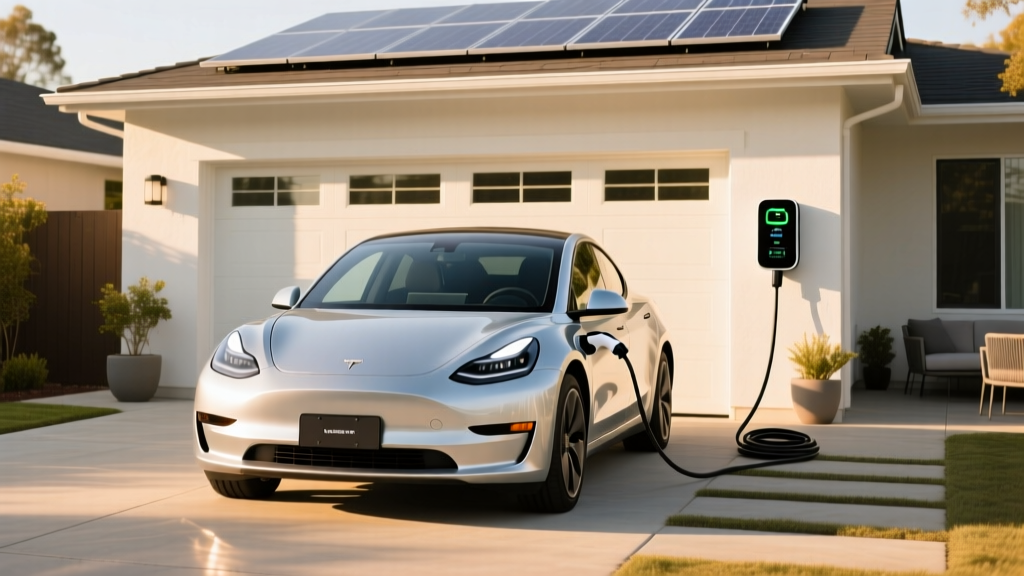
A Level 2 home charger requires a dedicated 240V circuit — the same voltage your electric dryer or oven uses. The most common residential setup is a 60-amp breaker feeding a hardwired charger rated for 48 amps continuous (the National Electrical Code requires circuits to be rated 125% above continuous load, so 48A × 1.25 = 60A). Some homes opt for a NEMA 14-50 outlet (50A breaker, 40A continuous), which allows you to unplug and take the charger if you move.
Before installation, your electrician will assess your electrical panel's available capacity. Most modern homes with 200-amp service have room for a 60A EV circuit. Older homes with 100A or 150A panels may require a panel upgrade to 200A, which is the single largest cost variable in a home charging install. Some utilities and municipalities now offer smart-panel solutions (like Span or Lumin) that manage load without a full upgrade, but availability varies.
| Component | Simple Install (Near Panel) | Complex Install (Far Run / Upgrade) |
|---|---|---|
| Level 2 Charger Equipment | $400–$700 | $400–$700 |
| Electrician Labor (2–6 hrs @ $100–$175/hr) | $200–$500 | $600–$1,500 |
| Materials (wire, conduit, breaker) | $50–$200 | $200–$600 |
| Permit & Inspection | $50–$150 | $50–$200 |
| Panel Upgrade (if needed, 100A → 200A) | N/A | $1,500–$3,500 |
| Total Estimated Cost | $700–$1,550 | $2,750–$6,500 |
The IRS §30C Alternative Fuel Vehicle Refueling Property Credit may cover up to 30% of home charging equipment and installation costs (capped at $1,000), but only if you live in a qualifying census tract and meet specific requirements. Check current-year eligibility with a tax professional — rules and qualifying areas change.
What Electrical Upgrades Might I Need?
Three scenarios drive upgrade costs: (1) Insufficient panel capacity — if your panel is near its amperage limit, adding 60A pushes it over, requiring a service upgrade. (2) Long wire runs — if your parking spot is far from the panel (detached garage, driveway), you need heavier-gauge copper wire and possibly trenching, adding $500–$2,000. (3) Old wiring or aluminum service — pre-1980s homes may need the service entry replaced entirely. Always get a load calculation from a licensed electrician before committing to a charger purchase.
Connector Compatibility: NACS, CCS1, CHAdeMO, and What Your EV Uses
The connector landscape has consolidated dramatically since 2024. As of 2026, the North American Charging Standard (NACS) — originally Tesla's proprietary connector, now an SAE standard (J3400) — is the dominant plug on new EVs sold in North America. Ford, GM, Rivian, Hyundai, Kia, BMW, and most other automakers have switched to NACS for new models. CCS1 (Combined Charging System) remains on many 2021–2024 vehicles and on most non-Tesla public DC fast chargers built before 2025. CHAdeMO is effectively legacy — only older Nissan Leafs and Mitsubishi Outlander PHEVs still use it, and new public CHAdeMO stations are rare.
| Connector | Brands Using It (New Vehicles) | Public Network Access | Adapter Needed? |
|---|---|---|---|
| NACS (J3400) | Tesla, Ford, GM, Rivian, Hyundai, Kia, BMW, Volvo, Polestar, Mercedes, Lucid | Tesla Superchargers + growing Electrify America, EVgo, ChargePoint NACS stalls | CCS1-to-NACS adapter for legacy CCS vehicles on Superchargers |
| CCS1 | Legacy: 2021–2024 VW ID.4, older Hyundai/Kia, Stellantis models | Electrify America, EVgo, ChargePoint (majority of existing DC stalls) | NACS-to-CCS adapter if vehicle is CCS and you want Supercharger access |
| CHAdeMO | None (discontinued for new models) | Limited legacy stations | No adapter available for NACS/CCS vehicles |
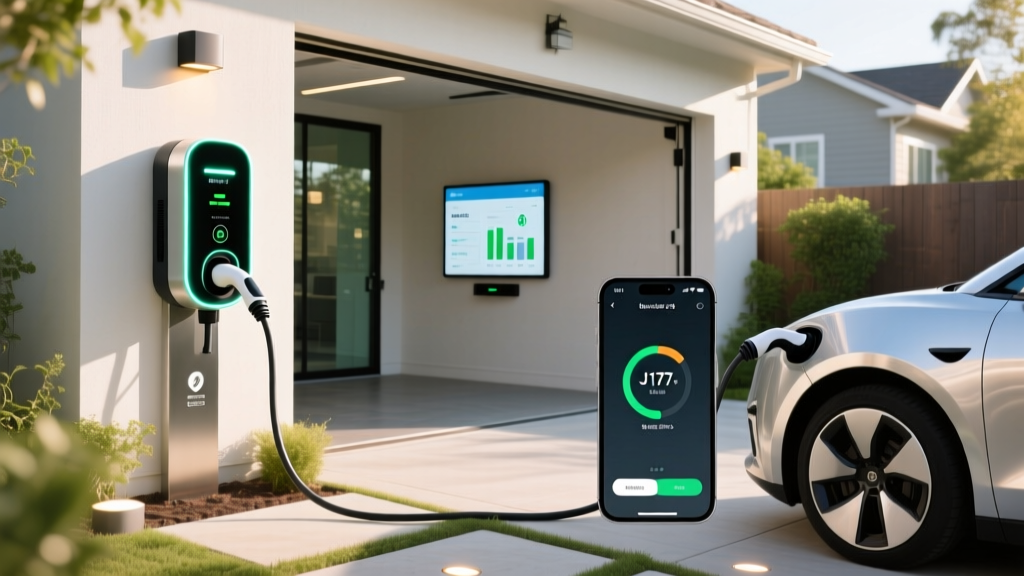
For home Level 2 charging, the connector situation is simpler: most home chargers now ship with a NACS plug or a universal J1772 plug (which NACS vehicles accept via the adapter included with most new EVs). If you own a 2026 NACS-equipped vehicle, buy a NACS home charger. If you own an older CCS1 vehicle, buy a J1772 charger and use your vehicle's J1772-to-NACS adapter if applicable, or a J1772 charger directly.
What Charging Actually Costs: Per-Mile Economics vs. Gasoline
The cost advantage of charging a long range electric car versus fueling a comparable gas vehicle depends heavily on where and when you charge. Here are realistic 2026 scenarios using an EV averaging 3.0 miles per kWh (roughly 112 MPGe combined — typical for a mid-size long range sedan or crossover):
| Scenario | Rate ($/kWh) | Cost Per Mile (EV at 3.0 mi/kWh) | Gas Equivalent (30 MPG @ $3.40/gal) |
|---|---|---|---|
| Home Off-Peak (Time-of-Use plan) | $0.08–$0.12 | $0.027–$0.040 | $0.113 |
| Home Standard Rate | $0.13–$0.18 | $0.043–$0.060 | $0.113 |
| Public Level 2 (ChargePoint, workplace) | $0.20–$0.35 | $0.067–$0.117 | $0.113 |
| DC Fast Charging (Electrify America, EVgo) | $0.35–$0.55 | $0.117–$0.183 | $0.113 |
The takeaway is clear: home charging at off-peak rates costs roughly one-quarter to one-third what gasoline does per mile. Even standard-rate home charging undercuts gas by about half. But exclusive reliance on DC fast charging can push your per-mile cost above gasoline — which is why home Level 2 installation isn't optional for most EV owners who want the economic benefit. For a long range EV driven 12,000 miles per year, home off-peak charging saves roughly $900–$1,100 annually versus a 30 MPG gas car.
Charging Times for Common Long Range EV Battery Sizes
How long does it actually take to charge a long range electric car? Here are real-world estimates for popular battery sizes, accounting for the charge curve taper — the fact that charging slows significantly above 80% State of Charge (SoC) to protect battery health. Peak kW ratings are never sustained across the full session.
| Battery Size (Usable kWh) | Level 2 at 11.5 kW (48A) | DC Fast (Peak / Sustained Avg) | Example Vehicles |
|---|---|---|---|
| 75 kWh | ~4.5 hours (10–80%) | ~22 min @ 170 kW avg | Tesla Model 3 LR (75 kWh, 363 mi EPA) |
| 85 kWh | ~5.2 hours (10–80%) | ~25 min @ 200 kW avg | Hyundai Ioniq 5 (84 kWh, 318 mi EPA) |
| 100 kWh | ~6.1 hours (10–80%) | ~30 min @ 210 kW avg | Rivian R1T Dual (106 kWh, 352 mi EPA) |
| 115 kWh | ~7.0 hours (10–80%) | ~35 min @ 230 kW avg | GMC Sierra EV Denali (120 kWh, 440 mi EPA) |
A critical nuance: preconditioning your battery before a DC fast charging stop dramatically affects real-world speed. Most long range EVs (Tesla, Hyundai E-GMP, GM Ultium) will warm or cool the battery to optimal temperature when you navigate to a charger via the built-in nav system. Skipping preconditioning in cold weather can cut your peak charge rate in half. Always navigate to the charger through the car's system, not a third-party app, to trigger preconditioning.
For home Level 2, the charge curve taper matters less because you're charging overnight — even 7 hours to reach 80% means you wake up with 80%+ every morning, which is actually the recommended daily SoC limit for NMC battery longevity. Set your charger or vehicle to stop at 80% for daily use and charge to 100% only before road trips.
Best Home EV Chargers for Long Range Electric Cars (2026 Picks)
For a long range EV with a large battery, you want a charger that delivers at least 11.5 kW (48A) to minimize overnight charging time. Here are three proven units across price tiers, each with verified specs:
Tesla Wall Connector (Gen 4)
- Power: 11.5 kW (48A) on 60A circuit
- Connector: NACS native
- Cable: 24 ft
- Smart Features: Wi-Fi, OTA updates, load sharing (pair two on one circuit), access control
- Price: ~$475
- Best For: NACS vehicles (Tesla, Ford, GM, Hyundai 2025+)
ChargePoint Home Flex (2nd Gen)
- Power: Up to 12 kW (50A adjustable) on 60A circuit
- Connector: NACS or J1772 (configurable)
- Cable: 23 ft
- Smart Features: Wi-Fi, scheduling, energy tracking, Alexa integration
- Price: ~$650
- Best For: Mixed-fleet households, J1772 legacy vehicles
Emporia Vue EV Charger
- Power: 11.5 kW (48A) on 60A circuit
- Connector: NACS or J1772
- Cable: 24 ft
- Smart Features: Wi-Fi, solar integration, energy monitoring via Emporia Vue panel
- Price: ~$400
- Best For: Budget-conscious, solar-panel homes
All three units are NEMA 4-rated (suitable for indoor and outdoor installation), UL-listed, and compatible with hardwire or NEMA 14-50 plug configurations. Hardwire is strongly recommended for 48A+ units — a 14-50 outlet is limited to 40A continuous, capping you at 9.6 kW. For a long range EV with an 85+ kWh battery, that extra 1.9 kW from hardwiring shaves about an hour off a full charge.
Safety, Code, and Installation Best Practices
EV charging is a high-draw, long-duration electrical load — your charger may run at full power for 6–8 hours straight. This demands proper installation per the National Electrical Code (NEC) Article 625:
- Dedicated circuit: Your EV charger must have its own breaker — no sharing with other appliances.
- GFCI protection: NEC 2023+ requires ground-fault circuit interrupter protection for all EV supply equipment. Hardwired units typically have built-in GFCI; outlet-based installs need a GFCI breaker.
- Outdoor rating: If your charger is installed outside (driveway, carport), it must be NEMA 3R or NEMA 4 rated. All three chargers recommended above meet this standard.
- Cable management: Long cables (24 ft) should be kept off the ground with a holster or retractable reel to prevent tripping hazards and insulation wear.
- Permit and inspection: Most jurisdictions require a permit for new 240V circuits. Your electrician should pull this — skip the inspection and you risk voiding homeowner's insurance coverage for electrical fires.
- Wire gauge: A 60A circuit requires 4 AWG copper wire (or 3 AWG aluminum) for runs up to ~50 feet. Longer runs may need 3 AWG copper to prevent voltage drop.
Do not attempt a DIY install unless you are a licensed electrician. A 240V/60A circuit carries enough current to be lethal, and improper connections can cause fires months after installation due to thermal cycling loosening terminations.
How Much Does Charging Cost Per Mile vs. Gas? (Decision Framework)
If you're deciding whether a long range electric car makes financial sense, here's the framework:
Choose a long range EV and install home Level 2 charging if:
- You can install a 240V circuit (owned home, landlord approval, or workplace charging available)
- You drive 10,000+ miles per year (the fuel savings offset the higher purchase price faster)
- Your utility offers time-of-use rates with off-peak periods (charge at $0.08–$0.12/kWh overnight)
- You qualify for the §30D federal EV tax credit (up to $7,500, subject to MSRP caps, buyer income limits, and battery sourcing rules — verify current-year eligibility)
Reconsider or opt for a PHEV if:
- You rent and cannot install a home charger, and public Level 2 access is limited in your area
- You rely exclusively on DC fast charging (per-mile cost approaches or exceeds gasoline)
- Your daily commute exceeds your EV's real-world range in your climate (expect 20–30% EPA range loss in sub-freezing temperatures)
For a typical long range EV owner charging at home 80% of the time and using DC fast charging for road trips 20% of the time, the blended cost per mile is approximately $0.04–$0.05 — roughly 55–65% less than a 30 MPG gas car at $3.40/gallon. Over five years and 60,000 miles, that's $3,000–$4,000 in fuel savings alone, before accounting for reduced maintenance (no oil changes, fewer brake replacements due to regenerative braking).
Frequently Asked Questions
How much does it cost to install a home EV charger?
A straightforward installation near your electrical panel typically costs $700–$1,550 total (charger + electrician + materials + permit). If your panel needs upgrading from 100A to 200A, or the wire run is long, expect $2,750–$6,500. Always get a load calculation from a licensed electrician first.
How fast will each charging level add range?
Level 1 (120V): 3–5 miles per hour. Level 2 (240V at 48A/11.5 kW): 35–40 miles per hour for most EVs. DC fast charging: 150–1,000+ miles per hour at peak, but sustained average is lower due to the charge curve taper above 80% SoC.
Which connector/charger is compatible with my EV?
Check your vehicle's charge port. 2025+ models from Tesla, Ford, GM, Hyundai, Kia, BMW, and most others use NACS. Older non-Tesla EVs (2021–2024) likely use CCS1. For home charging, match your charger's plug to your car's port, or use the adapter that came with your vehicle.
How much does charging cost per mile vs gas?
Home off-peak charging costs $0.03–$0.04 per mile; standard home rates cost $0.04–$0.06 per mile. A comparable 30 MPG gas car costs about $0.11 per mile at $3.40/gallon. Exclusive DC fast charging ($0.12–$0.18/mi) can exceed gas costs.
What electrical upgrades might I need?
The three most common upgrades are: (1) panel upgrade from 100A/150A to 200A service ($1,500–$3,500), (2) heavy-gauge wire for long runs from panel to parking spot ($500–$2,000), and (3) service entry replacement in pre-1980s homes. A licensed electrician's load calculation will determine if any of these apply to your home.