Why "Lincoln Mark VIII Supercharger" Keeps Coming Up
Search forums and EV-conversion threads and you'll see the phrase Lincoln Mark VIII supercharger pop up with surprising regularity. The 1993–1998 Lincoln Mark VIII — built on Ford's FN10 platform with the 4.6L DOHC V8 and air suspension — is a popular candidate for classic luxury EV swaps. Enthusiasts are dropping Tesla drive units, NetGain Hyper9 motors, and salvaged Leaf or Model S battery packs into these grand tourers. When these builds go live, owners immediately ask: how do I actually charge this thing?
That question doesn't have a one-word answer. A conversion Mark VIII has no factory charge port, no EPA-rated battery chemistry, and no guaranteed connector. Everything depends on what the builder installed. This guide breaks down the full charging ecosystem — Level 1, Level 2, and DC fast charging — with the exact numbers you need whether you're plugging in a finished conversion or planning one.
Charging Levels Explained: kW, Speed, and What Each Adds
Before anything else, let's lock in the distinction that trips up even experienced builders: kW (kilowatts) measures power — how fast energy flows into the battery. kWh (kilowatt-hours) measures energy capacity — how much the battery holds. A 40 kWh battery charged at 10 kW takes roughly 4 hours from empty. Confusing these two is the single most common EV-charging mistake.
| Level | Voltage | Max Power (kW) | Miles of Range Added per Hour | Typical Use Case |
|---|---|---|---|---|
| Level 1 | 120V AC | 1.2–1.9 kW | 3–5 miles | Overnight top-off, emergency |
| Level 2 | 240V AC | 3.3–19.2 kW | 12–75 miles | Home daily charging, workplace |
| DC Fast (Level 3) | 200–925V DC | 50–350 kW | 150–1,200+ miles (peak) | Road trips, rapid top-ups |
For a Mark VIII conversion running a ~40–60 kWh battery pack (typical for a Tesla Model S salvage pack or a custom LFP array), Level 2 at 7.2 kW is the practical daily standard. You'll recover 25–30 miles of range per hour of charging, enough to refill overnight after a 100-mile drive.
Home Charger Installation: Electrical Requirements and Costs
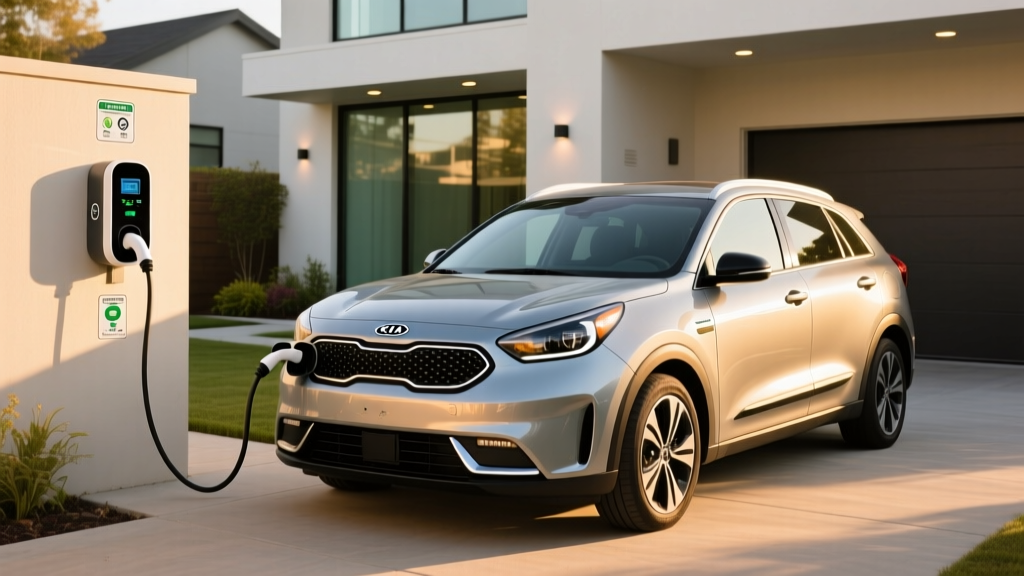
Most EV conversions, including Mark VIII builds, use a J1772 Level 2 inlet wired to the onboard charger. That means a standard 240V home circuit. Here's what the electrical side actually requires:
- Circuit: A dedicated 40-amp or 50-amp breaker feeding a NEMA 14-50 outlet or hardwired wall unit
- Wire gauge: 6 AWG copper (50A) or 8 AWG (40A), run through conduit where exposed
- Panel capacity: Your main service panel needs at least 200 amps total for a 50A EV circuit without overloading existing loads
- GFCI protection: NEC 2020 and later require GFCI on 240V receptacles used for EV charging — this means a GFCI breaker or a hardwired unit (which often has internal ground-fault protection)
- Permit: Nearly all jurisdictions require an electrical permit and inspection for new 240V circuits
Typical Home Level 2 Installation Cost Breakdown
| Item | Low Estimate | High Estimate |
|---|---|---|
| Level 2 EVSE equipment (wall charger) | $350 | $750 |
| Electrician labor (2–6 hours) | $400 | $1,500 |
| Materials (wire, conduit, breaker, outlet) | $150 | $500 |
| Electrical permit and inspection | $50 | $250 |
| Panel upgrade (if needed — 100A to 200A) | $1,500 | $4,000 |
| Total (no panel upgrade) | $950 | $3,000 |
| Total (with panel upgrade) | $2,450 | $7,000 |
Homes built before 1990 frequently have 100-amp or 150-amp panels that are already near capacity. A licensed electrician will run a load calculation (NEC Article 220) to determine if your panel can handle the additional 40–50 amp continuous draw. If not, a panel upgrade is non-negotiable — and it's the single biggest cost variable in the project. Don't skip this step or risk tripping your main breaker or, worse, overheating undersized bus bars.
Connector Compatibility: What Fits a Conversion Mark VIII?
Unlike a production EV where the connector is fixed, a conversion's charge port depends entirely on the builder's choices. Here's the connector landscape as of 2026:
| Connector | Standard Use | Notes for Conversions |
|---|---|---|
| J1772 (Type 1) | Level 1 & 2 AC charging in North America | Most common inlet for conversions; universally compatible with public Level 2 stations |
| NACS (Tesla) | AC + DC charging; adopted by Ford, GM, Rivian, others from 2025+ | Tesla Mobile Connector works; adapters available for J1772 stations |
| CCS1 | DC fast charging (non-Tesla) | Requires CCS inlet and compatible BMS communication — complex for conversions |
| CHAdeMO | DC fast charging (Nissan Leaf, older Japanese EVs) | Being phased out; limited new station deployment |
For a Mark VIII conversion, J1772 is the default recommendation for AC charging. It's simple, requires no CAN-bus handshake, and works with every public Level 2 station in the US. If you want DC fast charging capability, you'll need a CCS1 inlet and a battery management system (BMS) that supports CCS communication protocols — this adds significant complexity and cost ($2,000–$5,000+ in components and integration labor).
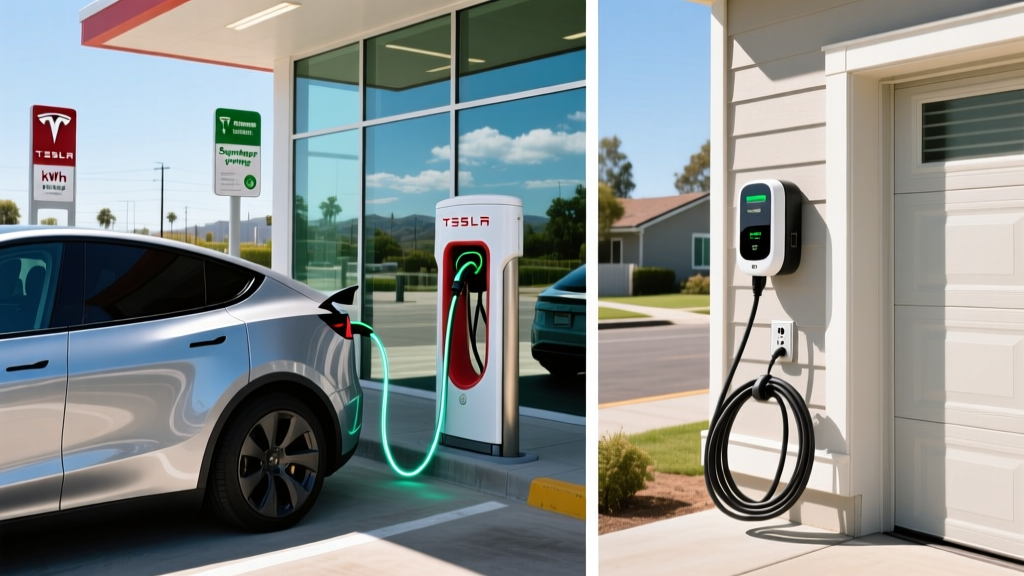
If your build uses a Tesla drive unit and charge controller, you may already have a NACS port. In that case, a Tesla-to-J1772 adapter (~$200–$300 from third-party makers) lets you use non-Tesla Level 2 public chargers. Tesla's Supercharger network has also opened to non-Tesla EVs via the Tesla app at select stations, but availability for conversions depends on whether your vehicle's software can handshake with the charger.
Charging Cost: Per-Mile Breakdown vs. Gasoline
One of the strongest arguments for converting a Mark VIII to electric is operating cost. The original 4.6L V8 averaged around 17–19 MPG combined per fueleconomy.gov. Let's compare real charging costs against that baseline.
| Scenario | Rate | Cost per Mile (EV at 3.0 mi/kWh) | Cost per Mile (Gas at 18 MPG) |
|---|---|---|---|
| Home off-peak (utility TOU rate) | $0.09/kWh | $0.030 | $0.194 (at $3.50/gal) |
| Home standard rate | $0.14/kWh | $0.047 | $0.194 |
| Public Level 2 (network average) | $0.28/kWh | $0.093 | $0.194 |
| DC fast charging (public) | $0.42/kWh | $0.140 | $0.194 |
Even at public DC fast-charging rates, a converted Mark VIII costs less per mile to drive than the original V8 on gasoline. At home off-peak rates, you're looking at roughly $0.03 per mile versus $0.19 — an 84% reduction. Over 12,000 miles per year, that's a savings of approximately $1,970 in energy costs alone.
Charging Time Examples for Common Conversion Battery Sizes
Most Mark VIII conversions fall into one of three battery-pack categories. Here's how long charging actually takes — and why the 10–80% window matters more than 0–100%.
40 kWh pack (e.g., salvaged Nissan Leaf pack or small custom LFP):
- Level 1 (1.4 kW): ~28 hours, 0–100%
- Level 2 (7.2 kW): ~5.5 hours, 0–100%
- DC fast (50 kW peak): ~35 minutes, 10–80% (charge curve tapers significantly above 80%)
60 kWh pack (e.g., Tesla Model S 60 or mid-size custom NMC):
- Level 2 (7.2 kW): ~8.3 hours, 0–100%
- Level 2 (11.5 kW): ~5.2 hours, 0–100%
- DC fast (50 kW): ~50 minutes, 10–80%
85 kWh pack (e.g., Tesla Model S 85 long-range pack):
- Level 2 (11.5 kW): ~7.4 hours, 0–100%
- DC fast (120 kW peak): ~35 minutes, 10–80% (sustained rate drops above 60% SoC)
The charge curve is the critical detail here. DC fast chargers don't deliver their peak kW the entire session. A 50 kW charger might deliver 45–50 kW up to 60% state of charge, then taper to 25 kW by 80%, and drop to under 10 kW for the final 20%. This is why manufacturers and builders quote 10–80% times — that's the useful fast-charging window. Charging from 80% to 100% on DC fast can take as long as the 10–80% portion.
Recommended Level 2 Equipment for Home Charging
If you're setting up a home charger for a converted Mark VIII (or any J1772-equipped EV), these are the units we recommend based on reliability, output, and feature set:
ChargePoint Home Flex
- Power output: Up to 12 kW (50A) on a 60A circuit, configurable down to 16A
- Connector: J1772 (25-foot cable)
- Smart features: Wi-Fi, app scheduling, Alexa integration, energy tracking
- Price: ~$550 (unit only)
- Best for: Flexible amperage if your panel is tight on capacity
Emporia Vue EV Charger
- Power output: Up to 11.5 kW (48A) on a 60A circuit
- Connector: J1772 (24-foot cable)
- Smart features: Wi-Fi, real-time energy monitoring, solar integration, load management
- Price: ~$400 (unit only)
- Best for: Budget-conscious installs with energy monitoring
Tesla Wall Connector (with J1772 adapter)
- Power output: Up to 11.5 kW (48A) on a 60A circuit
- Connector: NACS native; use Tesla's J1772 adapter (~$200) for non-Tesla EVs
- Smart features: Wi-Fi, OTA updates, power sharing between two units
- Price: ~$450 (unit only) + adapter cost
- Best for: Households with both Tesla and non-Tesla vehicles
Grizzl-E Smart
- Power output: Up to 10 kW (40A) on a 50A circuit
- Connector: J1772 (24-foot cable)
- Smart features: OCPP-compatible, app control, adjustable amperage
- Price: ~$450 (unit only)
- Best for: Outdoor installs (IP67 rated, -40°C to +50°C operating range)
For a garage-mounted Mark VIII, the ChargePoint Home Flex offers the best balance of features and flexibility. If your build will live outside or in an unheated garage, the Grizzl-E's extreme temperature tolerance makes it the safer pick.
Safety, Code, and What Not to Skip
EV conversions draw serious current. A 48A continuous load on a residential circuit is comparable to running an electric range and a dryer simultaneously. Here's what code and safety demand:
- Dedicated circuit: Your EV charger must have its own breaker — never share a circuit with other appliances
- Continuous load derating: NEC requires that continuous loads (3+ hours) use only 80% of the breaker rating. A 50A breaker supports 40A continuous; a 60A breaker supports 48A
- GFCI protection: Required for receptacle-based (NEMA 14-50) installs per NEC 625. Hardwired units often have internal ground-fault protection, which may exempt them from the GFCI breaker requirement — confirm with your inspector
- Outdoor rating: If your charge point is outside, the EVSE must carry at minimum a NEMA 4 or IP65 rating. All four units above qualify
- Strain relief and cable management: A heavy J1772 cable hanging from an outlet will eventually loosen the connection. Use a cable holster or hardwire the unit
For conversion vehicles specifically, ensure your onboard charger (the unit inside the car that converts AC to DC for the battery) is rated for the amperage your home EVSE delivers. Sending 48A to an onboard charger rated for 32A will either trip the charger's protection or, in poorly designed systems, cause overheating. Match the EVSE output to the onboard charger's max AC input.
Frequently Asked Questions
How much does it cost to install a home EV charger?
A typical Level 2 home installation runs $950–$3,000 if your electrical panel has sufficient capacity. If you need a panel upgrade from 100A to 200A, add $1,500–$4,000. Total cost with a panel upgrade: $2,450–$7,000. Always get a licensed electrician to perform a load calculation before committing to equipment.
How fast will each charging level add range?
Level 1 (120V) adds 3–5 miles per hour. Level 2 (240V at 7.2 kW) adds roughly 25–30 miles per hour. DC fast charging at 50 kW can add 150+ miles in 30 minutes, but only up to ~80% state of charge — after that, the charge curve tapers sharply to protect the battery.
Which connector and charger is compatible with my EV conversion?
Most EV conversions use a J1772 inlet for AC charging, which is compatible with every public Level 2 station in the US. If your build uses Tesla components with a NACS port, you'll need a NACS-to-J1772 adapter for non-Tesla public chargers. DC fast charging requires either CCS1 or CHAdeMO inlets plus a compatible BMS — significantly more complex for conversions.
How much does charging cost per mile compared to gas?
At home off-peak rates (~$0.09/kWh), a converted Mark VIII achieving 3.0 miles per kWh costs about $0.03 per mile. The original 4.6L V8 at 18 MPG and $3.50/gallon gasoline costs $0.19 per mile. Even at public DC fast-charging rates ($0.42/kWh), the EV conversion at $0.14/mile still beats gasoline.
What electrical upgrades might I need?
The most common upgrade is a panel replacement from 100A or 150A to 200A service, required when your existing panel can't support an additional 40–50A continuous load. Older homes may also need new wire runs from the meter to the panel, upgraded grounding, or a new meter socket. Your electrician's load calculation (per NEC Article 220) will determine exactly what's needed. Always pull a permit — unpermitted electrical work can void insurance coverage and create fire risk.