Why a Level 2 Charger Is the Single Best EV Upgrade You Can Make
If you own or are shopping for an electric vehicle, plugging into a standard 120V household outlet (Level 1) adds roughly 3 to 5 miles of range per hour — barely enough to replenish a daily commute, let alone recharge for a road trip. A Level 2 charger operating on 240V power transforms that reality, delivering 15 to 44 miles of range per hour and letting you wake up to a full battery every morning. This guide breaks down exactly what a Level 2 charger requires, what it costs to install, which connectors fit your EV, and which units deliver the best value in 2026.
Charging Levels Explained: Level 1 vs. Level 2 vs. DC Fast Charging
Before selecting equipment, you need to understand the three charging tiers and — critically — the difference between kW (kilowatts), which measures power flow rate, and kWh (kilowatt-hours), which measures energy stored in your battery. Think of kW as the width of the hose and kWh as the size of the bucket. A Level 2 charger rated at 11.5 kW delivers 11.5 kWh of energy into your battery for every hour it charges at peak rate.
| Level | Voltage / Phase | Power Output (kW) | Miles of Range Added per Hour | Typical Use Case |
|---|---|---|---|---|
| Level 1 | 120V / Single | 1.0–1.9 kW | 3–5 mi/hr | Overnight trickle; PHEV top-ups |
| Level 2 | 240V / Single | 3.3–19.2 kW | 15–44 mi/hr | Home daily charging; workplace; public destination |
| DC Fast Charging | 400–900V DC | 50–350+ kW | 150–1,000+ mi/hr (peak) | Road trips; highway corridors |
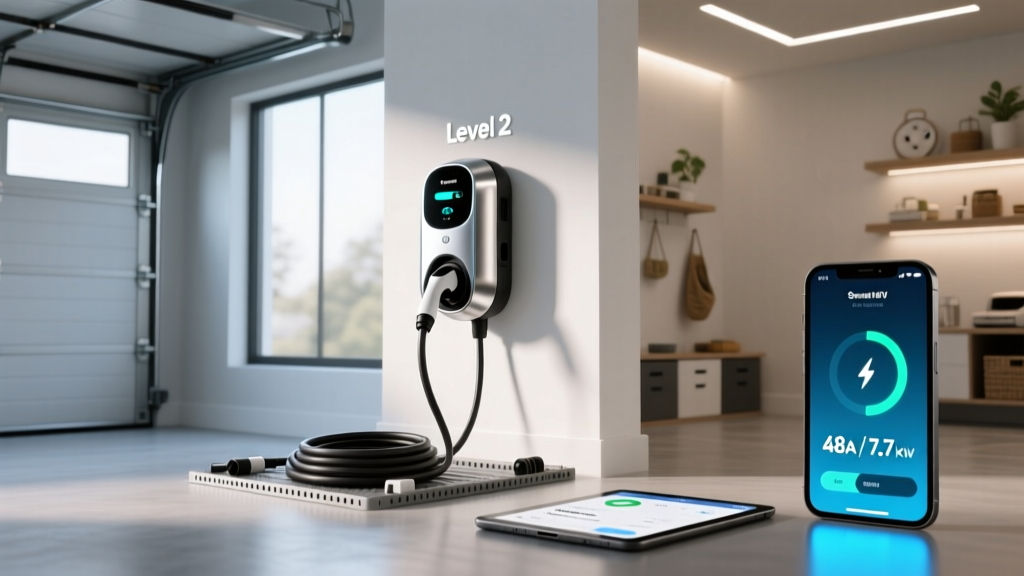
Most home Level 2 chargers run between 7.2 kW (32A on a 40A circuit) and 11.5 kW (48A on a 60A circuit). At 11.5 kW, a 75 kWh battery (like the one in a Tesla Model Y Long Range) charges from 10% to 80% in roughly 5 hours. At 7.2 kW, that same charge takes about 7.5 hours — still easily achievable overnight.
Electrical Requirements: What Your Home Needs for a Level 2 Charger
Installing a Level 2 charger isn't a plug-and-play affair. It requires a dedicated 240V circuit — the same voltage your electric dryer or oven uses — and the amperage of that circuit determines your charging speed.
Circuit and Amperage Basics
The National Electrical Code (NEC) requires that continuous loads (like EV charging, which runs for 3+ hours) use no more than 80% of a circuit's rated capacity. This means:
- A 40A circuit delivers up to 32A / 7.7 kW continuous
- A 50A circuit delivers up to 40A / 9.6 kW continuous
- A 60A circuit delivers up to 48A / 11.5 kW continuous
If you install a 48A hardwired charger, you need a 60A breaker and 6 AWG copper wire (or 4 AWG aluminum). A 32A plug-in unit using a NEMA 14-50 outlet needs a 40A breaker and 8 AWG copper. Always defer final wire gauge and breaker sizing to a licensed electrician — local code amendments and wire-run length can change requirements.
Panel Capacity and Upgrade Reality
Here's where costs can escalate. Most homes built after 2000 have a 200A electrical panel, which usually accommodates a 60A EV circuit alongside existing loads. Older homes with 100A or 150A panels may need a panel upgrade to 200A before an electrician will sign off on a Level 2 install.
A licensed electrician will perform a load calculation per NEC Article 220 to determine whether your panel has headroom. If your home already runs electric heat, a dryer, an oven, and an A/C unit on a 150A panel, adding 48A of continuous EV draw may exceed the calculated load.
How Much Does It Cost to Install a Home Level 2 Charger?
Installation costs vary enormously based on your home's electrical infrastructure, the distance from panel to charger location, and local labor rates. Here's a realistic breakdown based on 2026 pricing:
| Component | Basic Install (Near Panel) | Standard Install (25–50 ft run) | Complex Install (Panel Upgrade + Long Run) |
|---|---|---|---|
| Level 2 charger equipment | $300–$500 | $400–$700 | $400–$700 |
| Electrician labor (2–8 hrs @ $85–$150/hr) | $250–$500 | $500–$1,200 | $800–$1,500 |
| Materials (wire, conduit, breaker, outlet) | $100–$250 | $200–$500 | $400–$800 |
| Permit fee | $50–$150 | $50–$200 | $100–$300 |
| Panel upgrade (if needed) | — | — | $1,500–$4,000 |
| Total estimated cost | $700–$1,400 | $1,150–$2,600 | $3,200–$7,300 |
The IRS §30D clean vehicle credit does not cover home charging equipment directly. However, some utilities offer rebates of $200–$500 for Level 2 charger purchases and installations. Check with your local electric cooperative or investor-owned utility — programs vary by jurisdiction and change annually.
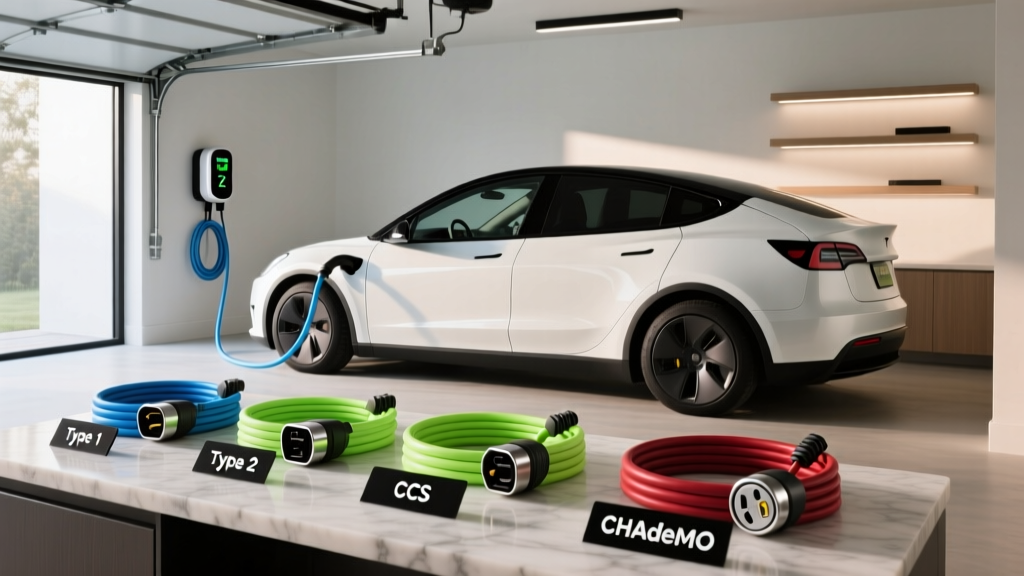
Connector Compatibility: NACS, CCS1, and CHAdeMO
The connector landscape has shifted dramatically. As of 2026, nearly all new EVs sold in North America use the North American Charging Standard (NACS) — the connector Tesla pioneered and opened to the industry in late 2022. Most legacy CCS1 vehicles from 2023–2025 model years can access Tesla Superchargers via an adapter.
| Connector | Brands Using It (New Vehicles) | Level 2 Home Charging? | Adapter Needed? |
|---|---|---|---|
| NACS (J3400) | Tesla, Ford, GM, Rivian, Volvo, Polestar, Mercedes, BMW, Hyundai, Kia (2025+) | Yes — native | No |
| CCS1 | Remaining 2023–2024 models (VW ID.4 early builds, some Stellantis) | Yes — via J1772 inlet | NACS-to-CCS adapter for Superchargers |
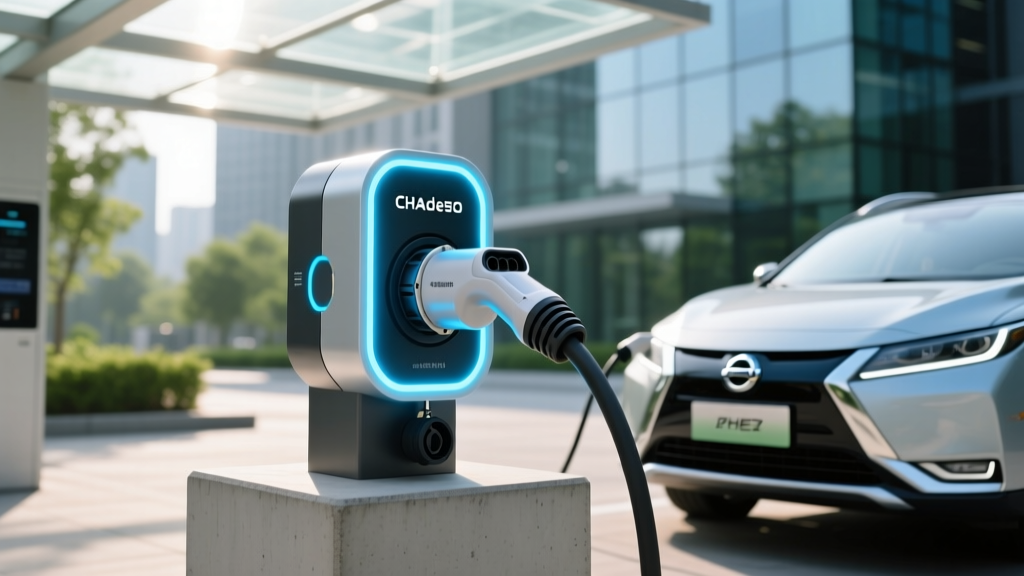
| CHAdeMO | Nissan Leaf (discontinued), Mitsubishi Outlander PHEV | Yes — via J1772 inlet | Limited DC fast network access |
For Level 2 home charging specifically, all connectors use the J1772 protocol for communication. NACS vehicles accept Level 2 AC power through the same connector pins used for DC fast charging. If you buy a hardwired or plug-in Level 2 charger with a NACS connector, it will work natively with new Fords, GMs, Rivians, and Teslas. For CCS1 vehicles, most Level 2 chargers ship with a J1772 connector (the round, 5-pin plug), which fits the upper portion of a CCS1 inlet. Adapters from NACS to J1772 are widely available ($80–$150) if you need cross-compatibility.
Charging Time Examples: How Long Does a Level 2 Charge Actually Take?
Charging time depends on two variables: your battery's usable capacity (kWh) and your charger's sustained power output (kW). Here are real-world scenarios for common 2026 EVs charging from 10% to 80% State of Charge on a home Level 2 unit:
- Tesla Model Y Long Range (75 kWh usable, 11.5 kW charger): ~4.5 hours (10–80%)
- Ford F-150 Lightning Extended Range (131 kWh usable, 11.5 kW charger): ~8 hours (10–80%)
- Hyundai Ioniq 5 (77.4 kWh usable, 10.9 kW onboard limit): ~5 hours (10–80%)
- Chevrolet Equinox EV (85 kWh usable, 11.5 kW charger): ~5.2 hours (10–80%)
- Toyota RAV4 Prime PHEV (18.1 kWh usable, 3.3 kW onboard limit): ~4 hours (10–80%)
Note that your vehicle's onboard charger caps the AC power it can accept. The Hyundai Ioniq 5, for example, has an 10.9 kW onboard charger — even if you plug it into an 11.5 kW wall unit, it will only draw 10.9 kW. PHEVs typically have smaller onboard chargers (3.3–6.6 kW) because their batteries are smaller and don't need high-power AC acceptance.
Cost to Charge: Level 2 at Home vs. Gas vs. Public DC Fast
One of the most compelling reasons to install a Level 2 charger is cost. Home electricity, especially during off-peak hours, delivers fuel savings that public charging cannot match.
| Scenario | Rate | Cost per Mile (3.5 mi/kWh EV) | Annual Cost (12,000 mi) |
|---|---|---|---|
| Home Level 2 (off-peak TOU rate) | $0.08/kWh | $0.023/mi | $274 |
| Home Level 2 (national avg electricity) | $0.17/kWh | $0.049/mi | $583 |
| Public Level 2 (network pricing) | $0.30–$0.45/kWh | $0.086–$0.129/mi | $1,029–$1,543 |
| DC Fast Charging (Electrify America, EVgo) | $0.40–$0.56/kWh | $0.114–$0.160/mi | $1,371–$1,920 |
| Gasoline vehicle (28 MPG combined, $3.30/gal) | $3.30/gal | $0.118/mi | $1,414 |
According to fueleconomy.gov, the average EV achieves roughly 3–4 miles per kWh. At national average residential electricity rates (~$0.17/kWh in early 2026), home Level 2 charging costs about $0.05 per mile — roughly 60% less than gasoline. Off-peak time-of-use rates from your utility can push that below $0.03 per mile. However, exclusive reliance on public DC fast charging erases most of the cost advantage, which is why home Level 2 access is economically essential.
Top Level 2 Charger Recommendations for 2026
Based on power output, connector options, smart features, build quality, and price, here are the units we recommend for home installation:
Tesla Wall Connector (Gen 4)
- Power: Up to 11.5 kW (48A)
- Connector: NACS native
- Cable: 24 ft
- Smart features: Wi-Fi, OTA updates, power sharing, load management
- Price: ~$475
- Best for: Tesla and NACS-equipped vehicles (Ford, GM, Rivian, Hyundai/Kia 2025+)
ChargePoint Home Flex
- Power: Up to 12 kW (50A, configurable down)
- Connector: J1772 (NACS adapter included in 2025+ kits)
- Cable: 23 ft
- Smart features: Wi-Fi, app scheduling, Alexa, utility demand-response
- Price: ~$550–$650
- Best for: Multi-EV households, utility rebate eligibility
Emporia Vue Level 2 Charger
- Power: Up to 11.5 kW (48A)
- Connector: J1772 or NACS (select at purchase)
- Cable: 24 ft
- Smart features: Wi-Fi, solar integration, energy monitoring, scheduling
- Price: ~$399
- Best for: Budget-conscious buyers, solar homes
Grizzl-E Smart
- Power: Up to 10 kW (40A)
- Connector: J1772 (NACS adapter available)
- Cable: 24 ft
- Smart features: Wi-Fi, OCPP support, adjustable amperage
- Price: ~$449
- Best for: Cold climates (rated to -40°F), rugged outdoor installs
Safety, Permits, and Code Requirements
A Level 2 charger installation must comply with NEC Article 625 (Electric Vehicle Charging System Equipment) and your local jurisdiction's amendments. Key requirements include:
- Dedicated circuit: Your EV charger must have its own breaker — no sharing with other outlets or appliances.
- GFCI protection: NEC 2020 and later require ground-fault circuit interrupter protection for outdoor receptacles. Hardwired units often have GFCI built into the charger itself.
- Outdoor rating: If your charger is mounted outside (driveway, exterior wall), it must carry a NEMA 4 or NEMA 4X rating for weather resistance.
- Permit: Most municipalities require an electrical permit for a new 240V circuit. Permits typically cost $50–$200 and trigger a post-install inspection. Skipping the permit risks insurance claim denials and code violations at resale.
- NEMA 14-50 outlet vs. hardwired: Plug-in units offer portability but require a properly installed 14-50 receptacle on a 50A breaker. Hardwired units eliminate the receptacle as a failure point and are often preferred for 60A circuits. Some fire codes now require GFCI breakers for 14-50 receptacles in garages, adding $50–$80 to material costs.
Hire a licensed electrician — not a general handyman — for this work. EV charging circuits run at high amperage for hours continuously, and improper wire sizing or loose connections create fire risk. The National Fire Protection Association (NFPA) maintains the NEC standards that govern this work.
Frequently Asked Questions
How much does it cost to install a home EV charger?
A straightforward Level 2 charger installation near your electrical panel typically costs $700–$1,400 including equipment, labor, and permits. A standard install with a 25–50 foot wire run ranges from $1,150–$2,600. If your home needs a panel upgrade (common in pre-1990 homes with 100A service), total costs can reach $3,200–$7,300. Always get at least two quotes from licensed electricians.
How fast will each charging level add range?
Level 1 (120V) adds 3–5 miles per hour. Level 2 (240V) adds 15–44 miles per hour depending on amperage (16A–80A) and your vehicle's onboard charger limit. DC fast charging adds 150–1,000+ miles per hour at peak rates, though charge curves taper significantly above 80% State of Charge.
Which connector and charger is compatible with my EV?
If your EV is a 2025+ model from Tesla, Ford, GM, Rivian, Hyundai, Kia, Volvo, or BMW, it likely uses NACS. Older CCS1 vehicles use J1772 for Level 2 AC charging. CHAdeMO vehicles (Nissan Leaf) also use J1772 for Level 2. Buy a charger with the matching connector, or use a J1772-to-NACS adapter (~$80–$150) for flexibility.
How much does charging cost per mile compared to gas?
At the national average residential electricity rate of ~$0.17/kWh, home Level 2 charging costs roughly $0.05 per mile for a typical EV. A comparable gas vehicle at 28 MPG and $3.30/gallon costs about $0.12 per mile. Off-peak utility rates can drop home charging to $0.02–$0.03 per mile. Public DC fast charging at $0.40–$0.56/kWh costs $0.11–$0.16 per mile — similar to or exceeding gasoline.
What electrical upgrades might I need?
The most common upgrade is a panel capacity increase from 100A or 150A to 200A, which costs $1,500–$4,000 depending on your utility's connection requirements and local labor rates. You may also need a new breaker slot (if your panel is full), a sub-panel, or a service entrance upgrade for older wiring. A licensed electrician's load calculation will identify these needs before work begins.