The Truth About "Level 3 EVSE" — What It Actually Means
If you've been researching EV charging, you've likely encountered the term Level 3 EVSE (Electric Vehicle Supply Equipment). It's a phrase that shows up in forums, dealership brochures, and search results — but it's also one of the most misunderstood terms in the EV space. Here's the critical distinction: what the industry colloquially calls "Level 3" is actually DC fast charging, and it is fundamentally different from the Level 1 and Level 2 equipment you install at home.
DC fast chargers bypass your car's onboard charger entirely, feeding direct current straight into the battery pack at power levels ranging from 50 kW to over 350 kW. They require dedicated commercial-grade electrical infrastructure — typically 480V three-phase service — that makes them impractical and cost-prohibitive for residential installation. When someone asks "can I install a Level 3 EVSE at home?" the honest answer is almost always no. Your home charging strategy will center on Level 2, while Level 3 / DC fast charging serves your road-trip and rapid-top-up needs.
This guide unpacks every charging level with exact power figures, installation realities, connector compatibility, per-mile costs, and specific equipment recommendations so you can build a complete charging plan.
Charging Levels Decoded: Speeds, Power, and Real-World Range Gains
Understanding EV charging requires keeping one rule front and center: kW (kilowatts) measures power — how fast energy flows — while kWh (kilowatt-hours) measures energy — how much your battery holds. A charger's kW rating tells you the rate; your battery's kWh capacity tells you the tank size.
| Level | Voltage | Max Power (kW) | Miles of Range Per Hour | Typical Use Case |
|---|---|---|---|---|
| Level 1 | 120V AC | 1.4–1.9 kW | 3–5 mi/hr | Overnight trickle, PHEV top-ups |
| Level 2 | 240V AC | 7.2–19.2 kW | 20–60 mi/hr | Home daily charging, workplace |
| DC Fast ("Level 3") | 400–800V DC | 50–350+ kW | 150–1,000+ mi/hr | Road trips, rapid top-ups |
Those miles-per-hour figures assume an average efficiency of roughly 3–4 miles per kWh, which is typical for crossovers like the Tesla Model Y or Hyundai Ioniq 5. Larger, less efficient vehicles like the Rivian R1T or GMC Hummer EV will see fewer miles per hour of charging at every level.
DC fast charging speeds also depend heavily on your vehicle's charge-curve profile. A charger rated at 250 kW doesn't deliver that rate for the entire session. Most EVs accept peak power only between roughly 10% and 40% state of charge (SoC), then taper progressively. A Hyundai Ioniq 5 with its 800V architecture can sustain high power longer than a 400V vehicle, reaching 10–80% in approximately 18 minutes at a 350 kW station. A 400V vehicle on that same station might take 25–30 minutes for the same 10–80% window.
Home Charging Installation: Electrical Requirements and Real Costs
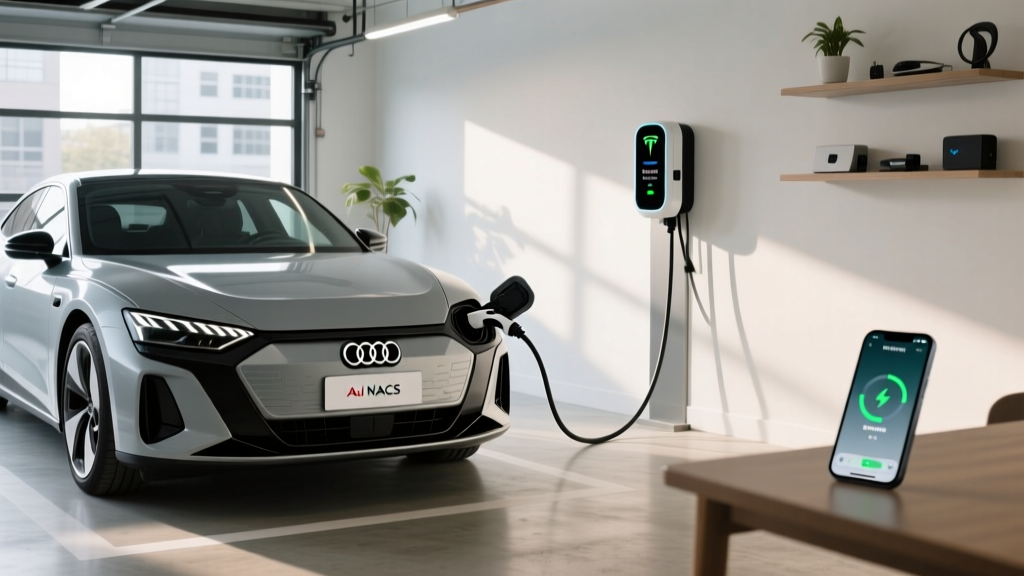
Since true Level 3 / DC fast charging isn't a residential option, your home setup will be Level 2 — and getting it right matters more than most buyers expect. The most common home Level 2 installation uses a 240V, 40-amp dedicated circuit (NEMA 14-50 outlet or hardwired), delivering up to 9.6 kW to the vehicle (the charger is typically rated at 48 amps to allow for the NEC 80% continuous-load rule).
Here's where many homeowners hit a wall: older homes often have 100-amp or 150-amp electrical panels that simply don't have the spare capacity for a 40-amp EV circuit. A panel upgrade to 200 amps can add $1,500–$3,500 to your project. Even newer homes may need a sub-panel if the main panel is full. Always get a load calculation from a licensed electrician before committing to equipment.
| Component | Typical Cost Range | Notes |
|---|---|---|
| Level 2 EVSE (hardware) | $300–$700 | Smart WiFi chargers at 40–48A |
| Electrician labor | $500–$2,000 | Varies by run length, conduit, wall type |
| Electrical permit | $50–$250 | Required in most jurisdictions |
| Panel upgrade (if needed) | $1,500–$3,500 | 100A → 200A service upgrade |
| Total (no panel upgrade) | $850–$2,950 | Most homes with 200A service |
| Total (with panel upgrade) | $2,350–$6,450 | Older homes with 100A/150A panels |
Some utility companies offer rebates of $200–$500 for Level 2 installations, and certain states provide additional incentives. Check with your local utility before scheduling work. The Alternative Fuels Data Center maintains a state-by-state incentive database.
Safety and Code Considerations
Any Level 2 installation must comply with NEC Article 625. Key requirements include:
- Dedicated circuit: Your EVSE needs its own breaker — no sharing with other appliances.
- GFCI protection: Required for outdoor outlets; hardwired units often have built-in ground-fault protection.
- Outdoor rating: If your charger mounts outside, it must carry a NEMA 4 (or IP56+) weather rating. All major chargers listed below meet this standard.
- Cable management: NEC requires the cord to not cross pedestrian walkways when not in use.
Connector Compatibility: NACS, CCS, and CHAdeMO in 2026
The connector landscape has shifted dramatically. As of 2026, the North American Charging Standard (NACS) — originally Tesla's proprietary connector — has become the dominant standard. Ford, GM, Rivian, Volvo, Polestar, and others have transitioned to NACS ports on new vehicles. Most legacy CCS1 vehicles can access Tesla Superchargers via a manufacturer-approved adapter.
| Connector | Native Vehicles | DC Fast Max Power | Adapter Available? |
|---|---|---|---|
| NACS (Tesla) | Tesla, Ford, GM, Rivian, Volvo, Polestar, Hyundai (new) | Up to 350 kW (V4 Supercharger) | CCS→NACS adapters from $200–$400 |
| CCS1 | Legacy VW ID.4, BMW iX, older Hyundai/Kia | Up to 350 kW | NACS→CCS adapters available |
| CHAdeMO | Nissan Leaf (legacy only) | Up to 100 kW | Limited; infrastructure declining |
For home Level 2 charging, all vehicles use the same J1772 connector (or a J1772-to-NACS adapter included with Tesla and newer NACS-native vehicles). This means any Level 2 home charger you buy will work with any EV currently sold — the connector fragmentation only matters at DC fast chargers.
What Charging Actually Costs: Home vs. Public vs. Gas
The single biggest ownership advantage of an EV emerges when you compare cost per mile. Electricity prices vary widely, but the pattern is clear: home charging is dramatically cheaper than gas, and public DC fast charging falls somewhere in between.
| Scenario | Rate | Cost Per Mile (at 3.5 mi/kWh or 30 MPG) |
|---|---|---|
| Home (national avg, off-peak) | $0.14/kWh | $0.04/mile |
| Home (California, peak TOU) | $0.35/kWh | $0.10/mile |
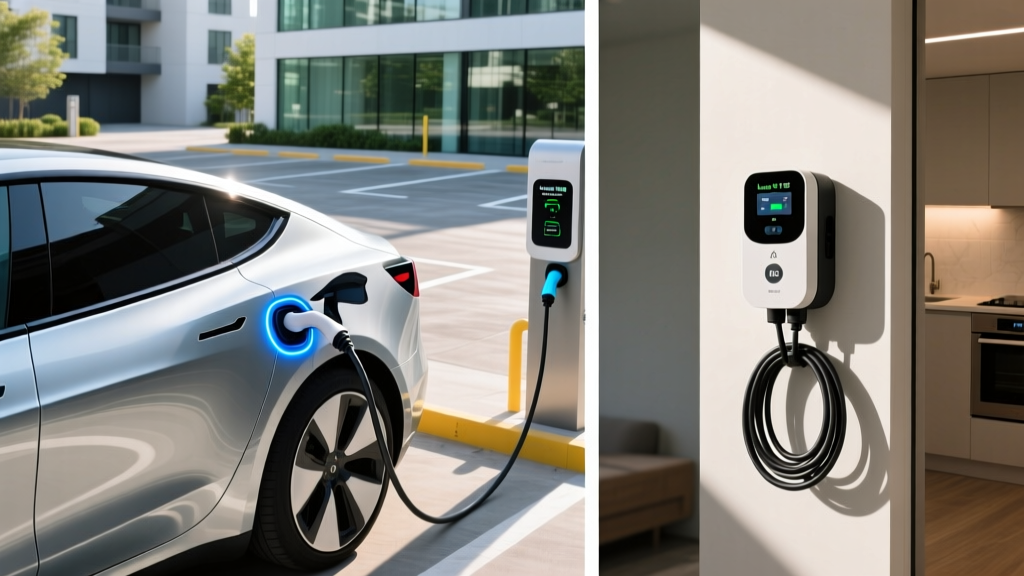
| Public Level 2 (ChargePoint, etc.) | $0.25–$0.49/kWh | $0.07–$0.14/mile |
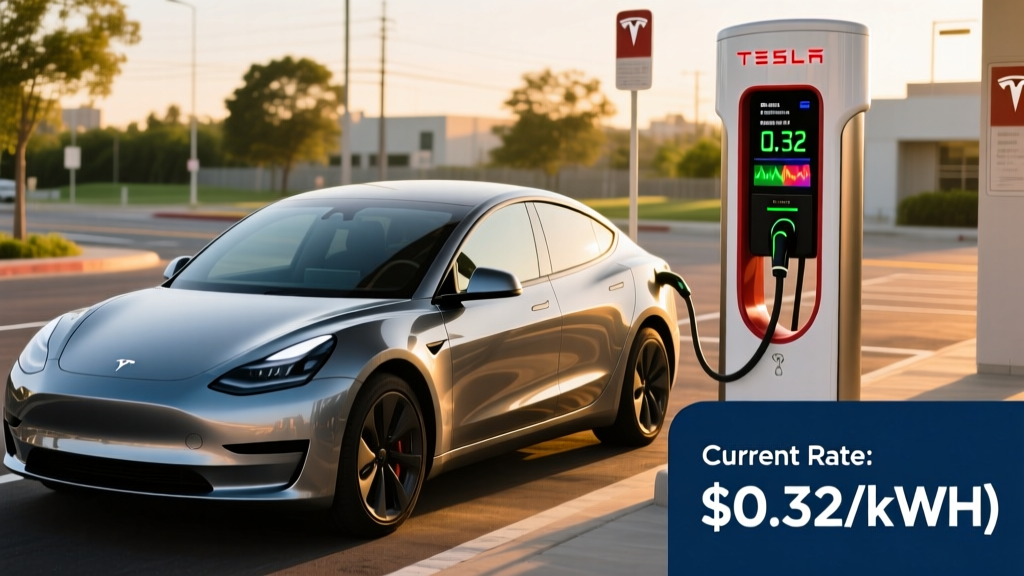
| DC Fast (Electrify America, Tesla) | $0.35–$0.56/kWh | $0.10–$0.16/mile |
| Gasoline (avg $3.40/gal, 30 MPG) | $3.40/gallon | $0.11/mile |
A driver covering 12,000 miles annually with home off-peak charging spends roughly $480/year on electricity versus $1,360 on gasoline. Even exclusive DC fast charging at $0.48/kWh comes to about $1,646/year — comparable to gas. The savings case for EVs depends heavily on reliable home or workplace charging access.
According to fueleconomy.gov, the average 2026 EV achieves between 100 and 130 MPGe combined, translating to roughly 3.0–4.0 miles per kWh — the efficiency figure that drives all of these cost calculations.
Charging Time Examples: 10–80% for Common Battery Sizes
Here's how long a 10–80% charge takes for representative 2026 EVs at different charger types. Note that DC fast charging times assume optimal battery temperature (preconditioned) and the vehicle's peak charge rate:
- Tesla Model Y (75 kWh battery, 250 kW peak): ~22 minutes at a V3 Supercharger; ~8.5 hours on a 9.6 kW home Level 2.
- Hyundai Ioniq 5 (77.4 kWh, 800V, 240 kW peak): ~18 minutes at a 350 kW station; ~9 hours on home Level 2.
- Ford F-150 Lightning (131 kWh extended, 150 kW peak): ~41 minutes at a 150 kW DC charger; ~15 hours on home Level 2.
- Chevrolet Equinox EV (85 kWh, 150 kW peak): ~30 minutes at DC fast; ~10 hours on home Level 2.
The charge curve matters enormously. That Ioniq 5 hits 80% in 18 minutes but going from 80% to 100% can take another 25+ minutes as the battery management system throttles current to protect cell health. For road trips, plan to charge from 10–80% and drive on — don't wait for a full battery.
Recommended Home Level 2 Chargers (2026)
Since Level 3 EVSE isn't a home option, here are the best Level 2 units for residential installation, each with verified specs:
ChargePoint Home Flex
- Power output: Up to 12 kW (50A circuit, configurable down to 16A)
- Connector: J1772 (NACS adapter included with newer bundles)
- Cable length: 23 feet
- Smart features: WiFi, scheduled charging, Alexa integration, energy tracking
- Price: ~$549
Tesla Wall Connector
- Power output: Up to 11.5 kW (48A on 60A circuit)
- Connector: NACS native (J1772 adapter available)
- Cable length: 24 feet
- Smart features: WiFi, power sharing (multiple units on one circuit), OTA updates
- Price: ~$475
Emporia Vue Level 2 Charger
- Power output: Up to 11.5 kW (48A)
- Connector: J1772
- Cable length: 24 feet
- Smart features: Whole-home energy monitoring integration, solar-aware charging, load management
- Price: ~$399
Grizzl-E Smart
- Power output: Up to 10 kW (40A)
- Connector: J1772
- Cable length: 24 feet
- Smart features: OCPP-compatible, adjustable amperage, extreme cold rated (-40°F)
- Price: ~$449
DC Fast Charging Networks: Where "Level 3" Actually Lives
While you can't put DC fast charging in your garage, knowing the public network landscape is essential for road-trip planning. In 2026, the major networks have expanded significantly, with NACS becoming the cross-compatible standard:
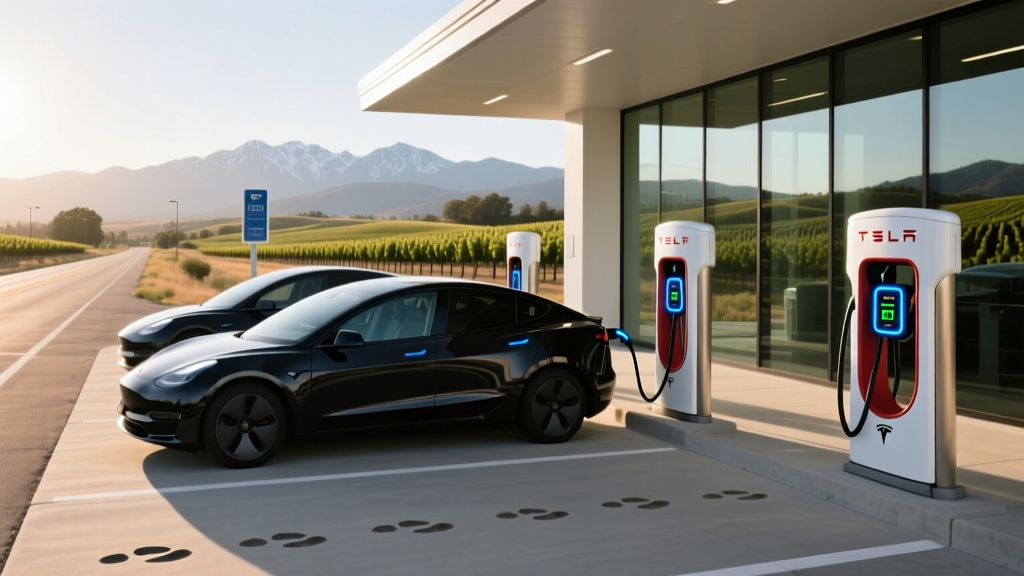
- Tesla Supercharger: Over 30,000 stalls in North America, now open to NACS-equipped Ford, GM, Rivian, and other vehicles. V4 cabinets deliver up to 350 kW. Reliability consistently above 95% uptime.
- Electrify America: ~5,000 CCS and NACS chargers at 800+ stations, up to 350 kW. Membership pricing at $0.36–$0.48/kWh.
- EVgo: ~4,500 public fast chargers, adding NACS connectors. Partners with GM and Pilot/Flying J for highway corridors.
- ChargePoint: Primarily Level 2 destination charging with some DC fast locations. App-based activation.
For the most current reliability data, the NHTSA and JD Power track public charger uptime, which has improved from roughly 78% in 2023 to over 90% for major networks in 2026.
Frequently Asked Questions
How much does it cost to install a home EV charger?
A typical Level 2 home installation runs $850–$2,950 total (equipment, electrician labor, and permit) if your electrical panel has sufficient capacity. Homes needing a panel upgrade to 200-amp service should budget $2,350–$6,450. Always get a load calculation from a licensed electrician first — never assume your panel can handle a 40-amp circuit without verification.
How fast will each charging level add range?
Level 1 (120V) adds 3–5 miles of range per hour — adequate for plug-in hybrids with small batteries but painfully slow for full EVs. Level 2 (240V) adds 20–60 miles per hour depending on amperage, which replenishes most EVs overnight. DC fast charging ("Level 3") adds 150–1,000+ miles per hour at peak power, enabling 10–80% charges in 18–40 minutes depending on the vehicle and charger.
Which connector/charger is compatible with my EV?
For home Level 2 charging, every EV uses J1772 or a J1772-to-NACS adapter — any home charger will work. For DC fast charging, check whether your vehicle has a NACS port (Tesla, 2025+ Ford/GM/Rivian/Volvo) or CCS1 (most 2024 and earlier non-Tesla EVs). CHAdeMO is effectively discontinued beyond the legacy Nissan Leaf. If you drive a CCS1 vehicle, a $200–$400 adapter grants access to Tesla Superchargers.
How much does charging cost per mile vs gas?
At the national average residential electricity rate of ~$0.14/kWh and an efficiency of 3.5 mi/kWh, home charging costs about $0.04 per mile. Gasoline at $3.40/gallon in a 30 MPG vehicle costs $0.11 per mile — nearly three times more. Even the most expensive public DC fast charging at $0.56/kWh comes to roughly $0.16/mile. The savings depend on consistent access to affordable home or workplace charging.
What electrical upgrades might I need?
The most common upgrade is a panel capacity increase from 100A or 150A to 200A, which costs $1,500–$3,500. You may also need a new conduit run from the panel to the garage (adding $300–$800 for longer runs), a sub-panel if your main panel lacks physical breaker spaces, or a utility service upgrade if the transformer feeding your home is undersized. An electrician's load calculation — which factors in HVAC, water heater, dryer, and oven draw — determines whether your existing panel can absorb a 40A EV circuit.
Can I ever install a true Level 3 DC fast charger at home?
Technically, companies like Tesla have announced residential DC charger concepts, but these require 480V three-phase power, dedicated transformer upgrades, and utility cooperation — making them impractical for virtually all single-family homes. The equipment alone costs $15,000–$50,000+. For residential use, a properly installed Level 2 charger delivering 9.6–11.5 kW covers overnight charging needs for every EV on the market.