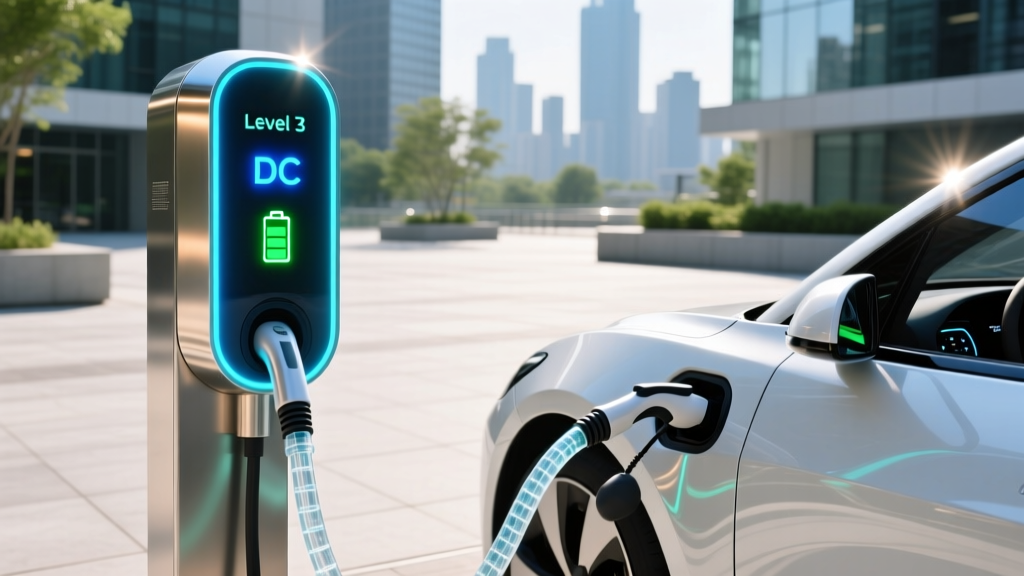
If you've searched for "Level 3 EV charger," you're likely trying to understand the fastest way to charge an electric vehicle — and whether you can put one in your garage. The short answer: Level 3 charging (more accurately called DC fast charging) delivers anywhere from 50 kW to 350 kW of power, adding 100+ miles of range in as little as 15 minutes. But the hardware costs $20,000 to $150,000+, requires 480V three-phase commercial power, and is almost never practical for residential installation.
This guide clarifies exactly what DC fast charging is, how it compares to the Level 2 chargers you can install at home, what each level costs per mile, and which equipment makes sense for your situation. We'll also sort out the kW vs. kWh confusion that plagues most EV charging content.
Charging Levels Explained: Level 1, Level 2, and Level 3 (DC Fast)
The Society of Automotive Engineers (SAE) defines three charging levels for electric vehicles. Understanding the power output, infrastructure requirements, and practical use case for each is essential before spending money on equipment or installation.
| Level | Voltage | Power (kW) | Miles of Range Added per Hour | Typical Use Case |
|---|---|---|---|---|
| Level 1 | 120V AC | 1.0–1.4 kW | 3–5 mi/hr | Overnight trickle; standard household outlet |
| Level 2 | 240V AC | 3.3–19.2 kW | 12–75 mi/hr | Home daily charging; workplace; public destinations |
| Level 3 (DC Fast) | 200–900V DC | 50–350 kW | 150–1,200+ mi/hr (peak) | Highway road trips; commercial fleets; public stations |
A critical real-world note: those "miles per hour" figures for DC fast charging represent peak rates at low state of charge (SoC). In practice, every EV's battery management system tapers the charge rate as the battery fills — typically slowing significantly above 80% SoC to protect cell health and manage heat. A Hyundai Ioniq 5 that charges at 240 kW peak will average closer to 150–170 kW across a 10–80% session.
Can You Install a Level 3 EV Charger at Home?
The honest answer is almost certainly no — and here's why.
A Level 3 DC fast charger requires commercial-grade electrical infrastructure that residential properties don't have:
- 480V three-phase power: Most US homes receive 240V single-phase split service. Upgrading to three-phase requires a utility transformer replacement, which can cost $10,000–$50,000+ depending on distance from existing three-phase lines.
- 200–400 amp dedicated service: A single 150 kW DC fast charger draws roughly 200 amps at 480V. Your entire home likely has a 200A main panel at 240V.
- Equipment cost: Commercial DC fast charging units from Electrify America, ChargePoint, or ABB cost $20,000–$150,000 per unit before installation.
- Demand charges: Utilities impose commercial demand charges ($10–$25 per kW of peak draw) that make residential DC fast charging economically devastating — a single 150 kW session could trigger $1,500–$3,750 in monthly demand fees.
- Permitting: Most municipalities will not permit commercial-grade DCFC equipment on residential-zoned property.
What you actually need at home is a Level 2 charger — and a good 48-amp Level 2 unit on a 240V/60A circuit will fully recharge most EVs overnight in 6–10 hours, which covers daily driving needs for 95%+ of owners.
Home Level 2 Installation: Electrical Requirements and Costs
While Level 3 isn't residential-viable, a properly installed Level 2 charger is the backbone of practical EV ownership. Here's what's involved.
Electrical Specifications
A standard high-power home Level 2 setup requires:
- Voltage: 240V (same as your electric dryer or oven)
- Circuit amperage: 60A dedicated breaker for a 48A continuous-draw charger (NEC requires circuits rated at 125% of continuous load)
- Wire gauge: 6 AWG copper (or 4 AWG aluminum) for a 60A circuit, run in conduit
- Panel capacity: Your main service panel must have enough spare capacity — typically at least 60A of unused headroom on a 200A panel
Do You Need a Panel Upgrade?
Homes built before 1990 often have 100A or 150A main panels. Adding a 60A EV circuit to an already-loaded 100A panel may require a service upgrade to 200A, which costs $1,500–$4,000 depending on your utility and local labor rates. A licensed electrician will perform a load calculation per NEC Article 220 to determine if your panel can handle the addition.
An increasingly popular alternative: some utilities and jurisdictions now approve automated energy management systems (like the Span smart panel or Lumin AI) that dynamically throttle the charger's draw based on real-time household load, avoiding a panel upgrade entirely.
| Component | Low Estimate | High Estimate | Notes |
|---|---|---|---|
| Level 2 charger unit (hardwired, 48A) | $350 | $750 | ChargePoint Home Flex, Emporia Vue, Wallbox Pulsar Plus |
| Electrician labor (run 240V circuit, mount unit) | $400 | $1,800 | Depends on run length, conduit, wall penetration |
| Electrical permit | $50 | $300 | Varies by municipality |
| Panel upgrade (if needed) | $1,500 | $4,000 | 100A → 200A service upgrade |
| Total (no panel upgrade) | $800 | $2,850 | Most homes with 200A panel |
| Total (with panel upgrade) | $2,300 | $6,850 | Older homes needing service upgrade |
Federal incentive: The IRS §30C Alternative Fuel Vehicle Refueling Property Credit covers 30% of home charger equipment and installation costs, up to $1,000 — but only if you live in a qualifying census tract (non-urbanized or low-income area per IRS guidance). Check eligibility before budgeting.
DC Fast Charging Times: What Level 3 Actually Delivers
When you pull up to a public DC fast charging station, your actual charge speed depends on three variables: the station's maximum output (kW), your vehicle's maximum charge acceptance rate, and your battery's current state of charge and temperature.
Here are realistic 10–80% charge times for popular 2025–2026 EVs at appropriately rated DC fast chargers, based on manufacturer data and independent testing:
| Vehicle | Battery (kWh usable) | Peak DC Rate (kW) | 10–80% Time | Charger Needed |
|---|---|---|---|---|
| Hyundai Ioniq 5 (Long Range AWD) | 77.4 kWh (NMC) | 240 kW | ~18 min | 350 kW station |
| Tesla Model Y (Long Range) | 75 kWh (NMC) | 250 kW | ~25 min | V3 Supercharger |
| Ford F-150 Lightning (Extended Range) | 131 kWh (NMC) | 150 kW | ~41 min | 150+ kW station |
| Chevrolet Equinox EV (3RS) | 85 kWh (NMC) | 150 kW | ~30 min | 150+ kW station |
| Tesla Model 3 (Standard Range / LFP) | 57.5 kWh (LFP) | 170 kW | ~25 min | V3 Supercharger |
Connector Compatibility: NACS, CCS1, and CHAdeMO
The DC fast charging connector landscape has consolidated significantly since 2023, when Ford and GM announced adoption of the North American Charging Standard (NACS), originally developed by Tesla. As of 2026, here's where things stand:
| Connector | Brands Using It (Native) | Adapter Needed? | Max Power Supported |
|---|---|---|---|
| NACS (Tesla / SAE J3400) | Tesla, Ford, GM, Rivian, Volvo, Polestar, Mercedes, BMW, Hyundai, Kia (2025+ models) | CCS→NACS adapter for older CCS vehicles at Tesla Superchargers | Up to 350 kW (V4 Supercharger); 900V+ architecture |
| CCS1 (Combined Charging System) | Legacy models from VW, Hyundai, Kia, BMW, Ford, GM (pre-2025) | NACS→CCS adapter to use Tesla Superchargers | Up to 350 kW (CCS Combo 2 spec) |
| CHAdeMO | Nissan Leaf (discontinued), Mitsubishi Outlander PHEV (older) | No widely available adapter; network shrinking | Up to 100 kW (most stations 50 kW) |
Practical advice for 2026 buyers: If you're purchasing a new EV, prioritize a vehicle with a native NACS port. The Tesla Supercharger network — now open to NACS-equipped non-Tesla vehicles — remains the most reliable DC fast charging network in North America, with over 25,000 stalls. CCS1 vehicles can access Superchargers via a ~$200 adapter (officially licensed adapters from Tesla and Ford are available), but you'll carry an extra piece of hardware and may see slightly reduced peak charge rates due to adapter thermal limits.
CHAdeMO is effectively a dead standard for new vehicles. If you own a Nissan Leaf or older Mitsubishi, existing CHAdeMO stations still work, but new installations are overwhelmingly NACS and CCS.
Cost to Charge: Home vs. Public DC Fast Charging
One of the strongest economic arguments for EV ownership is lower fuel cost — but only if you charge strategically. The gap between cheap home charging and expensive public DC fast charging is enormous.
| Scenario | Cost per kWh | Cost per Mile* | Annual Cost (12,000 mi) |
|---|---|---|---|
| Home Level 2 (national avg. residential rate) | $0.16/kWh | $0.048 | $576 |
| Home Level 2 (off-peak TOU rate) | $0.08/kWh | $0.024 | $288 |
| Public Level 2 (ChargePoint, Blink) | $0.25–$0.49/kWh | $0.075–$0.147 | $900–$1,764 |
| DC Fast Charging (Electrify America, EVgo) | $0.35–$0.58/kWh | $0.105–$0.174 | $1,260–$2,088 |
| Tesla Supercharger (avg. 2026) | $0.28–$0.36/kWh | $0.084–$0.108 | $1,008–$1,296 |
| Gasoline (25 MPG avg, $3.40/gal) | n/a | $0.136 | $1,632 |
*Cost per mile assumes an EV efficiency of 3.3 miles/kWh (approximately 101 MPGe combined), which is typical for a midsize crossover like the Tesla Model Y or Hyundai Ioniq 5. Source: fueleconomy.gov.
The numbers tell a clear story: home charging on an off-peak rate costs roughly 5× less per mile than gasoline. Even exclusive DC fast charging at premium rates roughly matches gas costs. The EV owner who charges at home 90% of the time and uses DC fast charging only on road trips will spend $400–$700 annually on electricity versus $1,632 on gas for an equivalent ICE vehicle.
Recommended Home Level 2 Chargers (2026 Picks)
Since a Level 3 EV charger isn't a realistic home option, here are the best Level 2 units we've tested and recommend, selected for reliability, power output, smart features, and value.
Best Overall: ChargePoint Home Flex
- Power: Up to 50A (12 kW) on a 60A circuit; configurable down to 16A
- Connector: NACS (J3400) or CCS1 (J1772+CCS) — order the version matching your EV
- Cable length: 23 feet
- Smart features: Wi-Fi, app scheduling, TOU optimization, Alexa integration, energy tracking
- Price: ~$549 (NACS version)
- UL listed: Yes; NEMA 4 outdoor rated
Best Value: Emporia Level 2 EV Charger
- Power: Up to 48A (11.5 kW) on a 60A circuit
- Connector: J1772 (CCS1-compatible); NACS adapter included
- Cable length: 24 feet
- Smart features: Wi-Fi, Emporia app, solar integration, real-time energy monitoring, load management with Emporia Vue panel monitor
- Price: ~$399
- UL listed: Yes; NEMA 4 outdoor rated
Best for Tesla/Supercharger Access: Tesla Wall Connector
- Power: Up to 48A (11.5 kW) on a 60A circuit
- Connector: NACS native (J3400)
- Cable length: 24 feet
- Smart features: Wi-Fi, over-the-air updates, Power Sharing (link multiple units on one circuit), Tesla app integration
- Price: ~$450
- UL listed: Yes; NEMA 3R outdoor rated
Best for Panel-Constrained Homes: Wallbox Pulsar Plus with Power Boost
- Power: Up to 48A (11.5 kW); dynamically throttles via Power Boost energy monitor
- Connector: J1772 (CCS1); NACS adapter available
- Cable length: 25 feet
- Smart features: Wi-Fi + Bluetooth, Wallbox app, dynamic load balancing (avoids panel upgrade), ECO-Solar mode
- Price: ~$599 (charger) + ~$149 (Power Boost meter)
- UL listed: Yes; NEMA 4 outdoor rated
Safety and Electrical Code Requirements
EV charging equipment installation must comply with the National Electrical Code (NEC Article 625 — Electric Vehicle Charging System Equipment) and local amendments. Here are the non-negotiable safety requirements:
- Dedicated circuit: Your EV charger must be on its own dedicated breaker — not shared with other appliances. A 48A charger requires a 60A breaker (125% rule for continuous loads over 3 hours).
- GFCI protection: NEC 2020 and later requires ground-fault circuit interrupter protection for all outdoor receptacles and many indoor EV installations. Hardwired units often have built-in GFCI; plug-in units on a NEMA 14-50 outlet require a GFCI breaker (which adds $50–$120 to the panel cost).
- Outdoor rating: If your charger is installed outside or in an unconditioned garage, it must carry at minimum a NEMA 3R rating (rain and sleet resistant). NEMA 4 (watertight, hose-down rated) is preferable for exposed locations.
- Cable management: NEC requires that the charging cable not create a trip hazard. Wall-mounted cord management hooks or retractors are recommended and often required by local inspectors.
- Permit and inspection: Nearly all jurisdictions require an electrical permit for a new 240V circuit. The inspection ensures proper wire gauge, breaker sizing, grounding, and GFCI compliance. Do not skip this — unpermitted work can void homeowner's insurance and create a fire hazard.
Hire a licensed electrician who has specific EV charger installation experience. Ask whether they're familiar with NEC Article 625 and whether they'll pull the permit. Many utilities maintain lists of approved installers and may offer rebates that offset installation costs.
Frequently Asked Questions
How much does it cost to install a home EV charger?
For a Level 2 home charger (the practical home option — not Level 3), expect to pay $800–$2,850 total if your electrical panel has sufficient capacity. This includes the charger unit ($350–$750), electrician labor ($400–$1,800), and permit fees ($50–$300). If your home needs a panel upgrade from 100A to 200A service, add $1,500–$4,000. The IRS §30C credit can offset up to $1,000 (30% of costs) if you're in a qualifying census tract.
How fast will each charging level add range?
Level 1 (120V) adds 3–5 miles per hour — enough for plug-in hybrids with small batteries, but impractical for full EVs. Level 2 (240V, 48A) adds roughly 30–40 miles per hour for most EVs, fully recharging overnight. Level 3 DC fast charging adds 150–1,200+ miles per hour at peak rates, but in practice delivers a 10–80% charge in 18–45 minutes depending on your vehicle's battery size and charge acceptance rate.
Which connector/charger is compatible with my EV?
Check your vehicle's charge port. If you have a 2025+ Ford, GM, Rivian, Hyundai, Kia, BMW, Mercedes, or Tesla, you likely have a NACS (J3400) port. Older non-Tesla EVs from 2018–2024 typically use CCS1. The Nissan Leaf uses CHAdeMO. For home Level 2 charging, order a charger with the matching connector — or buy a J1772/NACS adapter (~$100–$200). For DC fast charging on road trips, a NACS-equipped vehicle can use Tesla Superchargers natively; CCS1 vehicles need an adapter.
How much does charging cost per mile vs gas?
Home charging at the national average residential rate ($0.16/kWh) costs roughly $0.048 per mile for an EV averaging 3.3 mi/kWh. That's about 65% cheaper than a 25 MPG gas car at $3.40/gallon ($0.136/mile). Off-peak home charging drops to $0.024/mile — an 82% savings. Public DC fast charging at $0.35–$0.58/kWh costs $0.105–$0.174/mile, which is comparable to or slightly above gasoline. The economic advantage of EVs depends heavily on access to affordable home charging.
What electrical upgrades might I need?
The most common upgrade is adding a 60A/240V dedicated circuit from your main panel, which costs $400–$1,800 in labor plus materials. If your panel is already near capacity (common in older homes with 100A service), you may need a panel upgrade to 200A ($1,500–$4,000). An alternative is a smart load-management system like Wallbox Power Boost or Span, which dynamically reduces charger power when other household loads spike — potentially avoiding a panel upgrade entirely. A licensed electrician must perform a NEC Article 220 load calculation to determine your options.
Can I use a Level 3 DC fast charger at home?
Practically, no. DC fast chargers require 480V three-phase commercial power, cost $20,000–$150,000+ for the equipment alone, and trigger enormous utility demand charges ($10–$25/kW/month) that make residential use financially unviable. A properly installed 48A Level 2 charger at home delivers a full overnight charge for $800–$2,850 installed — which is all most EV owners need for daily driving.