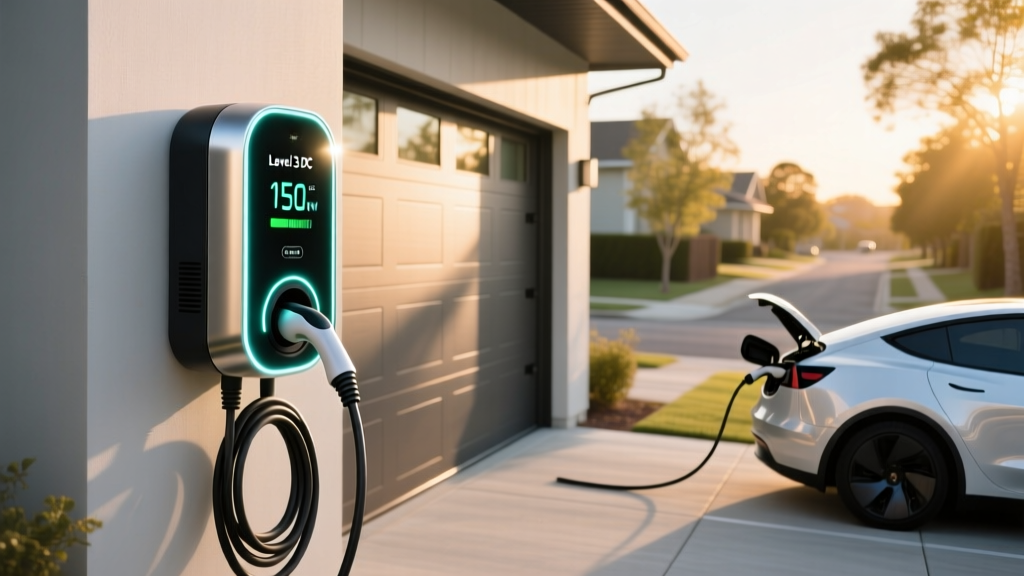
If you've searched for "level 3 charger power requirements" hoping to install one in your garage, here's the honest answer up front: you almost certainly can't, and you don't need to. Level 3 DC fast chargers demand industrial-grade electrical infrastructure — typically 480V three-phase power drawing 25 kW to 350+ kW — that no residential electrical panel can support. The good news? You don't need Level 3 at home. A properly installed Level 2 charger replenishes your EV overnight at a fraction of the cost, while Level 3 infrastructure is best reserved for highway road trips.
This guide breaks down exactly what each charging level requires electrically, what you can install at home, what it costs, and how to plan your charging strategy around real-world power availability.
The Three Charging Levels: Power, Speed, and Where Each Belongs
Before diving into electrical specifications, let's establish the critical distinction between kW (kilowatts) and kWh (kilowatt-hours). Kilowatts measure power — the rate at which electricity flows into your battery, like water pressure from a hose. Kilowatt-hours measure energy — the total amount stored, like gallons in a tank. A charger's kW rating tells you how fast it can push energy; your battery's kWh capacity tells you how much it holds. Confusing these two is the single most common mistake in EV ownership research.
| Level | Voltage | Power (kW) | Miles Added/Hour | Typical Location | 10–80% Time (75 kWh Battery) |
|---|---|---|---|---|---|
| Level 1 | 120V AC | 1.0–1.4 kW | 3–5 mi/hr | Standard household outlet | ~50+ hours (impractical) |
| Level 2 | 240V AC | 3.3–19.2 kW | 12–70 mi/hr | Home, workplace, public | ~4–8 hours |
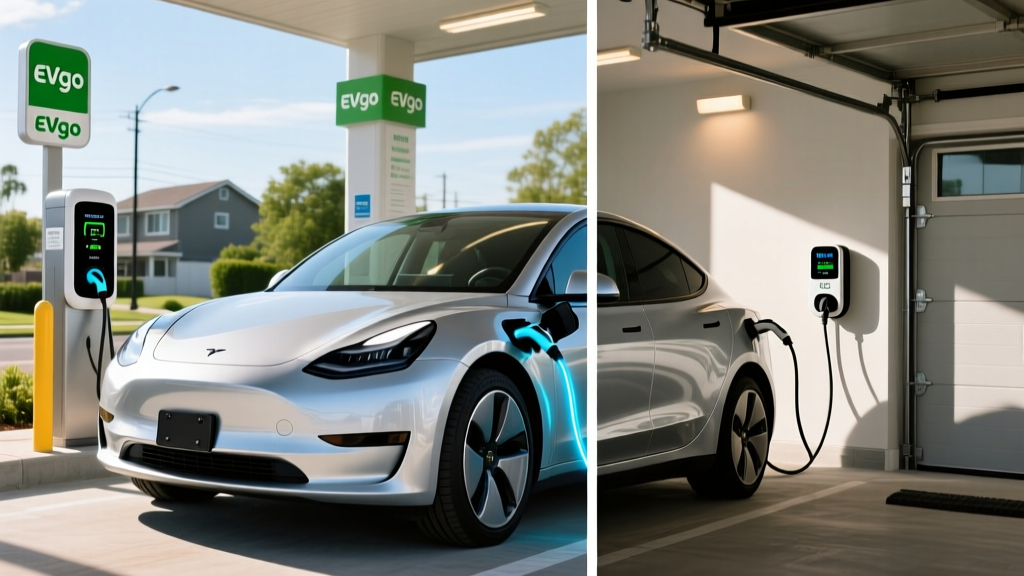
| Level 3 (DC Fast) | 200–920V DC | 25–350+ kW | 150–1,200+ mi/hr | Highway corridors, commercial | 15–35 minutes |
The miles-per-hour figures assume an average EV efficiency of roughly 3–4 miles per kWh. Your actual rate depends on your specific vehicle's efficiency, battery temperature, and state of charge.
Why Level 3 Charger Power Requirements Exclude Residential Installation
Understanding Level 3 charger power requirements means confronting the physics of moving massive energy quickly. Here's what a DC fast charger actually demands from the electrical grid:
- Voltage: 480V three-phase AC input, converted internally to 200–920V DC output to the vehicle
- Amperage: 60–400+ amps per phase depending on charger output
- Service capacity: A single 150 kW DC fast charger can draw as much power as 30–50 homes combined
- Infrastructure: Dedicated transformer, utility service upgrade, commercial-grade switchgear, and often a new utility drop
- Cost: Equipment alone runs $25,000–$150,000+; installation with utility upgrades can exceed $200,000 per stall
Most US homes have a 200-amp, 240V split-phase electrical panel. Even the largest residential panels max out around 400 amps at 240V — roughly 96 kW total for the entire house. A single Level 3 charger operating at 150 kW would need more power than your entire home's capacity, delivered at a voltage your home's wiring cannot handle.
This isn't a matter of hiring a better electrician. Three-phase 480V power simply doesn't exist on residential utility lines in most of North America. Getting it would require the utility company to install new transformers and run new service — a project that can cost tens of thousands of dollars and take months, assuming the utility agrees to do it at all.
What You CAN Install at Home: Level 2 Charging Done Right
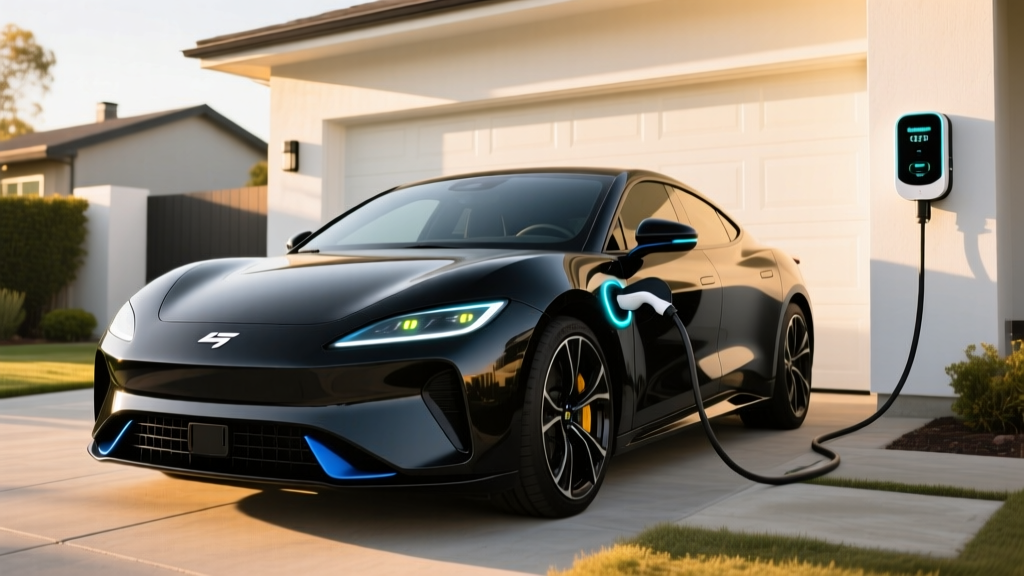
Level 2 is the home charging sweet spot. A 240V circuit — the same voltage your electric dryer or oven uses — delivers enough power to fully recharge virtually any EV overnight. Here's what a proper Level 2 installation requires:
Electrical Specifications
- Voltage: 240V (split-phase, standard US residential)
- Circuit amperage: 40A, 50A, or 60A dedicated breaker (supports 32A, 40A, or 48A continuous charging respectively — NEC requires circuits rated 125% above continuous load)
- Wire gauge: 6 AWG copper for 50A circuits; 4 AWG for 60A (your electrician will specify based on run length)
- Outlet or hardwire: NEMA 14-50 outlet for plug-in flexibility, or hardwired connection for higher amperage (60A+) and code compliance in many jurisdictions
Panel Capacity Assessment
Before installing any Level 2 charger, your electrician will perform a load calculation on your existing panel. This determines whether you have enough spare capacity to add a 40–60A circuit without overloading the system. Homes with 200A panels and modest existing loads usually have room. Homes with older 100A panels, electric heat, or heavy appliance loads may need an upgrade.
Some utilities and municipalities now allow automated load management devices (like the Emporia VUE or Span smart panel) that dynamically throttle charger draw to stay within panel limits — potentially avoiding a costly panel upgrade.
Home Charger Installation Cost Breakdown
Installation costs vary enormously based on your home's existing electrical infrastructure, the distance from panel to charger location, and local permit fees. Here's a realistic range based on 2026 contractor data:
| Component | Simple Install (Near Panel) | Complex Install (Far Run / Upgrade Needed) |
|---|---|---|
| Level 2 Charger Equipment | $350–$700 | $500–$800 |
| Electrician Labor (2–8 hrs) | $300–$600 | $800–$2,000 |
| Materials (Wire, Conduit, Breaker) | $50–$150 | $200–$600 |
| Permit & Inspection | $50–$150 | $100–$300 |
| Panel Upgrade (if needed) | $0 | $1,500–$4,000 |
| Total Estimated Cost | $750–$1,600 | $3,100–$7,700 |
The simple-install scenario assumes your panel has spare capacity, the charger mounts on a wall within 10–15 feet of the panel, and no structural work is needed. The complex scenario covers 50+ foot wire runs through finished walls, panel upgrades from 100A to 200A, or trenching for detached garages.
As of 2026, the federal Alternative Fuel Vehicle Refueling Property Credit (IRS Form 8911) covers up to 30% of home charging equipment and installation costs, capped at $1,000, for homeowners in eligible census tracts. Check the IRS site or consult a tax professional for your specific eligibility.
Charging Costs: Home vs. Public vs. Gas
One of the strongest arguments for home Level 2 charging is the cost advantage. Here's how different scenarios compare on a per-mile basis, assuming an EV averaging 3.5 miles/kWh and a gas vehicle averaging 28 MPG:
| Scenario | Rate | Cost per kWh | Cost per Mile |
|---|---|---|---|
| Home (national avg. residential) | $0.17/kWh | $0.17 | $0.049 |
| Home (off-peak TOU rate) | $0.08/kWh | $0.08 | $0.023 |
| Public Level 2 (network avg.) | $0.30/kWh | $0.30 | $0.086 |
| DC Fast Charging (public avg.) | $0.48/kWh | $0.48 | $0.137 |
| Gasoline ($3.50/gal, 28 MPG) | $3.50/gal | — | $0.125 |
The takeaway is clear: home charging — especially on time-of-use (TOU) off-peak rates — costs roughly a quarter to a fifth of gasoline per mile. Public DC fast charging, however, can actually exceed the per-mile cost of gasoline. This is why DC fast charging should be treated as a road-trip convenience, not your primary fueling strategy.
Connector Compatibility: NACS, CCS, and CHAdeMO
The connector landscape has consolidated significantly since 2024, when Ford, GM, Rivian, Volvo, and most other automakers committed to adopting the North American Charging Standard (NACS) — the connector Tesla developed and opened to the industry. Here's where things stand for 2026-model EVs:
| Connector | Brands Using It | Notes |
|---|---|---|
| NACS (J3400) | Tesla, Ford, GM, Rivian, Volvo, Polestar, Mercedes, BMW, Hyundai, Kia, Lucid, Subaru, Toyota | Industry standard going forward; access to Tesla Supercharger network |
| CCS1 | Legacy models (pre-2025 VW ID.4, some Stellantis); most public non-Tesla DC stations | Still widely available at Electrify America, EVgo; adapters available |
| CHAdeMO | Nissan Leaf (discontinued); Mitsubishi Outlander PHEV | Effectively deprecated in North America; few new installations |
If you own a CCS-equipped EV from model year 2024 or earlier, most automakers and third-party companies (including Tesla, Lectron, and A2Z) now sell CCS-to-NACS adapters for $150–$250, granting access to the Supercharger network. Conversely, NACS-equipped vehicles can use CCS stations with a NACS-to-CCS adapter.
For home Level 2 charging, virtually all EVs (regardless of DC fast-charge connector) use the J1772 inlet for AC charging — and NACS vehicles come with a J1772 adapter in the glovebox. Any Level 2 home charger with a J1772 plug will work with any EV sold in North America.
Recommended Level 2 Home Chargers for 2026
These are proven, widely available units that balance charging speed, build quality, smart features, and value. All are UL-listed or ETL-certited for safety.
ChargePoint Home Flex
- Power Output: Up to 12 kW (50A circuit) / 9.6 kW (40A circuit)
- Connector: J1772 (NACS adapter included)
- Cable Length: 23 feet
- Smart Features: Wi-Fi, ChargePoint app scheduling, Alexa integration, energy tracking
- Price: ~$550 (equipment only)
- Best For: Most EV owners; flexible amperage settings match your circuit
Emporia Level 2 EV Charger
- Power Output: Up to 11.5 kW (48A on 60A circuit)
- Connector: J1772 (NACS version available)
- Cable Length: 24 feet
- Smart Features: Wi-Fi, Emporia app, real-time energy monitoring, solar integration, load management
- Price: ~$400
- Best For: Budget-conscious buyers who want energy monitoring and solar pairing
Tesla Wall Connector
- Power Output: Up to 11.5 kW (48A on 60A circuit)
- Connector: NACS native (J1772 adapter sold separately)
- Cable Length: 24 feet
- Smart Features: Wi-Fi, Tesla app, OTA updates, power sharing between multiple units
- Price: ~$475
- Best For: Tesla owners or NACS-native vehicle owners; cleanest aesthetic
Grizzl-E Smart
- Power Output: Up to 10 kW (40A on 50A circuit)
- Connector: J1772 (NACS adapter available)
- Cable Length: 24 feet
- Smart Features: Wi-Fi, OCPP-compatible, adjustable amperage via DIP switch
- Price: ~$450
- Best For: Harsh climates (rated to -40°F); Canadian-built durability
Key selection tip: Match the charger's maximum amperage to your circuit. A 48A charger needs a 60A breaker; a 40A charger needs a 50A breaker. Don't buy a 48A charger and install it on a 40A circuit — you'll be capped at 32A charging anyway.
Charging Time Examples: What to Expect by Battery Size
Charge times depend on battery capacity, the vehicle's onboard charger limit (for Level 2), and the charger's output. Here are realistic 10–80% times for common battery sizes:
| Battery Size (Usable) | Example Vehicles | Level 2 at 11.5 kW | Level 3 at 150 kW (DCFC) | Level 3 at 250 kW (DCFC) |
|---|---|---|---|---|
| 58 kWh | VW ID.4 Standard, base Leaf | ~3.5 hours | ~22 min | ~18 min |
| 75 kWh | Tesla Model Y LR, Ford Mustang Mach-E ER | ~4.5 hours | ~28 min | ~20 min |
| 95 kWh | Tesla Model S, Rivian R1S Large Pack | ~5.7 hours | ~35 min | ~25 min |
| 123 kWh | GMC Hummer EV, Silverado EV Max Range | ~7.5 hours | ~45 min | ~32 min |
Critical caveat on DC fast charging: Peak kW ratings are not sustained. A vehicle that advertises "250 kW peak" typically holds that rate only between roughly 10–30% state of charge, then tapers progressively. Above 80% SoC, charging speed drops dramatically to protect battery health — often below 50 kW. This is why 10–80% is the standard measurement; charging from 80–100% can take as long as the entire 10–80% session.
Cold weather compounds this. Battery chemistry slows ion transfer at low temperatures, and without adequate preconditioning (warming the battery before arriving at the charger), DC fast charging speeds can drop 30–50% in freezing conditions. Most modern EVs automatically precondition when you navigate to a charging station — always use this feature in winter.
Safety, Code, and Installation Best Practices
EV charging involves sustained high-current draw — often 8+ hours at a time. This is more demanding than any other household appliance and demands proper installation:
- Dedicated circuit: Your EV charger must be on its own breaker — never shared with other outlets or appliances. This is an NEC requirement.
- GFCI protection: NEC 2020 and later requires GFCI protection for EV charging outlets. Hardwired installations may be exempt depending on jurisdiction, and many EV engineers actually recommend hardwiring to avoid nuisance GFCI trips (the charger's internal ground fault protection is often sufficient).
- Outdoor rating: If your charger mounts outdoors, ensure it carries a NEMA 4 (weatherproof) rating. Most quality Level 2 chargers are rated for outdoor use, but the connector holster should protect the plug from rain and debris.
- Permit and inspection: Virtually all jurisdictions require an electrical permit for new 240V circuits. Skipping the permit risks voiding your homeowner's insurance in the event of an electrical fire. Budget $50–$300 for the permit and plan for a final inspection.
- Wire gauge and run length: Longer wire runs require thicker gauge wire to prevent voltage drop. Your electrician will calculate this — don't try to save money by undersizing wire.
Hire a licensed electrician experienced with EV charger installations. Ask whether they've installed chargers before, whether they'll pull a permit, and whether they'll perform a load calculation on your panel. References from the Department of Energy's EV charging resources can help you find qualified installers.
Frequently Asked Questions
How much does it cost to install a home EV charger?
A straightforward Level 2 installation near your electrical panel typically costs $750–$1,600 including equipment, labor, materials, and permit. Complex installations requiring long wire runs, trenching, or a panel upgrade can range from $3,100 to $7,700. True Level 3 DC fast chargers are not residential-viable and cost $25,000–$200,000+ commercially.
How fast will each charging level add range?
Level 1 (120V) adds roughly 3–5 miles of range per hour — adequate only for plug-in hybrids with small batteries. Level 2 (240V) adds 12–70 miles per hour depending on amperage, fully recharging most EVs overnight. Level 3 DC fast charging adds 150–1,200+ miles per hour at peak rates, enabling 10–80% charges in 15–35 minutes on the road.
Which connector/charger is compatible with my EV?
For home Level 2 AC charging, all North American EVs use the J1772 inlet — any Level 2 charger with a J1772 plug works universally (NACS vehicles include a J1772 adapter). For DC fast charging, most 2025+ models use NACS; earlier CCS vehicles can access NACS/Supercharger stations with a $150–$250 adapter. CHAdeMO is effectively discontinued for new vehicles.
How much does charging cost per mile vs. gas?
Home charging on average residential rates ($0.17/kWh) costs about $0.05 per mile — roughly 60% less than gasoline at $3.50/gallon in a 28 MPG vehicle ($0.125/mile). Off-peak TOU rates can push home charging below $0.03/mile. However, public DC fast charging at $0.40–$0.60/kWh can cost $0.11–$0.17/mile, sometimes exceeding gasoline. Home charging is where the economics win decisively.
What electrical upgrades might I need?
If your home has a 200A panel with moderate existing loads, you likely have capacity for a 40–60A Level 2 circuit with no upgrade. Homes with 100A panels, electric baseboard heat, or heavy simultaneous loads may need a panel upgrade ($1,500–$4,000) or a smart load management system that dynamically throttles the charger to avoid tripping the main breaker. Your electrician's load calculation will determine this.
Can I ever install a Level 3 DC fast charger at home?
For virtually all residential properties, no. Level 3 charger power requirements include 480V three-phase service drawing 25–350+ kW — infrastructure that doesn't exist on residential utility lines and would cost tens of thousands of dollars (plus months of utility coordination) to install. Some rural properties with existing three-phase service for agricultural equipment might theoretically support a lower-power DC unit, but the equipment cost ($25,000+) and electricity demand charges make it economically irrational when a $1,000 Level 2 installation handles overnight charging completely.