If you've been searching for a level 3 charger for home, you're not alone. Plenty of EV owners wonder whether they can replicate the 150–350 kW speeds of a public DC fast charger in their own garage. The short answer: you technically can, but for 95% of homeowners, it's a wildly impractical and expensive proposition. This guide explains exactly why, what you should install instead, and the rare scenarios where residential DC fast charging might actually make sense.
Understanding Charging Levels: Level 1, Level 2, and Level 3 (DC Fast)
Before spending a dime on equipment, you need to understand the three charging tiers and what each delivers in practical terms. The single most important distinction in EV charging is between kW (kilowatts — the rate of power delivery, like water pressure) and kWh (kilowatt-hours — the total energy delivered, like gallons of water). Your electricity bill charges you per kWh consumed; your charger's kW rating determines how quickly those kWh flow into your battery.
| Level | Power Source | Typical kW Output | Miles of Range per Hour | 10–80% Time (75 kWh battery) |
|---|---|---|---|---|
| Level 1 | 120V household outlet | 1.0–1.4 kW | 3–5 miles | ~40–55 hours |
| Level 2 | 240V (dryer-style outlet or hardwired) | 3.3–19.2 kW | 12–75 miles | ~3–12 hours |
| Level 3 (DC Fast) | 480V+ three-phase commercial supply | 50–350+ kW | 150–1,000+ miles | ~15–45 minutes |
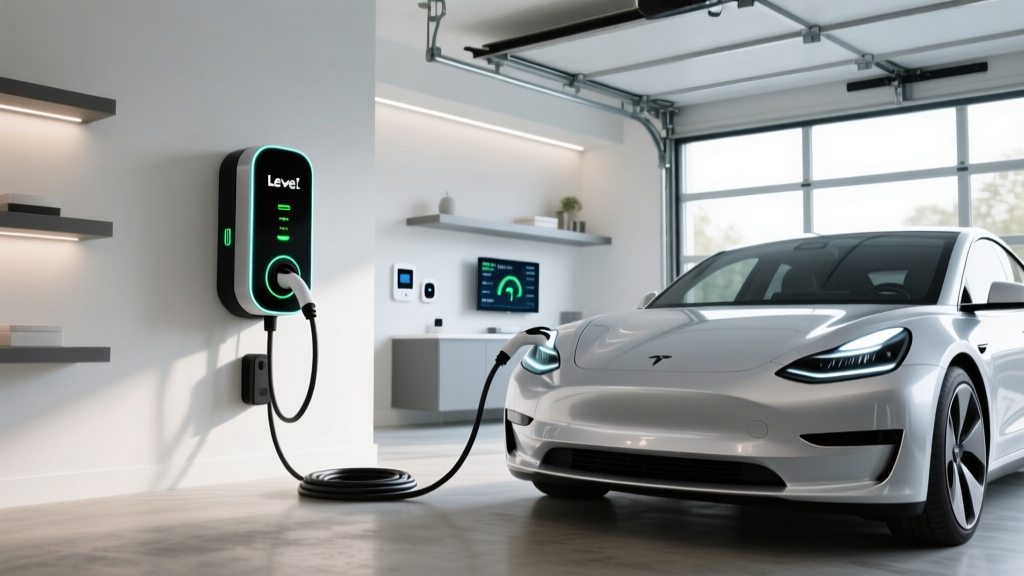
Level 2 is the gold standard for home charging. A 48-amp, 11.5 kW Level 2 unit on a 240V circuit adds roughly 40–45 miles of range per hour — enough to fully replenish even a large-battery EV like the Ford F-150 Lightning (131 kWh usable) overnight in about 12–13 hours. For daily driving needs (the U.S. average is ~37 miles per day according to the FHWA), a Level 2 charger replaces everything you need each day in under an hour of charging.
Why a Level 3 Charger for Home Is Almost Never Practical
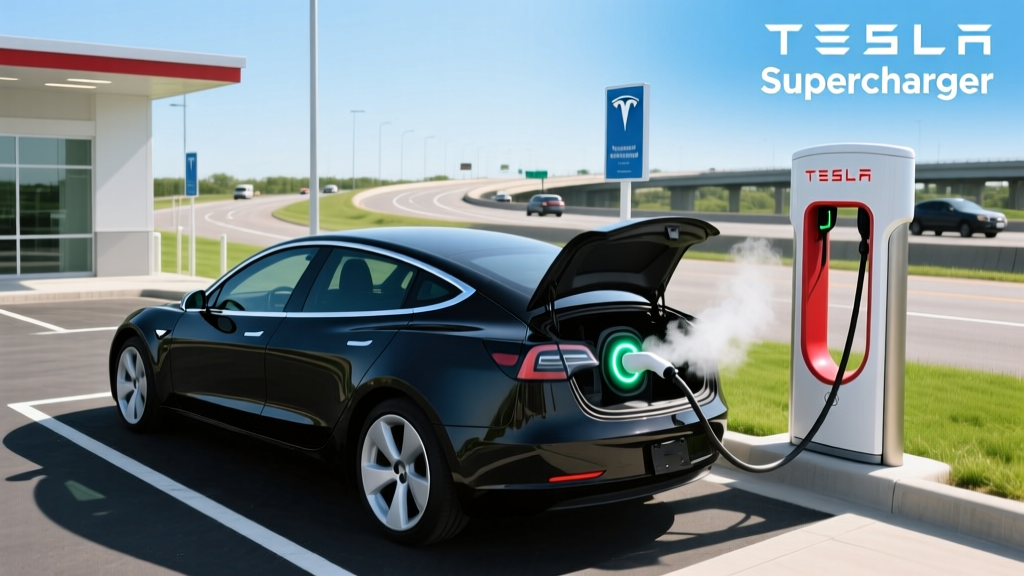
Level 3 chargers — also called DC fast chargers or DCFC — bypass the vehicle's onboard charger and supply direct current (DC) straight to the battery. That's how they achieve 50–350 kW rates. But the infrastructure requirements make them a poor fit for residential settings:
- Three-phase 480V power: Most U.S. homes receive single-phase 240V service. Upgrading to three-phase 480V requires a utility transformer upgrade, new service entrance conductors, and often a completely new utility drop — a process that can cost $10,000–$50,000+ and take months of utility coordination.
- Equipment cost: A residential-capable DC fast charger (like the 50 kW Blink HQ or similar commercial-grade unit) starts around $20,000–$40,000 for the hardware alone, before installation.
- Demand charges: Many utilities impose commercial demand charges on high-draw equipment, which can add hundreds of dollars per month to your electric bill regardless of how much you actually charge.
- Diminishing returns: Your EV's battery management system (BMS) limits DC fast charging to protect cell health. Most EVs taper charge rate significantly above 80% state of charge. Charging at home is almost always overnight — where speed is irrelevant.
- Permitting complexity: Most local electrical codes and inspectors are not equipped to approve 480V three-phase residential installations. Expect extensive review and possible rejection.
The rare exceptions? Owners of large EV fleets (multi-vehicle households with electric delivery vans), rural properties with existing three-phase service (some farms and workshops), or those with ultra-high-capacity battery systems paired with solar. For everyone else, Level 2 is the right answer.
Level 2 Home Charger Installation: Electrical Requirements and Costs
A proper Level 2 installation involves more than plugging into an existing outlet. Here's what you need to budget for:
Electrical Requirements
- Circuit: A dedicated 240V circuit — typically 40A, 50A, or 60A depending on your charger's amperage. A 48A charger (the most common high-power residential unit) requires a 60A breaker per NEC 80% continuous-load rules.
- Wire gauge: 6 AWG copper for a 60A circuit, or 4 AWG aluminum for longer runs. Longer wire runs from your panel to the charger location increase material cost.
- Panel capacity: Your electrical panel must have enough spare amperage. A typical 200A panel can usually accommodate a 60A EV circuit. Older 100A panels often need a full service upgrade ($2,000–$5,000+).
- GFCI protection: The 2020 NEC requires GFCI protection for EV charging outlets (not hardwired units in most jurisdictions). Hardwired installations often sidestep this requirement.
- Permit: Required in virtually all jurisdictions. Costs range from $50–$300 depending on your municipality.
| Component | Simple Install (panel nearby, no upgrade) | Complex Install (long run, panel upgrade) |
|---|---|---|
| Level 2 charger hardware | $350–$750 | $350–$750 |
| Electrician labor (2–8 hours) | $300–$600 | $800–$2,500 |
| Materials (wire, conduit, breaker) | $100–$300 | $400–$1,200 |
| Permit | $50–$150 | $100–$300 |
| Electrical panel upgrade (if needed) | $0 | $2,000–$5,000 |
| Total | $800–$1,800 | $3,650–$9,750 |
Before committing to an installation, check the IRS §30C Alternative Fuel Vehicle Refueling Property Credit — this offers up to $1,000 in tax credit for home charging equipment installed in qualifying census tracts, though eligibility rules are specific and change periodically. Always consult a tax professional and verify current-year rules.
Which Connector Does Your EV Need? NACS, CCS1, and CHAdeMO Compatibility
The connector landscape has shifted dramatically. As of the 2025–2026 model years, the vast majority of new EVs sold in North America use the NACS (North American Charging Standard, originally developed by Tesla). Legacy vehicles and some 2024 models still use CCS1 (Combined Charging System). CHAdeMO is effectively discontinued for new vehicles but persists on older Nissan Leafs and Mitsubishi Outlander PHEVs.
| Connector | Brands Using It (New Vehicles) | Home Charger Availability |
|---|---|---|
| NACS (Tesla plug) | Tesla (all), Ford, GM, Rivian, Hyundai, Kia, Volvo, Polestar, BMW, Mercedes-Benz, Honda (Prologue), Nissan (new Ariya refresh) | Tesla Wall Connector, ChargePoint Home Flex (NACS), Lectron V-BOX Pro NACS |
| CCS1 | Legacy 2022–2024 models (VW ID.4, early Hyundai Ioniq 5, BMW i4 pre-2025, Stellantis EVs) | ChargePoint Home Flex, Emporia Vue, JuiceBox (legacy units) |
| CHAdeMO | Nissan Leaf (2011–2025), Mitsubishi Outlander PHEV (older) | Very limited home options; most CHAdeMO is public-only |
Adapter note: If you own a CCS1-equipped EV but want a NACS charger (or vice versa), adapters are available. Tesla sells a CCS-to-NACS adapter (~$250), and third-party options from Lectron and A2Z exist. However, adapters add a point of failure and may slightly reduce charge efficiency. For a permanent home installation, match the charger connector to your vehicle's native port.
Cost to Charge at Home vs. Public vs. Gas: The Real Per-Mile Economics
Home Level 2 charging is where EV ownership economics shine. Here's how costs break down across scenarios, using a midsize EV averaging 3.0 miles per kWh (roughly 112 MPGe combined, similar to a 2026 Tesla Model Y or Hyundai Ioniq 6):
| Scenario | Cost per kWh | Cost per Mile (at 3.0 mi/kWh) | Annual Cost (12,000 mi/yr) |
|---|---|---|---|
| Home Level 2 (national avg residential rate ~$0.17/kWh) | $0.17 | $0.057 | $680 |
| Home Level 2 (off-peak TOU rate ~$0.08/kWh) | $0.08 | $0.027 | $320 |
| Public Level 2 (network avg ~$0.30/kWh) | $0.30 | $0.10 | $1,200 |
| Public DC Fast (avg ~$0.40–$0.55/kWh) | $0.48 | $0.16 | $1,920 |
| Gas vehicle (28 MPG avg, $3.40/gallon) | — | $0.12 | $1,440 |
The takeaway: home charging on an off-peak rate plan cuts your per-mile energy cost to roughly one-quarter of what a comparable gas vehicle costs. Even at the national average residential rate, you're paying less than half. Public DC fast charging, however, often exceeds gas costs on a per-mile basis — which is why home Level 2 is the financial backbone of EV ownership.
Best Level 2 Home Chargers for 2026: Equipment Picks
Since a level 3 charger for home isn't practical, here are the Level 2 units we recommend based on power output, reliability, smart features, connector options, and price. All units listed support NACS unless otherwise noted.
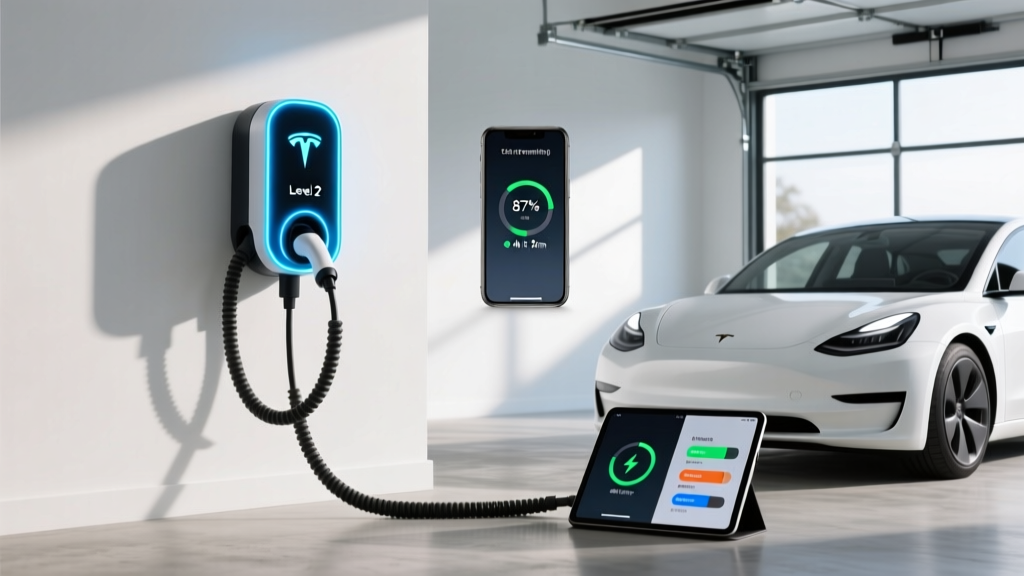
Tesla Wall Connector (Gen 4)
- Max output: 11.5 kW (48A) on a 60A circuit
- Connector: NACS native
- Cable length: 24 ft
- Smart features: Wi-Fi, OTA updates, load sharing (pair two units on one circuit), power sharing, energy tracking via Tesla app
- Price: ~$475
- Best for: Tesla owners and any NACS-equipped EV. The load-sharing feature is ideal for two-EV households.
ChargePoint Home Flex
- Max output: 12.0 kW (50A) on a 60A circuit — adjustable down to 16A
- Connector: NACS (2025+ models); CCS1 available on older stock
- Cable length: 23 ft
- Smart features: Wi-Fi, Alexa/Google Home integration, scheduling, detailed energy reports, plug-in or hardwired install
- Price: ~$599–$699
- Best for: Multi-EV households with different brands, users who want granular scheduling and energy data.
Emporia Vue EV Charger
- Max output: 11.5 kW (48A) on a 60A circuit
- Connector: NACS (with J1772 adapter included for legacy)
- Cable length: 24 ft
- Smart features: Integrates with Emporia Vue home energy monitor, solar-aware charging, time-of-use scheduling, real-time cost tracking
- Price: ~$399–$449
- Best for: Budget-conscious buyers and solar-panel owners who want to charge exclusively from excess solar production.
Grizzl-E Smart (United Chargers)
- Max output: 10.0 kW (40A) on a 50A circuit
- Connector: NACS and J1772 versions available
- Cable length: 24 ft
- Smart features: Wi-Fi, OCPP-compatible (works with utility demand-response programs), adjustable amperage via dip switches, extreme cold rating (-40°F)
- Price: ~$449–$499
- Best for: Cold-climate owners and those enrolled in utility smart-charging programs. Built in Canada with robust cold-weather engineering.
Safety, Electrical Code, and Installation Best Practices
A Level 2 charger draws continuous high current for hours — this is one of the most demanding loads in a residential electrical system. Cutting corners here creates fire risk. Here's what proper installation looks like:
- Dedicated circuit: Your EV charger must be on its own dedicated breaker — never shared with other appliances. A 48A charger needs a 60A breaker; a 32A charger needs a 40A breaker.
- Hardwired vs. plug-in: Hardwired installations (no plug) eliminate the GFCI breaker requirement in most jurisdictions and reduce the risk of overheating at the receptacle. If you use a NEMA 14-50 outlet, invest in a high-quality industrial-grade receptacle (Hubbell or Bryant brand — avoid cheap big-box-store outlets, which have a documented history of melting under continuous EV-charging loads).
- Outdoor rating: If your charger is installed outdoors or in an unenclosed carport, ensure the unit carries a NEMA 4 (weatherproof) rating. Most modern smart chargers are NEMA 4 rated, but verify before purchasing.
- Load calculation: A licensed electrician will perform a NEC Article 220 load calculation to confirm your panel can handle the EV circuit alongside existing loads (HVAC, electric range, dryer, water heater). If the calculation fails, a panel upgrade or a smart load-management device (like the Emporia Smart Load Center or Span panel) can defer the upgrade cost.
- Permit and inspection: Always pull a permit. The inspection ensures your installation meets code and protects your home insurance coverage. Unpermitted electrical work can void claims in the event of a fire.
When Does DC Fast Charging at Home Actually Make Sense?
While we've established that a level 3 charger for home is impractical for most people, there are narrow scenarios where it might be justified:
- Fleet operators: If you run 3+ commercial EVs (delivery vans, work trucks) and need rapid turnaround between shifts, a 50–100 kW DCFC at a depot may be cost-effective versus lost operational time.
- Properties with existing three-phase power: Some rural workshops, farms, or light-industrial properties already have 480V three-phase service. Adding a DCFC is dramatically cheaper here since the utility upgrade is eliminated.
- Multi-unit dwellings with shared infrastructure: Some large apartment complexes and condo buildings with commercial-grade electrical service are installing shared DCFC units for residents — but this is a commercial installation, not a residential one.
For the vast majority of single-family homeowners, a properly installed Level 2 charger on a time-of-use rate plan delivers 99% of the convenience at a fraction of the cost. Plug in when you get home, wake up to a full battery every morning, and pay $0.03–$0.06 per mile for fuel.
Frequently Asked Questions
How much does it cost to install a home EV charger?
A typical Level 2 home charger installation costs between $800 and $1,800 when your electrical panel has adequate capacity and the charger is located near the panel. If you need a panel upgrade (from 100A to 200A), a long wire run, or conduit work, costs can reach $3,650–$9,750. The charger hardware itself runs $350–$750 for quality smart units.
How fast will each charging level add range?
Level 1 (120V) adds roughly 3–5 miles of range per hour — suitable only for PHEVs with small batteries or emergency top-ups. Level 2 (240V, 48A/11.5 kW) adds approximately 40–45 miles per hour for a typical EV. Level 3 DC fast charging (150+ kW) can add 150–300+ miles in 20–30 minutes at a public station, but requires commercial-grade power infrastructure unavailable in most homes.
Which connector/charger is compatible with my EV?
For 2025–2026 model-year vehicles, most major brands (Tesla, Ford, GM, Hyundai, Kia, Rivian, BMW, Volvo, Honda) have adopted the NACS connector. Older vehicles (2022–2024 model years from VW, Stellantis, and early Hyundai/Kia models) may still use CCS1. Check your vehicle's charge port or owner's manual. Adapters exist to bridge the two standards, but a native-matching charger is always preferred for home use.
How much does charging cost per mile vs. gas?
Home Level 2 charging on an off-peak rate (~$0.08/kWh) costs roughly $0.027 per mile for an EV averaging 3.0 mi/kWh. The national average residential rate (~$0.17/kWh) brings that to about $0.057 per mile. A comparable gas vehicle at 28 MPG and $3.40/gallon costs about $0.12 per mile. Home charging is 50–75% cheaper per mile than gasoline.
What electrical upgrades might I need?
The most common upgrade is a panel capacity increase from 100A to 200A service, which costs $2,000–$5,000. You may also need a new dedicated 240V circuit with appropriate wire gauge (6 AWG copper for 60A), a high-quality NEMA 14-50 receptacle (if not hardwiring), and possibly conduit runs through walls or underground. Homes with 200A panels and available breaker slots typically need no panel upgrade. A licensed electrician's load calculation will determine your specific requirements.