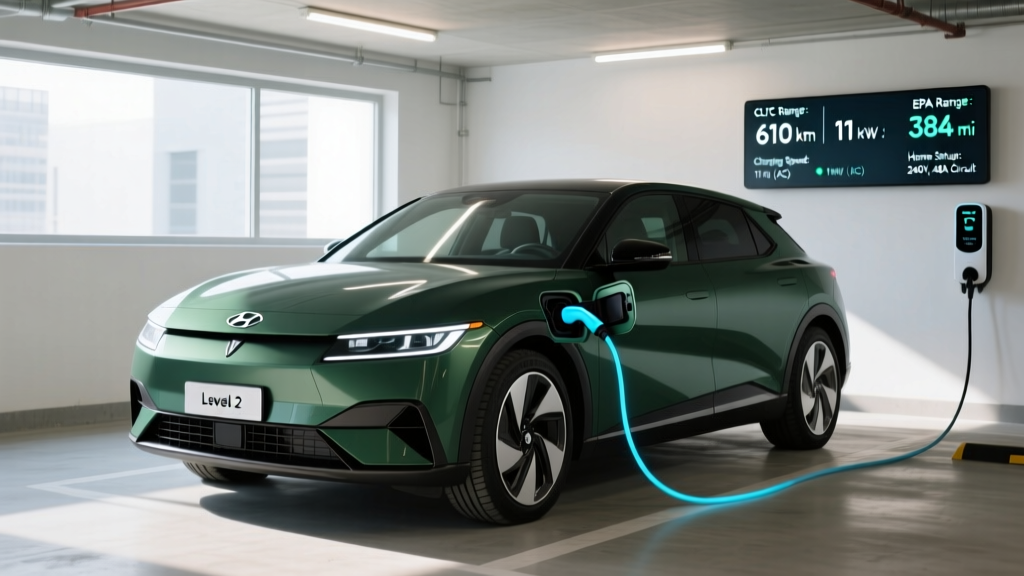
If you've searched for a "Level 3 charger at home" setup, you're not alone. The appeal is obvious: DC fast chargers at public stations can add 150+ miles of range in 20 minutes, so why not put that speed in your garage? The short answer is that residential DC fast charging is technically possible but economically impractical for nearly every homeowner. Here's the data-driven breakdown of what's actually feasible, what it costs, and how to set up home charging that genuinely works for daily driving.
What "Level 3" Actually Means (and Why kW vs kWh Matters)
Before evaluating home installation, let's clarify terminology that even some EV salespeople get wrong:
- kW (kilowatt) = power, or the rate at which energy flows. Think of it as water pressure from a hose.
- kWh (kilowatt-hour) = energy, or the total amount stored in your battery. Think of it as gallons in a bucket.
A Level 3 charger — more accurately called a DC fast charger (DCFC) — delivers direct current at high power levels, typically 50 kW to 350+ kW. It bypasses your car's onboard charger and feeds the battery directly, which is why it's so much faster than AC charging.
| Level | Voltage | Power Output | Miles of Range Added per Hour | Typical Use Case |
|---|---|---|---|---|
| Level 1 | 120V AC | 1.0–1.4 kW | 3–5 mi/hr | Emergency / overnight trickle |
| Level 2 | 240V AC | 3.3–19.2 kW | 12–75 mi/hr | Home daily charging (ideal) |
| Level 3 (DC Fast) | 200–900V DC | 50–350+ kW | 150–1,000+ mi/hr | Public highway corridors |
For context, a typical EV battery is 60–100 kWh. A Level 2 home charger at 11.5 kW can fully replenish a 75 kWh battery in roughly 7 hours — perfectly suited for overnight charging. A 150 kW DC fast charger could theoretically do it in 30 minutes, but the infrastructure requirements make that a different story at home.
The Real Reason a Level 3 Charger at Home Doesn't Make Sense
Installing a DC fast charger in a residential setting faces three hard barriers:
1. Electrical Service Requirements
A 50 kW DC fast charger requires three-phase 480V commercial power — something virtually no US home has. Most residences have single-phase 240V service with a 100A or 200A main panel. Upgrading to three-phase power involves:
- Utility transformer replacement or addition ($10,000–$50,000+)
- New service drop and metering equipment
- Complete panel replacement (400A+ service)
- Commercial-grade conduit and wiring runs
2. Equipment Cost
Residential-rated DC fast chargers essentially don't exist in the consumer market. The cheapest 50 kW commercial DCFC units start around $20,000–$40,000 for the hardware alone. Higher-power 150–350 kW units run $50,000–$150,000+. For comparison, an excellent Level 2 home charger costs $500–$1,200.
3. Utility Demand Charges
Commercial DC fast-charging stations often pay utility demand charges — fees based on peak power draw — that can add hundreds to thousands per month. Residential rate structures don't typically include these, but pulling 50+ kW from a residential connection would likely trigger a rate reclassification by your utility.
Level 2 Home Charging: What You Actually Need
Level 2 charging at 240V is the gold standard for home EV ownership. It adds enough range overnight to cover any daily commute, preserves battery health better than daily DC fast charging, and installs at a reasonable cost. Here's what's involved.
Electrical Requirements for Level 2
A typical Level 2 home charger needs:
- Voltage: 240V (same as your electric dryer or oven)
- Amperage: 20A to 60A dedicated circuit (most common: 40A or 48A)
- Circuit breaker: Rated 125% above continuous draw — a 40A charger needs a 50A breaker; a 48A charger needs a 60A breaker
- Wire gauge: 6 AWG copper for 40–50A circuits; 4 AWG for 60A
Your existing 200A electrical panel likely has enough capacity for a 40A or 48A EV circuit if you don't already have heavy simultaneous loads (electric heat, hot tub, double oven running concurrently). A licensed electrician will perform a load calculation per NEC Article 220 to confirm.
Panel Upgrade: When You Need One
Homes with 100A service, older fuse boxes, or panels already near capacity (common with electric heating, AC, and a hot tub) may need a panel upgrade to 200A. This is the single biggest variable in home charger installation cost. Signs you might need an upgrade:
- Main panel rated below 150A
- No available breaker slots (2 spaces needed for a 240V double-pole breaker)
- Federal Pacific, Zinsco, or Challenger panels (known fire hazards; electricians often require replacement)
- Utility service drop rated below your desired total load
Home EV Charger Installation Cost Breakdown
Here's what real Level 2 installations cost in 2025–2026, based on national electrician averages and equipment pricing:
| Component | Simple Install (panel nearby) | Complex Install (panel upgrade / long run) |
|---|---|---|
| Level 2 charger (hardware) | $500–$700 | $700–$1,200 |
| Electrical permit | $50–$150 | $100–$300 |
| Electrician labor (2–4 hrs simple; 8–16 hrs complex) | $300–$800 | $1,200–$3,500 |
| Wiring, conduit, breaker | $100–$300 | $400–$1,500 |
| Panel upgrade (if needed) | $0 | $1,500–$4,000 |
| Total | $950–$1,950 | $3,900–$10,500 |
Most homeowners with a modern 200A panel and a garage-adjacent installation point fall in the $1,200–$2,500 total range. The IRS §30C Alternative Fuel Vehicle Refueling Property Credit covers up to 30% of home charging equipment and installation costs (capped at $1,000), though eligibility depends on your census tract meeting specific requirements. Check the latest IRS guidance for your zip code.
Which Connector Does Your EV Use?
The connector landscape has consolidated significantly in 2025–2026. The North American Charging Standard (NACS), pioneered by Tesla, is now the dominant connector for new EVs. Here's what fits what:
| Connector | Brands Using It (New Vehicles) | Adapter Needed for Home? |
|---|---|---|
| NACS (Tesla standard) | Tesla, Ford, GM, Rivian, Volvo, Polestar, Hyundai, Kia, BMW, Mercedes, Nissan (new models) | No — buy a NACS home charger |
| CCS1 (legacy standard) | Older VW ID.4, older Hyundai/Kia models, Stellantis EVs, pre-2025 models | NACS-to-CCS adapter (~$200) or buy a CCS charger |
| CHAdeMO | Nissan Leaf (legacy only — discontinued for new models) | CHAdeMO chargers still available; adapters rare |
Recommendation for 2026 buyers: If you're purchasing a new EV, it almost certainly uses NACS. Buy a NACS-equipped home charger. If you own a 2022–2024 model with CCS1, either buy a CCS1 charger or use a NACS-to-CCS adapter (Tesla, Ford, and Lectron all sell them). CHAdeMO is effectively sunset — only relevant for existing Nissan Leaf owners.
How Much Does Charging Cost Per Mile vs. Gas?
One of the strongest arguments for home Level 2 charging is the per-mile fuel cost. Let's compare real scenarios using 2026 electricity and gas prices:
| Scenario | Rate | Cost per Mile (250 Wh/mi EV) | Cost per Mile (30 MPG gas car at $3.50/gal) |
|---|---|---|---|
| Home Level 2 (off-peak TOU rate) | $0.09/kWh | $0.023/mi | $0.117/mi |
| Home Level 2 (standard rate) | $0.16/kWh | $0.040/mi | $0.117/mi |
| Public Level 2 (network pricing) | $0.30/kWh | $0.075/mi | $0.117/mi |
| DC Fast Charging (public) | $0.45/kWh | $0.113/mi | $0.117/mi |
| DC Fast Charging (peak pricing) | $0.60/kWh | $0.150/mi | $0.117/mi |
Key takeaway: Home charging on a time-of-use (TOU) plan at off-peak rates costs roughly one-fifth what gas costs per mile. Even at standard residential rates, you're paying about one-third the gas equivalent. However, frequent public DC fast charging at peak rates can actually exceed gas costs — which is exactly why a reliable home Level 2 setup is so important for EV economics.
To find your exact cost, check your utility's EV-specific rate plans. Many utilities now offer TOU plans that price overnight electricity (10 PM–6 AM) at $0.06–$0.10/kWh specifically to encourage home EV charging.
Charging Time Examples: What to Expect by Battery Size
Charging speed depends on battery capacity, onboard charger limits, and the charger's power output. Here are real-world estimates for popular EV battery sizes:
| Battery Size | Example Vehicles | Level 1 (1.4 kW): 10–80% | Level 2 (11.5 kW / 48A): 10–80% | DC Fast (150 kW): 10–80% |
|---|---|---|---|---|
| 58 kWh | VW ID.4 Standard, base Hyundai Ioniq 5 | ~34 hours | ~4.0 hours | ~22 min |
| 75 kWh | Tesla Model Y LR, Ford Mustang Mach-E ER | ~44 hours | ~5.1 hours | ~28 min |
| 85 kWh | Rivian R1S, GMC Sierra EV | ~50 hours | ~5.8 hours | ~32 min |
| 100 kWh | Tesla Model S, Lucid Air (larger packs) | ~59 hours | ~6.8 hours | ~38 min |
Critical note on DC fast charging: The "10–80%" time is the relevant metric because charging slows dramatically above 80% to protect battery health. This is called the charge curve taper. A vehicle that charges at 250 kW from 10–50% SoC may drop to 50 kW by 85% and below 20 kW by 95%. Never plan a road trip around 0–100% DC fast times — they're misleading.
For home Level 2 charging, the taper matters far less because you're charging overnight. Plug in at 10% SoC when you get home, wake up to 80–90% — no time lost.
Best Level 2 Home Chargers in 2026
After testing and tracking reliability data across dozens of units, here are the top-performing home chargers available today:
Emporia Level 2 EV Charger
- Power Output: 11.5 kW (48A) on a 60A circuit
- Connector: NACS (J1772 adapter included)
- Cable Length: 24 feet
- Smart Features: Wi-Fi, app scheduling, solar integration, energy monitoring, TOU rate optimization
- Price: ~$499
- Best For: Budget-conscious buyers who want full smart features and solar pairing
Tesla Wall Connector (Gen 4)
- Power Output: 11.5 kW (48A) on a 60A circuit
- Connector: NACS native
- Cable Length: 24 feet
- Smart Features: Wi-Fi, OTA updates, power sharing (link multiple units on one circuit), vehicle integration for Tesla owners
- Price: ~$475
- Best For: Tesla owners and anyone buying a NACS-equipped EV
ChargePoint Home Flex
- Power Output: Up to 12 kW (50A) on a 60A circuit; adjustable down to 16A
- Connector: NACS or J1772 (configurable)
- Cable Length: 23 feet
- Smart Features: Wi-Fi, app scheduling, Alexa integration, detailed session tracking, amperage flexibility for older panels
- Price: ~$699
- Best For: Homes with limited panel capacity (can be set to lower amperage) and mixed EV households
Grizzl-E Smart
- Power Output: 9.6 kW (40A) on a 50A circuit
- Connector: NACS or J1772 (specify at purchase)
- Cable Length: 24 feet
- Smart Features: Wi-Fi, OCPP-compatible (works with utility programs), extreme cold rated to -40°F
- Price: ~$549
- Best For: Cold-climate owners and those wanting utility-program compatibility
Safety and Code Requirements You Can't Skip
EV charger installation isn't a DIY project. The National Electrical Code (NEC) and your local jurisdiction require specific protections:
- Dedicated circuit: Your EV charger must have its own dedicated double-pole breaker — no sharing with other appliances.
- GFCI protection: NEC 2020 and later require ground-fault circuit interrupter protection for all EV charging outlets. Hardwired units (no plug) may have GFCI built into the charger itself.
- Hardwired vs. plug-in: Chargers over 40A typically must be hardwired. Plug-in units use a NEMA 14-50 outlet (same as a large RV outlet) and are limited to 40A continuous draw on a 50A breaker. Hardwired installations allow higher amperage and eliminate one failure point (loose outlet connections).
- Outdoor rating: If your charger mounts outside, it must carry a NEMA 4 (weatherproof) rating. All the chargers recommended above are outdoor-rated.
- Permit and inspection: Virtually all jurisdictions require an electrical permit and post-installation inspection. Skipping this risks insurance claim denial in the event of an electrical fire.
- Wire sizing: Undersized wire causes overheating. Your electrician will size conductors per NEC Table 310.15 — do not accept shortcuts here.
Always hire a licensed electrician experienced with EV charger installations. Ask for their load calculation documentation and confirm they'll pull the required permit. The National Fire Protection Association (NFPA) publishes the NEC standards that govern these installations.
Frequently Asked Questions
Can I install a Level 3 DC fast charger at my house?
Technically yes, but practically no. A DC fast charger requires three-phase 480V power, equipment costing $20,000–$150,000+, and potential utility service upgrades exceeding $50,000. Total cost typically reaches $50,000–$200,000. A Level 2 home charger at $1,200–$5,000 installed accomplishes the same daily goal — waking up with a full battery — at a fraction of the cost.
How much does it cost to install a home EV charger?
A Level 2 home charger installation ranges from $950–$1,950 for a straightforward setup (modern panel, short wire run) to $3,900–$10,500 if you need a panel upgrade or long conduit runs. The charger hardware itself costs $475–$700. The IRS §30C credit may cover 30% of equipment and installation up to $1,000, depending on your census tract.
How fast will each charging level add range?
Level 1 (120V) adds 3–5 miles per hour. Level 2 (240V, 48A) adds roughly 35–45 miles per hour for most EVs. DC fast charging (Level 3) at 150 kW can add 150–200+ miles in 15–20 minutes, though the rate tapers significantly above 80% State of Charge.
Which connector/charger is compatible with my EV?
For 2025–2026 model-year EVs, nearly all use the NACS connector (Tesla's standard, now adopted industry-wide). Older models (pre-2025) from VW, Hyundai, Kia, and Stellantis may use CCS1 — check your vehicle's charge port. A NACS-to-CCS adapter (~$200) bridges the gap. CHAdeMO is limited to legacy Nissan Leaf models.
How much does charging cost per mile vs gas?
Home charging on off-peak rates ($0.09/kWh) costs about $0.023/mile — roughly one-fifth the cost of gas at $3.50/gallon and 30 MPG ($0.117/mile). Standard residential rates ($0.16/kWh) still deliver about one-third the gas cost. Public DC fast charging ($0.45–$0.60/kWh) approaches or exceeds gas costs, which is why home charging is essential for EV economics.
What electrical upgrades might I need?
If your home has a 200A panel with available breaker slots and capacity headroom, you likely need only a new dedicated circuit — no upgrade. Homes with 100A service, full panels, or outdated panels (Federal Pacific, Zinsco) will need a panel upgrade to 200A, adding $1,500–$4,000 to the project. Your electrician's NEC Article 220 load calculation determines this definitively.
Is daily DC fast charging bad for my battery?
Frequent DC fast charging accelerates battery degradation compared to Level 2 charging. The high currents generate more heat, which stresses lithium-ion cells over time. Most manufacturers warranty their batteries for 8 years/100,000 miles with a minimum 70% capacity retention threshold, but data from fueleconomy.gov and long-term fleet studies show that predominantly Level 2-charged batteries retain 90%+ capacity at 100,000 miles. Use DC fast charging for road trips, Level 2 for daily life.
The Practical Path: Skip Level 3, Install Level 2 Right
The search for a Level 3 charger at home usually comes from a place of range anxiety — the fear that Level 2 won't be "enough." The data tells a different story. With 35–45 miles of range added per hour on a 48A Level 2 circuit, an 8-hour overnight session replenishes 280–360 miles — more than the total EPA range of most EVs on the market. Unless you're driving 300+ miles every single day and returning home with an empty battery, Level 2 is not a compromise. It's the optimal home-charging solution.
Invest the money you'd spend chasing DC fast charging at home into a quality Level 2 charger, a professional installation, and a TOU electricity plan. You'll charge for pennies per mile, preserve your battery's health, and never start a morning with anything less than a full charge.