Understanding EV Charging Levels: Speeds and Range Added Per Hour
Before installing any home charging equipment, you need to understand the three charging levels and what each delivers in practical terms. The single most important distinction in EV charging is between kW (kilowatts) and kWh (kilowatt-hours): kW measures the rate of power delivery — think of it as how fast water flows through a hose — while kWh measures total energy stored in your battery, like the total volume of water in a tank. A 48-amp Level 2 charger delivering 11.5 kW adds roughly 44 miles of range per hour to a typical EV with 3.5 mi/kWh efficiency.
| Level | Voltage | Power (kW) | Miles Added/Hour | Typical Use Case |
|---|---|---|---|---|
| Level 1 | 120V AC | 1.0–1.4 kW | 3–5 mi/hr | Overnight trickle; PHEVs with small batteries |
| Level 2 | 240V AC | 7.2–19.2 kW | 25–75 mi/hr | Home daily charging; workplace; retail destinations |
| DC Fast Charge | 400–800V DC | 50–350 kW | 150–1,000+ mi/hr | Road trips; highway corridors; fleet depots |
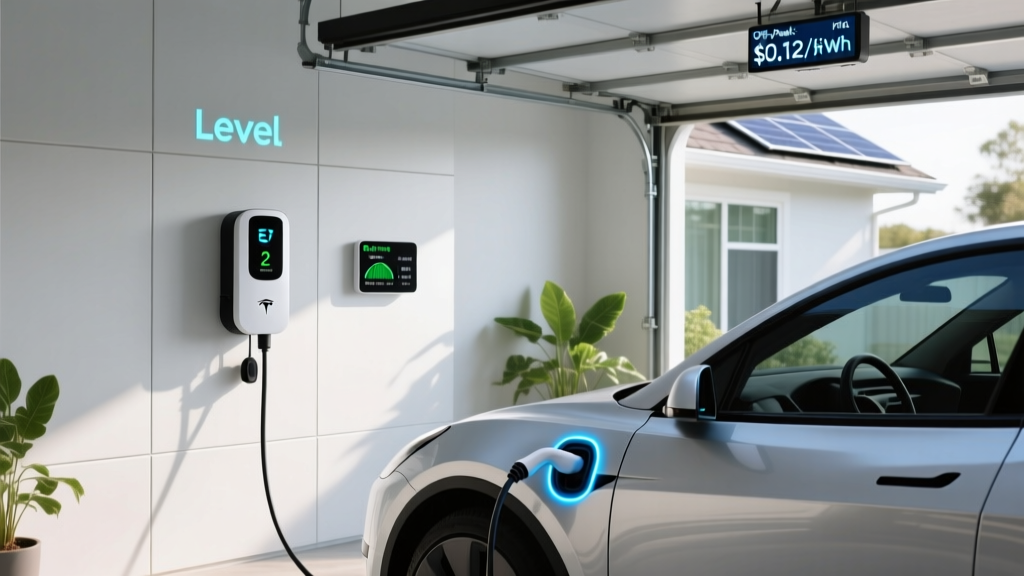
Level 1 charging from a standard 120V outlet works for plug-in hybrids with 25–45 kWh batteries or for BEV owners who drive under 30 miles daily and can leave the car plugged in for 10–12 hours overnight. For most battery electric vehicle owners, however, Level 2 is the practical minimum for daily home charging. A Level 2 station replenishes a 75 kWh battery from 20% to 80% in roughly 4–5 hours at 11.5 kW, making overnight charging effortless.
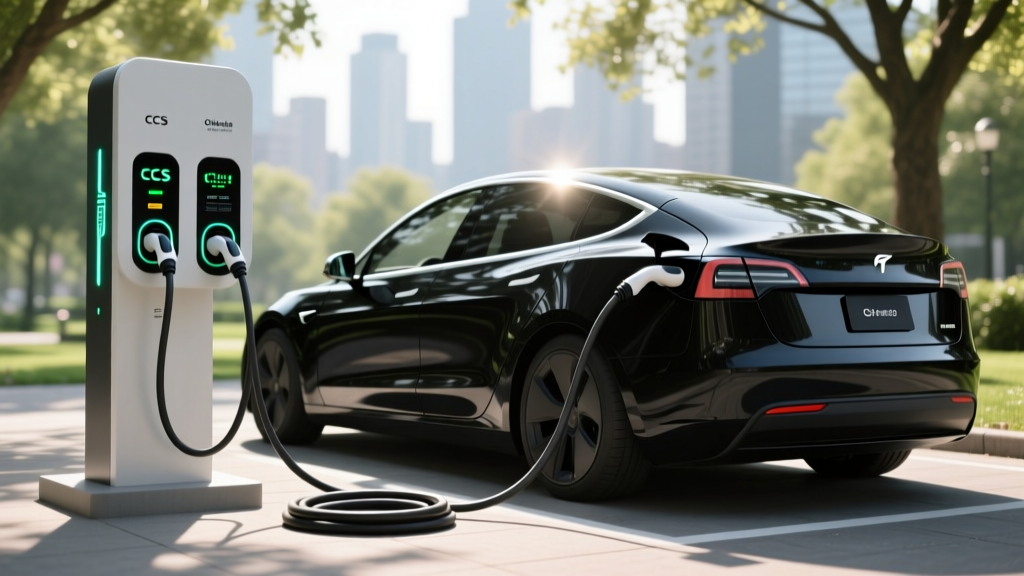
DC fast charging bypasses the vehicle's onboard AC-to-DC converter and feeds direct current straight to the battery pack. Modern 800-volt architectures — found in the Hyundai Ioniq 5, Porsche Taycan, and Kia EV6 — can accept peak rates above 250 kW, though sustained rates taper significantly above 80% state of charge to protect battery health. Expect a 10–80% session in 18–25 minutes at a 350 kW station with a compatible vehicle, but plan for 35–45 minutes at a 50–150 kW station.
Home Electrical Requirements: What Your Panel Needs to Handle
A Level 2 home charger requires a dedicated 240-volt circuit, similar to what powers an electric dryer or oven. The most common residential setup is a 240V/40A or 240V/48A circuit feeding a hardwired wall unit or a NEMA 14-50 receptacle. Here's what determines whether your existing electrical panel can support it:
- Panel capacity: Most modern homes have a 200-amp main service panel. If your panel is already near capacity — running electric heat, a large electric range, an electric water heater, and central AC — adding a 40A or 48A EV circuit may push you over the safe 80% continuous-load threshold that the National Electrical Code (NEC) requires for circuits running 3+ hours.
- Available breaker slots: You need two adjacent slots for the double-pole breaker. If your panel is full, a subpanel or tandem breakers (where code permits) may be necessary.
- Wire run distance: The farther the charger is from the panel, the thicker (and more expensive) the copper wire must be to prevent voltage drop. Runs over 50 feet typically require 4 AWG or 3 AWG copper instead of 6 AWG, adding $3–$6 per foot in material cost.
- Panel age and condition: Homes built before 1990 often have 100A or 150A service. Upgrading to a 200A panel costs $1,500–$3,500 depending on your utility's requirements and local labor rates. Some homeowners opt for a smart panel or load-management device (such as the Emporia Vue with EV load shedding) to avoid a full panel upgrade — these systems throttle the charger's draw when other large appliances kick on.
For homes where a panel upgrade is prohibitively expensive, consider a lower-amperage Level 2 unit. A 24A charger (requiring only a 30A circuit and 10 AWG wire) still delivers 5.8 kW — enough to fully recharge a 75 kWh battery overnight in about 10 hours, starting from 20%.
How Much Does It Cost to Install a Home EV Charger?
Installation costs vary enormously based on your home's electrical infrastructure, the distance from panel to parking spot, and local permit fees. Here's a realistic breakdown based on 2026 pricing from licensed electricians across major U.S. metro areas:
| Component | Simple Install (Same Wall as Panel) | Moderate Install (25–50 ft Run) | Complex Install (50+ ft, Panel Upgrade) |
|---|---|---|---|
| EVSE Equipment (Level 2 unit) | $300–$700 | $300–$700 | $300–$700 |
| Electrician Labor (2–8 hours) | $300–$600 | $500–$1,200 | $1,000–$2,000 |
| Materials (Wire, Conduit, Breaker) | $50–$150 | $150–$400 | $300–$600 |
| Permit & Inspection | $50–$150 | $50–$200 | $100–$300 |
| Panel Upgrade (if needed) | $0 | $0 | $1,500–$3,500 |
| Total Estimated Cost | $700–$1,600 | $1,000–$2,500 | $3,200–$7,100 |
The IRS §30C alternative fuel vehicle refueling property credit covers up to 30% of home charging equipment and installation costs, capped at $1,000 — but eligibility depends on your census tract meeting specific low-income or non-urban criteria. Check the IRS eligibility map before assuming you qualify. Additionally, many utilities offer rebates of $200–$500 for installing a smart Level 2 charger on a time-of-use rate plan.
Connector Compatibility: NACS, CCS1, and CHAdeMO Explained
As of 2026, the North American Charging Standard (NACS), originally developed by Tesla, has become the dominant connector for new EVs sold in the United States. Ford, GM, Rivian, Volvo, Polestar, and others have transitioned to NACS ports on their 2025–2026 model-year vehicles. Legacy CCS1 vehicles (2020–2024 models from Hyundai, Kia, BMW, Volkswagen, and others) remain on the road in large numbers, and CCS1 chargers are still widely available at Electrify America, EVgo, and ChargePoint stations.
| Connector | Brands Using It (2026 MY) | DC Fast Charge Availability | Adapter Needed? |
|---|---|---|---|
| NACS (Tesla-style) | Tesla, Ford, GM, Rivian, Volvo, Polestar, Mercedes (2026+), Hyundai (2026+) | Tesla Supercharger network + growing third-party | CCS1 vehicles need NACS-to-CCS1 adapter (~$200–$300) |
| CCS1 | Hyundai (pre-2026), Kia (pre-2026), BMW, VW, older Ford/GM | Electrify America, EVgo, ChargePoint | NACS vehicles need CCS1-to-NACS adapter (included by some OEMs) |
| CHAdeMO | Nissan Leaf (discontinued), Mitsubishi Outlander PHEV (legacy) | Limited and declining | No practical adapter to NACS/CCS1 for DCFC |
For home Level 2 charging, the connector situation is simpler. All home EVSEs (Electric Vehicle Supply Equipment) sold in North America use the J1772 plug or the NACS plug for Level 2 AC charging. J1772-to-NACS adapters are inexpensive ($30–$60) and widely available, so any home charger works with any EV. The real connector question matters for public DC fast charging — and that's where knowing your vehicle's port type determines which networks you can access without an adapter.
Cost to Charge: Home vs. Public vs. Gas Per Mile
Charging economics depend on your electricity rate, charging speed, and how you compare it to gasoline. Here's a practical cost-per-mile breakdown for a typical 2026 midsize EV consuming 3.0 miles per kWh (roughly 100 MPGe combined):
| Charging Scenario | Rate ($/kWh) | Cost Per Mile (at 3.0 mi/kWh) | Equivalent MPG Gas Cost ($3.50/gal) |
|---|---|---|---|
| Home (off-peak TOU rate) | $0.08–$0.12 | $0.03–$0.04 | 88–117 MPG equivalent |
| Home (standard flat rate) | $0.14–$0.18 | $0.05–$0.06 | 58–70 MPG equivalent |
| Public Level 2 (workplace/retail) | $0.20–$0.35 | $0.07–$0.12 | 29–50 MPG equivalent |
| DC Fast Charge (public) | $0.35–$0.55 | $0.12–$0.18 | 19–29 MPG equivalent |
| Gasoline (30 MPG vehicle) | $3.50/gal | $0.12 | 30 MPG (baseline) |
Home charging on an off-peak time-of-use rate is the cheapest way to fuel any vehicle on the road — roughly one-quarter the cost per mile of a 30 MPG gasoline car. Public DC fast charging, however, can equal or exceed the cost of gasoline on a per-mile basis. The economic case for EV ownership is strongest when you can charge at home or at a workplace offering free or subsidized Level 2 charging.
Level 2 Charger Equipment Recommendations for 2026
Based on reliability, feature sets, and compatibility, here are four Level 2 home chargers that cover the range of budgets and installation scenarios:
Emporia Vue Smart EV Charger — Best Value
- Power Output: 48A / 11.5 kW (hardwired) or 40A / 9.6 kW (NEMA 14-50 plug)
- Connector: J1772 (works with all EVs; J1772-to-NACS adapter included for Tesla/NACS vehicles)
- Cable Length: 24 feet
- Smart Features: Wi-Fi scheduling, solar integration, load management with Emporia Vue panel monitor, energy tracking
- Price: ~$350–$400
- Best For: Budget-conscious buyers who want smart scheduling and solar-aware charging
ChargePoint Home Flex — Most Flexible Amperage
- Power Output: Adjustable 16A–50A (3.8–12.0 kW) via dip-switch configuration
- Connector: J1772 (23-foot cable)
- Smart Features: Wi-Fi, Alexa integration, ChargePoint app scheduling, works with utility demand-response programs
- Price: ~$550–$650
- Best For: Homes with limited panel capacity that need to dial amperage down to match available circuit size
Tesla Wall Connector (Gen 4) — Best for NACS Vehicles
- Power Output: 48A / 11.5 kW (hardwired, 60A circuit required)
- Connector: NACS native (J1772 adapter included for non-Tesla vehicles)
- Cable Length: 24 feet
- Smart Features: Wi-Fi updates, power sharing between multiple Wall Connectors on one circuit, Tesla app integration
- Price: ~$425–$475
- Best For: Tesla owners or households with multiple NACS vehicles wanting power-sharing capability
Grizzl-E Smart — Most Durable Outdoor Unit
- Power Output: 40A / 9.6 kW (NEMA 14-50) or 48A / 11.5 kW (hardwired)
- Connector: J1772 (24-foot cable)
- Smart Features: Wi-Fi, OCPP protocol support, adjustable amperage, load balancing
- Price: ~$450–$550
- Best For: Outdoor installations in extreme climates — rated to -40°F, IP67 water resistance, aluminum enclosure
Charging Time Examples for Common Battery Sizes
Charging speed depends on both the EVSE's output and the vehicle's onboard charger capacity. Most 2026 EVs have onboard chargers rated between 7.7 kW and 11.5 kW, meaning even a 19.2 kW EVSE won't charge them faster than their onboard limit. Here are realistic 10–80% charging times for popular battery sizes at common home power levels:
| Battery Size (kWh Usable) | Example Vehicles | At 7.7 kW (32A) | At 9.6 kW (40A) | At 11.5 kW (48A) |
|---|---|---|---|---|
| 58 kWh | VW ID.4 (Standard) | 5 hr 15 min | 4 hr 15 min | 3 hr 35 min |
| 75 kWh | Tesla Model Y, Ford Mustang Mach-E (Extended Range) | 6 hr 50 min | 5 hr 30 min | 4 hr 35 min |
| 84 kWh | Hyundai Ioniq 5 (Long Range), Kia EV6 | 7 hr 40 min | 6 hr 10 min | 5 hr 10 min |
| 100 kWh | Tesla Model S, Rivian R1S (Max Pack) | 9 hr 05 min | 7 hr 20 min | 6 hr 05 min |
| 131 kWh | Ford F-150 Lightning (Extended Range) | 11 hr 55 min | 9 hr 35 min | 8 hr 00 min |
For DC fast charging on the road, the picture changes dramatically. A Hyundai Ioniq 5 with its 800V architecture can charge from 10% to 80% in approximately 18 minutes at a 350 kW station, peaking at around 240 kW before tapering above 60% SoC. A Tesla Model Y at a V3 Supercharger (250 kW peak) achieves 10–80% in roughly 25–30 minutes. Always precondition your battery before arriving at a DC fast charger — most EVs do this automatically when you navigate to a charger via the built-in navigation system, warming the battery to optimal temperature for faster charge acceptance.
Safety, Electrical Code, and Permit Requirements
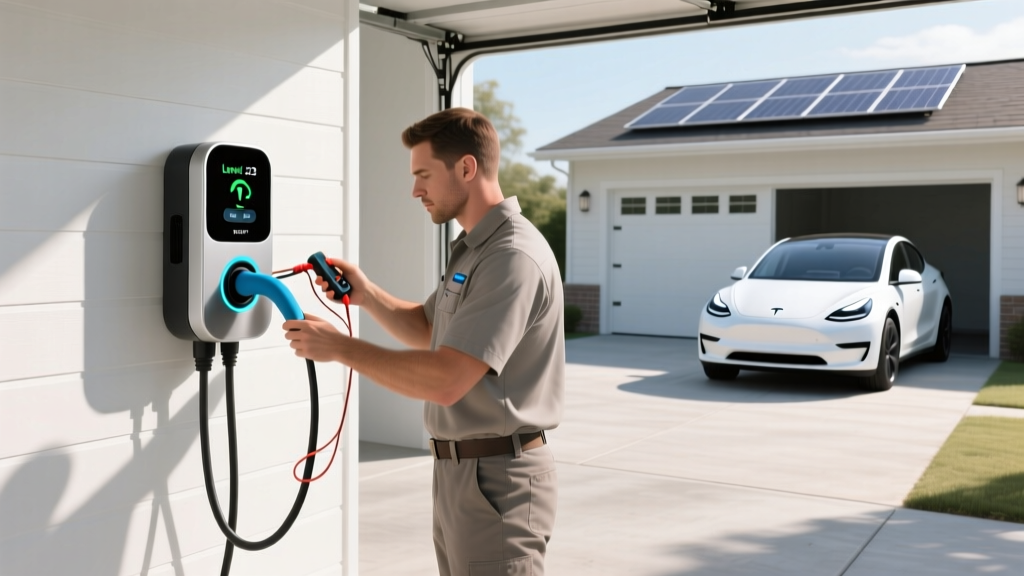
EV charger installation is regulated by the National Electrical Code (NEC) and enforced through local building departments. Key requirements that your licensed electrician will address:
- Dedicated circuit: Your Level 2 charger must be on its own dedicated double-pole breaker — it cannot share a circuit with other appliances. Continuous loads (defined as running 3+ hours) require the circuit to be rated at 125% of the charger's maximum draw. A 48A charger therefore requires a 60A breaker and 4 AWG copper wire (or 3 AWG aluminum).
- GFCI protection: The 2020 NEC revision and subsequent updates require ground-fault circuit interrupter (GFCI) protection for all EVSE receptacles rated 150V to ground or less and 50A or less. Many modern EVSEs have built-in GFCI protection, but your electrician will verify code compliance for your jurisdiction. Note: GFCI breakers can cause nuisance tripping with some EVSEs — if this occurs, a hardwired installation (which may not require a GFCI breaker depending on local interpretation) often resolves the issue.
- Outdoor rating: If your charger is installed outdoors, the EVSE must carry at least a NEMA 4 (weatherproof) rating. The NEMA 14-50 receptacle, if used outdoors, must be in an in-use weatherproof cover. Most quality EVSEs carry IP55 to IP67 ratings suitable for outdoor mounting.
- Permit and inspection: Nearly all U.S. jurisdictions require an electrical permit for EVSE installation, typically costing $50–$200. The inspection ensures proper wire gauge, breaker sizing, grounding, and torque on connections. Skipping the permit risks voiding your homeowner's insurance in the event of an electrical fire and may cause issues at resale.
- Utility notification: Some utilities require or incentivize notification when you install a Level 2 charger, particularly if you're enrolling in a time-of-use rate or demand-response program. Contact your utility before installation to learn about available rebates — many utilities offer $200–$500 rebates that offset installation costs.
Frequently Asked Questions
How much does it cost to install a home EV charger?
A straightforward Level 2 installation with the charger on the same wall as your electrical panel typically costs $700–$1,600 including equipment, labor, and permit. A moderate run of 25–50 feet costs $1,000–$2,500. If your home needs a 200A panel upgrade, total costs can reach $3,200–$7,100. The IRS §30C credit may cover 30% (up to $1,000) if your census tract qualifies.
How fast will each charging level add range?
Level 1 (120V) adds 3–5 miles per hour. Level 2 (240V at 48A) adds 35–45 miles per hour for a typical midsize EV. DC fast charging at 150 kW can add 150–250 miles in a 20–30 minute session, depending on the vehicle's charge acceptance rate and battery state of charge.
Which connector/charger is compatible with my EV?
For home Level 2 charging, any J1772 EVSE works with any EV using the appropriate adapter (J1772-to-NACS adapters cost $30–$60). For DC fast charging, 2026 models from Tesla, Ford, GM, Rivian, Volvo, and Polestar use NACS. Older CCS1 vehicles need a NACS-to-CCS1 adapter (~$200–$300) to access Tesla Superchargers. CHAdeMO is effectively discontinued for new vehicles.
How much does charging cost per mile vs. gas?
Home charging on off-peak rates costs $0.03–$0.04 per mile — roughly one-third the cost of a 30 MPG gasoline vehicle at $3.50/gallon. Public DC fast charging at $0.40–$0.55/kWh costs $0.12–$0.18 per mile, comparable to or exceeding gasoline costs. The financial advantage of an EV is maximized with consistent home charging access.
What electrical upgrades might I need?
Homes with 100A or 150A service panels may need a panel upgrade to 200A ($1,500–$3,500). Homes with full panels may need a subpanel or tandem breakers. Older wiring may need replacement to meet current code. Alternatively, a smart load-management device ($200–$400) can allow EV charging without a panel upgrade by dynamically reducing charger power when other appliances draw heavily. Always have a licensed electrician perform a load calculation before installation.