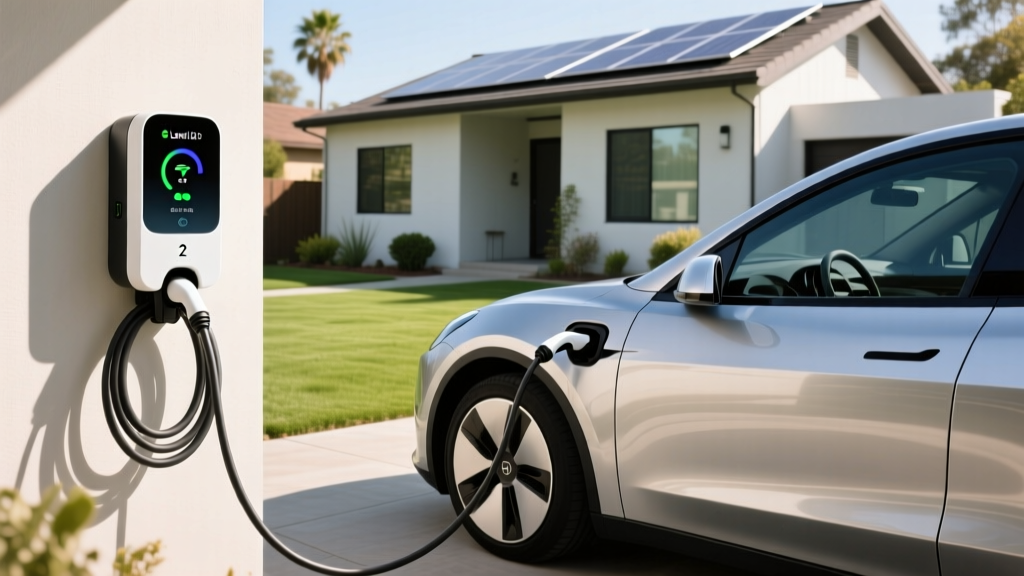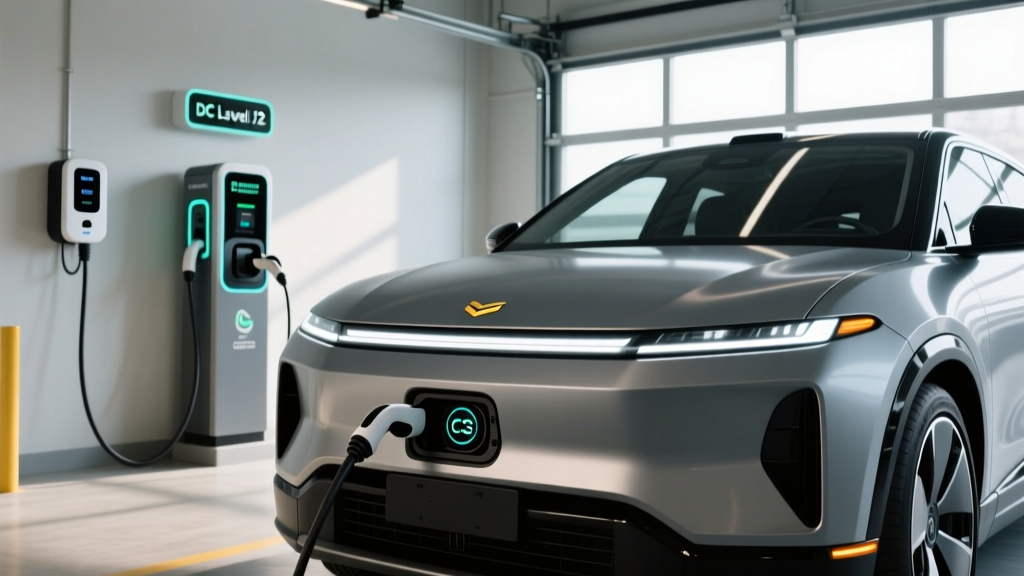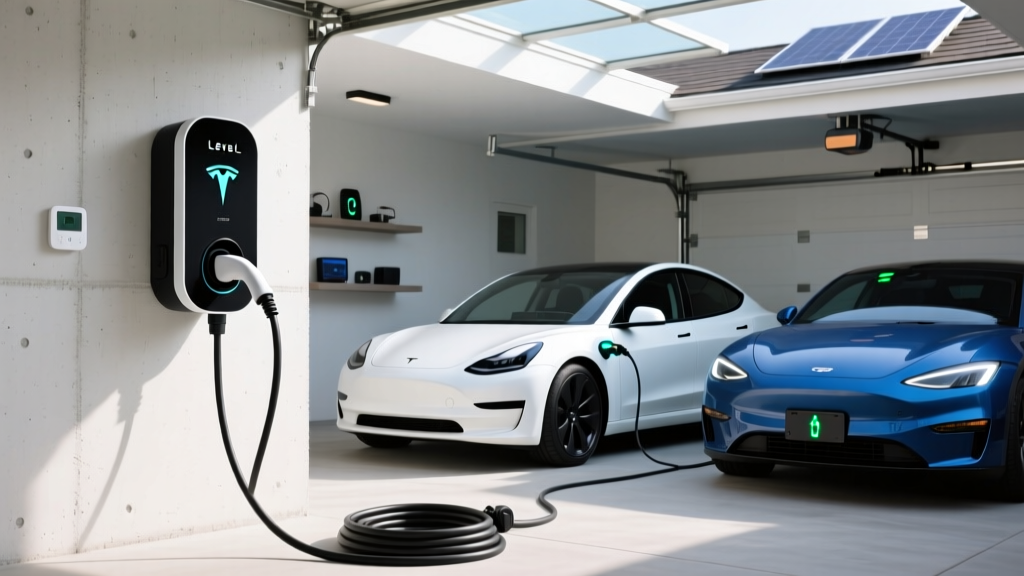
Why a Level 2 Home Charging Station Changes EV Ownership
Plug into a standard 120V outlet and you'll add roughly 3–5 miles of range per hour. For a 75 kWh battery, that's nearly two full days to reach 80%. A Level 2 home charging station operating at 240V compresses that timeline to 6–10 hours overnight — fast enough to wake up with a full battery every morning, regardless of what you drove the day before.
This guide breaks down the electrical requirements, real installation costs (including the panel upgrade scenario nobody talks about upfront), connector compatibility across every major brand, equipment recommendations, and what you'll actually pay per mile compared to gasoline. All figures reflect 2026 pricing and the current IRS §30D Alternative Fuel Vehicle Refueling Property Credit, which covers 30% of home charger hardware and installation costs up to $1,000 for eligible taxpayers in qualifying census tracts.
Charging Levels Explained: kW, Miles Per Hour, and Real Charge Times
The single most important distinction in EV charging is kW versus kWh. Kilowatts (kW) measure power — the rate at which energy flows into your car. Kilowatt-hours (kWh) measure energy — the total capacity of your battery. Think of kW as the width of a hose and kWh as the size of the bucket. A wider hose (higher kW) fills the bucket faster.
| Level | Voltage | Power (kW) | Miles of Range Added Per Hour | Typical Use Case |
|---|---|---|---|---|
| Level 1 | 120V AC | 1.0–1.4 kW | 3–5 mi/hr | Overnight trickle; PHEVs with small batteries |
| Level 2 (Home) | 240V AC | 7.2–11.5 kW | 25–44 mi/hr | Daily home charging; covers most BEV needs |
| Level 2 (Public/Commercial) | 208–240V AC | 11.5–19.2 kW | 37–70 mi/hr | Workplace, apartments, destination charging |
| DC Fast Charging | 400–800V DC | 50–350 kW | 150–1,000+ mi/hr (peak) | Road trips; 10–80% in 15–40 min |
Real-world charge time examples (Level 2 at 11.5 kW / 48A):
- Tesla Model Y (75 kWh usable, NMC): 10–80% in approximately 5.5 hours
- Hyundai Ioniq 5 (77.4 kWh usable, NMC): 10–80% in approximately 5.7 hours
- Ford F-150 Lightning Extended Range (131 kWh usable, NMC): 10–80% in approximately 9.5 hours
- Chevrolet Equinox EV (85 kWh usable, NMC): 10–80% in approximately 6.2 hours
These times assume sustained peak Level 2 draw. Unlike DC fast charging, Level 2 power delivery stays relatively flat across the state-of-charge window — there's minimal taper until you approach 95–100%.
Electrical Requirements: What Your Panel Must Handle
A Level 2 home charging station requires a dedicated 240V circuit, identical in concept to what powers your electric dryer or oven. The specific amperage depends on the charger's maximum output:
- 32A charger (7.7 kW): Requires a 40A breaker (NEC code mandates circuits be rated 125% of continuous load)
- 40A charger (9.6 kW): Requires a 50A breaker
- 48A charger (11.5 kW): Requires a 60A breaker
- 80A charger (19.2 kW): Requires a 100A breaker — uncommon in residential settings
The Panel Upgrade Reality
Most modern homes have a 200A main electrical panel. Before adding a 50A or 60A EV circuit, your electrician will perform a load calculation per NEC Article 220 to verify available headroom. If your panel is already near capacity — common in older homes with electric heat, electric water heaters, and electric dryers — you may need:
- Panel upgrade to 200A or 400A: $1,500–$4,000 depending on local labor rates and utility requirements
- Smart load management device: $300–$600 (e.g., Emporia Smart Load Manager) — monitors real-time panel load and throttles the charger to avoid tripping the main breaker, often avoiding a panel upgrade entirely
- Sub-panel installation: $500–$1,500 if the charger is located far from the main panel (detached garage, carport)
Homes with 100A or 150A service almost always need either a panel upgrade or a load-management device before adding Level 2 charging. This is the cost surprise that catches many new EV buyers off guard.
How Much Does It Cost to Install a Home EV Charger?
Installation costs vary enormously based on your home's existing electrical infrastructure, the distance from panel to charger location, and local permit fees. Here's a realistic breakdown for a typical 48A (11.5 kW) hardwired Level 2 station:
| Component | Simple Install (Panel Nearby) | Complex Install (Long Run / Upgrade) |
|---|---|---|
| Charger hardware (48A smart station) | $400–$700 | $400–$700 |
| Electrical permit | $50–$200 | $50–$200 |
| Electrician labor (2–4 hrs simple / 6–12 hrs complex) | $300–$700 | $900–$2,000 |
| Wiring, conduit, breaker (50–60A) | $100–$300 | $300–$800 |
| Panel upgrade (if needed) | $0 | $1,500–$4,000 |
| Smart load management device (if needed) | $0 | $300–$600 |
| Total estimated cost | $850–$1,900 | $3,450–$8,300 |
Federal tax credit: The IRS Alternative Fuel Vehicle Refueling Property Credit covers 30% of qualified hardware and installation expenses, up to $1,000 per tax year. Eligibility requires installation at your primary residence in a qualifying census tract (non-urbanized area or eligible low-income community). Check your eligibility at the IRS site or consult a tax professional — rules and qualifying tracts are updated annually.
Connector Compatibility: NACS, CCS, and CHAdeMO
The North American charging connector landscape has consolidated significantly since 2024. Here's where things stand for 2026 model-year vehicles:
| Connector | Brands Using It | Home Charger Availability |
|---|---|---|
| NACS (J3400) | Tesla, Ford, GM, Rivian, Volvo, Polestar, Mercedes-Benz, Nissan (2025+), Honda, BMW, Hyundai/Kia (2025+), Fisker, Lucid | Widely available; Tesla Wall Connector, ChargePoint Home Flex (NACS), Emporia Vue (NACS) |
| CCS1 (Combo) | Legacy models pre-conversion; Volkswagen ID.4 (through 2024), some Stellantis models, BMW i4/iX (pre-2025) | ChargePoint Home Flex (CCS), Grizzl-E Smart (CCS); NACS-to-CCS adapters available ($150–$250) |
| CHAdeMO | Nissan Leaf (discontinued 2025); Mitsubishi Outlander PHEV (legacy) | Limited new hardware; most owners use adapter or CHAdeMO-specific stations |
Adapter strategy: If you own a CCS1-equipped vehicle but want a NACS charger (for future-proofing or Tesla Supercharger access via adapter), a CCS-to-NACS adapter from Lectron, A2Z, or Tesla ($150–$250) bridges the gap. For home Level 2 charging, the adapter adds minimal resistance and doesn't meaningfully affect charge speed at 11.5 kW. Tesla's official CCS adapter is rated for up to 250A DC and works flawlessly for AC Level 2 as well.
Cost to Charge: Home vs. Public vs. Gas per Mile
The economic case for home charging rests on one fact: residential electricity is dramatically cheaper per mile than gasoline or public DC fast charging. Here's a data-driven comparison using a mid-size electric SUV consuming 3.0 miles per kWh (roughly 333 Wh/mi — typical for a Model Y or Ioniq 5):
| Charging Scenario | Rate | Cost Per Mile | Annual Cost (12,000 mi) |
|---|---|---|---|
| Home Level 2 (national avg. residential) | $0.16/kWh | $0.053 | $640 |
| Home Level 2 (off-peak TOU rate) | $0.09/kWh | $0.030 | $360 |
| Home Level 2 (high-cost state: CA/HI) | $0.32/kWh | $0.107 | $1,280 |
| Public Level 2 (network: ChargePoint/EVgo) | $0.30–$0.49/kWh | $0.10–$0.16 | $1,200–$1,920 |
| DC Fast Charging (Electrify America/Tesla) | $0.35–$0.56/kWh | $0.12–$0.19 | $1,440–$2,280 |
| Gasoline (25 MPG combined, $3.40/gal) | $3.40/gal | $0.136 | $1,632 |
| Gasoline (25 MPG combined, $4.00/gal) | $4.00/gal | $0.160 | $1,920 |
Source: Residential electricity rates from EIA monthly data; fuel economy baselines from fueleconomy.gov.
The takeaway: Home Level 2 charging at off-peak rates costs roughly $0.03–$0.05 per mile — about 70–80% less than gasoline. Even at peak residential rates in high-cost states, home charging matches or undercuts gasoline. Public DC fast charging, however, can approach or exceed gas costs. This is why a Level 2 home charging station isn't just convenient — it's where nearly all the fuel savings materialize.
Best Level 2 Home Charging Stations for 2026
These recommendations prioritize reliability, smart features, build quality, and value based on sustained market availability and owner feedback. All models listed support NACS (J3400) natively or via included adapter.
Tesla Wall Connector (Gen 4)
- Power output: 11.5 kW (48A) on a 60A circuit
- Connector: NACS native; includes J1772 adapter in box
- Cable length: 24 ft
- Smart features: Wi-Fi, OTA updates, Tesla app scheduling, Powerwall integration, load sharing (up to 6 units on one circuit)
- Price: ~$475
- Best for: Tesla owners; multi-Tesla households; cleanest NACS integration
ChargePoint Home Flex (Gen 2)
- Power output: Up to 12 kW (50A) on a 60A circuit; adjustable down to 16A via app
- Connector: Available in NACS or CCS1 configurations
- Cable length: 23 ft
- Smart features: Wi-Fi, ChargePoint app, Alexa/Google Home integration, detailed energy reporting, flexible amperage dial
- Price: ~$599 (NACS) / ~$549 (CCS1)
- Best for: Multi-EV households; renters who may move (adjustable amperage adapts to different panels)
Emporia Vue EV Charger
- Power output: 11.5 kW (48A) on a 60A circuit
- Connector: NACS or J1772 (configurable)
- Cable length: 24 ft
- Smart features: Wi-Fi, Emporia app with whole-home energy monitoring integration, solar-aware charging (pair with Emporia Vue energy monitor), EV-only energy tracking
- Price: ~$399
- Best for: Solar-equipped homes; budget-conscious buyers who want smart features; energy-monitoring enthusiasts
Grizzl-E Smart
- Power output: 9.6 kW (40A) on a 50A circuit
- Connector: Available in NACS or CCS1
- Cable length: 24 ft
- Smart features: Wi-Fi, Grizzl-E app, OCPP protocol support (compatible with utility demand-response programs)
- Price: ~$449
- Best for: Extreme climates (rated -40°F to 122°F); Canadian-built durability; outdoor installations
Safety, Code, and Installation Best Practices
A Level 2 charger is a continuous high-amperage load — it runs for hours at maximum draw. This makes proper installation non-negotiable. Here's what the National Electrical Code (NEC) and best practices require:
- Dedicated circuit: Your EV charger must have its own dedicated breaker — it cannot share a circuit with other appliances. A 60A breaker serving a 48A charger is standard.
- Hardwired vs. plug-in: Hardwired installations (no plug) are preferred for 48A+ chargers. Plug-in units using a NEMA 14-50 outlet are convenient for portability but require a properly torqued receptacle — loose 14-50 outlets are a documented fire risk. If using a receptacle, specify a commercial-grade Hubbell or Bryant unit ($80–$120), not a residential-grade outlet.
- GFCI protection: NEC 2023 and later require GFCI protection for all receptacles in garages. Hardwired chargers are exempt from this requirement, which is another reason electricians often recommend hardwiring.
- Wire gauge: 6 AWG copper for 48A (60A breaker); 4 AWG copper for longer runs exceeding 50 feet to reduce voltage drop.
- Outdoor rating: If mounting outside, confirm the charger carries a NEMA 4 or IP65 rating for weather resistance. All chargers recommended above are outdoor-rated.
- Permit and inspection: Most jurisdictions require an electrical permit ($50–$200) and a post-installation inspection. Skipping the permit can void homeowner's insurance coverage for electrical fires and create issues during a home sale.
Frequently Asked Questions
How much does it cost to install a home EV charger?
A straightforward Level 2 installation with the electrical panel close to the charger location typically costs $850–$1,900 total (hardware + electrician + permit). Complex installs requiring long wire runs, sub-panels, or a main panel upgrade can reach $3,450–$8,300. The IRS Alternative Fuel Vehicle Refueling Property Credit can offset 30% of costs (up to $1,000) if you meet census-tract and income requirements.
How fast will each charging level add range?
Level 1 (120V) adds 3–5 miles per hour. Level 2 (240V, 48A) adds approximately 35–44 miles per hour depending on vehicle efficiency. DC fast charging adds 150–1,000+ miles per hour at peak, but tapers significantly above 80% state of charge — a 250 kW peak station averages closer to 120–150 kW across a 10–80% session.
Which connector and charger is compatible with my EV?
For 2026 models, most new EVs use the NACS (J3400) connector — including Tesla, Ford, GM, Hyundai/Kia, Honda, and Rivian. Older CCS1-equipped vehicles can use a CCS-to-NACS adapter ($150–$250) with a NACS home charger. Check your vehicle's charge port before purchasing a charger. If you plan to own multiple EV brands over the next decade, a NACS charger with a J1772/CCS adapter offers the broadest forward compatibility.
How much does charging cost per mile compared to gas?
Home Level 2 charging at the national average residential rate ($0.16/kWh) costs approximately $0.05 per mile for a typical electric SUV — roughly 65% less than gasoline at $3.40/gallon and 25 MPG. Off-peak time-of-use rates can drop this to $0.03/mile. Public DC fast charging ($0.35–$0.56/kWh) costs $0.12–$0.19 per mile, which is comparable to or slightly more than gasoline.
What electrical upgrades might I need before installing a Level 2 charger?
Your electrician will perform a load calculation on your main panel. Homes with 200A service and gas appliances (furnace, water heater, dryer) rarely need upgrades. Homes with 100–150A service, or 200A panels already running multiple electric appliances, may need a panel upgrade ($1,500–$4,000) or a smart load management device ($300–$600) that dynamically limits charger draw to keep total household load within the panel's rating.
Can I install a Level 2 charger myself?
If you're experienced with electrical work and local code allows homeowner permits, it's technically possible. However, a Level 2 charger is a continuous 48A+ load running for hours — mistakes in wire sizing, torque, or breaker selection create real fire risk. Most EV owners use a licensed electrician, and the labor cost ($300–$700 for a simple install) is modest relative to the risk. Many jurisdictions also require a licensed professional to pull the permit.
Does a Level 2 charger degrade my EV battery faster than Level 1?
No. Battery degradation is driven primarily by state-of-charge extremes (sustained 100% or near-0%), temperature, and DC fast charging heat. Level 2 charging generates minimal additional heat compared to Level 1 and is well within safe charge rates for modern NMC and LFP battery packs. Most manufacturers warranty their batteries for 8 years/100,000 miles with a minimum 70% capacity retention — a threshold that real-world data shows most packs exceed comfortably with Level 2 charging.