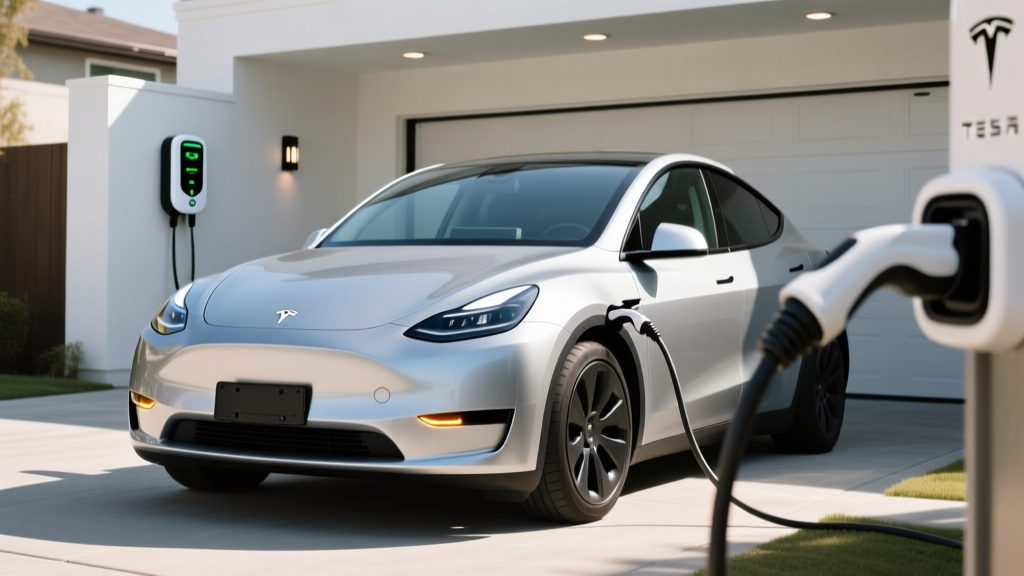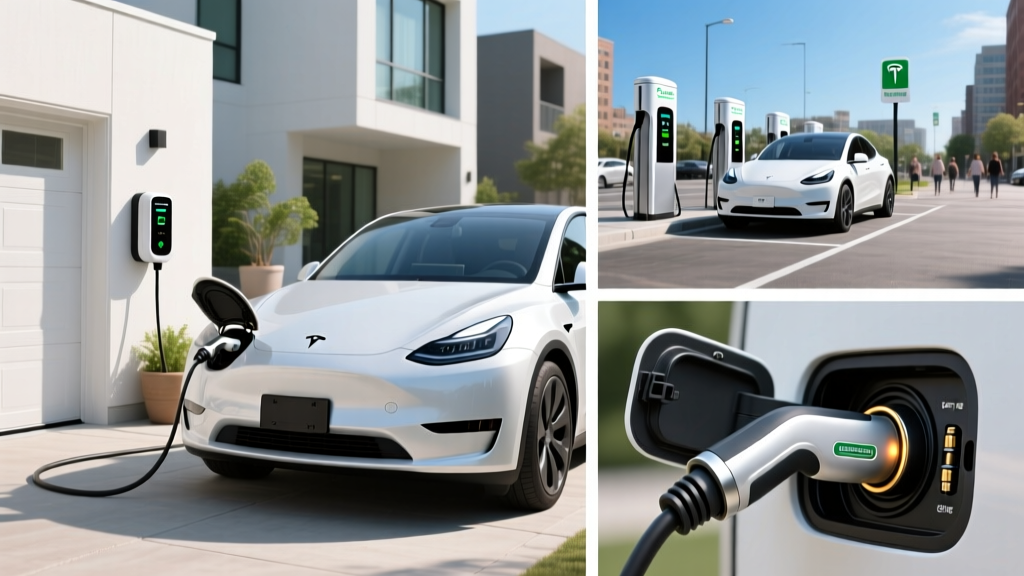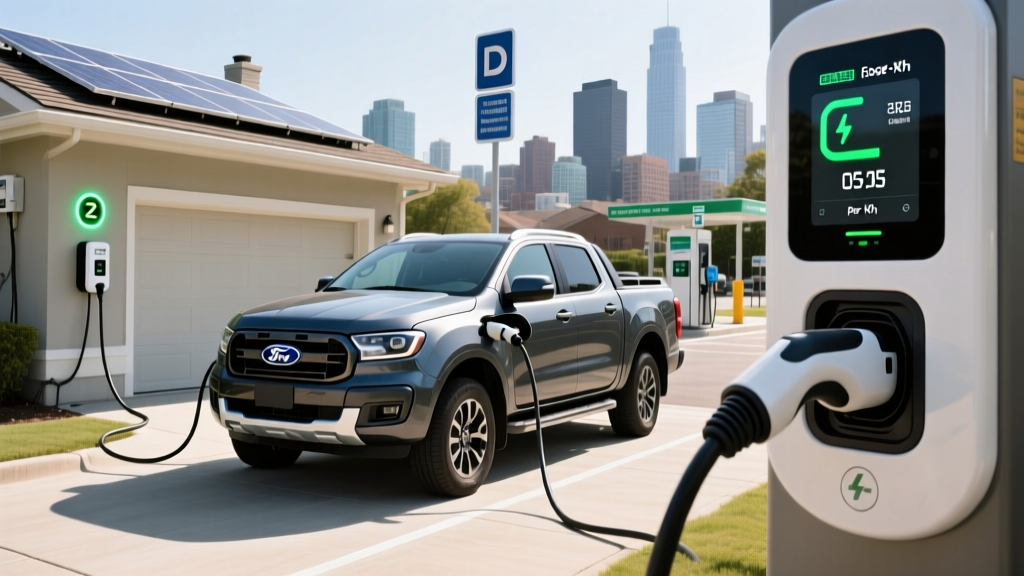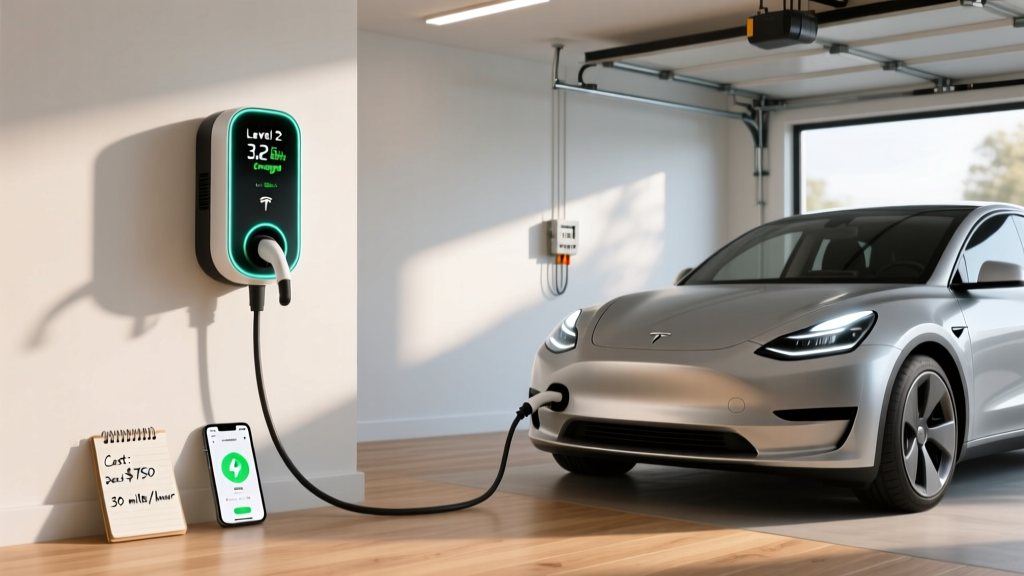
The Case for Level 2 Charging: Why 120V Isn't Enough
Plug an EV into a standard 120V household outlet (Level 1) and you'll add roughly 3–5 miles of range per hour. For a 75 kWh battery depleted to 20%, that's a 20+ hour session just to reach 80%. For most EV owners, Level 2 charging at 240V is the practical baseline — it's the difference between waking up with a full battery every morning and planning your life around charging.
Level 2 charging delivers anywhere from 3.3 kW to 19.2 kW of power, adding 12–75 miles of range per hour depending on the circuit, the charger hardware, and the vehicle's onboard charger limit. Most home installations land in the 7.7–11.5 kW range, which fully replenishes even a large-battery EV like the Ford F-150 Lightning (131 kWh extended-range pack) or the Rivian R1S (149 kWh Max Pack) overnight.
Charging Levels Compared: Speed, Power & Miles Per Hour
Here's how the three EV charging tiers stack up in real-world use. "Miles per hour" figures assume an average efficiency of 3.0–3.5 miles per kWh, which covers most sedans and crossovers. Heavy trucks and large SUVs will see lower per-hour gains.
| Level | Voltage | Power (kW) | Miles Added/Hour | 10–80% Time (75 kWh Battery) | Typical Location |
|---|---|---|---|---|---|
| Level 1 | 120V AC | 1.4–1.9 kW | 3–5 mi | ~37 hours | Standard outlet |
| Level 2 | 208/240V AC | 3.3–19.2 kW | 12–75 mi | 5–10 hours | Home, workplace, public |
| DC Fast | 400–900V DC | 50–350 kW | 150–1,000+ mi | 18–45 minutes | Highway corridors, urban hubs |
A critical nuance: the vehicle's onboard charger caps Level 2 speed regardless of how much power the wall connector supplies. The Hyundai Ioniq 5, for instance, has an 10.9 kW onboard charger — connecting it to a 19.2 kW EVSE won't charge it faster than 10.9 kW. The Tesla Model Y accepts up to 11.5 kW on Level 2. Always check your vehicle's onboard charger rating before overspending on a high-amperage home unit.
Home Installation: Electrical Requirements, Panel Upgrades & Permitting
A Level 2 charger needs a dedicated 240V circuit, the same voltage your electric dryer or oven uses. The most common residential installations are:
- 240V / 40A circuit → 32A continuous draw → 7.7 kW (covers most EVs overnight)
- 240V / 50A circuit → 40A continuous draw → 9.6 kW
- 240V / 60A circuit → 48A continuous draw → 11.5 kW (Tesla Wall Connector max)
- 240V / 80A circuit → 64A continuous draw → 15.3 kW (requires heavy-gauge wire, rare in homes)
The National Electrical Code (NEC) requires that continuous loads — and EV charging qualifies — use no more than 80% of a circuit's rated amperage. That's why a 40A breaker yields 32A of usable charging current.
Will You Need a Panel Upgrade?
Most homes built after 1990 have a 200A main electrical panel, which usually supports a 40–60A EV circuit alongside existing loads. But older homes with 100A or 150A service may need a panel upgrade or a load-management device that throttles the charger when the house is drawing heavily (e.g., HVAC + oven + dryer running simultaneously).
A panel upgrade from 100A to 200A typically costs $1,500–$3,000 including the new panel, permits, and utility coordination. Some utilities offer rebates that offset this. A load-management device (like the Emporia VUE with Smart EV Charger integration) can avoid the upgrade entirely at a cost of $300–$500.
Permits and Code
Nearly every jurisdiction requires an electrical permit for a new 240V circuit. The permit fee typically runs $50–$200. An inspector will verify wire gauge, breaker sizing, grounding, and GFCI protection (required for outdoor installations per NEC 2020 and later). Skipping the permit risks insurance claim denial if an electrical fire occurs.
Installation Cost Breakdown: What You'll Actually Pay
Installation costs vary enormously based on the distance from your panel to the charging location, whether walls need to be opened, and local labor rates. Here's a realistic breakdown:
| Component | Simple Install (panel near garage) | Complex Install (long run, outdoor, panel upgrade) |
|---|---|---|
| EVSE hardware (Level 2 charger) | $350–$700 | $400–$750 |
| Electrician labor (240V circuit) | $300–$600 | $800–$2,000 |
| Wire, conduit, breaker, fittings | $100–$250 | $300–$800 |
| Permit & inspection | $50–$150 | $100–$250 |
| Panel upgrade (if needed) | $0 | $1,500–$3,000 |
| Outdoor-rated enclosure / pedestal | $0 | $100–$300 |
| Total | $800–$1,700 | $3,200–$7,100 |
The IRS Residential Clean Energy Credit (Form 5695) covers 30% of EVSE equipment and installation costs up to $1,000 through 2032, provided you live in a qualifying census tract. This is separate from the §30D vehicle tax credit. Check irs.gov for current eligibility rules and consult a tax professional for your situation.
Connector Compatibility: NACS, CCS1, CHAdeMO & Adapter Needs
The North American charging landscape has consolidated heavily around NACS (North American Charging Standard), the connector Tesla developed and opened to other automakers starting in 2024. By the 2026 model year, most new EVs ship with a native NACS charge port.
| Connector | Brands Using It (2025–2026) | Level 2 Home Charging? | DC Fast Charging? |
|---|---|---|---|
| NACS (J3400) | Tesla, Ford, GM, Rivian, Volvo, Polestar, Mercedes, Hyundai, Kia (select models) | Yes — Tesla Wall Connector, ChargePoint Home Flex (NACS) | Tesla Supercharger, Electrify America, EVgo |
| CCS1 (Combined Charging System) | Volkswagen, BMW, Stellantis, some Hyundai/Kia, legacy 2022–2024 EVs | Yes — J1772 for L2 (CCS is DC-only addition) | Electrify America, EVgo, ChargePoint |
| CHAdeMO | Nissan Leaf (discontinued), Mitsubishi Outlander PHEV (legacy) | Yes — J1772 for L2 | Declining availability |
| J1772 | Universal Level 1/Level 2 standard (all EVs via adapter or native port) | Yes — universal AC connector | N/A (AC only) |
For home Level 2 charging, the AC connector is either J1772 or NACS (which carries AC for Level 2 on the same physical connector used for DC). If you own a CCS-equipped vehicle and want to use a Tesla Wall Connector, you'll need a J1772-to-NACS adapter (~$150–$250). Conversely, Tesla owners charging at J1772 public Level 2 stations need a J1772-to-NACS adapter (Tesla includes one with most vehicles).
Cost to Charge: Level 2 at Home vs. Public vs. Gas
Charging costs depend on your electricity rate, time-of-use pricing, and whether you're at home or on a public network. Here's how common scenarios compare for a vehicle averaging 3.0 miles/kWh (roughly 33 kWh/100mi, typical for a midsize crossover like the Tesla Model Y or Hyundai Ioniq 5):
| Scenario | Rate ($/kWh) | Cost for 300 Miles | Cost Per Mile |
|---|---|---|---|
| Home Level 2 — off-peak (utility TOU) | $0.09–$0.13 | $9–$13 | $0.03–$0.04 |
| Home Level 2 — standard rate (national avg) | $0.16 | $16 | $0.05 |
| Public Level 2 (ChargePoint, EVgo L2) | $0.25–$0.49 | $25–$49 | $0.08–$0.16 |
| DC Fast Charging (Electrify America, EA Pass) | $0.36–$0.56 | $36–$56 | $0.12–$0.19 |
| Gasoline equivalent (25 MPG combined, $3.40/gal) | — | $41 | $0.14 |
The takeaway: home Level 2 charging on an off-peak rate is roughly one-quarter to one-third the per-mile cost of gasoline. Public DC fast charging, by contrast, often costs as much as or more than gas per mile — which is why DC fast charging should be reserved for road trips, not daily use.
For charging time context, here's what 10–80% sessions look like on Level 2 for popular battery sizes:
- 60 kWh battery (e.g., base Tesla Model Y RWD) at 7.7 kW: ~5.5 hours
- 77 kWh battery (e.g., Ford Mustang Mach-E Extended Range) at 9.6 kW: ~5.6 hours
- 84 kWh battery (e.g., Hyundai Ioniq 5 Long Range) at 10.9 kW: ~5.4 hours (onboard charger limited)
- 131 kWh battery (e.g., F-150 Lightning Extended Range) at 11.5 kW: ~8.0 hours
All of these fit comfortably within an overnight window, which is why Level 2 is the "set it and forget it" sweet spot for EV ownership.
Best Level 2 Home Chargers for 2026: Specs & Recommendations
We evaluate chargers on power output, connector availability, cable length, smart features (scheduling, load management, energy tracking), build quality, and price. All picks below are hardwired units (hardwired is preferred over plug-in NEMA 14-50 for safety and to avoid the NEC requirement for GFCI breakers on receptacles, which can nuisance-trip).
Tesla Wall Connector (Gen 4)
- Power: Up to 11.5 kW (48A on 60A circuit)
- Connector: NACS native
- Cable: 24 ft
- Smart features: Wi-Fi, OTA updates, Tesla app scheduling, Powerwall integration
- Load sharing: Yes — daisy-chain up to 6 units on one circuit
- Outdoor rated: Yes (NEMA 4)
- Price: ~$475
- Best for: Tesla owners and any NACS-equipped EV
ChargePoint Home Flex (2nd Gen)
- Power: Up to 12 kW (50A on 60A circuit), configurable 16–50A
- Connector: J1772 or NACS (choose at purchase)
- Cable: 23 ft
- Smart features: Wi-Fi, ChargePoint app, Alexa, scheduling, energy reports
- Load sharing: Yes — Flex groups with other ChargePoint units
- Outdoor rated: Yes (NEMA 4 with weatherproof enclosure)
- Price: ~$550–$650
- Best for: Multi-EV households with mixed connectors
Emporia Level 2 EV Charger
- Power: Up to 11.5 kW (48A on 60A circuit)
- Connector: J1772 or NACS
- Cable: 24 ft
- Smart features: Wi-Fi, Emporia app, real-time energy monitoring, solar integration, TOU scheduling
- Load management: Yes — pairs with Emporia VUE panel monitor
- Outdoor rated: Yes (NEMA 4)
- Price: ~$350–$400
- Best for: Budget-conscious buyers, solar owners, panel-load management
Grizzl-E Smart
- Power: Up to 10 kW (40A on 50A circuit)
- Connector: J1772 (NACS adapter available)
- Cable: 24 ft
- Smart features: Wi-Fi, evDuty app, scheduling
- Build: Aluminum enclosure, extreme cold rated (-40°F)
- Outdoor rated: Yes (IP67)
- Price: ~$450–$550
- Best for: Cold-climate durability, Canadian-built, rugged installations
Safety, Code & Best Practices for Level 2 Installations
Level 2 charging involves sustained high-current draw over many hours — it's the most demanding continuous load in most homes. These safety and code considerations are non-negotiable:
- Dedicated circuit: Your EV charger must have its own breaker. Never share a circuit with other appliances.
- Correct wire gauge: 6 AWG copper for 50A circuits; 4 AWG for 60A. Aluminum wire requires larger gauge. Your electrician will size this per NEC Table 310.16.
- GFCI protection: NEC 2020+ requires GFCI on 240V receptacles (NEMA 14-50). Hardwired EVSEs are exempt from this requirement, which is one reason hardwired is preferred — it eliminates nuisance GFCI trips that plague some receptacle installations.
- Outdoor rating: If the charger is mounted outside or in an unenclosed carport, it must carry a NEMA 4 (or IP65+) rating to resist rain, dust, and hose spray.
- Cable management: Use a holster or cable organizer to keep the cord off the ground. A cable dragging across concrete wears the jacket and exposes conductors over time.
- Surge protection: A whole-panel surge protective device (SPD, ~$150–$300 installed) protects your EVSE and other electronics from grid voltage spikes — especially valuable in lightning-prone regions.
- Utility notification: Some utilities require you to report a new EV load. Many offer TOU rate plans that cut your charging cost by 40–60% during overnight hours. Contact your utility before installation to enroll.
According to data from NHTSA and the National Fire Protection Association, EV charging fires are exceedingly rare and overwhelmingly tied to damaged cords, improper wiring, or unpermitted installations — not the vehicles or certified EVSE hardware themselves. A permitted, professional installation with a UL-listed (or ETL-listed) charger is the safest approach.
Frequently Asked Questions
How much does it cost to install a home Level 2 EV charger?
A straightforward installation (panel within 20–30 feet of the garage, no panel upgrade) typically costs $800–$1,700 total including the charger, electrician labor, materials, and permit. Complex installs with long wire runs, outdoor mounting, or a panel upgrade can reach $3,200–$7,100. The IRS Residential Clean Energy Credit may cover 30% of costs up to $1,000 if you're in a qualifying area. Always get at least two quotes from licensed electricians.
How fast will Level 2 charging add range to my EV?
At 7.7 kW (the most common home setup on a 40A circuit), expect roughly 25–30 miles of range added per hour for an efficient sedan or crossover. At 11.5 kW (48A on a 60A circuit), you'll gain 35–42 miles per hour. Your vehicle's onboard charger rating is the upper limit — if your car maxes out at 7.2 kW onboard, a 48A charger won't speed things up.
Which connector and charger is compatible with my EV?
Check your vehicle's charge port: if it's NACS (the Tesla-style connector, now used by Ford, GM, Rivian, Hyundai, Kia, and others), buy a NACS charger like the Tesla Wall Connector. If it's J1772/CCS (common on 2022–2024 VW, BMW, and Stellantis models), buy a J1772 charger like the ChargePoint Home Flex or Emporia. For DC fast charging, NACS vehicles use Tesla Superchargers and select third-party networks; CCS vehicles use Electrify America and EVgo.
How much does home Level 2 charging cost per mile vs. gas?
On a national average electricity rate of $0.16/kWh, home Level 2 charging costs roughly $0.05 per mile for a vehicle averaging 3.0 mi/kWh. Off-peak TOU rates can drop this to $0.03–$0.04/mi. Gasoline at $3.40/gallon in a 25 MPG vehicle costs $0.14/mi — roughly 3–4x more than home charging. Use the DOE's fueleconomy.gov calculator to compare your specific vehicle and local utility rate.
What electrical upgrades might I need for Level 2 charging?
If your home has a 200A panel (standard in most post-1990 construction), you likely need nothing beyond the new 240V circuit. Homes with 100A or 150A service may need a panel upgrade ($1,500–$3,000) or a smart load-management device that dynamically reduces charger amperage when other large loads are running. A licensed electrician will perform a load calculation per NEC Article 220 to determine whether your panel has sufficient headroom.
Can I plug a Level 2 charger into a dryer outlet?
Technically, a NEMA 14-50 (50A) or NEMA 14-30 (30A) receptacle can power a plug-in Level 2 EVSE. However, NEC 2020+ requires a GFCI breaker on these receptacles, and GFCI nuisance trips are a well-documented problem with EV charging loads. Most EV owners and electricians now recommend hardwiring the charger directly to the panel, which eliminates the GFCI requirement and provides a more reliable connection. If you do use a receptacle, ensure it's a commercial-grade unit (not a $10 big-box store outlet) rated for daily plug/unplug cycles.
Is it safe to charge in the rain or snow?
Yes. UL-listed (or ETL-listed) outdoor-rated chargers with a NEMA 4 or IP65+ rating are designed for wet conditions. The connector and vehicle inlet are engineered so that no current flows until a secure, sealed connection is confirmed. That said, avoid submerging the connector in standing water and inspect the cable jacket periodically for cracks or damage.