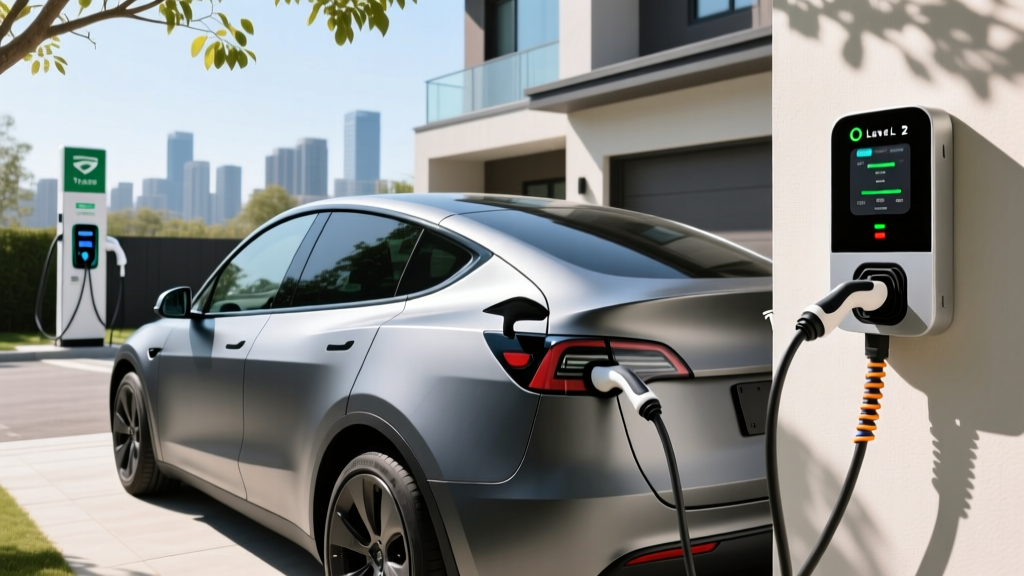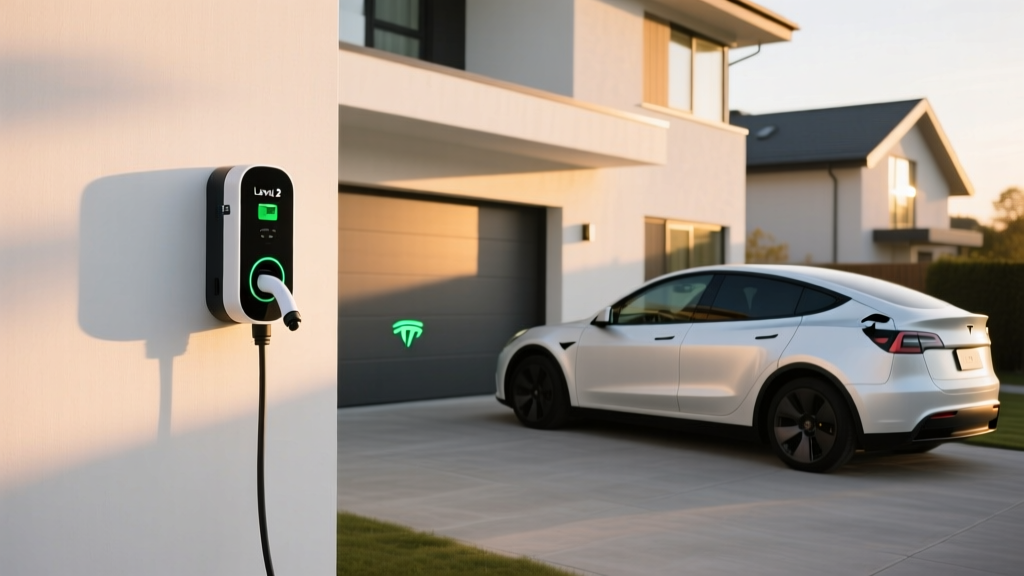
If you've just bought an electric vehicle — or are seriously considering one — the single most impactful ownership decision you'll make is installing a Level 2 home charger. Public DC fast chargers get the headlines, but the reality of EV ownership is that 80% or more of your charging will happen at home, overnight, while you sleep. A properly installed Level 2 unit refills your battery in hours instead of days, costs a fraction of public charging, and eliminates the range-anxiety calculus that plagues first-time EV buyers.
This guide breaks down exactly what a Level 2 charger delivers in real-world speeds, what your home's electrical system needs to support one, what you'll actually pay for equipment and installation, and which units earn our recommendation for 2026. We'll also clarify the critical difference between kW (power — how fast energy flows) and kWh (energy — what's stored in your battery), because confusing the two is the most common mistake new EV owners make.
Charging Levels Explained: kW Speeds and Miles Added Per Hour
Before choosing hardware, you need to understand the three charging tiers available to EV owners. The numbers below assume typical EV efficiency of 3–4 miles per kWh, which covers most sedans and crossovers. Larger trucks like the Rivian R1T or Ford F-150 Lightning will see fewer miles per hour due to higher consumption.
| Level | Voltage | Power (kW) | Miles of Range Per Hour | Typical Use Case |
|---|---|---|---|---|
| Level 1 | 120V AC | 1.0–1.4 kW | 3–5 mi/hr | Emergency / PHEV overnight top-up |
| Level 2 | 240V AC | 3.3–19.2 kW | 12–75 mi/hr | Daily home and workplace charging |
| DC Fast Charge | 400–800V DC | 50–350+ kW | 150–1,000+ mi/hr | Road trips and highway corridors |
Why Level 2 is the home standard: A Level 1 outlet adds roughly 4 miles of range per hour. Plug in a Tesla Model Y (75 kWh usable battery, ~310 miles EPA range) at Level 1 from empty, and you're looking at nearly 80 hours for a full charge — completely impractical. A 48-amp Level 2 charger delivering 11.5 kW refills that same battery in roughly 7 hours, meaning you start every morning with a full charge. For most EV owners, Level 2 is the minimum viable home setup.
DC fast charging is not for daily home use. DCFC stations deliver direct current at high voltage, bypassing the car's onboard charger entirely. They're designed for 10–80% top-ups in 15–30 minutes on road trips. The equipment costs $30,000–$150,000+ and requires commercial-grade electrical service — it's not a residential option.
Electrical Requirements: What Your Home Needs for a Level 2 Charger
A Level 2 charger requires a 240-volt circuit — the same type of outlet your electric dryer or oven uses. The specific amperage determines how fast you can charge, and this is where most homeowners need professional guidance.
Circuit Amperage and Charger Output
Here's the math that matters: a charger's output in kW equals voltage × amperage ÷ 1,000. On a 240V circuit:
- 20-amp circuit → 16 amps continuous (80% NEC rule) → 3.8 kW → ~15 mi/hr
- 30-amp circuit → 24 amps continuous → 5.8 kW → ~23 mi/hr
- 40-amp circuit → 32 amps continuous → 7.7 kW → ~30 mi/hr
- 50-amp circuit → 40 amps continuous → 9.6 kW → ~37 mi/hr
- 60-amp circuit → 48 amps continuous → 11.5 kW → ~44 mi/hr
- 100-amp circuit → 80 amps continuous → 19.2 kW → ~75 mi/hr
The National Electrical Code (NEC) requires that continuous loads — which EV charging is classified as — use only 80% of a circuit's rated capacity. So a 48-amp charger needs a 60-amp breaker, not a 48-amp breaker. This trips up many first-time buyers who read "48 amp" on a charger spec sheet and assume a 50-amp circuit is sufficient. It isn't.
Does Your Electrical Panel Have Capacity?
Most modern homes have a 200-amp main panel. Adding a 60-amp circuit for EV charging consumes a significant chunk of that capacity, especially if you're already running central air, an electric range, and a dryer. A licensed electrician will perform a load calculation to determine whether your panel can handle the additional circuit.
When a panel upgrade is needed: Homes with 100-amp or 150-amp service, older homes with fuse boxes, or homes already near capacity will likely need a panel upgrade to 200 amps. This is the single biggest variable in installation cost — a panel upgrade adds $1,500–$4,000+ to the project. Don't skip this assessment; overloading a panel is a fire hazard and will fail inspection.
Hardwired vs. Plug-In (NEMA 14-50)
You have two installation options:
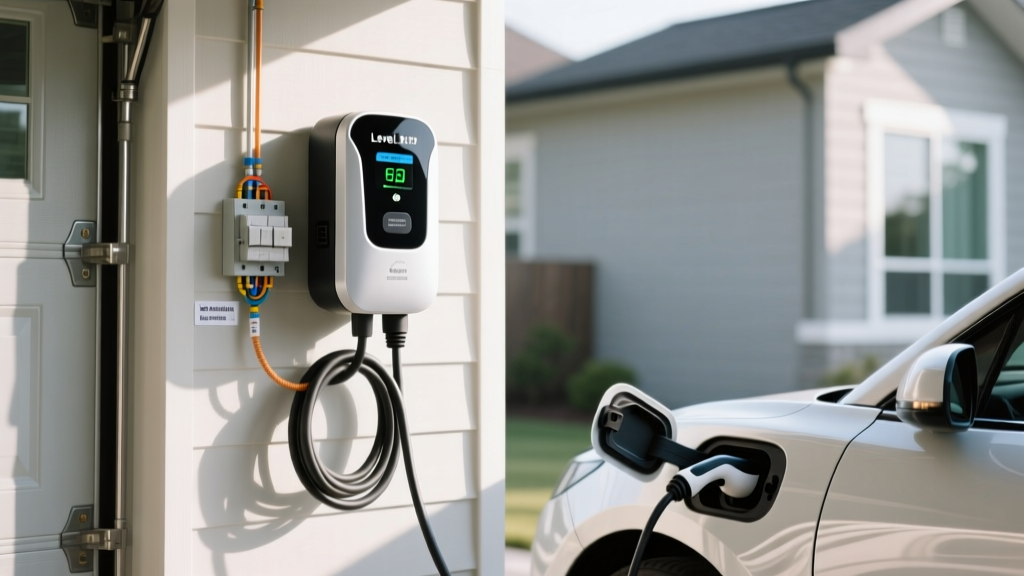
- Hardwired: The charger is directly wired into a dedicated breaker. This is the preferred method for circuits above 50 amps, avoids the cost of a receptacle, and eliminates the failure point of a plug connection. Most 48-amp and all 80-amp chargers require hardwiring.
- Plug-in (NEMA 14-50): The charger plugs into a 240V outlet, making it portable if you move. This works well for 40-amp chargers on a 50-amp circuit. However, NEC 2023/2026 code in many jurisdictions now requires GFCI protection on 14-50 receptacles, which can add $50–$150 and occasionally causes nuisance tripping with some charger models. Hardwired installations typically do not require GFCI breakers because the charger itself provides ground-fault protection.
How Much Does It Cost to Install a Level 2 Home Charger?
Installation costs vary enormously based on your home's electrical infrastructure, the distance from your panel to the charging location, and local permit fees. Here's a realistic breakdown based on 2026 electrician rates and equipment pricing:
| Component | Simple Install | Typical Install | Complex Install |
|---|---|---|---|
| Level 2 Charger (hardware) | $300–$450 | $450–$700 | $600–$800 |
| Electrical permit | $50–$100 | $100–$200 | $150–$300 |
| Electrician labor (2–4 hrs simple, 4–8 hrs complex) | $300–$600 | $600–$1,200 | $1,200–$2,500 |
| Conduit, wiring, breaker | $100–$200 | $200–$500 | $500–$1,000 |
| Panel upgrade (if needed) | $0 | $0–$1,500 | $1,500–$4,000 |
| Total Estimated Cost | $750–$1,350 | $1,350–$4,100 | $3,950–$8,600 |
Simple install = Panel has capacity, charger location is within 10 feet of the panel, same wall or easy attic/crawlspace run. Typical install = 20–50 foot wire run through walls or conduit, panel has marginal capacity but no upgrade needed. Complex install = Panel upgrade required, long conduit run to a detached garage, or trenching needed.
Federal tax credit: The IRS §30D alternative fuel vehicle refueling property credit covers 30% of charger hardware and installation costs, up to $1,000, for equipment placed in service through 2032. This credit has specific census-tract eligibility requirements — not every zip code qualifies. Check the IRS guidelines and consult a tax professional to confirm eligibility.
Connector Compatibility: NACS, CCS1, and CHAdeMO
As of 2026, the North American EV connector landscape has consolidated significantly around NACS (the Tesla-designed North American Charging Standard), but legacy connectors remain in widespread use. Your home charger must match your vehicle's charge port.
| Connector | Brands Using It | Home Charger Availability |
|---|---|---|
| NACS (J3400) | Tesla (all), Ford, GM, Rivian, Volvo, Polestar, Hyundai/Kia (2025+), BMW, Mercedes-Benz, Subaru | Widely available — Tesla Wall Connector, ChargePoint, Emporia, Grizzl-E |
| CCS1 | Volkswagen ID.4 (pre-2025), some remaining Hyundai/Kia (pre-2025), legacy models | Widely available — ChargePoint, JuiceBox, Emporia |
| CHAdeMO | Nissan LEAF (discontinued 2025), Mitsubishi Outlander PHEV (legacy) | Limited — mostly legacy units; adapters available |
Adapter note: Tesla sells a CCS-to-NACS adapter (~$175) and a J1772-to-NACS adapter for use with non-Tesla Level 2 chargers. If you own a NACS-equipped vehicle but already have a J1772 (the legacy Level 2 standard) charger installed, you can use an adapter rather than replacing the unit. However, for new installations in 2026, buying a native NACS charger is the straightforward choice for most buyers.
For public DC fast charging, the NACS transition means most new chargers at Electrify America, EVgo, and other networks now offer NACS cables alongside CCS1. CHAdeMO infrastructure is being phased out.
Cost to Charge: Home vs. Public vs. Gas Per Mile
The economic case for home charging is overwhelming. Here's how the numbers stack up for a typical EV getting 3.5 miles per kWh (roughly equivalent to a mid-size crossover like the Tesla Model Y or Hyundai Ioniq 5):
| Scenario | Rate | Cost Per kWh | Cost Per Mile |
|---|---|---|---|
| Home — Off-peak utility rate | $0.09–$0.14/kWh | $0.12 avg | $0.034 |
| Home — Standard rate (no TOU plan) | $0.13–$0.20/kWh | $0.16 avg | $0.046 |
| Home — Solar (owned system, net cost) | $0.04–$0.08/kWh | $0.06 avg | $0.017 |
| Public Level 2 (ChargePoint, etc.) | $0.25–$0.49/kWh | $0.35 avg | $0.100 |
| DC Fast Charge (Electrify America, EVgo) | $0.35–$0.65/kWh | $0.48 avg | $0.137 |
| Gasoline vehicle (27 MPG combined, $3.40/gal) | — | — | $0.126 |
Source: fueleconomy.gov efficiency data; AAA Your Driving Costs 2025 for fuel pricing.
The takeaway: home off-peak charging costs roughly one-quarter to one-third what gasoline costs per mile. Even standard-rate home charging undercuts gas. Public DC fast charging, however, can equal or exceed gas costs — which is why relying on public infrastructure as your primary charging strategy erodes the EV cost advantage. A Level 2 home charger isn't just a convenience; it's the financial backbone of EV ownership.
Pro tip: Many utilities offer time-of-use (TOU) plans that drop rates to $0.05–$0.10/kWh between 10 PM and 6 AM. Set your charger's scheduling feature (most smart chargers support this) to charge during off-peak hours and you'll minimize cost while also reducing grid strain.
Charging Time Examples: How Long Does a Full Charge Take?
Charging time depends on your battery size (measured in kWh — that's energy capacity) and your charger's output (measured in kW — that's power delivery rate). The formula is straightforward: usable battery kWh ÷ charger kW = hours for a full charge, plus roughly 10–15% overhead for efficiency losses.
Here are real-world estimates for popular 2026 EVs charging from 10% to 80% state of charge on a 48-amp (11.5 kW) Level 2 home charger:
- Tesla Model Y Long Range (75 kWh usable): ~4.5 hours, 10–80%
- Hyundai Ioniq 5 (77.4 kWh usable): ~4.7 hours, 10–80%
- Ford F-150 Lightning Extended Range (131 kWh usable): ~8 hours, 10–80%
- Chevrolet Equinox EV (85 kWh usable): ~5.2 hours, 10–80%
- BMW i4 eDrive40 (81.5 kWh usable): ~5 hours, 10–80%
- Toyota bZ4X (71.4 kWh usable): ~4.3 hours, 10–80%
All of these comfortably complete overnight. Even the massive F-150 Lightning battery fills from 10–80% while you sleep. For context, on a 32-amp (7.7 kW) charger, add roughly 50% to these times — still manageable for most daily driving patterns, but tight if you regularly drive 200+ miles and need a quick turnaround.
Level 2 charging and battery health: Unlike DC fast charging, which generates significant heat and accelerates degradation when used frequently, Level 2 charging is gentle on battery chemistry. Most manufacturers recommend Level 2 as the primary charging method for long-term battery health. For NMC batteries, keeping daily charge to 80% and charging to 100% only for road trips maximizes longevity. LFP batteries (found in some Tesla Model 3/Y Standard Range and Ford Mustang Mach-E Select trims) tolerate — and actually benefit from — regular 100% charges.
Recommended Level 2 Home Chargers for 2026
We've tested and tracked reliability data on the major home charging units available in 2026. Here are our picks across key categories, all verified for current production specs:
Tesla Wall Connector (NACS) — Best Overall for NACS Vehicles
- Power output: Up to 48 amps (11.5 kW on 240V)
- Connector: Native NACS
- Cable length: 24 feet
- Smart features: Wi-Fi, OTA updates, Tesla app scheduling, Power-Share (load balancing between two units on one circuit)
- Price: ~$425
- Verdict: Sleek, reliable, and the obvious pick if you own a Tesla or any NACS-equipped EV. The 24-foot cable is generous. No J1772/CCS variant available — this is NACS-only.
Emporia Vue Smart Charger — Best Value with Energy Monitoring
- Power output: Up to 48 amps (configurable down to 16A)
- Connector: NACS or J1772 (choose at purchase)
- Cable length: 24 feet
- Smart features: Wi-Fi, Emporia app, real-time energy monitoring, solar integration, TOU scheduling, EVA (Emporia Vehicle Analytics) for tracking charging cost per session
- Price: ~$399 (NACS) / ~$349 (J1772)
- Verdict: Outstanding value. The built-in energy monitoring pairs with Emporia's whole-home Vue energy monitor for granular cost tracking. Amperage is software-configurable, so you can match it to your circuit without buying a different unit. Hardwired installation required for 48A.
ChargePoint Home Flex — Best for CCS1 and Flexibility
- Power output: Up to 50 amps (12 kW) — configurable via dip switches from 16A to 50A
- Connector: NACS or J1772 (CCS1-compatible J1772 plug with adapter)
- Cable length: 23 feet
- Smart features: Wi-Fi, ChargePoint app, Alexa/Google Home integration, scheduling, detailed session history
- Price: ~$649 (NACS) / ~$599 (J1772)
- Verdict: The most flexible unit on the market thanks to its configurable amperage. If you're unsure about your panel capacity, you can set it to 32A now and increase later if you upgrade your service. Premium build quality, UL-listed, and widely recommended by electricians. Available as plug-in (NEMA 14-50) or hardwired.
Grizzl-E Smart — Most Durable for Outdoor / Cold Climate
- Power output: Up to 40 amps (9.6 kW)
- Connector: NACS or J1772
- Cable length: 24 feet
- Smart features: Wi-Fi (Smart model), OCPP-compatible, works with multiple apps, cold-weather rated to -40°F
- Price: ~$449 (Smart) / ~$349 (non-Smart)
- Verdict: Built in Canada for harsh winters. The aluminum enclosure and extreme cold rating make it ideal for outdoor installations in northern climates. The 40-amp max is sufficient for most daily needs. The non-smart version is a solid budget pick if you don't need app features.
Safety, Permits, and Code Requirements
EV charging is a continuous high-amperage load that runs for hours — it demands proper installation. Here's what you need to know:
- Dedicated circuit: Your Level 2 charger must be on its own dedicated breaker. Sharing a circuit with other appliances is a code violation and a fire risk.
- Permit and inspection: Virtually all jurisdictions require an electrical permit for a new 240V circuit. The permit fee is typically $50–$300, and a city/county inspector will verify the installation meets NEC code. Do not skip this step — unpermitted work can void your homeowner's insurance coverage in the event of an electrical fire.
- GFCI requirements: NEC 2023 (and the adopted 2026 code cycle in many states) requires GFCI protection on 240V receptacles in garages. This applies to NEMA 14-50 plug-in installations. Hardwired chargers with built-in ground-fault protection are generally exempt. Nuisance GFCI trips have been reported with some charger/breaker combinations — hardwiring avoids this issue entirely.
- Outdoor rating: If your charger is mounted outside, it must carry a NEMA 4 (weatherproof) or IP65+ rating. All units recommended above meet this standard. Ensure the connector holster protects the plug from rain and debris when not in use.
- Wire gauge: Your electrician will size wire to the circuit amperage. For a 60-amp circuit (48A charger), 6 AWG copper or 4 AWG aluminum is typical. Longer runs may require upsizing to minimize voltage drop.
- Utility notification: Some utilities require notification before adding a large new load. A few offer rebates for Level 2 charger installation — check with your local provider. According to the Alternative Fuels Data Center, state and utility incentives vary widely.
Frequently Asked Questions
Can I install a Level 2 charger myself?
If you're experienced with electrical work and your jurisdiction allows homeowner permits, it's technically possible. However, most homeowners should hire a licensed electrician. A mistake with a 60-amp 240V circuit can cause a fire, and most insurance policies require permitted, professional installation for coverage. The labor cost ($300–$1,200 for a typical install) is worth the safety and code compliance.
Will a Level 2 charger work with any EV I buy in the future?
Most likely, yes — if you buy a NACS-equipped charger. As of 2026, nearly every major automaker has adopted NACS for new models. If you currently own a CCS1 vehicle, you can use a NACS-to-CCS adapter (available from Tesla and third-party makers) or install a J1772 charger with an adapter. The connector landscape has consolidated enough that a NACS charger is the safest long-term bet.
Do I need a smart charger, or is a "dumb" charger fine?
A non-smart charger works perfectly for basic charging — plug in and it charges. Smart features (Wi-Fi, app scheduling, energy monitoring) add value if you want to optimize for off-peak utility rates, track charging costs, or integrate with solar panels. If your utility offers time-of-use rates, a smart charger that can schedule charging automatically will pay for its price premium within months.
How fast will each charging level add range?
Level 1 (120V): approximately 3–5 miles per hour. Level 2 (240V, 48A): approximately 37–44 miles per hour depending on vehicle efficiency. DC Fast Charge (150 kW+): approximately 150–400+ miles in 15–20 minutes. For daily driving of 30–50 miles, Level 2 replaces everything you use overnight. Level 1 is only practical for plug-in hybrids with small batteries (10–40 kWh) or very low daily mileage.
What electrical upgrades might I need beyond the charger circuit?
The most common upgrade is a panel upgrade from 100A or 150A to 200A, which costs $1,500–$4,000. Older homes may also need new grounding rods, updated meter bases, or service lateral replacements. In rare cases, the utility may need to upgrade the transformer serving your home — this is typically free but can add weeks to the timeline. Get a load calculation from your electrician before committing to a charger amperage.