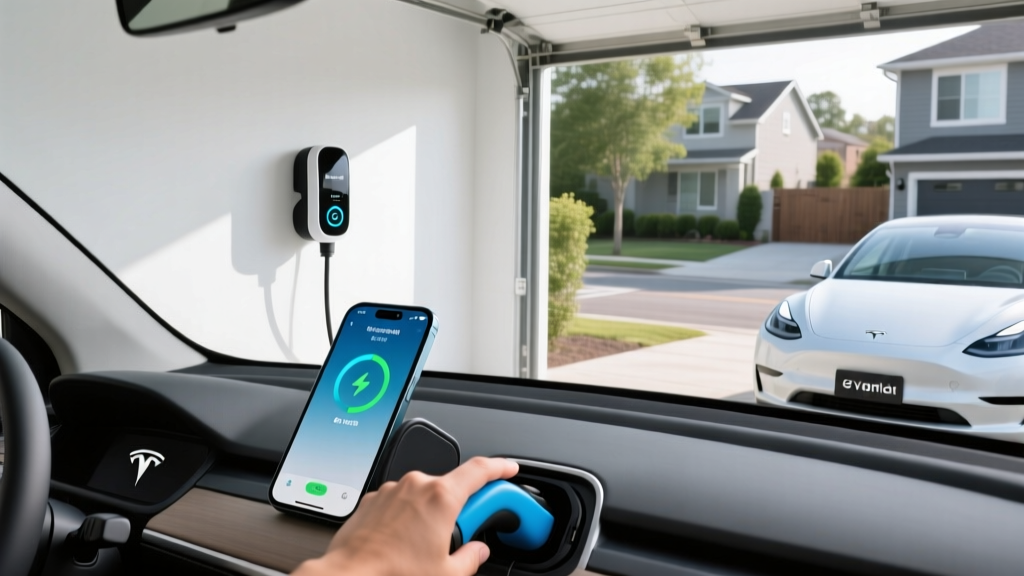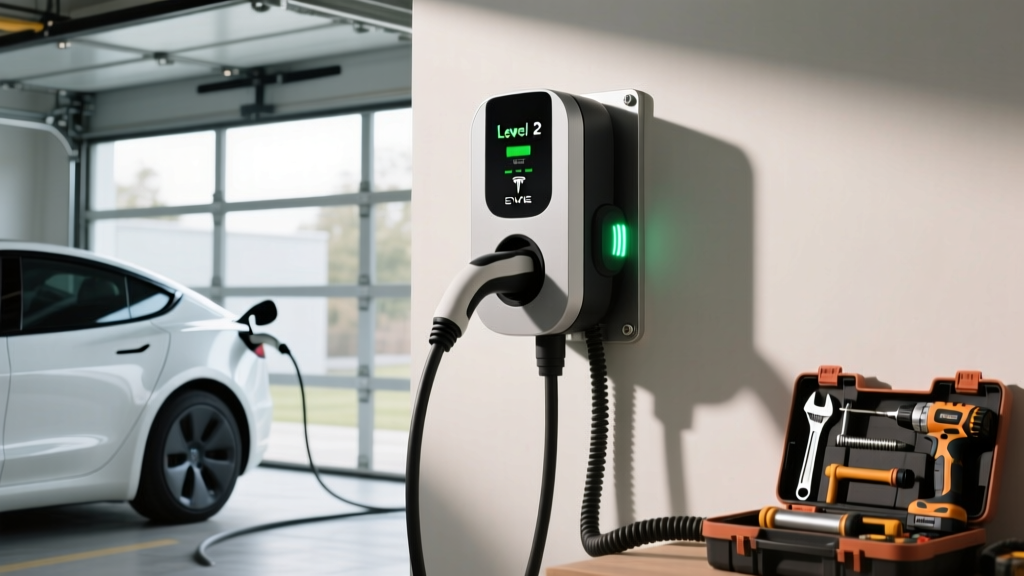
If you own or plan to buy a battery-electric vehicle, a Level 2 EVSE charger at home is the single highest-impact upgrade you can make. Level 2 equipment delivers 240-volt AC power — the same voltage as your electric dryer — and replenishes 15 to 44 miles of range per hour depending on the unit's amperage and your vehicle's onboard charger. For most EV owners, a Level 2 EVSE charger means waking up every morning with a full battery, eliminating routine visits to public stations, and paying the lowest per-mile energy cost available.
This guide covers the electrical requirements, real installation costs, connector compatibility, equipment recommendations, and the cost-per-mile math you need to make an informed decision in 2026.
Charging Levels Explained: kW, Miles Per Hour, and Real-World Speeds
Before evaluating equipment, you need to understand the three charging tiers available to EV drivers. The critical distinction: kW (kilowatts) measures power — the rate at which energy flows into your battery — while kWh (kilowatt-hours) measures energy — the total capacity stored in your battery. A 10 kWh battery charged at 10 kW reaches full in roughly one hour. Confusing these two units is the most common EV literacy mistake.
| Level | Voltage | Max Power (kW) | Miles of Range Added Per Hour | Typical Use Case |
|---|---|---|---|---|
| Level 1 | 120V AC | 1.4–1.9 kW | 3–5 mi/hr | Overnight top-off, PHEV owners, low-mileage drivers |
| Level 2 | 240V AC | 3.3–19.2 kW | 15–44 mi/hr (varies by vehicle onboard charger) | Daily home charging, workplace, public destination |
| DC Fast Charge | 200–900V DC | 50–350+ kW | 150–300+ mi in 20–30 min | Road trips, highway corridors, rapid top-up |
The miles-per-hour figures for Level 2 vary significantly based on your vehicle's onboard charger capacity. A Tesla Model 3 with an 11.5 kW onboard charger gains roughly 44 miles per hour on a 48-amp Level 2 EVSE charger. A Chevrolet Equinox EV with an 11.5 kW onboard charger achieves similar speeds. But a Nissan Leaf limited to 6.6 kW onboard charging gains only about 25 miles per hour even on a 48-amp unit — the vehicle, not the charger, is the bottleneck.
Electrical Requirements: What Your Home Needs for a Level 2 EVSE Charger
A Level 2 EVSE charger requires a dedicated 240-volt circuit, similar to what powers an electric range or dryer. The specific amperage determines your charging speed and your electrical infrastructure needs.
Common Circuit Configurations
- 20-amp circuit: Delivers up to 16 amps continuous (3.8 kW). Suitable for PHEVs with small batteries or BEVs driven fewer than 30 miles daily.
- 30-amp circuit: Delivers up to 24 amps continuous (5.8 kW). Adds roughly 20–25 miles per hour. Adequate for most daily driving needs.
- 40-amp circuit: Delivers up to 32 amps continuous (7.7 kW). Adds roughly 28–32 miles per hour. The most popular residential configuration.
- 50-amp circuit: Delivers up to 40 amps continuous (9.6 kW). Adds roughly 35–38 miles per hour. Requires 6-gauge copper wire.
- 60-amp circuit: Delivers up to 48 amps continuous (11.5 kW). Adds roughly 40–44 miles per hour for vehicles with 11.5 kW+ onboard chargers. Requires 4-gauge copper wire.
National Electrical Code (NEC) requires that continuous loads — and EV charging qualifies — must not exceed 80% of the circuit breaker rating. A 40-amp breaker therefore delivers a maximum of 32 amps to your EVSE. This 80% rule is non-negotiable and will be verified during inspection.
Panel Capacity and Upgrade Considerations
Before purchasing a Level 2 EVSE charger, have a licensed electrician perform a load calculation on your electrical panel. This calculation determines whether your existing panel can handle the additional 40–60 amps without overloading.
Homes built after 2000 typically have 200-amp service panels with sufficient spare capacity. Older homes — particularly those with 100-amp or 150-amp panels and existing high-draw appliances (electric heat, electric range, electric dryer) — may require a panel upgrade to 200 amps before adding a 40–60 amp EV circuit.
A panel upgrade from 100A to 200A typically costs $1,500–$3,500 including the new panel, permit, and labor. This is a significant upfront cost, but it also increases your home's resale value and accommodates future electrification (heat pumps, induction stoves, solar inverters).
Level 2 EVSE Charger Installation Cost Breakdown
Installation costs vary dramatically based on your home's electrical layout, the distance from panel to charger location, and whether upgrades are needed. Here is a realistic breakdown based on national averages in 2026.
| Component | Simple Install (Panel adjacent, no upgrade) |
Standard Install (30–50 ft run, no upgrade) |
Complex Install (Long run or panel upgrade) |
|---|---|---|---|
| EVSE Equipment (Level 2 unit) | $300–$700 | $300–$700 | $300–$700 |
| Electrical Permit | $50–$150 | $50–$150 | $50–$200 |
| Electrician Labor (2–4 hrs simple, 4–8 hrs standard, 8–16 hrs complex) | $300–$600 | $600–$1,200 | $1,200–$3,000 |
| Wire, Conduit, Breaker, Materials | $50–$150 | $200–$500 | $500–$1,500 |
| Panel Upgrade (if needed) | $0 | $0 | $1,500–$3,500 |
| Total Estimated Cost | $700–$1,600 | $1,150–$2,550 | $3,550–$8,900 |
According to data compiled by the U.S. Department of Energy, the national average for a straightforward Level 2 home installation falls between $1,000 and $2,500 including equipment and labor. Homes requiring panel upgrades or long conduit runs through finished walls can exceed $5,000.
Some states and utilities offer rebates that offset installation costs. California's utility programs, for example, have historically offered $500–$1,500 toward EVSE installation. Check with your local utility for current incentive availability — these programs change frequently and are jurisdiction-specific.
Federal Tax Credit for Home Charging Equipment
The federal Alternative Fuel Vehicle Refueling Property Credit (IRS Form 8911) covers 30% of the cost of home EV charging equipment and installation, up to a maximum credit of $1,000. This credit is subject to eligibility requirements including placement in a qualifying census tract (generally non-urban or low-income areas). Consult a tax professional to confirm eligibility — census-tract qualification varies by address and is not universal.
Connector Compatibility: NACS, CCS1, and CHAdeMO
As of 2026, the North American charging connector landscape has largely consolidated around the North American Charging Standard (NACS), originally developed by Tesla and now adopted by nearly every major automaker. However, many EVs on the road still use the CCS1 (Combined Charging System) connector, and older Nissan Leafs and Mitsubishi Outlander PHEVs use CHAdeMO.
| Connector | Vehicle Brands Using It (New Vehicles) | Adapter Availability |
|---|---|---|
| NACS (J3400) | Tesla (all), Ford, GM, Rivian, Volvo, Polestar, Mercedes-Benz, BMW, Hyundai, Kia, Subaru, Lucid, Toyota | N/A — native connector |
| CCS1 | Legacy models (2024 and earlier); some Stellantis models still transitioning | CCS1-to-NACS adapters available ($150–$250) from Tesla and third parties |
| CHAdeMO | Discontinued for new vehicles (last: Nissan Leaf 2025) | Limited adapter options; CHAdeMO infrastructure declining |
| J1772 (Level 1/2 only) | All non-Tesla EVs pre-2025; many PHEVs still use J1772 for AC charging | Tesla Mobile Connector includes J1772 adapter; NACS vehicles may need J1772-to-NACS adapter for older public Level 2 stations |
For Level 2 home charging, the connector situation is straightforward: if your EV has a NACS port, buy a NACS-equipped EVSE. If your EV has a CCS1 port, buy a CCS1/J1772-equipped EVSE or use an adapter. Most modern Level 2 EVSE chargers now ship with NACS connectors as the default, reflecting the market shift.
Best Level 2 EVSE Charger Picks for 2026
These recommendations are based on power output, build quality, smart features, cable length, connector options, and real-world reliability reports from EV owner communities.
Tesla Wall Connector (Gen 4)
- Power Output: Up to 11.5 kW (48A)
- Connector: NACS (native); J1772 adapter included
- Cable Length: 24 feet
- Smart Features: Wi-Fi, OTA updates, power sharing between multiple units, Tesla app integration
- Outdoor Rating: Yes (NEMA 4)
- Price: ~$475
Best for Tesla owners and NACS-equipped EVs. Power-sharing feature lets you install two units on a single 60A circuit — useful for two-EV households.
ChargePoint Home Flex
- Power Output: Up to 12 kW (50A), configurable down to 16A for smaller circuits
- Connector: NACS or J1772 (select at purchase)
- Cable Length: 23 feet
- Smart Features: Wi-Fi, ChargePoint app, scheduled charging, energy tracking, Alexa integration
- Outdoor Rating: Yes (NEMA 4)
- Price: ~$550–$650
Best all-around smart charger. The configurable amperage means you can install it on a 20A circuit today and reconfigure for a 60A circuit after a future panel upgrade.
EnelX JuiceBox 2 (48A)
- Power Output: Up to 11.5 kW (48A)
- Connector: J1772 (NACS adapter available)
- Cable Length: 25 feet
- Smart Features: Wi-Fi, JuiceNet app, energy monitoring, utility demand-response compatible
- Outdoor Rating: Yes (NEMA 4)
- Price: ~$450–$550
Strong pick for utility-integrated homes. Some utilities offer demand-response rebates specifically for JuiceBox units that allow off-peak scheduling.
Grizzl-E Smart (United Chargers)
- Power Output: Up to 10 kW (40A)
- Connector: J1772 or NACS
- Cable Length: 24 feet
- Smart Features: Wi-Fi, app control, OCPP compatibility (future utility integration)
- Outdoor Rating: Yes (NEMA 4X — superior weather resistance)
- Price: ~$450–$500
Best for harsh climates. Built in Canada with extreme cold tolerance (rated to -40°F) and a rugged aluminum enclosure. Ideal for outdoor installations in northern states.
For a budget option, the Emporia Level 2 EV Charger (~$300–$350) delivers 48A/11.5 kW with Wi-Fi and energy monitoring via the Emporia app. It lacks the premium build quality of the ChargePoint or Tesla units but offers exceptional value for price-conscious buyers.
Cost to Charge: Home vs. Public vs. Gas Per-Mile Comparison
One of the strongest arguments for home Level 2 charging is the per-mile cost advantage. Electricity prices vary by region, but even at above-average rates, home charging undercuts gasoline on a per-mile basis.
| Scenario | Rate ($/kWh) | Vehicle Efficiency (kWh/100 mi) | Cost Per Mile | Annual Cost (12,000 mi) |
|---|---|---|---|---|
| Home Level 2 — Off-Peak TOU Rate | $0.08–$0.12 | 28 kWh/100 mi (e.g., Tesla Model Y) | $0.022–$0.034 | $264–$408 |
| Home Level 2 — Standard Residential Rate | $0.14–$0.18 | 28 kWh/100 mi | $0.039–$0.050 | $468–$600 |
| Public Level 2 (Networked Station) | $0.20–$0.35 | 28 kWh/100 mi | $0.056–$0.098 | $672–$1,176 |
| DC Fast Charging (Electrify America, Tesla Supercharger) | $0.30–$0.55 | 28 kWh/100 mi | $0.084–$0.154 | $1,008–$1,848 |
| Gasoline Vehicle (28 MPG combined, $3.40/gal) | $3.40/gal | 3.57 gal/100 mi | $0.121 | $1,452 |
These figures use fueleconomy.gov efficiency data for a mid-size electric crossover. The takeaway is clear: home Level 2 charging at off-peak rates costs roughly one-quarter to one-third of what gasoline costs per mile. Even at standard residential rates without time-of-use optimization, you save 60–70% versus gas.
However, if you rely exclusively on DC fast charging — as apartment dwellers without home charging access sometimes must — your per-mile cost can equal or exceed gasoline. This is the economic case for investing in a home Level 2 EVSE charger: it's where the fuel-cost savings actually materialize.
Charging Time Examples for Common Battery Sizes
How long does a Level 2 EVSE charger take to replenish a typical EV battery? Here are real-world estimates for a 10% to 80% state-of-charge session — the range most EV owners use for daily charging, since charging above 80% slows dramatically to protect battery health.
- Tesla Model Y (75 kWh battery, 11.5 kW onboard charger): ~4.5 hours on a 48A Level 2 unit (10–80%)
- Hyundai Ioniq 5 (84 kWh battery, 10.9 kW onboard charger): ~5.3 hours on a 48A unit (10–80%)
- Ford Mustang Mach-E Extended Range (91 kWh battery, 10.5 kW onboard charger): ~5.9 hours on a 48A unit (10–80%)
- Chevrolet Equinox EV (85 kWh battery, 11.5 kW onboard charger): ~5.1 hours on a 48A unit (10–80%)
- Toyota RAV4 Prime PHEV (18.1 kWh battery, 6.6 kW onboard charger): ~2.0 hours on a 32A unit (10–80%)
For overnight charging, even a 32-amp (7.7 kW) Level 2 EVSE charger provides ample speed — you'll wake up to a full battery after 8–10 hours regardless of battery size. The 48A units are most valuable for drivers who need rapid turnaround between trips or who charge opportunistically during the day.
Safety, Electrical Code, and Installation Best Practices
A Level 2 EVSE charger draws substantial current for extended periods — often 6 to 10 continuous hours. This places it among the most demanding loads in your home, and safety considerations are paramount.
Key Code and Safety Requirements
- Dedicated circuit: Your EVSE must be on a dedicated breaker — it cannot share a circuit with other outlets or appliances. This prevents overloads and ensures consistent power delivery.
- GFCI protection: The 2023 NEC (and subsequent editions adopted by most states by 2026) requires GFCI (Ground Fault Circuit Interrupter) protection for all EVSE outlets. Hardwired EVSE units typically have built-in ground-fault protection and may not require a separate GFCI breaker — but verify with your local inspector, as jurisdiction-level interpretations vary.
- Outdoor rating: If your charger is installed outdoors or in an exposed carport, it must carry a NEMA 4 (weather-resistant) or NEMA 4X (weather- and corrosion-resistant) rating. All recommended units above meet this standard.
- Cable management: EVSE cables should not trail across walkways or driveways where they create a trip hazard. Wall-mounted cable organizers or retractable cord reels keep installations clean and safe.
- Permit and inspection: Virtually all jurisdictions require an electrical permit for a new 240V circuit. The inspection ensures proper wire gauge, breaker sizing, grounding, and GFCI compliance. Do not skip this step — unpermitted work can void home insurance coverage and cause problems at resale.
Hardwired vs. Plug-In (NEMA 14-50 Outlet)
You have two installation options: hardwire the EVSE directly to the circuit, or install a NEMA 14-50 (50A) or NEMA 6-50 (50A, no neutral) receptacle and plug the unit in.
Hardwired installations are slightly cheaper (no receptacle cost), eliminate the risk of a loose plug connection, and are preferred for outdoor installations. Plug-in installations offer portability — you can unplug the EVSE and take it when you move, or swap units without calling an electrician. A NEMA 14-50 receptacle adds approximately $50–$150 to installation cost.
One important note: some jurisdictions now require GFCI breakers for 14-50 receptacles used for EV charging, and GFCI breakers for 50–60A circuits cost $80–$150 and can occasionally nuisance-trip with certain EVSE units. Hardwiring avoids this issue entirely.
Frequently Asked Questions
How much does it cost to install a home Level 2 EVSE charger?
A straightforward installation with an adequate electrical panel and short wire run costs $700–$1,600 including equipment, labor, and permit. The national average falls between $1,000 and $2,500. Homes requiring a panel upgrade from 100A to 200A service should budget $3,500–$8,900 total. Always get 2–3 quotes from licensed electricians and confirm they include the permit and inspection in their estimate.
How fast will each charging level add range?
Level 1 (120V) adds 3–5 miles per hour — sufficient only for PHEVs or very low daily mileage. Level 2 (240V) adds 15–44 miles per hour depending on the circuit amperage and your vehicle's onboard charger capacity. DC fast charging adds 150–300+ miles in 20–30 minutes but is not intended for daily use due to battery stress and higher cost.
Which connector and charger is compatible with my EV?
For 2026 model-year vehicles, most new EVs use the NACS connector. Vehicles from 2024 and earlier may use CCS1 or CHAdeMO. Check your vehicle's charge port or owner's manual. For Level 2 home charging, match your EVSE connector to your vehicle's port — or use a verified adapter. The J1772 connector is used for AC Level 2 on non-Tesla legacy vehicles and is still common on public Level 2 stations.
How much does charging cost per mile compared to gas?
Home Level 2 charging at off-peak electricity rates ($0.08–$0.12/kWh) costs approximately $0.022–$0.034 per mile for a mid-size electric crossover. A comparable gasoline vehicle at 28 MPG and $3.40/gallon costs $0.121 per mile. That's a 70–80% per-mile fuel savings with home charging. Public DC fast charging narrows the gap significantly — at $0.30–$0.55/kWh, per-mile costs can approach or exceed gasoline.
What electrical upgrades might I need?
The most common upgrade is a new 240V circuit with an appropriately sized breaker (40A or 60A). Older homes with 100A service panels may need a full panel upgrade to 200A ($1,500–$3,500). Homes with full breaker panels but adequate amperage may only need a sub-panel or tandem breakers. A licensed electrician's load calculation is the only reliable way to determine your specific needs.