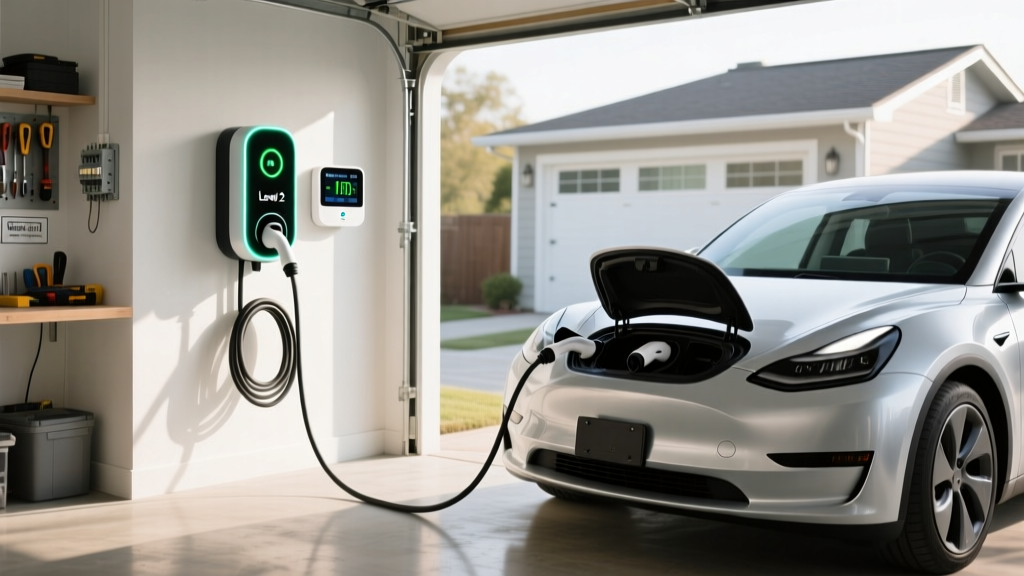
If you own or are shopping for an electric vehicle, you have probably encountered the term level 2 electric vehicle charging and wondered what separates it from plugging into a standard wall outlet or visiting a DC fast-charging station. The short answer: Level 2 is the practical sweet spot for daily EV ownership. It delivers enough power to fully replenish most EV batteries overnight, using the same 240-volt circuit that powers your electric dryer or oven.
This guide breaks down every layer of Level 2 charging — from electrical requirements and installation costs to real-world charging speeds, connector compatibility, and per-mile economics — with the exact numbers you need to plan your setup.
Charging Levels Explained: Speeds in kW and Miles Per Hour
EV charging is categorized into three levels based on power delivery. The critical distinction to internalize: kW (kilowatts) measures the rate of power delivery — how fast energy flows into your battery. kWh (kilowatt-hours) measures total energy capacity — how much the battery holds. Think of kW as the width of a pipe and kWh as the size of the tank it fills.
| Level | Voltage | Power (kW) | Miles of Range Added Per Hour | Typical Use Case |
|---|---|---|---|---|
| Level 1 | 120V (standard outlet) | 1.0–1.9 kW | 3–5 miles | Emergency/top-up, PHEVs with small batteries |
| Level 2 | 240V (dryer-style outlet or hardwired) | 3.3–19.2 kW | 12–75 miles | Daily home and workplace charging |
| DC Fast Charging | 400–900V DC | 50–350+ kW | 150–1,000+ miles (peak rate) | Road trips, highway corridors |
For most EV owners, Level 2 at home handles 90–95% of all charging. A typical commuter driving 30–40 miles per day needs only 3–4 hours of Level 2 charging at 7.7 kW to fully restore their daily consumption. DC fast charging is reserved for road trips where you need to add 150+ miles in 20–30 minutes.
Home Level 2 Installation: Electrical Requirements and Panel Upgrades
Installing a Level 2 charger at home means adding or repurposing a 240-volt circuit rated for continuous load. Most residential Level 2 chargers operate at one of these configurations:
- 32-amp circuit (25.6A continuous): 6.1 kW — sufficient for most daily needs
- 40-amp circuit (32A continuous): 7.7 kW — the most common home setup
- 48-amp circuit (38.4A continuous): 9.2 kW — faster, requires thicker wire and a robust panel
- 80-amp circuit (64A continuous): 15.4–19.2 kW — rare in homes; most EVs cannot accept this rate on AC anyway
The National Electrical Code (NEC) requires that continuous loads not exceed 80% of a circuit breaker's rating. So a 40A breaker supports 32A continuous draw, yielding 7.7 kW on a 240V circuit. This is non-negotiable and your licensed electrician will size accordingly.
Does Your Electrical Panel Need an Upgrade?
Many homes built before 2000 have 100-amp or 150-amp main service panels. If your panel is already near capacity — running central AC, an electric range, an electric water heater, and a dryer — adding a 40A EV circuit may push you over the limit. A load calculation (required by most permitting authorities) will determine whether you need a panel upgrade to 200 amps.
Panel upgrades typically cost $1,500–$4,000 depending on your local utility, the distance from the meter to the panel, and whether trenching is required. This is the single biggest variable in your total installation cost and the reason blanket estimates like "$500 to install a charger" are misleading.
Permitting and Code Requirements
Virtually all jurisdictions require an electrical permit for a new 240V circuit. The permit ensures your installation meets NEC Article 625 (Electric Vehicle Charging System Equipment) and local amendments. Your electrician pulls the permit, the work is inspected, and you receive a sign-off. Budget $50–$300 for the permit fee depending on your municipality. Skipping the permit risks insurance denial if an electrical fire occurs and may complicate a future home sale.
Level 2 Charger Installation Cost Breakdown
The total cost to install a home Level 2 charger spans a wide range because it depends on your panel capacity, the distance from panel to charger location, and whether you choose a plug-in (NEMA 14-50 outlet) or hardwired unit. Here is a realistic breakdown based on 2025–2026 electrician rates and equipment pricing:
| Component | Low-End Estimate | High-End Estimate | Notes |
|---|---|---|---|
| Level 2 charging unit (hardware) | $300 | $750 | Wi-Fi-enabled smart chargers cost more; basic units start lower |
| Electrician labor (240V circuit run) | $400 | $1,500 | Depends on run length, wall/floor penetration, conduit type |
| Electrical permit fee | $50 | $300 | Varies by municipality |
| Panel upgrade (if needed) | $1,500 | $4,000 | Required if existing panel lacks capacity; not all homes need this |
| NEMA 14-50 outlet (if plug-in) | $50 | $150 | Industrial-grade receptacle; GFCI breaker may be required by local code |
| Total (no panel upgrade) | $800 | $2,700 | Most homeowners with adequate panel capacity fall in this range |
| Total (with panel upgrade) | $2,300 | $6,700 | Older homes with 100A service are likely to need this |
Charging Speeds: How Long Does Level 2 Take for Common EVs?
Charging time depends on two variables: your charger's power output (kW) and your vehicle's onboard charger capacity. The onboard charger is the component inside the EV that converts AC power from your Level 2 station into DC power for the battery. Most 2025–2026 EVs have onboard chargers rated between 7.7 kW and 11.5 kW, with some exceptions.
Here are real-world charging times from 10% to 80% state of charge at common Level 2 power levels:
| Vehicle (Model Year) | Battery Capacity (kWh, usable) | Onboard Charger Max (kW) | Time at 7.7 kW | Time at 11.5 kW |
|---|---|---|---|---|
| Tesla Model Y Long Range (2026) | ~75 kWh | 11.5 kW | ~7.5 hours | ~5 hours |
| Hyundai Ioniq 5 (2026) | ~74 kWh | 10.9 kW | ~7.5 hours | ~5.2 hours |
| Ford F-150 Lightning Extended Range (2026) | ~131 kWh | 19.2 kW | ~14 hours | ~9 hours |
| Chevrolet Equinox EV (2026) | ~85 kWh | 11.5 kW | ~8.5 hours | ~5.8 hours |
| Toyota RAV4 Plug-in Hybrid (2026) | ~14.9 kWh | 6.6 kW | ~2 hours | ~2 hours (capped by onboard charger) |
Note that charging above 80% slows significantly due to battery management system (BMS) tapering. The final 20% can take nearly as long as the first 80%. For daily driving, setting your charge limit to 80% preserves battery longevity and eliminates the slow top-off phase.
Connector Compatibility: NACS, CCS, and CHAdeMO
The connector landscape has consolidated significantly since 2023, when Ford, GM, Rivian, and most major automakers adopted the North American Charging Standard (NACS) — the connector Tesla developed and opened to the industry. Here is where things stand for 2025–2026 model-year vehicles:
| Connector Type | Brands Using It (Native) | Adapter Required? |
|---|---|---|
| NACS (J3400) | Tesla (all), Ford (2025+), GM/Chevrolet/Cadillac (2025+), Rivian (2025+), Hyundai/Kia (2026+), Volvo/Polestar (2025+), Fisker, Lucid (2025+) | CCS-to-NACS adapter needed for older CCS vehicles at Tesla Superchargers |
| CCS1 (Combined Charging System) | Older model-year vehicles from VW, BMW, Mercedes, Stellantis, some Hyundai/Kia pre-2026 | NACS-to-CCS adapter may be needed for Tesla Supercharger access |
| CHAdeMO | Nissan Leaf (legacy); largely discontinued on new vehicles after 2025 | Limited adapter options; CHAdeMO infrastructure declining |
For home Level 2 charging, this connector shift matters less than it does for DC fast charging. Most Level 2 chargers sold today ship with a NACS connector or a universal J1772 connector (which all non-Tesla EVs used prior to the NACS transition). If your EV has a NACS port and your charger has a J1772 plug, a simple J1772-to-NACS adapter (typically $40–$80) solves the mismatch. Many charger manufacturers now offer NACS-terminated cables as a factory option.
Cost to Charge: Level 2 at Home vs. Public vs. Gas
The economics of Level 2 charging are where EV ownership delivers its most tangible savings. Electricity prices vary widely by state and utility, but here are representative scenarios using national averages as of early 2026:
| Scenario | Rate ($/kWh) | Vehicle Efficiency (kWh/100mi) | Cost Per Mile |
|---|---|---|---|
| Home Level 2 (national avg. residential rate) | $0.16 | 30 kWh/100mi | $0.048 |
| Home Level 2 (off-peak time-of-use rate) | $0.09 | 30 kWh/100mi | $0.027 |
| Public Level 2 (network pricing, e.g., ChargePoint) | $0.30 | 30 kWh/100mi | $0.090 |
| DC Fast Charging (Electrify America, EVgo) | $0.48 | 30 kWh/100mi | $0.144 |
| Gas vehicle (25 MPG combined, $3.40/gal) | — | — | $0.136 |
The takeaway: home Level 2 charging at off-peak rates costs roughly one-fifth what gasoline costs per mile. Even public Level 2 undercuts gas in most markets. DC fast charging is the only scenario where EV fueling costs approach or exceed gasoline — which is why home charging access is the single most important factor in EV ownership economics.
For a driver covering 12,000 miles per year, the annual fuel cost difference is stark:
- Gas at 25 MPG / $3.40/gal: $1,632/year
- Home Level 2 at $0.16/kWh: $576/year
- Home Level 2 at off-peak $0.09/kWh: $324/year
Recommended Level 2 Home Chargers for 2026
The home charger market has matured to the point where reliable, smart, and affordable options are plentiful. Below are four units that represent the best value-to-performance ratios across common use cases. All are UL-listed (or equivalent) and support the latest connector standards.
ChargePoint Home Flex
- Power Output: Up to 12 kW (50A circuit)
- Connector: NACS or J1772 (configurable)
- Cable Length: 23 feet
- Smart Features: Wi-Fi, scheduled charging, Alexa integration, energy dashboard
- Price: ~$599
- Best For: Versatility — adjustable amperage from 16A to 50A to match your circuit
Tesla Wall Connector
- Power Output: Up to 11.5 kW (48A / 60A circuit)
- Connector: NACS native; J1772 adapter included
- Cable Length: 24 feet
- Smart Features: Wi-Fi, OTA updates, Power-Share (load balancing between two units)
- Price: ~$475
- Best For: Tesla owners and NACS-equipped EVs; excellent value at 11.5 kW
Emporia Vue Level 2 Charger
- Power Output: Up to 11.5 kW (48A)
- Connector: J1772 or NACS
- Cable Length: 24 feet
- Smart Features: Real-time energy monitoring, solar integration, load management with Emporia panel sensors
- Price: ~$399
- Best For: Budget-conscious buyers who want smart features and solar-aware charging
Grizzl-E Smart
- Power Output: Up to 9.6 kW (40A)
- Connector: J1772 or NACS
- Cable Length: 24 feet
- Smart Features: OCPP-compatible, works with multiple network apps, extreme cold rated (-40°F)
- Price: ~$449
- Best For: Cold-climate durability and open-protocol flexibility
When selecting a charger, match its maximum output to both your circuit capacity and your vehicle's onboard charger limit. A 48A charger on a 60A circuit is pointless if your EV caps at 32A (7.7 kW) — you will never use the extra capacity. Conversely, if you drive an F-150 Lightning with a 19.2 kW onboard charger, a 48A or higher circuit maximizes your overnight recovery.
Safety, Code, and Installation Best Practices
Level 2 charging involves sustained high-current draw over many hours, making proper installation critical. Key safety and code considerations include:
- Dedicated circuit: Your Level 2 charger must be on its own dedicated breaker — not shared with other appliances. This prevents overloading and nuisance tripping.
- GFCI protection: NEC 2023 and later editions require GFCI (Ground Fault Circuit Interrupter) protection for outdoor receptacles used for EV charging. Hardwired installations may be exempt depending on local code interpretation. Your electrician will determine the requirement.
- Outdoor rating: If your charger is mounted outside, ensure it carries a NEMA 4 or NEMA 4X enclosure rating for weather resistance. All units listed above meet this standard.
- Wire gauge: A 40A circuit requires minimum 8 AWG copper wire; a 48A circuit requires 6 AWG. Longer wire runs may require upsizing to prevent voltage drop beyond 3%.
- Cable management: Use a holster or retractor to keep the charging cable off the ground, preventing trip hazards and connector damage.
- Smart load management: If your panel is near capacity but you want to avoid a costly upgrade, consider a charger with dynamic load management (e.g., Emporia with panel sensors) that adjusts charging current in real time based on your home's total consumption.
Frequently Asked Questions
How much does it cost to install a home EV charger?
Expect $800–$2,700 if your electrical panel has adequate capacity, covering the charger unit ($300–$750), electrician labor ($400–$1,500), and permit fees ($50–$300). If your home needs a 200-amp panel upgrade, add $1,500–$4,000. Always get a load calculation from a licensed electrician before committing to a charger amperage.
How fast will each charging level add range?
Level 1 (120V) adds 3–5 miles of range per hour. Level 2 (240V) at 7.7 kW adds roughly 28–32 miles per hour for a typical EV consuming 30 kWh/100mi. At 11.5 kW, that increases to roughly 42–46 miles per hour. DC fast charging at 150+ kW can add 150–300+ miles in 20–30 minutes, though the charge curve tapers significantly above 80% state of charge.
Which connector or charger is compatible with my EV?
For 2025–2026 model-year vehicles, NACS is the dominant standard across Tesla, Ford, GM, Rivian, Hyundai, Kia, Volvo, and others. If your EV has a NACS port, buy a NACS-terminated charger or use a J1772-to-NACS adapter. If your EV still uses CCS1 (older model years), a J1772 plug works natively for Level 2 charging. CHAdeMO is limited to legacy Nissan Leaf models and is not recommended for new purchases.
How much does charging cost per mile vs gas?
Home Level 2 charging at the national average residential rate of $0.16/kWh costs approximately $0.048 per mile for a vehicle averaging 30 kWh/100mi. Off-peak rates can drop this to $0.027/mile. A comparable gas vehicle at 25 MPG and $3.40/gallon costs $0.136 per mile — roughly 3 to 5 times more expensive. Source: fueleconomy.gov EV efficiency data.
What electrical upgrades might I need?
The most common upgrade is a panel capacity increase from 100A or 150A to 200A, costing $1,500–$4,000. Other potential needs include: running a new dedicated 240V circuit with appropriate wire gauge, installing an industrial-grade NEMA 14-50 receptacle with a GFCI breaker (if required by local code for outdoor outlets), and potentially adding a smart load-management system if you want to avoid a panel upgrade. A licensed electrician performing a NEC-compliant load calculation will identify exactly what your home requires.