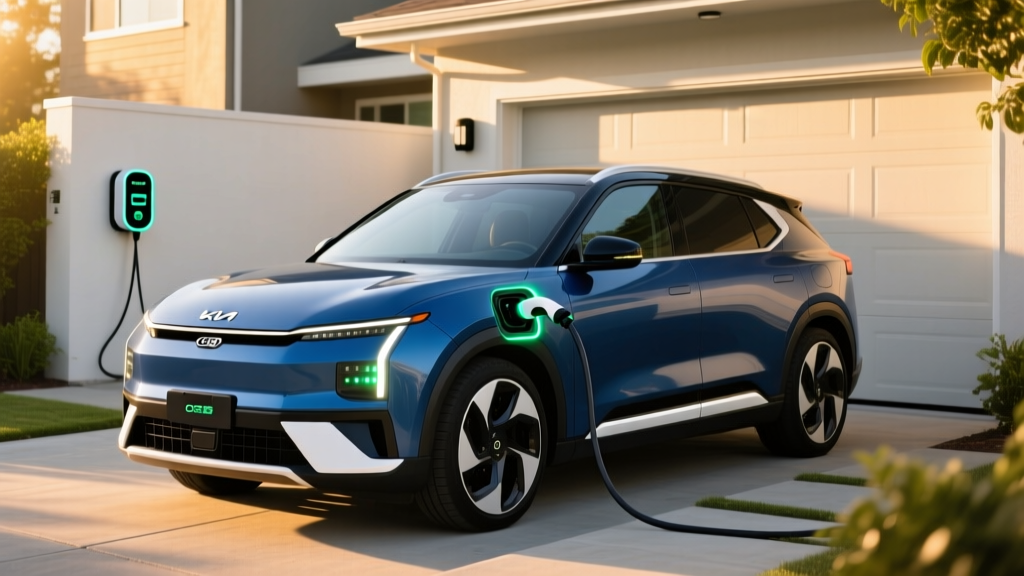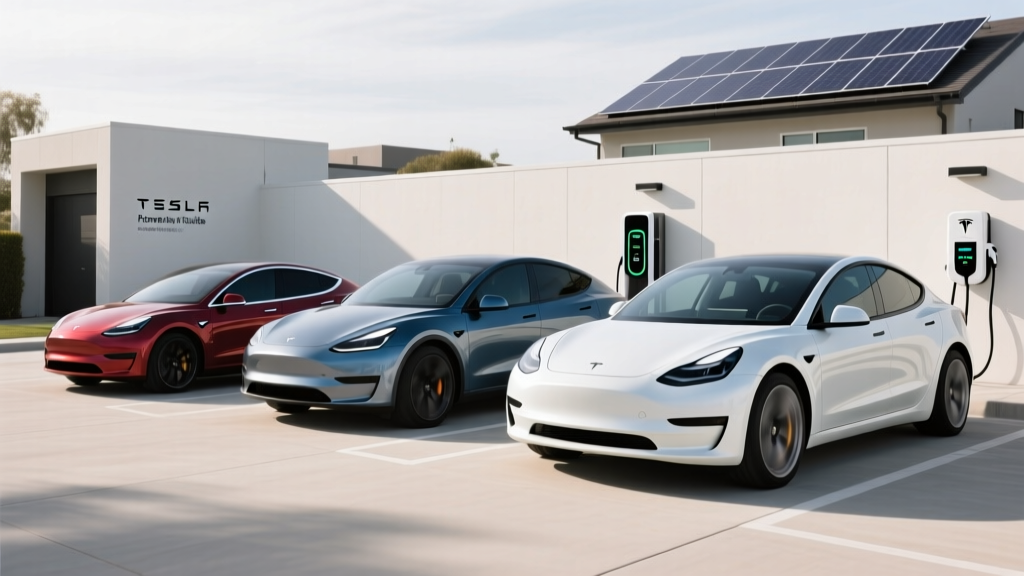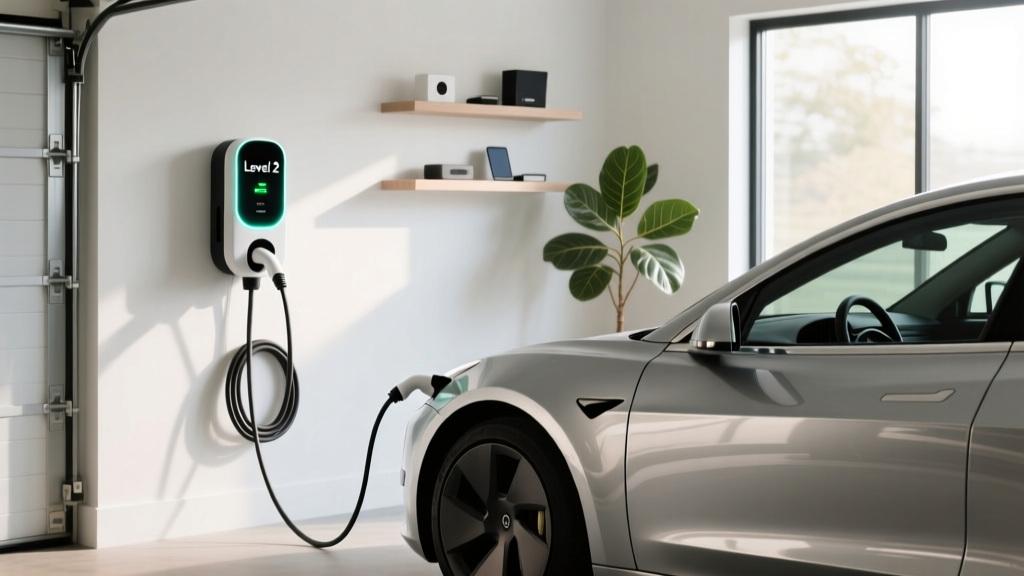
Why a Level 2 Electric Vehicle Charger Is the Single Best EV Upgrade
If you own an electric vehicle and are still plugging into a standard 120V wall outlet, you are leaving most of your car's convenience on the table. A Level 2 electric vehicle charger — operating on a 240-volt circuit like your dryer or oven — adds 20 to 44 miles of range per hour of charging, compared to the 3 to 5 miles per hour you get from a basic Level 1 cord. For a typical EV with a 75–85 kWh battery, that's the difference between a 30-hour full charge and a 6-hour full charge overnight.
This guide walks through exactly what a Level 2 charger requires, what it costs to install in 2026, which hardware to buy, and how the math stacks up against gasoline. We'll also clarify the critical distinction between kW (kilowatts) — the rate of power delivery, like water pressure — and kWh (kilowatt-hours) — the total energy stored or delivered, like gallons in a tank. Confusing these two is the single most common EV mistake new owners make.
Charging Levels Explained: Level 1 vs Level 2 vs DC Fast Charging
Before choosing equipment, you need to understand the three charging tiers available to EV owners. Each serves a different use case.
| Level | Voltage | Power (kW) | Miles of Range Added Per Hour | Typical Use Case |
|---|---|---|---|---|
| Level 1 | 120V AC | 1.0–1.4 kW | 3–5 mi/hr | Emergency top-offs, PHEVs, very low daily mileage |
| Level 2 | 240V AC | 3.3–19.2 kW | 14–44 mi/hr (varies by amperage) | Daily home charging, workplace, destination |
| DC Fast (Level 3) | 400–800V DC | 50–350+ kW | 150–1,000+ mi/hr (first 20 min) | Road trips, highway corridor stops |
For most EV owners, a Level 2 home charger handles 90–95% of all charging needs. You wake up with a full battery every morning, eliminating the weekly gas-station ritual. DC fast charging is reserved for road trips and is harder on battery longevity when used frequently due to the thermal stress of high C-rates.
How Much Does It Cost to Install a Level 2 EV Charger at Home?
Installation costs vary enormously depending on your home's electrical panel capacity, the distance from the panel to your garage or parking spot, and local permit requirements. Here's a realistic 2026 breakdown based on national averages:
| Component | Simple Install (Panel Nearby, Adequate Capacity) | Complex Install (Long Run or Panel Upgrade) |
|---|---|---|
| Level 2 Charger Hardware (hardwired or plug-in) | $350–$700 | $400–$800 |
| Electrician Labor (licensed, 2–4 hrs simple / 6–12 hrs complex) | $400–$800 | $1,200–$3,000 |
| Materials (conduit, wire, junction box, receptacle) | $100–$300 | $400–$1,200 |
| Permit & Inspection | $50–$200 | $100–$300 |
| Electrical Panel Upgrade (100A → 200A service, if needed) | $0 (not needed) | $1,500–$4,000 |
| Total Estimated Cost | $900–$2,000 | $3,600–$9,300 |
The panel upgrade is the wildcard. Homes built before the 1990s often have 100-amp electrical service. Adding a 40-amp or 48-amp dedicated EV circuit may push total load beyond the panel's rating, requiring a service upgrade to 200 amps. This alone can add $1,500 to $4,000 and may require utility coordination. Always get a load calculation from your electrician before assuming you have headroom.
Some utilities offer rebates of $200–$500 for Level 2 charger installation, and certain states provide additional incentives. Check your local utility's EV program page — some even offer time-of-use (TOU) rate plans that dramatically reduce overnight charging costs.
Electrical Requirements: What Your Circuit Needs
A typical Level 2 installation uses a 240V dedicated circuit. The National Electrical Code (NEC) requires that continuous loads — and EV charging counts as continuous — use no more than 80% of the circuit breaker's rated amperage. This means:
- 40-amp breaker → 32 amps continuous → up to 7.7 kW output
- 50-amp breaker → 40 amps continuous → up to 9.6 kW output
- 60-amp breaker → 48 amps continuous → up to 11.5 kW output
Most modern EVs have onboard chargers rated between 7.7 kW and 11.5 kW. If your car's onboard charger maxes at 11.5 kW (like the Ford F-150 Lightning extended-range or Tesla Model 3/Y), a 60-amp circuit with a 48-amp charger lets you use the vehicle's full AC charging capability. Installing a lower-amperage circuit won't damage anything, but it will leave charging speed on the table.
Charging Time Examples: How Long Does Level 2 Actually Take?
Real charging times depend on your vehicle's onboard charger capacity, battery size, and the circuit amperage. Here are representative scenarios:
| Vehicle (Battery Size) | Onboard Charger | 48A/11.5 kW Circuit | 40A/9.6 kW Circuit | 32A/7.7 kW Circuit |
|---|---|---|---|---|
| Tesla Model 3 LR (82 kWh usable) | 11.5 kW | ~6.5 hrs (0–100%) | ~8 hrs | ~10 hrs |
| Hyundai Ioniq 5 (77.4 kWh) | 10.9 kW | ~6.5 hrs | ~7.5 hrs | ~9.5 hrs |
| Ford F-150 Lightning ER (131 kWh) | 19.2 kW | ~11 hrs (circuit-limited) | ~13 hrs | ~16 hrs |
| Chevrolet Equinox EV (85 kWh) | 11.5 kW | ~7 hrs | ~8.5 hrs | ~10.5 hrs |
| Toyota RAV4 Prime PHEV (18.1 kWh) | 6.6 kW | ~2.5 hrs (car-limited) | ~2.5 hrs | ~2.5 hrs |
For most daily driving — 30 to 50 miles consumed — even a 32-amp Level 2 charger replenishes that in roughly 2 to 3 hours. Overnight charging on any Level 2 circuit is more than sufficient unless you regularly deplete large batteries in a single day.
Note that the Ford F-150 Lightning with its optional 19.2 kW onboard charger can accept more power than a standard 48A home circuit delivers. To unlock that speed at home, you'd need an 80-amp breaker (64A continuous) and a charger like the Ford Charge Station Pro — a significant electrical upgrade.
Connector Compatibility: NACS, CCS, and CHAdeMO in 2026
The connector landscape has consolidated significantly since 2024. Here's where things stand for 2026 model-year vehicles:
| Connector Type | Brands Using It (2026) | Notes |
|---|---|---|
| NACS (J3400) | Tesla, Ford, GM, Rivian, Volvo, Polestar, Mercedes-Benz, Nissan, Honda, Fisker, Lucid, BMW (new models) | Now the dominant North American standard; same plug for AC Level 2 and DC fast charging |
| CCS1 (J1772 Combo) | Hyundai, Kia, Stellantis (Chrysler/Dodge/Jeep), VW (ID.4), Subaru, some legacy models | Still widely supported at public stations; NACS adapters available |
| CHAdeMO | Nissan Leaf (legacy), Mitsubishi Outlander PHEV (legacy) | Effectively discontinued for new models; infrastructure declining |
For home Level 2 charging, the physical plug matters less than you might think. All Level 2 chargers sold in North America deliver 240V AC through the same basic protocol (SAE J1772 signaling). The difference is the connector shape:
- NACS-equipped vehicles: Buy a charger with a native NACS connector, or use a CCS-to-NACS adapter (many automakers include one).
- CCS1 vehicles: Buy a charger with the traditional J1772/CCS connector, or use a NACS-to-J1772 adapter if you want to use Tesla Wall Connectors.
- Tesla Wall Connector: Now ships with NACS native. Tesla sells a J1772 adapter for non-Tesla CCS vehicles.
The key purchasing decision: buy a charger whose native connector matches your current EV. If you plan to switch brands, consider adapters or a charger that ships with both (some newer models offer swappable connector heads).
Cost to Charge: Home vs Public vs Gas — The Real Math
The economic case for home Level 2 charging is compelling, but it depends heavily on your local electricity rates and whether you use time-of-use (TOU) pricing.
| Scenario | Rate | Cost to Add 200 Miles (at 3.5 mi/kWh efficiency) | Cost Per Mile |
|---|---|---|---|
| Home Level 2 — Off-Peak TOU | $0.08–$0.12/kWh | $4.57–$6.86 | $0.023–$0.034 |
| Home Level 2 — Standard Rate | $0.14–$0.18/kWh | $8.00–$10.29 | $0.040–$0.051 |
| Home Level 2 — Peak / High-Cost Area (CA, HI) | $0.25–$0.40/kWh | $14.29–$22.86 | $0.071–$0.114 |
| Public Level 2 (ChargePoint, EVgo, etc.) | $0.25–$0.49/kWh | $14.29–$28.00 | $0.071–$0.140 |
| DC Fast Charging (Electrify America, Tesla Supercharger) | $0.30–$0.55/kWh | $17.14–$31.43 | $0.086–$0.157 |
| Gasoline Vehicle (28 MPG combined, $3.30/gal) | $3.30/gal | $23.57 | $0.118 |
The takeaway: home Level 2 charging on off-peak rates is 3–5x cheaper per mile than gasoline. Even on standard residential rates, the EV wins. Public DC fast charging, however, narrows the gap considerably — and in some high-cost networks, can approach or exceed gasoline costs per mile. This is why home charging access is the single most important factor in EV satisfaction.
Per fueleconomy.gov, the average 2026 EV achieves 3.0–4.0 miles per kWh. Efficiency varies — a Tesla Model 3 Long Range extracts about 4.2 mi/kWh, while a Ford F-150 Lightning manages roughly 2.0–2.3 mi/kWh. Adjust the math above to your specific vehicle's efficiency rating.
Best Level 2 EV Chargers for 2026: Equipment Recommendations
After testing and tracking reliability data across the major brands, here are the standout Level 2 chargers for home installation in 2026:
Tesla Wall Connector (Gen 4)
- Power Output: Up to 11.5 kW (48A)
- Connector: NACS native; J1772 adapter available
- Cable Length: 24 ft
- Smart Features: Wi-Fi, OTA updates, load sharing (up to 6 units on one circuit), Power Sharing
- Price: ~$475
- Best For: Tesla and NACS-adopting EV owners; multi-EV households
ChargePoint Home Flex (2nd Gen)
- Power Output: Up to 12 kW (50A) — adjustable via DIP switch
- Connector: J1772 (CCS-compatible); NACS adapter included in box
- Cable Length: 23 ft
- Smart Features: Wi-Fi, app scheduling, Alexa integration, energy reports
- Price: ~$599
- Best For: CCS1 vehicle owners wanting flexibility; smart-home integrators
Emporia Level 2 EV Charger
- Power Output: Up to 11.5 kW (48A)
- Connector: J1772 (NACS adapter sold separately)
- Cable Length: 24 ft
- Smart Features: Wi-Fi, app control, integrates with Emporia Vue energy monitor for solar-aware charging
- Price: ~$399
- Best For: Budget-conscious buyers; solar panel owners wanting charge-from-sun optimization
Grizzl-E Smart (United Chargers)
- Power Output: Up to 10 kW (40A)
- Connector: J1772 (NACS adapter available)
- Cable Length: 24 ft
- Smart Features: Wi-Fi, OCPP-compatible, adjustable amperage, built-in holster
- Price: ~$549
- Best For: Cold-climate durability (rated to -40°F); Canadian-made; commercial-grade build
Hardwired vs. Plug-In: Chargers above 40 amps (continuous) generally require hardwiring — there is no standard NEMA receptacle rated for continuous 48A loads. A 32A or 40A charger can plug into a NEMA 14-50 outlet, which gives you portability if you move. However, hardwired installations are more reliable (no loose outlet connections) and often cheaper since they skip the $50–$100 receptacle cost.
Safety, Code, and Installation Best Practices
EV charging is a high-draw, long-duration electrical load. Cutting corners here risks fire, equipment damage, or failed inspections. Key requirements and recommendations:
- Dedicated circuit: Your Level 2 charger must be on its own dedicated breaker — not shared with other appliances. The NEC (Article 625) is explicit on this for EV supply equipment.
- GFCI protection: The 2020 NEC revision requires GFCI protection for outdoor receptacles used for EV charging. Hardwired installations are exempt from this requirement, which is one reason electricians often prefer hardwiring.
- Outdoor rating: If your charger will be mounted outside (carport, driveway post), verify it carries a NEMA 4 or IP65 rating for weather resistance. All four chargers recommended above meet this standard.
- Wire gauge: A 60-amp breaker with 48A continuous load requires 4 AWG copper wire (or 2 AWG aluminum) for runs up to about 100 feet. Longer runs need upsized wire to limit voltage drop. Your electrician will calculate this.
- Permit and inspection: Virtually all jurisdictions require a permit for new 240V circuit installations. The inspection ensures proper grounding, wire sizing, and breaker rating. Skipping the permit risks insurance claim denials if an electrical fire occurs.
- Cable management: Use a holster or retractable reel to keep the charging cable off the ground. Dragging cables across concrete accelerates insulation wear.
For homes with solar panels, some chargers (like the Emporia and certain Enel X models) can prioritize charging from excess solar production rather than drawing from the grid. This can push your effective cost-per-mile near zero on sunny days.
Frequently Asked Questions
Do I need a permit to install a Level 2 EV charger?
Yes, in nearly all US jurisdictions. A new 240V circuit requires a permit and inspection to verify code compliance. Permit fees typically range from $50 to $200. Your electrician usually pulls the permit on your behalf. Some municipalities offer expedited EV-charger permits.
Can I install a Level 2 charger myself?
Unless you are a licensed electrician, no. A 240V circuit operating at 40–60 amps carries lethal fault current and requires proper wire sizing, grounding, torque-spec terminations, and load calculations. DIY errors can cause fires or void your homeowner's insurance. Always hire a licensed electrician and pull a permit.
Will a Level 2 charger work with any EV?
Electrically, yes — all Level 2 chargers deliver 240V AC using the SAE J1772 protocol. The physical connector may differ: NACS-equipped vehicles need a NACS plug or adapter, while CCS vehicles use the J1772 connector. As of 2026, most new chargers ship with adapters or offer them as accessories. Check the IRS clean vehicle credit page if you're also evaluating the federal tax credit for your EV purchase.
How much will my electric bill increase with a Level 2 charger?
Driving 12,000 miles per year at 3.5 mi/kWh efficiency requires about 3,429 kWh annually. At the US average residential rate of $0.16/kWh (2026 EIA data), that's roughly $549/year — or about $46/month. With off-peak TOU rates ($0.08–$0.12/kWh), the annual cost drops to $274–$411. Compare this to $1,414/year in gasoline at 28 MPG and $3.30/gallon.
Is Level 2 charging bad for my EV battery?
No. Level 2 AC charging is actually gentler on battery health than DC fast charging. The slower charge rate generates less heat, reducing thermal stress on the cells. Most battery degradation occurs from sustained high temperatures and frequent DC fast charging at high C-rates. For daily use, Level 2 is the optimal charging method for long-term battery State of Health (SoH). Per manufacturer guidance from Hyundai and Tesla, keeping your battery between 20% and 80% SoC for daily driving further extends longevity — many EVs offer a configurable charge-limit setting for exactly this purpose.
What if my home only has 100-amp electrical service?
You have options. A lower-amperage Level 2 charger (16A or 24A on a 20A or 30A breaker) draws 3.8–5.8 kW and may fit within a 100A panel's capacity, depending on your other loads. Alternatively, a smart panel or load-management device (like the Emporia VUE with smart breaker) can dynamically throttle the charger when other appliances are running, avoiding a full panel upgrade. A load calculation from a licensed electrician will determine what's feasible without an upgrade.