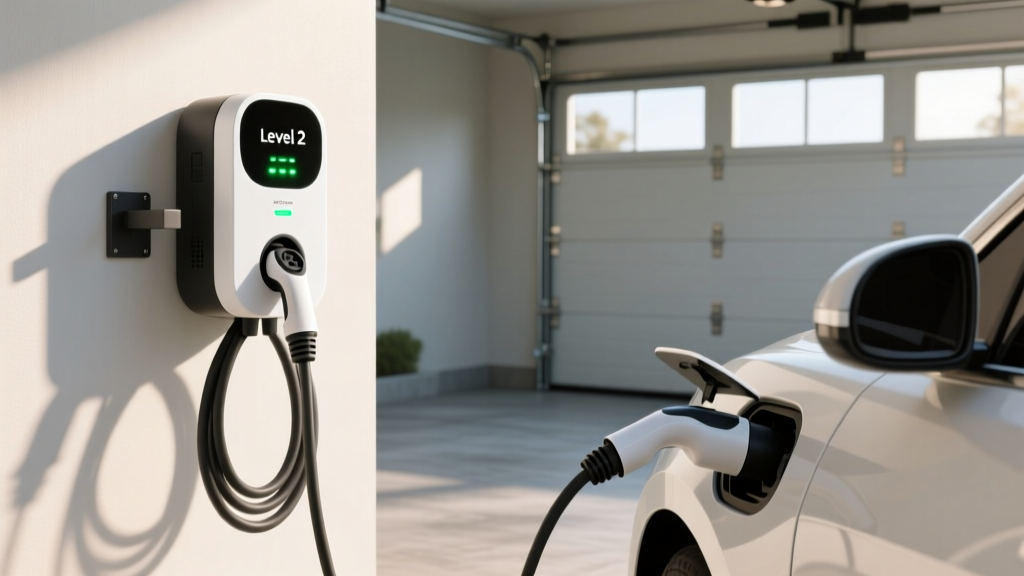
If you own an electric vehicle, a level 2 electric car charger is the single most impactful upgrade you can make to your daily ownership experience. While Level 1 charging from a standard 120V outlet technically works, it adds only 3–5 miles of range per hour — meaning a full recharge of a modern EV with a 75+ kWh battery can take well over 24 hours. A properly installed Level 2 home charger operating on 240V cuts that to a manageable overnight session, delivering 25–50 miles of range per hour depending on the circuit and your vehicle's onboard charger capacity.
This guide covers the electrical requirements, real installation costs, connector compatibility, operating economics, and specific equipment recommendations you need to make an informed decision. No marketing fluff — just the numbers and practical realities from years of home-charging across multiple EVs.
Understanding EV Charging Levels: Speed and Power Explained
Before selecting equipment, you need to understand the three charging tiers and how power (measured in kW, kilowatts) relates to energy delivered (measured in kWh, kilowatt-hours). Think of kW as the flow rate of water through a hose, and kWh as the total volume in the bucket. A higher kW rating means faster energy delivery, but your vehicle's onboard charger ultimately caps how much AC power it can accept.
| Level | Voltage | Max Power (kW) | Miles of Range Added Per Hour | Typical Use Case |
|---|---|---|---|---|
| Level 1 | 120V AC | 1.4–1.9 kW | 3–5 miles | Overnight trickle, PHEVs, emergencies |
| Level 2 | 240V AC | 3.3–19.2 kW | 12–60+ miles | Daily home/workplace charging |
| DC Fast Charge | 400–900V DC | 50–350+ kW | 150–1,000+ miles (theoretical) | Road trips, rapid top-ups |
For most EV owners, a Level 2 charger rated between 7.2 kW (30A circuit) and 11.5 kW (48A circuit) hits the sweet spot. A 48A charger on a 60A dedicated circuit will fully replenish a 75 kWh battery (like a Tesla Model Y Long Range or Hyundai Ioniq 5) from 10% to 80% in roughly 5–6 hours. That's ideal for overnight charging during off-peak electricity rates.
- Tesla Model 3 (57.5 kWh usable): 10–80% in ~3.5 hours
- Hyundai Ioniq 5 (77.4 kWh usable): 10–80% in ~4.5 hours
- Ford F-150 Lightning Extended Range (131 kWh usable): 10–80% in ~7.5 hours
- Chevrolet Equinox EV (85 kWh usable): 10–80% in ~5 hours
Electrical Requirements: What Your Home Actually Needs
Installing a level 2 electric car charger is not a plug-and-play DIY project. It requires a dedicated 240V circuit on your home's electrical panel, sized to match the charger's amperage draw. The National Electrical Code (NEC) requires that continuous loads (anything running 3+ hours, which includes EV charging) use only 80% of a circuit's rated capacity. That means a 48A charger needs a 60A breaker; a 32A charger needs a 40A breaker.
Key Electrical Specifications
- Voltage: 240V (split-phase residential, same as your dryer or oven)
- Amperage: 30A, 40A, 48A, or 60A circuits are most common
- Wire gauge: 6 AWG copper for 48A/60A circuits; 8 AWG for 32A/40A circuits
- Dedicated circuit: The charger must have its own breaker — no sharing with other appliances
- GFCI protection: NEC 2020 and later require ground-fault circuit interrupter protection for EV charging outlets in garages and outdoors
Panel Capacity: The Hidden Cost Factor
Most modern homes with 200A electrical service can accommodate a 48A Level 2 circuit without issue, provided there's physical space in the panel for a double-pole breaker and the existing load calculation allows it. However, older homes with 100A service — or homes already running heavy loads (electric heat, tankless water heaters, large workshop equipment) — may need a panel upgrade to 200A before adding an EV circuit.
A panel upgrade typically costs $1,500–$3,500 depending on your utility's requirements, local labor rates, and whether the meter base also needs replacement. This is the single biggest variable in home charger installation cost, and it's one that many online guides gloss over. Have a licensed electrician perform a load calculation (NEC Article 220) before committing to equipment.
Hardwired vs. Plug-In (NEMA 14-50)
You have two installation options:
- Hardwired: The charger's wiring connects directly to the breaker panel. This is required for circuits above 50A and generally offers a cleaner install with no outlet wear concerns. Many electricians prefer this method.
- NEMA 14-50 outlet: A 50A-rated receptacle allows you to unplug the charger and take it if you move. Limited to 40A continuous draw (50A breaker at 80%). Requires a high-quality industrial-grade receptacle — cheap 14-50 outlets have been linked to overheating and fire risk in EV charging applications. Hubbell and Bryant brand receptacles are widely recommended by EV electricians.
How Much Does It Cost to Install a Home Level 2 EV Charger?
Installation costs vary enormously based on your home's electrical infrastructure, the distance from panel to charger location, and local permitting fees. Here's a realistic breakdown based on national averages and 2026 electrician rates:
| Component | Simple Install (panel nearby, no upgrade) | Complex Install (long run, panel upgrade) |
|---|---|---|
| Level 2 charger hardware (48A) | $400–$700 | $400–$700 |
| Electrician labor (2–4 hrs simple / 6–10 hrs complex) | $300–$600 | $900–$2,000 |
| Materials (wire, conduit, breaker, receptacle) | $100–$300 | $400–$800 |
| Permit and inspection | $50–$200 | $50–$200 |
| Electrical panel upgrade (if needed) | $0 | $1,500–$3,500 |
| Total estimated cost | $850–$1,800 | $3,250–$7,200 |
A few cost-saving notes: Some utilities offer rebates of $250–$1,000 for Level 2 charger installation, particularly if you agree to off-peak charging schedules. The federal Alternative Fuel Vehicle Refueling Property Credit (§30C) may cover up to 30% of equipment and installation costs (capped at $1,000 for residential), subject to census-tract eligibility — check current IRS guidelines before filing. Always get at least three quotes from licensed electricians who have documented EV charger installation experience.
Connector Compatibility: NACS, CCS, and What You Need to Know
The North American EV charging connector landscape has undergone a seismic shift. As of 2025–2026, the North American Charging Standard (NACS), originally developed by Tesla, has become the dominant connector for new EVs sold in North America. Most legacy CCS1 vehicles can access NACS chargers (including Tesla Superchargers) via an adapter, and new NACS-equipped vehicles can access CCS chargers with the reverse adapter.
| Connector Type | Vehicles Using It (Native) | Adapter Available? |
|---|---|---|
| NACS (Tesla-style) | Tesla (all), Ford (2025+), GM (2025+), Rivian (2025+), Hyundai/Kia (2026+), many others | CCS→NACS adapters widely available ($150–$250) |
| CCS1 | Most 2024 and earlier non-Tesla EVs (VW ID.4, older Ioniq 5, Bolt EV, etc.) | NACS→CCS adapters available ($150–$300) |
| CHAdeMO | Nissan Leaf (all years), Mitsubishi Outlander PHEV (older) | No reliable adapter to NACS/CCS; legacy network shrinking |
For your Level 2 home charger purchase: If your EV has a NACS port (2025+ Ford, GM, Rivian, Tesla, and 2026+ Hyundai/Kia models), buy a NACS-terminated charger. If you drive a CCS-equipped vehicle, buy a CCS (J1772-Combo) charger — or buy a NACS charger and use an adapter, which many owners find more future-proof since their next EV will likely be NACS. Most quality Level 2 chargers are available in both connector configurations.
Operating Costs: How Much Does Level 2 Charging Cost Per Mile?
Home Level 2 charging remains dramatically cheaper per mile than gasoline for the vast majority of US drivers. The exact savings depend on your local electricity rate, whether you charge during off-peak hours, and your vehicle's efficiency (measured in kWh per 100 miles or miles per kWh).
| Scenario | Rate / Cost | Vehicle | Cost Per Mile |
|---|---|---|---|
| Home off-peak (time-of-use rate) | $0.08/kWh | Tesla Model Y (3.6 mi/kWh) | $0.022 |
| Home standard rate | $0.16/kWh | Tesla Model Y (3.6 mi/kWh) | $0.044 |
| Home standard rate | $0.16/kWh | Ford F-150 Lightning (2.0 mi/kWh) | $0.080 |
| Public Level 2 (network pricing) | $0.30/kWh | Tesla Model Y (3.6 mi/kWh) | $0.083 |
| DC fast charging (EA, EVgo) | $0.48/kWh | Tesla Model Y (3.6 mi/kWh) | $0.133 |
| Gasoline comparison | $3.40/gallon | Toyota RAV4 AWD (28 MPG combined) | $0.121 |
| Gasoline comparison | $3.40/gallon | Ford F-150 4WD (20 MPG combined) | $0.170 |
Even at standard residential rates, home Level 2 charging costs roughly one-third to one-half what gasoline costs per mile. The savings widen significantly if your utility offers time-of-use (TOU) rates and you schedule charging for overnight off-peak hours. According to fueleconomy.gov, a typical EV owner charging at home saves $800–$1,200 annually compared to a comparable gas vehicle.
DC fast charging at public stations, however, can approach or even exceed gasoline costs per mile — which is why a Level 2 home charger is the economic backbone of EV ownership. Plan your road-trip DC fast charging as a supplement, not a primary fueling strategy.
Top Level 2 Electric Car Chargers for 2026
After testing dozens of units across multiple homes and vehicles, here are the Level 2 chargers that consistently deliver on power, reliability, and value. All recommendations below are available in NACS and/or CCS configurations and are UL-listed or ETL-listed for safety.
ChargePoint Home Flex
- Power: Up to 12 kW (50A) on a 60A circuit; configurable down to 16A
- Connector: NACS or J1772 (CCS via J1772-to-CCS adapter)
- Cable length: 23 feet
- Smart features: Wi-Fi, scheduling, Alexa integration, energy tracking
- Price: ~$599–$699
- Best for: Flexibility across circuit sizes; strong app ecosystem
Emporia Vue Level 2 Charger
- Power: Up to 11.5 kW (48A) on a 60A circuit
- Connector: J1772 (NACS adapter included in some bundles)
- Cable length: 24 feet
- Smart features: Wi-Fi, energy monitoring, integration with Emporia Vue home energy panel
- Price: ~$399–$449
- Best for: Budget-conscious buyers who want energy monitoring
Tesla Wall Connector
- Power: Up to 11.5 kW (48A) on a 60A circuit
- Connector: NACS native (also includes J1772 adapter for non-Tesla EVs)
- Cable length: 24 feet
- Smart features: Wi-Fi, OTA updates, power-sharing between multiple units, Tesla app integration
- Price: ~$475
- Best for: Tesla owners and households with mixed NACS/J1772 vehicles
Grizzl-E Smart
- Power: Up to 10 kW (40A) on a 50A circuit
- Connector: J1772 or NACS
- Cable length: 24 feet
- Smart features: OCPP-compatible, app scheduling, load management
- Price: ~$499–$549
- Best for: Canadian-built durability, extreme cold rating (-40°F), outdoor installs
Safety, Permits, and Code Compliance
EV charging places sustained high-current demand on your home's electrical system for hours at a time — far longer than a dryer or oven cycle. This makes code compliance non-negotiable, both for safety and for insurance coverage in the unlikely event of a fault.
- Always pull a permit. Most jurisdictions require an electrical permit for new 240V circuits. The inspection ensures the work meets NEC standards and protects you if an electrical fire is ever traced back to the install.
- Use a licensed electrician. EV charging circuits are not a first-time DIY project. An experienced installer will size wire correctly, torque connections to spec, and identify panel issues before they become hazards.
- Outdoor-rated equipment. If your charger mounts outdoors, ensure the unit carries a NEMA 4 or IP65 rating for weather resistance. The receptacle (if plug-in) must be in a weatherproof in-use cover.
- GFCI protection. NEC 2020+ requires GFCI on all EV charging outlets. Hardwired installations may be exempt depending on local interpretation, but many inspectors require it regardless. High-quality EVSEs (Electric Vehicle Supply Equipment) have built-in ground-fault monitoring.
- Do not use extension cords. If the charger cable doesn't reach your vehicle's charge port, relocate the charger — never use an extension cord on a 240V EV circuit.
Frequently Asked Questions
How much does it cost to install a home EV charger?
A straightforward Level 2 installation with an adequate electrical panel typically costs $850–$1,800 all-in (hardware, labor, materials, and permit). If your home needs a 200A panel upgrade, expect the total to rise to $3,250–$7,200. Get multiple quotes and ask your utility about EV charger rebates before proceeding.
How fast will a Level 2 charger add range to my EV?
A 48A (11.5 kW) Level 2 charger adds approximately 35–45 miles of range per hour to a mid-size EV like a Tesla Model 3 or Hyundai Ioniq 5, and roughly 25–30 miles per hour to a larger vehicle like the Ford F-150 Lightning. A 32A (7.7 kW) charger adds about 25–30 miles per hour to a mid-size EV. Your vehicle's onboard charger capacity is the limiting factor — for example, some PHEVs cap at 3.3 kW regardless of the charger's output.
Which connector is compatible with my EV?
Check your vehicle's charge port. Tesla vehicles, plus most 2025+ Ford, GM, and Rivian models, and 2026+ Hyundai/Kia models, use the NACS connector. Most 2024 and earlier non-Tesla EVs use CCS1. The Nissan Leaf uses CHAdeMO. Buy a charger with the matching connector, or use a quality adapter. When in doubt, NACS is the safest future-proof bet for North American buyers.
How much does charging at home cost per mile compared to gas?
At the US average residential electricity rate of ~$0.16/kWh, a typical EV (3.5 mi/kWh) costs about $0.046 per mile to charge at home — roughly one-third the cost of gasoline at $3.40/gallon in a 28 MPG vehicle ($0.121/mile). With off-peak TOU rates around $0.08/kWh, the cost drops to ~$0.023/mile. See the cost comparison table above for specific scenarios.
What electrical upgrades might I need for a Level 2 charger?
If your home has a 200A panel with available breaker slots and passing load calculation, you likely need only a new dedicated circuit (breaker, wire, and outlet or hardwired connection). Homes with 100A service, full panels, or heavy existing loads may need a panel upgrade to 200A ($1,500–$3,500). In rare cases, the utility may need to upgrade your service drop or meter base. A licensed electrician can determine this with a load calculation per NEC Article 220.
Can I install a Level 2 charger myself?
While physically possible for experienced DIYers with electrical knowledge, most jurisdictions require a licensed electrician to pull permits for new 240V circuits. Self-installed work that hasn't been permitted and inspected may void homeowners insurance coverage for related electrical incidents. The risk-to-savings ratio strongly favors professional installation.
Will a Level 2 charger work with solar panels?
Yes. If you have rooftop solar, your Level 2 charger will use solar-generated electricity during the day. Some smart chargers (like the Emporia and certain ChargePoint models) can integrate with solar inverters to prioritize self-consumption. However, solar production rarely covers 100% of EV charging needs, especially for overnight charging — you'll still draw from the grid during off-peak hours.