For most EV owners, the single biggest quality-of-life upgrade isn't a software update or a new wheel design — it's reliable level 2 charging at home. A properly installed 240-volt home charger replenishes 200 to 300 miles of range overnight, eliminates routine visits to public stations, and cuts your per-mile fuel cost to a fraction of gasoline. But the path from unboxing a charger to plugging in involves real electrical work, code requirements, and equipment choices that directly affect your daily experience.
This guide walks through every decision point: charging speeds, electrical panel capacity, installation cost breakdowns, connector compatibility across 2026 models, and specific charger recommendations with real power outputs. All figures reflect current pricing and the latest North American Charging Standard (NACS) transition.
Charging Levels Explained: Speed, Power, and Real-World Range Added
The first distinction every EV buyer needs is between kW (kilowatts — the rate of power delivery, like water pressure) and kWh (kilowatt-hours — the total energy stored in your battery, like gallons in a tank). Charging speed is measured in kW; battery capacity is measured in kWh. A 72 kWh battery charged at 11.5 kW takes roughly 6.3 hours from empty to full, before accounting for charging losses.
| Level | Voltage | Max Power (kW) | Miles of Range Added Per Hour | Typical Use Case |
|---|---|---|---|---|
| Level 1 | 120V AC | 1.4–1.9 kW | 3–5 mi/hr | Overnight top-up, PHEVs, emergencies |
| Level 2 | 240V AC | 3.3–19.2 kW | 12–75 mi/hr | Daily home and workplace charging |
| DC Fast Charge | 400–900V DC | 50–350+ kW | 150–1,000+ mi/hr (peak) | Road trips, rapid top-ups |
Level 1 charging from a standard 120V household outlet is universally available but painfully slow for battery-electric vehicles (BEVs). Adding 40 miles of range requires 10–12 hours — adequate for a plug-in hybrid with 30–40 miles of electric range, but impractical as a primary strategy for a 300-mile BEV.
Level 2 charging at home operates on a 240V circuit — the same voltage your electric dryer or oven uses. Most residential installations deliver between 7.7 kW (32A) and 11.5 kW (48A), adding 25–45 miles of range per hour. An overnight session of 8–10 hours fully replenishes even the largest consumer EV batteries.
DC fast charging bypasses the vehicle's onboard charger and feeds direct current straight to the battery at far higher power levels. It's essential for road trips but not suitable for daily home use due to equipment cost ($25,000+), utility service requirements, and long-term battery health considerations.
Electrical Requirements for Home Level 2 Installation
Before purchasing a charger, you need an honest assessment of your home's electrical capacity. Here's what a licensed electrician will evaluate:
Circuit Amperage and Breaker Sizing
The National Electrical Code (NEC) requires that continuous loads — and EV charging qualifies — use no more than 80% of a circuit's rated capacity. This means:
- 40A circuit (breaker): Delivers up to 32A continuous / 7.7 kW at 240V
- 50A circuit: Delivers up to 40A continuous / 9.6 kW at 240V
- 60A circuit: Delivers up to 48A continuous / 11.5 kW at 240V
Most modern EVs have onboard chargers that accept between 7.7 kW and 11.5 kW of AC power. The Hyundai Ioniq 5 accepts 10.9 kW; the Tesla Model Y accepts 11.5 kW; the Ford F-150 Lightning (extended range) accepts 19.2 kW with the optional dual onboard charger. Matching your circuit to your vehicle's onboard charger capacity avoids paying for power you can't use — or bottlenecking a vehicle capable of faster AC charging.
Electrical Panel Capacity
A typical home has a 100A or 200A main service panel. A 60A EV charging circuit represents 30–60% of that capacity. Your electrician will perform a load calculation per NEC Article 220 to determine whether your panel can handle the additional draw alongside existing loads (HVAC, water heater, dryer, range).
Homes with 200A service and natural gas appliances usually have sufficient headroom. Homes with 100A service and all-electric appliances (heat pump, electric water heater, electric range) often require a panel upgrade — a significant cost factor addressed below.
Wiring, Conduit, and Run Length
Level 2 circuits require appropriately sized copper or aluminum wire (typically 6 AWG copper for a 60A circuit), run through conduit where exposed. The distance from your panel to the charging location affects wire cost and potential voltage drop over long runs (100+ feet).
How Much Does It Cost to Install a Home EV Charger?
Installation costs vary enormously based on panel capacity, circuit run length, local permitting, and whether structural work (trenching, wall penetration) is needed. Here's a realistic breakdown based on national averages for 2026:
| Component | Simple Install (panel near garage) | Complex Install (long run / panel upgrade) |
|---|---|---|
| Level 2 charging equipment (hardwired or plug-in) | $350–$700 | $350–$700 |
| Electrical permit | $50–$200 | $50–$300 |
| Electrician labor (2–4 hrs standard) | $300–$800 | $800–$2,000+ |
| Wire, conduit, breaker, materials | $100–$300 | $300–$800 |
| Panel upgrade (if needed: 100A → 200A) | N/A | $1,500–$4,000 |
| Trenching or structural modification | N/A | $500–$2,500 |
| Total estimated cost | $800–$2,000 | $2,500–$7,000+ |
The Panel Upgrade Factor
For older homes with 100A service, a panel upgrade to 200A is often the single largest line item — and one that many online cost calculators omit. If your electrician flags this during the initial assessment, get at least two quotes. Some utilities offer panel-upgrade financing or bundle it with EV rebate programs.
An alternative for panel-constrained homes: smart load-management systems like the Emporia VUE or Span Drive panel can dynamically share capacity between your EV charger and other loads, potentially avoiding a panel upgrade entirely. These add $300–$600 in equipment cost but can save thousands.
Connector Compatibility: NACS, CCS, and What You Need in 2026
The connector landscape has shifted dramatically since Ford, GM, Rivian, Volvo, and nearly every major automaker adopted the North American Charging Standard (NACS) — originally developed by Tesla — beginning in 2024–2025. Here's where things stand for 2026 model-year vehicles:
| Connector | Brands Using It (New Vehicles) | Notes |
|---|---|---|
| NACS (J3400) | Tesla, Ford, GM, Rivian, Volvo, Polestar, Mercedes-Benz, Nissan, Fisker, Lucid, Hyundai/Kia (select 2026 models) | Now the dominant standard; smaller, lighter connector |
| CCS1 (Combo) | VW, BMW, Stellantis/Jeep, some Hyundai/Kia carry-over models | Still widely supported at public stations; adapters available |
| CHAdeMO | Nissan Leaf (legacy, discontinued for new US sales) | Declining public infrastructure; not recommended for new purchases |
What this means for your charger purchase: If you're buying a new EV in 2026, it almost certainly uses NACS or CCS1. Most Level 2 home chargers are now sold with a NACS connector or include a CCS-to-NACS adapter. If you own a CCS-equipped vehicle, chargers like the Tesla Universal Wall Connector include a built-in CCS adapter, making them compatible with both standards from a single unit.
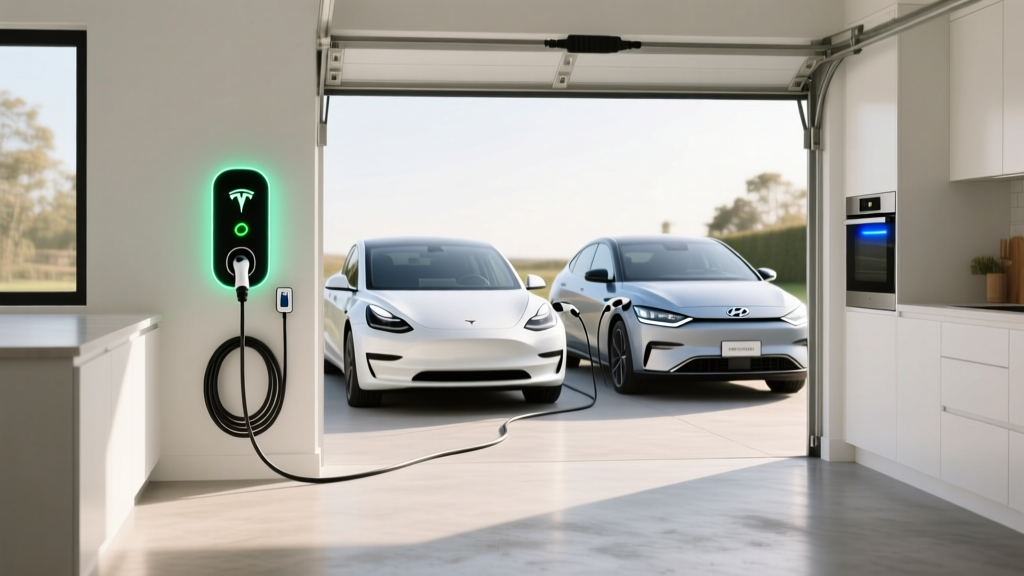
For households with two EVs using different connectors, a dual-connector charger or a simple adapter cable ($100–$200) resolves the issue without buying two separate units.
How Much Does Charging Cost Per Mile vs. Gasoline?
Electricity prices vary by region, time of day, and rate plan. Here's a realistic comparison using a mid-size electric SUV averaging 3.0 miles per kWh (roughly equivalent to the 2026 Tesla Model Y or Hyundai Ioniq 5):
| Scenario | Rate | Cost Per Mile (3.0 mi/kWh vehicle) |
|---|---|---|
| Home, off-peak utility rate (national avg) | $0.09–$0.14/kWh | $0.03–$0.047 |
| Home, standard residential rate | $0.15–$0.20/kWh | $0.05–$0.067 |
| Public Level 2 (network pricing) | $0.25–$0.49/kWh | $0.083–$0.163 |
| DC fast charging (Electrify America, Tesla Supercharger) | $0.30–$0.58/kWh | $0.10–$0.193 |
| Gasoline (25 MPG combined, $3.40/gal) | $3.40/gal | $0.136 |
At off-peak home rates, charging costs roughly one-quarter to one-third of what gasoline costs per mile. Even at standard residential rates without time-of-use optimization, most EV owners pay 40–50% less per mile than a comparable 25 MPG gasoline vehicle.
The economics shift at public DC fast chargers, where per-kWh pricing can approach or exceed gasoline costs on a per-mile basis. This is why home charging isn't just convenient — it's where the financial case for EV ownership is strongest. According to fueleconomy.gov, the average EV driver who charges primarily at home saves $800–$1,400 annually on fuel compared to a 25 MPG gasoline vehicle.
Time-of-Use Rate Plans
Most utilities offer EV-specific time-of-use (TOU) plans with dramatically reduced rates during off-peak hours (typically 11 PM – 6 AM). Scheduling your Level 2 charger to operate during these windows — a feature built into every smart charger — maximizes savings. Some TOU plans offer rates as low as $0.05–$0.08/kWh overnight.
Charging Time Examples: How Long to Replenish Common Battery Sizes
Real-world charging time depends on battery capacity, onboard charger acceptance rate, circuit amperage, and charging losses (typically 5–10% for AC Level 2). Here are representative examples for a 10% to 80% session — the typical daily charging window, since charging above 80% slows significantly to protect battery health:
| Vehicle (Example) | Usable Battery (kWh) | Onboard Charger | Circuit Power | 10–80% Time |
|---|---|---|---|---|
| Tesla Model Y Long Range | 75 kWh | 11.5 kW | 11.5 kW (48A) | ~4.5 hours |
| Hyundai Ioniq 5 (Long Range) | 77.4 kWh | 10.9 kW | 11.5 kW (48A) | ~5.0 hours |
| Ford F-150 Lightning (Std Range) | 98 kWh | 11.3 kW | 11.5 kW (48A) | ~6.1 hours |
| Chevrolet Equinox EV | 85 kWh | 11.5 kW | 11.5 kW (48A) | ~5.2 hours |
| Toyota RAV4 Prime (PHEV) | 14.9 kWh | 6.6 kW | 7.7 kW (32A) | ~1.6 hours |
For overnight charging, all of these times fit comfortably within an 8-hour sleep window. The key insight: you rarely need to charge from 0% to 100%. Setting your charger to target 80% daily (with periodic 100% sessions before long trips) extends battery longevity — particularly important for NMC chemistry batteries, which degrade faster when held at high state of charge for extended periods.
Level 2 Charger Recommendations: Equipment Picks for 2026
The home charger market has matured significantly. Here are proven units across price and feature tiers, all current as of 2026:
Tesla Universal Wall Connector
- Power: Up to 11.5 kW (48A)
- Connector: NACS with integrated CCS adapter
- Cable length: 24 feet
- Smart features: Wi-Fi, OTA updates, Tesla app scheduling, load sharing between two units
- Price: ~$600
- Best for: Mixed-fleet households (NACS + CCS vehicles)
Emporia Level 2 EV Charger
- Power: Up to 11.5 kW (48A)
- Connector: NACS (J3400)
- Cable length: 24 feet
- Smart features: Energy monitoring, solar integration, TOU scheduling, load management with Emporia VUE panel monitor
- Price: ~$400
- Best for: Solar homes and budget-conscious buyers wanting smart features
ChargePoint Home Flex
- Power: Up to 12 kW (50A) — configurable in 4A increments
- Connector: NACS or CCS (select at purchase)
- Cable length: 23 feet
- Smart features: App scheduling, Alexa/Google Home integration, detailed session history, flexible amperage tuning
- Price: ~$700
- Best for: Homes needing flexible amperage to match panel capacity
Grizzl-E Smart
- Power: Up to 10 kW (40A)
- Connector: NACS or CCS
- Cable length: 24 feet
- Smart features: OCPP-compatible, app control, adjustable amperage (16–40A)
- Price: ~$450
- Best for: Cold climates (rated to -40°F), outdoor installs, Canadian-made durability
All units listed above are hardwired or available in both hardwired and NEMA 14-50 plug-in configurations. Hardwired installations generally qualify for higher amperage (48A+ vs. 40A on a plug-in 14-50 outlet, due to NEC rules on receptacle continuous-load ratings) and eliminate the risk of outlet overheating — a documented concern with some 14-50 installations where the receptacle quality varies.
Safety, Code Compliance, and Installation Best Practices
Level 2 charging involves sustained high-current operation — hours of continuous draw at 32–48 amps. Safety isn't optional, and cutting corners here risks fire, equipment damage, and insurance claim denials.
Non-Negotiable Requirements
- Dedicated circuit: Your EV charger must have its own breaker — not shared with other appliances or outlets.
- Proper wire gauge: 6 AWG copper minimum for 48A continuous (60A breaker); 4 AWG for longer runs to minimize voltage drop.
- GFCI protection: NEC 2023 (Article 625.54) requires GFCI protection for all EV receptacles rated 150V to ground or less. Hardwired installations may not require GFCI in all jurisdictions — check with your local inspector.
- Outdoor-rated equipment: If your charger is installed outside (driveway, carport), it must carry a NEMA 4 or IP65 weather rating. All recommended chargers above meet this standard.
- Permit and inspection: Virtually all jurisdictions require an electrical permit for a new 240V circuit. The inspection verifies wire sizing, breaker rating, grounding, and code compliance. Unpermitted work can void homeowner's insurance coverage for related claims.
The NEMA 14-50 Outlet Debate
Some installers use a NEMA 14-50 receptacle (the same as an electric range outlet) for plug-in EV chargers. While convenient — you can unplug the charger and take it when you move — there are important caveats:
- NEC limits continuous loads on a receptacle to 80% of the breaker rating, so a 50A breaker yields only 40A continuous (9.6 kW max).
- Consumer-grade 14-50 receptacles ($10–$15) have been linked to overheating under sustained EV charging loads. If you go the plug-in route, specify an industrial-grade receptacle (Hubbell 9450A or Bryant 9450FR, ~$80–$120) designed for continuous high-current use.
- Hardwired installations avoid these concerns entirely and are generally preferred for 48A+ circuits.
Federal and State Incentives for Home Charging
The federal Alternative Fuel Vehicle Refueling Property Credit (IRS Form 8911) provides a tax credit of up to 30% of equipment and installation costs, capped at $1,000 for residential property. However, eligibility depends on whether your census tract qualifies as a non-urban or low-income area — a requirement that excludes many suburban and urban installations. Per IRS guidelines, you must verify eligibility by census tract before claiming.
Many state and utility programs stack on top of federal incentives. California's utilities, for example, frequently offer $500–$1,500 in rebates for Level 2 equipment and installation. New York's NYSERDA program provides up to $1,000. Always check your state energy office and utility EV program pages for current offerings — these change annually.
Frequently Asked Questions
Can I install a Level 2 charger myself?
Technically, a homeowner can pull their own electrical permit in many jurisdictions. However, 240V circuits at 40–48 amps carry genuine fire and shock risk if wired incorrectly. A mistake can also void your homeowner's insurance. We strongly recommend using a licensed electrician — the labor cost ($300–$800 for a straightforward install) is modest relative to the risk.
Will a Level 2 charger work with any EV I buy in the future?
Yes, with the right connector. All Level 2 chargers deliver standard AC power; the only variable is the physical plug. With NACS becoming the dominant standard by 2026, a NACS-equipped charger will work with the vast majority of new EVs sold. For the few remaining CCS vehicles, adapters are readily available for $100–$200.
How fast will a Level 2 charger add range to my EV?
At 11.5 kW (48A, the most common high-power residential setup), expect roughly 35–45 miles of range added per hour for a typical electric SUV or sedan. A full overnight charge (8–10 hours) adds 280–450 miles of range — more than enough to replenish any consumer EV from near-empty to full.
Do I need a smart charger, or is a basic unit sufficient?
A basic ("dumb") Level 2 charger will charge your vehicle reliably. Smart features — Wi-Fi connectivity, app-based scheduling, energy monitoring, and utility TOU integration — add convenience and can reduce electricity costs by 20–40% through off-peak scheduling. Given the small price premium ($50–$150 more than basic units), smart chargers are the recommended choice for nearly all installations.
What electrical upgrades might I need for Level 2 charging?
The most common upgrades are: (1) adding a new 240V circuit with appropriate breaker and wiring — standard for any installation; (2) upgrading from 100A to 200A main service panel — needed in older homes with limited electrical capacity; (3) installing a smart load-management system to share capacity between the charger and existing loads. Your electrician's load calculation will determine which, if any, upgrades are necessary. According to the National Highway Traffic Safety Administration, proper electrical installation is a key component of safe EV ownership.
Is Level 2 charging at home better for battery health than DC fast charging?
Yes. Level 2 charging generates significantly less heat than DC fast charging, and heat is the primary driver of lithium-ion battery degradation. Studies consistently show that vehicles charged predominantly on Level 2 retain 2–5% more battery capacity over 100,000 miles compared to vehicles that rely heavily on DC fast charging. For daily use, Level 2 is both the most economical and the most battery-friendly option.