Why Level 2 Charging Amps Matter More Than You Think
Plug in at 16 amps and you might wake up to a half-charged battery. Plug in at 48 amps and you could add 35+ miles of range per hour — enough to fully replenish most EVs overnight. The amperage of your Level 2 home charger is the single biggest variable in your daily EV ownership experience, yet most buyers focus on brand names and cable length while ignoring the number that actually determines charge speed.
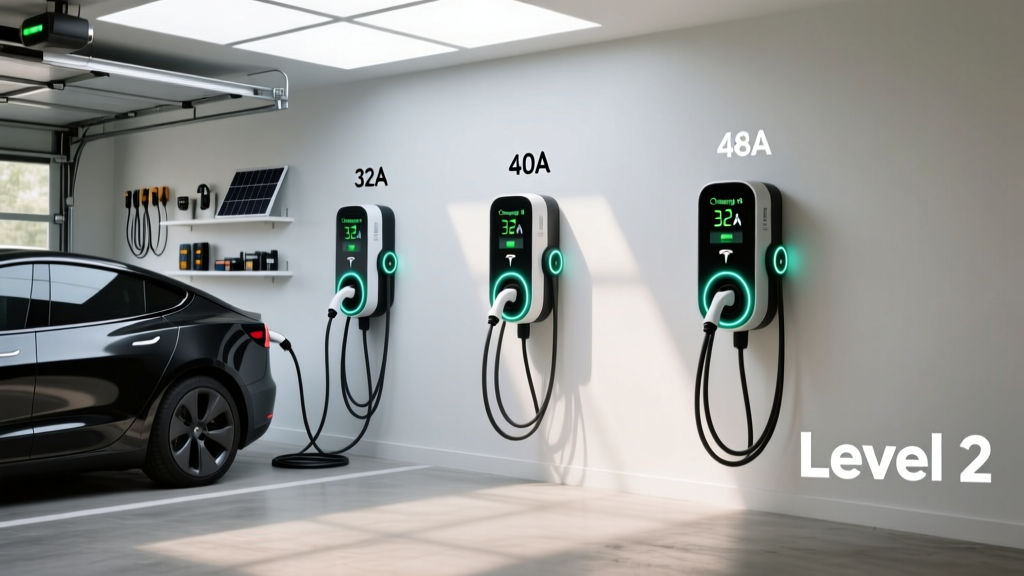
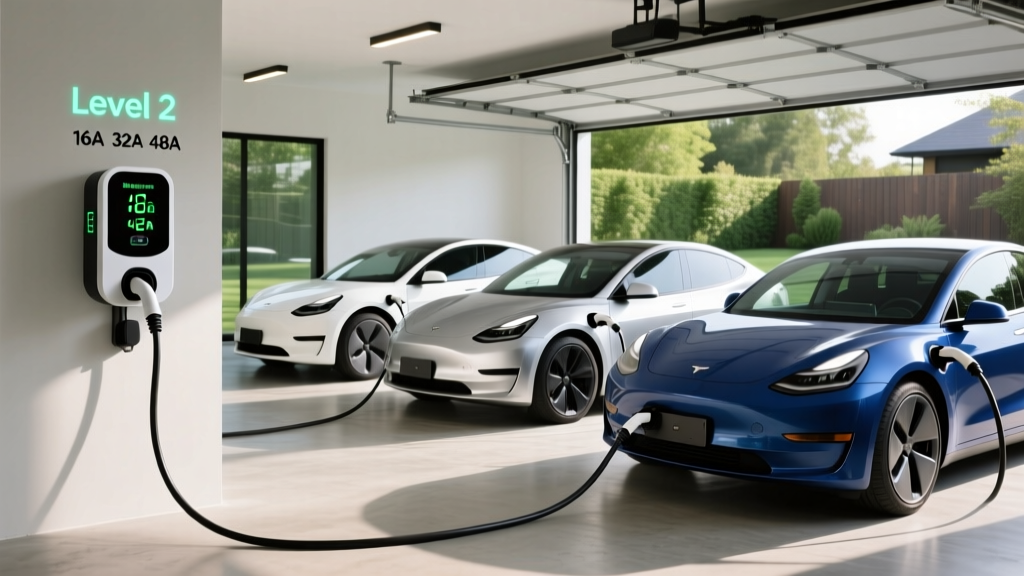
This guide breaks down what 16A, 32A, and 48A Level 2 charging actually delivers in real-world miles, what your electrical panel can support, what installation really costs in 2026, and which chargers we recommend at each amperage tier.
Charging Levels Compared: Speed, Power, and Range Added
Before we focus on Level 2 amperage options, here's how all three charging levels stack up in 2026. Note the critical distinction: kW (kilowatts) measures power — the rate of energy delivery — while kWh (kilowatt-hours) measures energy capacity, the size of your battery. Confusing the two is the most common EV literacy mistake.
| Level | Voltage | Max Power (kW) | Miles of Range Added per Hour | Typical Use Case |
|---|---|---|---|---|
| Level 1 | 120V AC | 1.2–1.9 kW | 3–5 mi/hr | Overnight trickle, PHEVs, emergencies |
| Level 2 (16A) | 240V AC | 3.8 kW | 12–15 mi/hr | Minimal install, older panels, PHEVs |
| Level 2 (32A) | 240V AC | 7.7 kW | 25–30 mi/hr | Most common home setup, mid-size BEVs |
| Level 2 (48A) | 240V AC | 11.5 kW | 35–44 mi/hr | Large-battery BEVs, fast overnight fills |
| DC Fast | 400–800V DC | 50–350 kW | 150–1,000+ mi/hr (peak) | Road trips, 10–80% in 18–40 min |
The miles-per-hour figures assume average EV efficiency of 3.0–3.5 miles per kWh. A highly efficient sedan like the Hyundai Ioniq 6 (4.1 mi/kWh per fueleconomy.gov) will gain more miles per hour than a heavy truck like the Rivian R1T (2.0–2.4 mi/kWh) on the same charger.
How Level 2 Charging Amps Translate to Real Charge Times
Amperage determines kilowatt output via a simple formula: Volts × Amps = Watts. At 240V, a 32A charger delivers 7.7 kW (240 × 32 = 7,680W). A 48A charger delivers 11.5 kW. That 50% amperage increase yields a 50% faster charge — but only if your EV's onboard charger can accept it.
Charging Time by Battery Size and Amperage
| Battery (usable kWh) | Example EV | 16A (3.8 kW) | 32A (7.7 kW) | 48A (11.5 kW) |
|---|---|---|---|---|
| 15.6 kWh | Toyota RAV4 Prime (PHEV) | 2.9 hrs | 1.4 hrs | 1.0 hr |
| 54 kWh | Hyundai Ioniq 5 (Standard Range) | 10.0 hrs | 4.9 hrs | 3.3 hrs |
| 77.4 kWh | Kia EV6 (Long Range) | 14.2 hrs | 7.0 hrs | 4.7 hrs |
| 82 kWh | Tesla Model Y (Long Range) | 15.1 hrs | 7.5 hrs | 5.0 hrs |
| 116 kWh | Hummer EV (24-module pack) | 21.4 hrs | 10.6 hrs | 7.1 hrs |
Onboard charger bottleneck: Most 2026 EVs accept 11.5 kW AC (48A) — including Tesla Model 3/Y, Ford Mustang Mach-E, and BMW iX. However, some models cap at 7.7 kW (32A), such as the Chevrolet Equinox EV and base Nissan Ariya. Buying a 48A charger for a 32A-limited EV isn't wasted money — it future-proofs your garage — but you won't see faster charging on that specific vehicle.
Electrical Requirements: What Your Panel Can Actually Handle
The National Electrical Code (NEC) requires that continuous loads — including EV chargers — use no more than 80% of a circuit's rated capacity. This means:
- 16A charger → requires a 20A circuit (16A ÷ 0.80 = 20A)
- 32A charger → requires a 40A circuit
- 48A charger → requires a 60A circuit
Panel Capacity Reality Check
Most homes built after 1990 have a 200A main panel. The average household base load (HVAC, appliances, lighting) consumes 60–100A at peak. A 60A EV circuit is feasible in most 200A panels, but if you already have electric heat, an electric range, a hot tub, or a workshop, a load calculation by a licensed electrician is mandatory.
Panel upgrade scenario: Homes with 100A service (common in pre-1980 construction) will almost certainly need an upgrade to 200A to support a 48A charger alongside modern appliances. Budget $1,500–$3,500 for a panel upgrade, depending on utility requirements and local labor rates.
For homes where a panel upgrade isn't feasible, a 32A charger on a 40A circuit is often the practical maximum — and it still delivers 25–30 miles of range per hour, which covers the needs of 90% of daily commuters.
How Much Does It Cost to Install a Home EV Charger?
Installation cost varies enormously based on the distance from your panel to the charger location, whether conduit must be run through walls or underground, and local permit fees. Here's a realistic 2026 breakdown:
| Component | Basic Install (32A, short run) | Standard Install (48A, 30–50 ft run) | Complex Install (48A + panel upgrade) |
|---|---|---|---|
| EVSE Equipment (charger) | $350–$500 | $500–$750 | $500–$750 |
| Electrician Labor | $400–$800 | $800–$1,500 | $1,500–$2,500 |
| Materials (conduit, wire, breaker) | $100–$250 | $200–$500 | $300–$600 |
| Permit & Inspection | $50–$150 | $100–$250 | $100–$250 |
| Panel Upgrade (if needed) | — | — | $1,500–$3,500 |
| Total Range | $900–$1,700 | $1,600–$3,000 | $3,900–$7,600 |
Federal incentive: The Alternative Fuel Vehicle Refueling Property Credit (IRS Form 8911) may cover up to 30% of home charger equipment and installation costs, capped at $1,000 per year, if you live in an eligible census tract. Check current eligibility on irs.gov — tract qualifications were updated under the Inflation Reduction Act and vary by location.
Connector Compatibility: NACS, CCS1, and CHAdeMO
The North American Charging Standard (NACS), originally developed by Tesla, is now the dominant connector for 2026 model-year EVs. Ford, GM, Rivian, Volvo, and most major automakers have adopted NACS. However, millions of CCS1-equipped EVs from 2019–2025 remain on the road, and a few Japanese models still use CHAdeMO for DC fast charging.
| Connector | Brands Using It (2026) | Home Level 2 Charger Availability |
|---|---|---|
| NACS (J3400) | Tesla, Ford, GM, Rivian, Volvo, Polestar, Hyundai/Kia (new), Mercedes | Tesla Wall Connector, ChargePoint Home Flex (NACS), Emporia Vue (NACS) |
| CCS1 (J1772 combo) | VW ID.4 (2021–2025), older Hyundai/Kia, BMW i4/iX (2022–2024), Audi e-tron (pre-2025) | ChargePoint Home Flex, Enel X JuiceBox, Emporia Vue (J1772) |
| CHAdeMO | Nissan Leaf (legacy DC only; Level 2 uses J1772) | All J1772 chargers work for Level 2 |
Adapter note: If you own a CCS1-equipped EV but want a NACS charger (to match your next vehicle), NACS-to-J1772 adapters are available from Lectron and Tesla for $150–$250. Most 2026 chargers ship with NACS connectors; J1772 versions may require a separate order. For Level 2 home charging, the physical connector difference matters less than for DC fast charging — all Level 2 chargers deliver single-phase AC regardless of plug shape.
Cost to Charge: Home vs. Public vs. Gas
The economics of EV charging depend heavily on where and when you plug in. Here's a 2026 comparison using national average rates:
| Scenario | Rate | Cost per Mile (3.0 mi/kWh EV) | Annual Cost (12,000 mi) |
|---|---|---|---|
| Home (off-peak utility rate) | $0.09–$0.13/kWh | $0.030–$0.043 | $360–$520 |
| Home (standard rate) | $0.14–$0.18/kWh | $0.047–$0.060 | $560–$720 |
| Public Level 2 (network pricing) | $0.25–$0.49/kWh | $0.083–$0.163 | $1,000–$1,960 |
| DC Fast Charging (public) | $0.30–$0.55/kWh | $0.100–$0.183 | $1,200–$2,200 |
| Gasoline (28 MPG, $3.40/gal) | $3.40/gal | $0.121 | $1,457 |
Key takeaway: Home Level 2 charging at off-peak rates is roughly 3–4× cheaper per mile than gasoline. Even standard-rate home charging undercuts gas by 60%. Public DC fast charging narrows the gap — at $0.48/kWh, it's nearly cost-equivalent to a 28 MPG gas car. This is why home charging access is the most important factor in EV ownership economics.
Recommended Level 2 Chargers by Amperage Tier
16A Tier — Emporia Vue (16A Config)
- Power Output: 3.8 kW (240V × 16A)
- Connector: NACS or J1772 (configurable)
- Cable Length: 24 ft
- Smart Features: Wi-Fi, app scheduling, energy monitoring, solar integration
- Price: ~$350
- Best For: PHEV owners, 100A panels, budget installs, garages with limited circuit capacity
32A Tier — Enel X JuiceBox (32A)
- Power Output: 7.7 kW (240V × 32A)
- Connector: J1772 (NACS adapter available)
- Cable Length: 25 ft
- Smart Features: Wi-Fi, app control, load management, Alexa compatible
- Price: ~$450
- Best For: Mid-size BEVs (Ioniq 5, EV6), 100–150A panels, balanced cost-to-speed ratio
48A Tier — Tesla Wall Connector (Gen 4)
- Power Output: 11.5 kW (240V × 48A)
- Connector: NACS (J1772 adapter included in box)
- Cable Length: 24 ft
- Smart Features: Wi-Fi, OTA updates, power sharing (up to 6 units on one circuit), access control
- Price: ~$475
- Best For: Large-battery BEVs (Model Y, F-150 Lightning, Rivian), 200A panels, fastest overnight charging
48A Tier — ChargePoint Home Flex (NACS, 2026)
- Power Output: Up to 11.5 kW (adjustable 16A–48A via app)
- Connector: NACS or J1772 (select at purchase)
- Cable Length: 23 ft
- Smart Features: Wi-Fi, app scheduling, flexible amperage dial, Alexa/Google Home
- Price: ~$650
- Best For: Multi-EV households, future-proofing (adjust amps if you move or add a second EV)
Pro tip: The ChargePoint Home Flex's adjustable amperage is genuinely useful. Set it to 32A on a 40A circuit today, then reconfigure to 48A if you upgrade your panel later — no new hardware required.
Safety, Code, and Installation Best Practices
EV chargers are continuous high-draw appliances. Cutting corners on installation creates fire risk and may void your homeowner's insurance. Here's what proper installation requires:
- Dedicated circuit: Your Level 2 charger must have its own breaker — never share a circuit with a dryer, HVAC unit, or workshop outlet.
- GFCI protection: NEC 2023 (and the 2026 update) requires ground-fault circuit interrupter protection for all EV receptacles. Hardwired chargers with built-in GFCI (like the Tesla Wall Connector) satisfy this requirement without a GFCI breaker, which can nuisance-trip on some EVSE units.
- Outdoor rating: If your charger is mounted outside or in an open carport, ensure the unit carries a NEMA 4 (weatherproof) rating. The Emporia Vue and Tesla Wall Connector are NEMA 4 rated; some JuiceBox models require an optional weather cover.
- Wire gauge: A 60A circuit (for 48A charging) typically requires 6 AWG copper wire for runs under 50 feet. Longer runs may need 4 AWG to prevent voltage drop. Your electrician will calculate this based on the specific installation.
- Permit and inspection: Nearly all jurisdictions require an electrical permit for EV charger installation. The inspection ensures code compliance and protects you in the event of a future insurance claim. Budget $50–$250 for the permit depending on your municipality.
Always hire a licensed electrician — not a handyman — for EV charger installation. The National Fire Protection Association (NFPA) maintains the NEC standards that govern these installations, and a licensed professional will ensure your setup meets current code.
Frequently Asked Questions
How much does it cost to install a home EV charger?
A straightforward 32A Level 2 installation with a short wire run typically costs $1,200–$2,000 total (equipment + electrician + permit). A 48A install with a longer run averages $1,600–$3,000. If your home needs a panel upgrade from 100A to 200A, add $1,500–$3,500, bringing the total to $3,900–$7,600. The federal refueling property credit may offset up to $1,000 if you're in an eligible census tract.
How fast will each Level 2 amperage add range?
At 240V: 16A adds roughly 12–15 miles per hour, 32A adds 25–30 miles per hour, and 48A adds 35–44 miles per hour. These figures assume average EV efficiency (3.0–3.5 mi/kWh). More efficient vehicles gain more miles per hour; heavier, less efficient vehicles gain fewer.
Which connector or charger is compatible with my EV?
If you drive a 2025–2026 Tesla, Ford, GM, Rivian, Volvo, or most new Hyundai/Kia models, you need a NACS connector. Older CCS1-equipped EVs (2019–2025 VW ID.4, older BMW i4, Hyundai Ioniq 5 pre-2026) need a J1772/CCS1 charger or a NACS-to-J1772 adapter. All EVs use the same connector for Level 2 AC charging regardless of their DC fast-charge port — the split between NACS and CCS1 primarily matters at public DC fast chargers.
How much does charging cost per mile compared to gas?
Home Level 2 charging at off-peak rates ($0.11/kWh average) costs roughly $0.037 per mile in an average EV — about 70% less than a 28 MPG gas car at $3.40/gallon ($0.121/mi). Even standard-rate home charging ($0.16/kWh) costs ~$0.053/mi. Public DC fast charging at $0.45/kWh narrows the gap to ~$0.15/mi, which is slightly more expensive than gas.
What electrical upgrades might I need for a 48A charger?
A 48A charger requires a dedicated 60A circuit. If your panel is 200A and doesn't already carry heavy loads (electric heat, hot tub, workshop), a 60A addition is usually fine. If you have a 100A panel, you'll almost certainly need a service upgrade to 200A ($1,500–$3,500). If your panel is 200A but near capacity, an electrician may recommend a smart load-management device (like the Emporia VUE with smart panel monitoring) that dynamically reduces charger amperage when household demand spikes — avoiding the need for a panel upgrade entirely.
Is hardwired or plug-in (NEMA 14-50) installation better?
Hardwired installations support the full 48A continuously and eliminate the failure point of a receptacle. A NEMA 14-50 outlet is limited to 40A continuous (32A charger max by code) and requires a GFCI breaker in most 2026 jurisdictions, which adds $80–$150 and can cause nuisance tripping. We recommend hardwired for 48A chargers and plug-in only if you want portability or are renting.