Why Your Level 2 Home Charger Choice Matters More Than You Think
If you're shopping for a home EV charger in 2026, you've likely encountered the term "charger v6" in forums, Reddit threads, or product listings. The phrase typically refers to the sixth-generation or current-iteration hardware from major Level 2 charging equipment makers — units that now routinely support 40–48 amps, Wi-Fi connectivity, NACS native connectors, and smart scheduling. But not all v6-class chargers are equal, and picking the wrong one can mean slower charging, higher installation bills, or adapter headaches down the road.
This guide breaks down exactly what you need to know: charging speeds in kW and miles per hour, real installation costs including panel upgrades, connector compatibility for every major EV brand, per-mile charging costs versus gasoline, and hands-on equipment picks with power output, cable length, and pricing. We'll keep it precise — no vague "charges fast" claims, just the numbers that matter.
Charging Levels Explained: Speeds, kW, and Miles Added Per Hour
Before choosing hardware, understand the three charging tiers available to EV owners. The critical distinction: kW (kilowatts) measures power — the rate of energy flow. kWh (kilowatt-hours) measures energy — the total amount stored in your battery. A 60 kWh battery charged at 11.5 kW takes roughly 5.2 hours from 0–100%. Never confuse the two.
| Level | Voltage / Amps | Power (kW) | Miles of Range Added Per Hour | Typical Use Case |
|---|---|---|---|---|
| Level 1 | 120V / 12A | 1.4 kW | 3–5 mi/hr | Overnight trickle; PHEVs with small batteries |
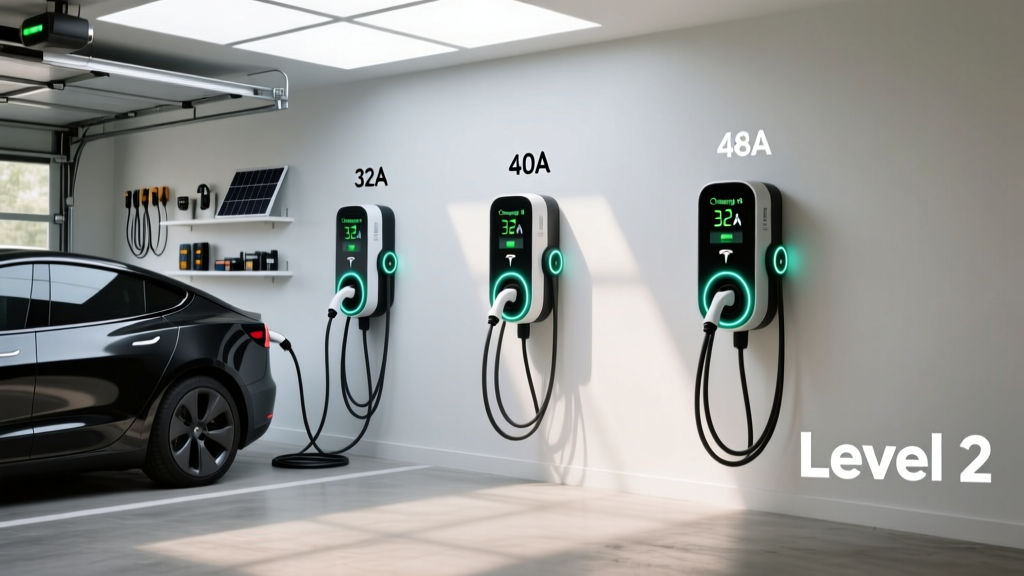
| Level 2 | 240V / 32–48A | 7.7–11.5 kW | 25–44 mi/hr | Primary home charging; daily replenishment |
| DC Fast Charge | 400–800V DC | 50–350 kW | 150–1,200+ mi/hr (peak) | Road trips; public stations (not home-installable) |
Real-world caveat: Those miles-per-hour figures assume a vehicle efficiency around 3.0–3.5 mi/kWh (typical for a mid-size crossover EV). A heavier truck like the Ford F-150 Lightning (roughly 2.0 mi/kWh) will add fewer miles per hour at the same kW rate. Cold weather below 32°F can reduce charging speed by 20–40% due to battery thermal management needs — preconditioning your battery before a DC fast session is essential.
How Much Does It Cost to Install a Home EV Charger?
The total installed cost of a Level 2 home charger varies enormously based on your electrical panel's capacity, the distance from panel to charger location, and local permit fees. Here's a realistic breakdown for a 240V/48A circuit (the most common v6-class charger configuration):
| Cost Component | Simple Install (Panel Near Garage) | Complex Install (Long Run or Panel Upgrade) |
|---|---|---|
| Level 2 Charger Unit (40–48A) | $400–$650 | $400–$650 |
| Electrician Labor (2–6 hrs @ $85–$150/hr) | $170–$400 | $500–$900 |
| Materials (wire, conduit, breaker) | $50–$150 | $200–$500 |
| Permit & Inspection | $50–$150 | $50–$200 |
| Electrical Panel Upgrade (100A→200A, if needed) | $0 | $1,500–$3,500 |
| Total Estimated Cost | $670–$1,350 | $2,650–$5,750 |
The panel upgrade gotcha: Homes built before 2000 often have 100-amp or 150-amp panels. Adding a 48A EV charger (which requires a 60A breaker per NEC 80% continuous-load rule) may push total household load beyond your panel's capacity. A licensed electrician will perform a load calculation. If you need a panel upgrade to 200A, budget an additional $1,500–$3,500. Some utilities offer rebates covering part of this cost — check your local provider.
Electrical requirements for v6-class 48A chargers: You'll need a dedicated 240V circuit with a 60A double-pole breaker (for hardwired units) or a NEMA 14-50 receptacle on a 50A breaker (for plug-in units limited to 40A continuous). Hardwired installations are preferred for 48A units because NEMA 14-50 outlets are rated for 50A maximum, and the 80% continuous-use rule caps them at 40A.
Connector Compatibility: NACS, CCS1, and CHAdeMO
The connector landscape has shifted dramatically. As of 2026, nearly all new EVs sold in North America use the NACS (North American Charging Standard) connector — originally Tesla's proprietary design, now adopted by Ford, GM, Rivian, Hyundai/Kia, BMW, and most other manufacturers. The legacy CCS1 connector still appears on older-model EVs (pre-2025 Volkswagen ID.4, some BMW iX, earlier Hyundai Ioniq 5). CHAdeMO is effectively discontinued for new vehicles, surviving only on legacy Nissan Leaf models.
| Connector | Compatible Vehicles (2025–2026 Models) | Adapter Needed? |
|---|---|---|
| NACS (Tesla-style) | Tesla Model 3/Y/S/X, Ford Mustang Mach-E & F-150 Lightning, GM Ultium vehicles (Equinox EV, Blazer EV, Silverado EV), Rivian R1T/R1S, Hyundai Ioniq 5/6 (2025+), Kia EV6/EV9 (2025+) | None for NACS-native vehicles |
| CCS1 | VW ID.4 (pre-2025), BMW i4/iX (pre-2025), older Hyundai/Kia EVs, Porsche Taycan (pre-2025) | NACS-to-CCS adapter (~$200–$300) for NACS chargers |
| CHAdeMO | Nissan Leaf (all years), Mitsubishi Outlander PHEV (older) | Limited adapter options; CHAdeMO infrastructure declining |
Buying advice: If your current EV uses CCS1 but you plan to buy a NACS-vehicle in the next 2–3 years, invest in a NACS-native charger now and use a CCS adapter for your current car. This future-proofs your installation. Most v6-class chargers from ChargePoint, Wallbox, and Grizzl-E now ship with NACS connectors as standard, with CCS1 available as an option or via adapter.
Top Level 2 Charger V6 Picks: Specs, Features, and Pricing
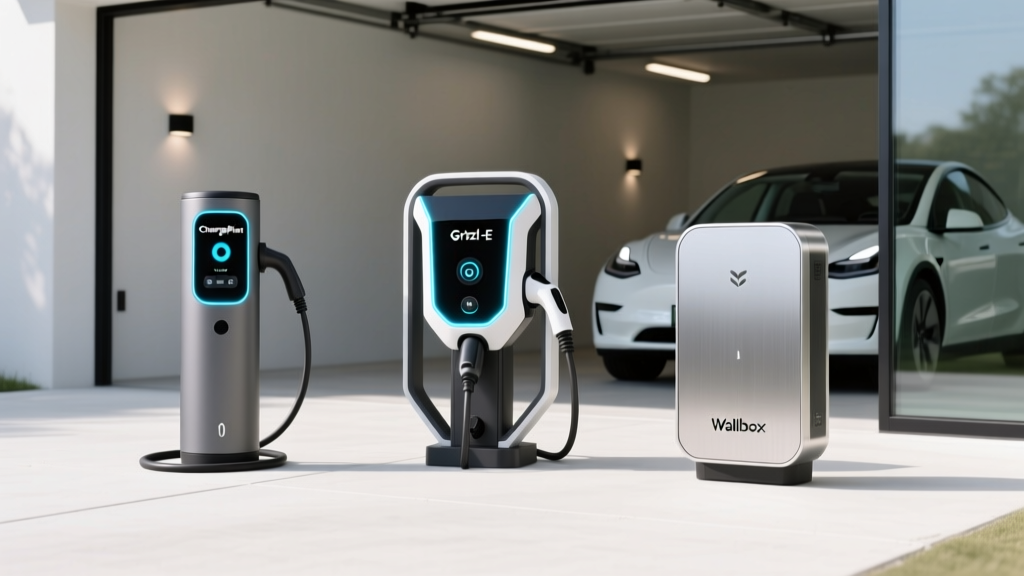
Here are three current-generation (v6-class) Level 2 chargers that represent the best options across different priorities — smart features, ruggedness, and value. All support 240V installation and deliver enough power to fully replenish most EV batteries overnight.
ChargePoint Home Flex (Gen 2 / v6 Platform)
- Power Output: Up to 11.5 kW (48A) on 60A circuit; adjustable down to 16A for lower-capacity panels
- Connector: NACS standard; J1772 adapter included (CCS via adapter)
- Cable Length: 23 feet
- Smart Features: Wi-Fi, app scheduling, Alexa/Google Home integration, energy tracking, utility demand-response compatible
- Indoor/Outdoor: NEMA 4 rated (outdoor-safe)
- Price: ~$549 (unit only)
Best for: Tech-forward buyers who want granular energy data, utility off-peak scheduling, and flexible amperage settings.
Grizzl-E Smart (v6 Firmware)
- Power Output: Up to 10 kW (40A) on 50A circuit; dip-switch adjustable to 32A/24A/16A
- Connector: NACS or J1772 (select at purchase)
- Cable Length: 24 feet
- Smart Features: Wi-Fi, OCPP-compatible, app control, firmware OTA updates
- Indoor/Outdoor: IP67 rated (fully outdoor-rated, operates to -40°F)
- Price: ~$449 (unit only)
Best for: Cold-climate owners and those wanting a rugged, no-nonsense unit built in Canada with a 3-year warranty.
Wallbox Pulsar Plus (v6 Hardware)
- Power Output: Up to 11.5 kW (48A) on 60A circuit
- Connector: NACS standard (2025+ models); J1772 on earlier units
- Cable Length: 25 feet (longest in class)
- Smart Features: Wi-Fi + Bluetooth, myWallbox app, solar-integration mode (Eco-Smart), Power Sharing for dual-charger setups
- Indoor/Outdoor: NEMA 4 rated
- Price: ~$499 (unit only)
Best for: Homes with solar panels or those needing the longest cable reach. The Eco-Smart mode charges only from excess solar production.
Charging Time Examples: How Long Does 10–80% Take at Home?
DC fast charging gets the headlines, but 80%+ of EV charging happens at home on Level 2. Here's what to expect from a 48A (11.5 kW) v6-class charger with common battery sizes, timing from 10% to 80% State of Charge:
| Vehicle (Example) | Usable Battery (kWh) | 10–80% at 11.5 kW (Level 2) | 10–80% at 7.7 kW (32A) |
|---|---|---|---|
| Tesla Model Y Long Range (2026) | 75 kWh | ~4.6 hours | ~6.8 hours |
| Hyundai Ioniq 5 (2026, NACS) | 77.4 kWh | ~4.7 hours | ~7.0 hours |
| Ford F-150 Lightning Extended Range | 131 kWh | ~8.0 hours | ~11.9 hours |
| Chevrolet Equinox EV (2026) | 85 kWh | ~5.2 hours | ~7.7 hours |
| Toyota RAV4 Prime (PHEV) | 18.1 kWh | ~1.1 hours | ~1.6 hours |
Key insight: Level 2 charging speed is linear — unlike DC fast charging, there's no significant taper curve below 80% SoC. A 75 kWh battery at 11.5 kW gains roughly 11.5 kWh per hour (minus ~5% conversion losses). For most daily drivers covering 30–50 miles, a 32A (7.7 kW) charger replenishes overnight easily. The 48A upgrade matters most for large-battery trucks and SUVs or high-mileage commuters.
Cost to Charge: Per-Mile Electricity vs. Gasoline
One of the strongest arguments for home EV charging is cost. Electricity prices vary by region and time-of-use, but the per-mile savings over gasoline are substantial in nearly every scenario. Here's a breakdown using a vehicle efficiency of 3.2 mi/kWh (typical mid-size EV crossover):
| Charging Scenario | Cost per kWh | Cost per Mile | Annual Cost (12,000 mi) |
|---|---|---|---|
| Home Off-Peak (utility TOU rate) | $0.08–$0.12 | $0.025–$0.038 | $300–$450 |
| Home Standard Rate (national avg) | $0.16 | $0.050 | $600 |
| Public Level 2 (ChargePoint, EVgo) | $0.25–$0.40 | $0.078–$0.125 | $940–$1,500 |
| DC Fast Charging (Electrify America, Tesla Supercharger) | $0.30–$0.55 | $0.094–$0.172 | $1,125–$2,060 |
| Gasoline Vehicle (28 MPG combined @ $3.40/gal) | $3.40/gal | $0.121 | $1,457 |
Bottom line: Home off-peak charging delivers fuel costs roughly 75–80% lower than a 28 MPG gasoline car. Even at standard residential rates, you'll save about 60% per mile. The savings shrink if you rely exclusively on public DC fast charging — another reason a home Level 2 installation pays for itself within 1–3 years for most drivers. According to fueleconomy.gov, EVs cost roughly half as much to fuel as comparable gasoline vehicles when charged primarily at home.
Safety, Electrical Code, and Installation Best Practices
A Level 2 charger draws significant continuous current — often for 6–10 hours at a stretch. Proper installation isn't optional; it's critical for fire safety and code compliance. Here's what your electrician should address:
- Dedicated circuit: Your EV charger must have its own dedicated double-pole breaker — never shared with other appliances. A 48A charger requires a 60A breaker (NEC Article 210.20 requires 125% overcurrent protection for continuous loads).
- GFCI protection: NEC 2020 and later require GFCI protection for all receptacles in garages. Hardwired chargers may be exempt in some jurisdictions, but GFCI breakers add an important safety layer. Note: some EV owners report nuisance GFCI trips with certain charger/receptacle combinations — hardwired installations avoid this issue entirely.
- Outdoor rating: If your charger mounts outside, it must carry at minimum a NEMA 4 rating (splash-resistant). For harsh climates, IP67-rated units like the Grizzl-E handle rain, snow, and dust ingress without issue.
- Wire gauge: A 60A circuit requires 6 AWG copper wire (THHN in conduit) or 4 AWG aluminum. Longer runs (over 100 feet) may need upsized wire to prevent voltage drop exceeding 3%.
- Permit and inspection: Nearly all jurisdictions require an electrical permit for a new 240V circuit. The inspection verifies proper breaker sizing, wire gauge, grounding, and GFCI compliance. Skipping permits risks insurance claim denials if an electrical fire occurs.
For the final electrical specification, always defer to a licensed electrician who can assess your specific panel capacity, wire routing, and local code amendments. The National Electrical Code (NEC) sets the baseline, but municipalities may add requirements.
Frequently Asked Questions
How much does it cost to install a home EV charger?
For a straightforward installation with an adequate 200A panel and short wire run, expect $670–$1,350 total (charger unit + electrician + materials + permit). If your home needs a panel upgrade from 100A to 200A, total costs can reach $2,650–$5,750. Always get a load calculation from a licensed electrician before committing.
How fast will each charging level add range?
Level 1 (120V) adds 3–5 miles of range per hour — fine for PHEVs but impractical for full EVs. Level 2 (240V, 48A) adds 35–44 miles per hour, easily replenishing a daily commute overnight. DC fast charging adds 150–1,200+ miles per hour at peak rates, but tapers significantly above 80% SoC and is only available at public stations.
Which connector/charger is compatible with my EV?
For 2025–2026 model-year EVs, NACS is now the dominant standard — Tesla, Ford, GM, Rivian, Hyundai, Kia, and BMW all use it. If you drive an older CCS1 vehicle (pre-2025 VW ID.4, BMW i4), buy a NACS-native charger and use a CCS adapter (~$200–$300) for compatibility. CHAdeMO vehicles (Nissan Leaf) face declining infrastructure; consider a J1772-to-CHAdeMO adapter or plan for a NACS vehicle as your next purchase.
How much does charging cost per mile vs gas?
Home charging at off-peak rates costs $0.025–$0.038 per mile, compared to $0.12 per mile for a 28 MPG gas car at $3.40/gallon. That's a 70–80% fuel cost reduction. Even at standard residential rates ($0.16/kWh), EV charging costs about $0.05/mile — roughly 60% less than gasoline. Public DC fast charging narrows the gap to $0.09–$0.17/mile.
What electrical upgrades might I need?
The most common upgrade is a panel capacity increase from 100A or 150A to 200A ($1,500–$3,500). You may also need: a new double-pole breaker slot (if your panel is full), upsized wire for long runs, or a sub-panel if the charger is far from the main service. Some utilities offer rebates of $200–$500 for panel upgrades done alongside EV charger installation — check with your provider. The IRS §30C alternative fuel vehicle refueling property credit may cover up to 30% of charger hardware and installation costs (capped at $1,000 for residential), subject to census-tract eligibility requirements.
Should I get a hardwired or plug-in (NEMA 14-50) charger?
Hardwired installations support the full 48A continuous draw that v6-class chargers offer, while NEMA 14-50 receptacles are limited to 40A continuous (50A breaker × 80% rule). Hardwired also eliminates GFCI nuisance-trip issues and provides a cleaner look. Plug-in units offer portability — useful if you rent or plan to move the charger. If maximum charging speed matters (large battery, high daily mileage), go hardwired.
Do I need a smart charger, or is a basic unit fine?
Smart features (Wi-Fi, app scheduling, energy tracking) are valuable if your utility offers time-of-use rates — scheduling charging to off-peak hours can cut your per-kWh cost by 40–60%. If you're on a flat rate and just want plug-and-charge simplicity, a basic non-smart unit like the Grizzl-E (non-Smart variant, ~$349) works perfectly. Smart chargers also enable future utility demand-response programs that may pay you for curtailing charge during grid peaks.