Choosing a home EV charger comes down to one practical question: how much range will it add while you sleep? Level 2 charger speed varies widely depending on the unit's kilowatt (kW) output, your home's electrical capacity, and your vehicle's onboard charger limit. A 48-amp hardwired station can add up to 44 miles of range per hour on a compatible vehicle, while a basic 16-amp plug-in unit might deliver just 14 miles per hour. Understanding these numbers — and the electrical work required to support them — is essential before you spend a dollar on equipment or an electrician.
This guide covers every layer of the decision: the three charging levels and their real speeds, what your electrical panel can actually handle, installation cost ranges, connector compatibility across brands, per-mile charging costs versus gasoline, and specific charger models worth buying in 2026.
The Three Charging Levels: Speeds in kW and Miles Per Hour
EV charging falls into three categories. The critical distinction to keep straight: kW (kilowatts) measures power — the rate at which energy flows into your battery. kWh (kilowatt-hours) measures energy — the total capacity of your battery. A 75 kWh battery charged at 7.5 kW takes roughly 10 hours from empty to full. Think of kW as the width of the pipe and kWh as the size of the tank.
| Level | Voltage | Typical kW Output | Miles of Range Added Per Hour | Best For |
|---|---|---|---|---|
| Level 1 (120V) | 120V AC | 1.2–1.9 kW | 3–5 mi/hr | Overnight top-ups, PHEVs, low-mileage drivers |
| Level 2 (240V) | 240V AC | 3.3–19.2 kW | 12–44 mi/hr (varies by vehicle) | Daily home charging, most BEV owners |
| DC Fast Charging | 400–800V DC | 50–350 kW | 150–300+ mi/hr (10–80% in 18–40 min) | Road trips, rapid top-ups away from home |
Level 1 charging uses a standard household outlet. It works fine for plug-in hybrids with 10–15 kWh batteries or battery-electric vehicles driven fewer than 30 miles per day. But for a 75–100 kWh BEV battery, Level 1 can take 40–80+ hours for a full charge — impractical for most owners.
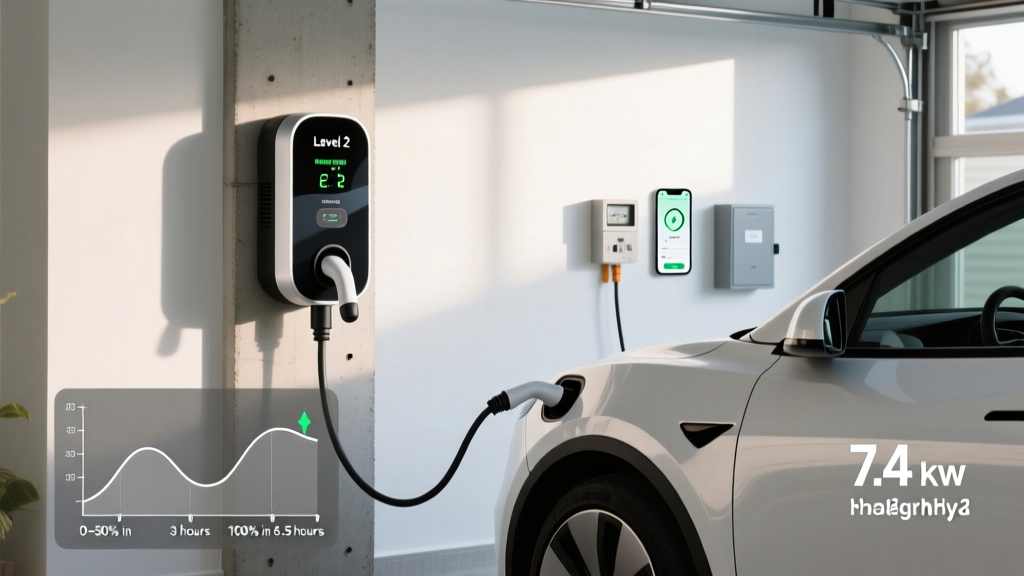
Level 2 is the home-charging standard. It requires a 240V circuit (the same voltage as your electric dryer or oven) and delivers enough power to fully recharge most EVs overnight. The actual speed depends on three factors: the charger's maximum kW output, the circuit's amperage, and your vehicle's onboard charger capacity. A Tesla Model 3 with an 11.5 kW onboard charger, for instance, can accept the full output of a 48-amp (11.5 kW) Level 2 station. A vehicle limited to 7.2 kW onboard charging — like some trims of the Chevrolet Equinox EV — won't charge any faster on a 48-amp unit than on a 32-amp unit.
DC fast charging bypasses the vehicle's onboard charger entirely, sending direct current straight to the battery at far higher power levels. These stations are found along highways and in commercial areas, not in homes. Charging speed on DC fast chargers follows a charge curve: power peaks at low state-of-charge (typically 10–30% SoC) and tapers significantly above 80% SoC to protect battery health. A station rated for 150 kW may only sustain that rate for 10–15 minutes before dropping to 50–70 kW as the battery fills.
Home Electrical Requirements: Voltage, Amperage, and Panel Capacity
Before selecting a Level 2 charger, you need to know what your home's electrical system can support. Most Level 2 chargers run on a 240V circuit, and the amperage of that circuit determines maximum power output:
- 20-amp circuit: Supports a 16-amp continuous draw → 3.8 kW (≈14 miles of range per hour)
- 30-amp circuit: Supports a 24-amp continuous draw → 5.8 kW (≈21 mi/hr)
- 40-amp circuit: Supports a 32-amp continuous draw → 7.7 kW (≈28 mi/hr)
- 50-amp circuit: Supports a 40-amp continuous draw → 9.6 kW (≈35 mi/hr)
- 60-amp circuit: Supports a 48-amp continuous draw → 11.5 kW (≈42 mi/hr)
Electrical code (NEC Article 625) requires that EV charging loads be treated as continuous, meaning the circuit must be rated for 125% of the charger's maximum draw. A 48-amp charger therefore requires a 60-amp breaker and appropriately sized wire (typically 6 AWG copper or 4 AWG aluminum).
How Much Does It Cost to Install a Home Level 2 Charger?
Installation costs depend on the distance between your electrical panel and the charger location, whether your panel needs upgrading, local permit fees, and whether you choose a hardwired or plug-in unit. Here's a realistic breakdown for a typical 2026 installation:
| Component | Low-End Estimate | High-End Estimate | Notes |
|---|---|---|---|
| Level 2 charger unit (hardware) | $300 | $700 | 32A–48A smart chargers; basic non-smart units start ~$200 |
| Electrician labor (standard install) | $400 | $1,200 | Short conduit run from panel to garage/carport |
| Electrical materials (wire, conduit, breaker) | $100 | $400 | Cost rises with distance; 6 AWG copper wire per foot |
| Permit and inspection fees | $50 | $300 | Varies by municipality; some jurisdictions waive EV permits |
| Panel upgrade (if needed) | $1,500 | $3,500 | 100A → 200A service upgrade; not required for every home |
| Total (no panel upgrade) | $850 | $2,600 | Most homes with 200A panels fall in the $1,000–$1,800 range |
| Total (with panel upgrade) | $2,350 | $6,100 | Older homes with 100A service |
The federal Alternative Fuel Vehicle Refueling Property Credit (IRC §30C) covers 30% of the cost of home charging equipment and installation, up to $1,000, for equipment placed in service through 2032. Eligibility depends on census-tract requirements — the home must be in a qualifying low-income or non-urban area. Consult irs.gov or a tax professional to confirm your eligibility before relying on this credit.
Which Connector Is Compatible With My EV?
The North American charging landscape has consolidated significantly since Tesla opened its Supercharger network and the North American Charging Standard (NACS) connector was adopted by nearly every major automaker. Here's where things stand for 2026 model-year vehicles:
| Connector Type | Brands Using It (Native) | Adapter Needed? |
|---|---|---|
| NACS (Tesla/J3400) | Tesla, Ford, GM, Rivian, Volvo, Polestar, Mercedes-Benz, BMW, Hyundai, Kia, Nissan (2026+) | No — native on most new vehicles; J1772-to-NACS adapter for older Teslas at public Level 2 |
| CCS1 (Combined Charging System) | VW, Audi, some remaining 2024–2025 models still on the road | NACS-to-CCS adapter available for Tesla Supercharger access; CCS still works at Electrify America, EVgo |
| CHAdeMO | Nissan Leaf (legacy); effectively discontinued on new vehicles after 2025 | Limited adapter options; CHAdeMO DC infrastructure declining |
For home Level 2 charging, the connector situation is straightforward. Most Level 2 chargers sold in 2026 ship with a NACS connector or offer it as the default option. If you drive a vehicle still equipped with a J1772 port (common on 2022–2024 models), you can purchase a J1772-to-NACS adapter for $50–$150, or buy a charger that still ships with a J1772 connector. Tesla's Wall Connector includes a NACS plug natively and can charge non-Tesla NACS vehicles directly.
Cost to Charge: Level 2 at Home vs. Gas and Public DC Fast Charging
One of the strongest arguments for home Level 2 charging is per-mile cost. Electricity rates vary widely by region and utility, but the math consistently favors home charging over gasoline — and often over public DC fast charging.
| Scenario | Rate / Cost Basis | Cost Per kWh | Cost Per Mile (250 Wh/mi EV) | Annual Cost (12,000 mi) |
|---|---|---|---|---|
| Home Level 2 — off-peak utility rate | Time-of-use overnight rate | $0.09–$0.14 | $0.023–$0.035 | $270–$420 |
| Home Level 2 — standard residential rate | Flat residential rate | $0.14–$0.20 | $0.035–$0.050 | $420–$600 |
| Public Level 2 (ChargePoint, EVgo L2) | Per-kWh pricing | $0.25–$0.49 | $0.063–$0.123 | $750–$1,470 |
| DC Fast Charging (EA, Tesla Supercharger) | Per-kWh pricing | $0.30–$0.55 | $0.075–$0.138 | $900–$1,650 |
| Gasoline (30 MPG combined, $3.40/gal) | Gas station pump price | N/A | $0.113 | $1,360 |
The numbers are clear: home Level 2 charging on an off-peak rate costs roughly one-quarter to one-third what gasoline does per mile. Even on a standard residential rate, home charging is typically 40–60% cheaper per mile than gas. The savings erode significantly if you rely entirely on public DC fast charging — at $0.45/kWh and above, you may match or exceed gasoline costs.
Efficiency matters in this calculation. A Tesla Model 3 achieves roughly 250 Wh/mile (about 4 miles per kWh), while a larger vehicle like the Ford F-150 Lightning may consume 400–450 Wh/mile (roughly 2.3 miles per kWh). The Lightning's per-mile cost at home is correspondingly higher — about $0.04–$0.06/mi on a $0.14/kWh rate — but still undercuts gasoline for an equivalent F-150 at 20 MPG.
Charging Time Examples: How Long Does Level 2 Actually Take?
Real-world Level 2 charging times depend on the charger's kW output, the battery's usable capacity, and the vehicle's onboard charger limit. Here are representative scenarios for common 2026 EVs charging on a 48-amp (11.5 kW) Level 2 circuit:
- Tesla Model 3 Long Range (75 kWh usable, 11.5 kW onboard): 0–100% in approximately 7.5 hours. A typical 20–80% daily charge completes in about 4 hours.
- Hyundai Ioniq 5 (77.4 kWh usable, 10.9 kW onboard): 0–100% in roughly 8 hours. 20–80% daily charge in about 4.2 hours.
- Ford F-150 Lightning Extended Range (131 kWh usable, 19.2 kW onboard): At 11.5 kW: 0–100% in ~12.5 hours. With the optional 19.2 kW onboard charger and an 80-amp circuit: 0–100% in ~8 hours.
- Chevrolet Equinox EV (85 kWh usable, 7.7 kW onboard limit on some trims): 0–100% in approximately 11 hours even on a 48-amp charger, due to the onboard charger bottleneck.
For context, DC fast charging delivers dramatically shorter sessions. The Ioniq 5 on a 350 kW Electrify America station can charge from 10–80% in approximately 18 minutes, adding roughly 200 miles of range. The Model 3 Long Range on a V4 Tesla Supercharger (250 kW peak) achieves 10–80% in roughly 22 minutes. These speeds are what make road-trip EV travel practical — but they come at 3–5× the per-kWh cost of home Level 2 charging.
Best Level 2 Chargers for Home in 2026
The following chargers represent strong value across different use cases. Each is UL-listed or ETL-certified, supports NACS or J1772, and includes smart features for scheduling and energy monitoring.
Tesla Wall Connector (Gen 4)
- Power output: Up to 11.5 kW (48A)
- Connector: NACS native
- Cable length: 24 ft
- Smart features: Wi-Fi, OTA updates, Tesla app scheduling, load sharing (pair up to 6 units on one circuit)
- Price: ~$475
- Best for: Tesla and NACS-equipped vehicles; clean integration with Tesla solar/Powerwall ecosystem
ChargePoint Home Flex
- Power output: Up to 12 kW (50A), adjustable down to 16A for panel-constrained homes
- Connector: NACS or J1772 (configurable)
- Cable length: 23 ft
- Smart features: Wi-Fi, ChargePoint app, Alexa/Google Home, amperage adjustment without swapping hardware
- Price: ~$550–$650
- Best for: Multi-EV households, panel-limited installations, users wanting flexible amperage
Emporia Level 2 EV Charger
- Power output: Up to 11.5 kW (48A)
- Connector: J1772 (NACS adapter included)
- Cable length: 24 ft
- Smart features: Wi-Fi, Emporia app, real-time energy monitoring, solar integration, scheduling
- Price: ~$350–$400
- Best for: Budget-conscious buyers wanting smart features and energy tracking
Grizzl-E Smart
- Power output: Up to 10 kW (40A)
- Connector: J1772 or NACS
- Cable length: 24 ft
- Smart features: Wi-Fi, app-based scheduling, OCPP compatibility, adjustable amperage (16A–40A)
- Price: ~$450–$550
- Best for: Outdoor installations (IP67-rated, -40°C to +50°C), Canadian-built, rugged build
Wallbox Pulsar Plus
- Power output: Up to 11.5 kW (48A)
- Connector: NACS or J1772
- Cable length: 25 ft
- Smart features: Wi-Fi + Bluetooth, Wallbox app, Power Sharing, Eco-Smart solar integration
- Price: ~$500–$600
- Best for: Compact form factor, solar-panel households, multi-charger setups
Safety, Code, and Installation Best Practices
Electrical safety for EV charging is non-negotiable. A Level 2 charger draws significant continuous current for hours at a time — far longer than most household appliances. Follow these guidelines:
- Dedicated circuit: Your Level 2 charger must be on its own dedicated circuit. Sharing a circuit with other loads violates NEC Article 625 and creates a fire risk.
- GFCI protection: NEC 2023 and later editions require GFCI (Ground Fault Circuit Interrupter) protection for receptacles used for EV charging. Hardwired installations may be exempt in some jurisdictions — your electrician will advise based on local code.
- Outdoor rating: If your charger is mounted outside or in an exposed carport, ensure it carries at least an IP55 rating (protected against water jets). Units rated IP67 can withstand temporary submersion and are ideal for harsh climates.
- Hardwired vs. plug-in: Hardwired chargers (directly connected to the circuit with no plug) are required for circuits above 50 amps and generally provide a cleaner, more reliable connection. Plug-in units (NEMA 14-50 receptacle) offer portability — you can take the charger when you move — but require a properly installed and torqued receptacle. Cheap or improperly wired 14-50 outlets are a known fire cause; insist on an industrial-grade receptacle (Hubbell, Bryant) installed by a licensed electrician.
- Permit and inspection: Most jurisdictions require a permit for new 240V circuit installations. Skipping the permit risks voiding your homeowner's insurance if an electrical fire occurs. The inspection ensures the work meets code — it's protection for you, not bureaucracy.
Frequently Asked Questions
How fast will a Level 2 charger add range to my EV?
Level 2 charger speed depends on the unit's kW output and your vehicle's efficiency. At 7.7 kW (32-amp circuit), expect roughly 25–30 miles of range per hour for a typical mid-size EV consuming 250–280 Wh/mile. At 11.5 kW (48-amp circuit), the same vehicle gains approximately 38–44 miles per hour. Larger, less efficient vehicles like electric trucks gain fewer miles per hour at the same kW rate because they consume more energy per mile.
Do I need a panel upgrade to install a Level 2 charger?
Not always, but possibly. A licensed electrician will perform a load calculation on your main panel. If you have a 200-amp panel with moderate existing loads, a 40–60 amp EV circuit typically fits without an upgrade. Homes with 100-amp or 150-amp service and heavy electric loads (electric heat, electric oven, dryer, A/C) may need a panel upgrade, which adds $1,500–$3,500. Choosing a lower-amperage charger (e.g., 32-amp on a 40-amp circuit) can sometimes avoid the upgrade while still providing 25+ miles of range per hour.
Is a smart charger worth the extra cost over a basic "dumb" charger?
For most buyers, yes — and the price gap has nearly closed. Smart chargers ($350–$650) include Wi-Fi connectivity, app-based scheduling, and energy monitoring. The scheduling feature alone can save real money: many utilities offer time-of-use rates where off-peak electricity costs $0.08–$0.12/kWh versus $0.18–$0.30/kWh during peak hours. Scheduling your charge to start at 11 PM instead of 6 PM can cut your charging cost by 40–60%. A basic non-smart charger ($200–$300) works identically in terms of power delivery but requires you to manually plug in at the right time or use your vehicle's built-in scheduling.
Can I use a NACS charger with my older J1772 EV?
Yes, with an adapter. J1772-to-NACS adapters from Lectron, A2Z, and Tesla allow J1772-equipped vehicles to charge at NACS connectors. For home Level 2 charging, the adapter approach works well. However, for DC fast charging, adapter compatibility varies — confirm with the adapter manufacturer that the unit is rated for DC fast charging voltages (up to 1,000V) before using one at a Supercharger or Electrify America station.
How does Level 2 home charging cost compare to gas over a year?
At 12,000 miles per year, a gasoline vehicle averaging 28 MPG at $3.40/gallon costs approximately $1,457 in fuel. A comparable EV at 250 Wh/mile charged at home on a $0.14/kWh rate costs about $504 in electricity — a savings of roughly $950 per year. Over five years, that's $4,750 in fuel savings, which often covers the cost of the charger installation and a meaningful portion of the vehicle's price premium. Source: fueleconomy.gov for vehicle-specific efficiency data.